Key findings
- Europeans paid far more for energy after 2021; in this report’s assessment, the largest cost, in 2022, followed Russia’s own gas cuts, not an EU gas sanction (moderate confidence: no held study apportions the rise). In 2025 EU household gas stood at 176 and industrial gas at 182 (2010–2019 = 100, not adjusted for inflation); wholesale gas prices were already twice their 2010–2019 average in 2021. The shock passed into power prices, inflation and interest rates; its effect on industry is less clear and differs by country (sections 1, 3.1).
- Two key measures no longer depend on unanimity. The 2026 gas phase-out and the blocking of Russia’s central-bank assets were adopted by qualified majority, so no single government could veto them; the motive is not established, and the gas law faces court challenges (section 3.2).
- Russian oil kept reaching sanctioning economies by a detour (moderate confidence). Assuming perfect mixing, CREA estimates that half the oil products G7+ states bought from six Indian and Turkish refineries in the invasion’s third year came from Russian crude; an EU ban has applied since January 2026. Tankers outside Western services carried 70–75 per cent of Russian seaborne crude in February, April and May 2026 (sections 3.3, 3.4).
- Sanctions raised Russia’s costs and its dependence on China for components important for weapons; in this report’s assessment, they did not collapse its economy (high confidence), and their effect on its military capabilities and on ending the war cannot be determined from the sources gathered (sections 3.5, 4).
- A Russian court has ruled against Euroclear; the EU lends Ukraine from its own borrowing instead. Euroclear does not recognise the RUB 18.17 trillion ruling, and no enforcement in the EU is recorded in the sources gathered. The EU lends up to EUR 90 billion, not proceeding “at this stage” with an asset-backed loan (moderate confidence that Belgium’s position shaped this) (section 3.6).
- The same facts support four readings; four scenarios set out indicators to watch. The one discriminating test now possible, the dated 2022 gas cuts, shows that no EU sanction covered pipeline gas that year, leaving open the part of other measures. Why the United States eased some measures in 2026 is not established (sections 3.7, 5, 6).
Scope: sanctions by the EU, the United States, the United Kingdom, Japan and aligned states, February 2022 to 19 October 2026; method in section 8, evidence in the dossier.
Review status: approved for publication by the responsible editor on 23 October 2026. Drafted with AI assistance and checked against stored sources by AI agents and scripts; no independent human fact-check or specialist review.
1. What is at stake
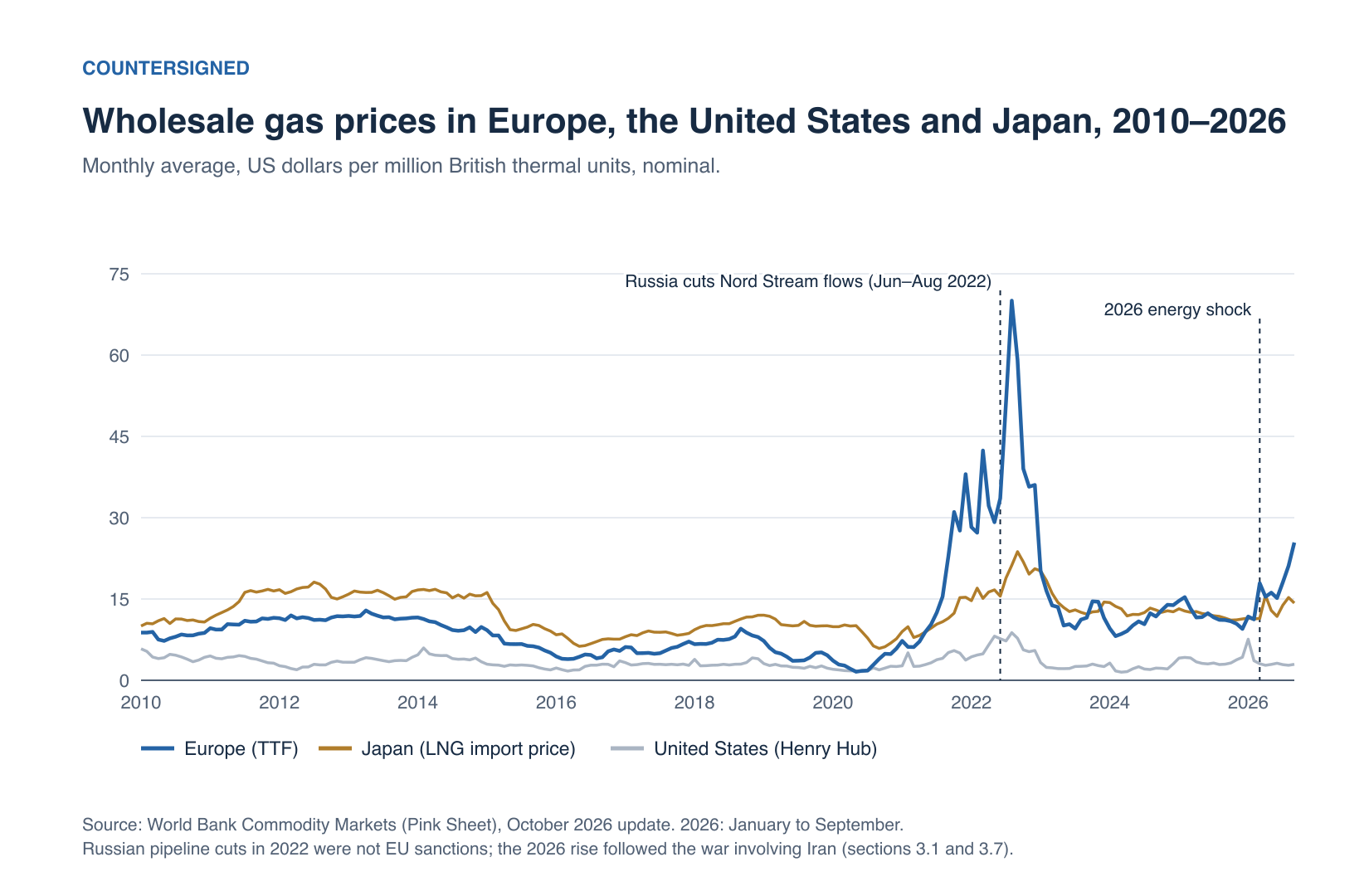
European households and firms paid far more for energy after 2021, and most still did in 2025. The wholesale gas price at the Dutch TTF hub, Europe’s benchmark, averaged 4.9 times its 2010–2019 level in 2022, 1.5 times in 2025 and 2.1 times in January–September 2026, during the 2026 energy shock that followed the outbreak of the war involving Iran S660, by Countersigned’s calculation from World Bank prices, not adjusted for inflation D08.
Countersigned also indexed Eurostat’s retail prices to each country’s 2010–2019 average (= 100, national currency, not adjusted for inflation); 200 means twice the long-run price. In 2025 household gas stood at 201 in France, 192 in Germany and 103 in Hungary (EU 176), and household electricity at 196 in Czechia, 188 in Poland, 136 in Germany and 108 in Hungary (EU 143) D02. Gas for medium-sized industrial users, excluding VAT, ranged from 159 in Spain to 246 in Sweden among the countries compared (Germany 193, Poland 205, EU 182) D03. In Hungary it stood at 207 D03, against 103 for households D02 (capped residential prices, according to the state energy group MVM S1133). For comparison, EU consumer prices rose by 9.2 per cent in 2022 and 6.4 per cent in 2023, by Countersigned’s calculation from Eurostat data D04.
What part “sanctions” played depends on the sense of the word:
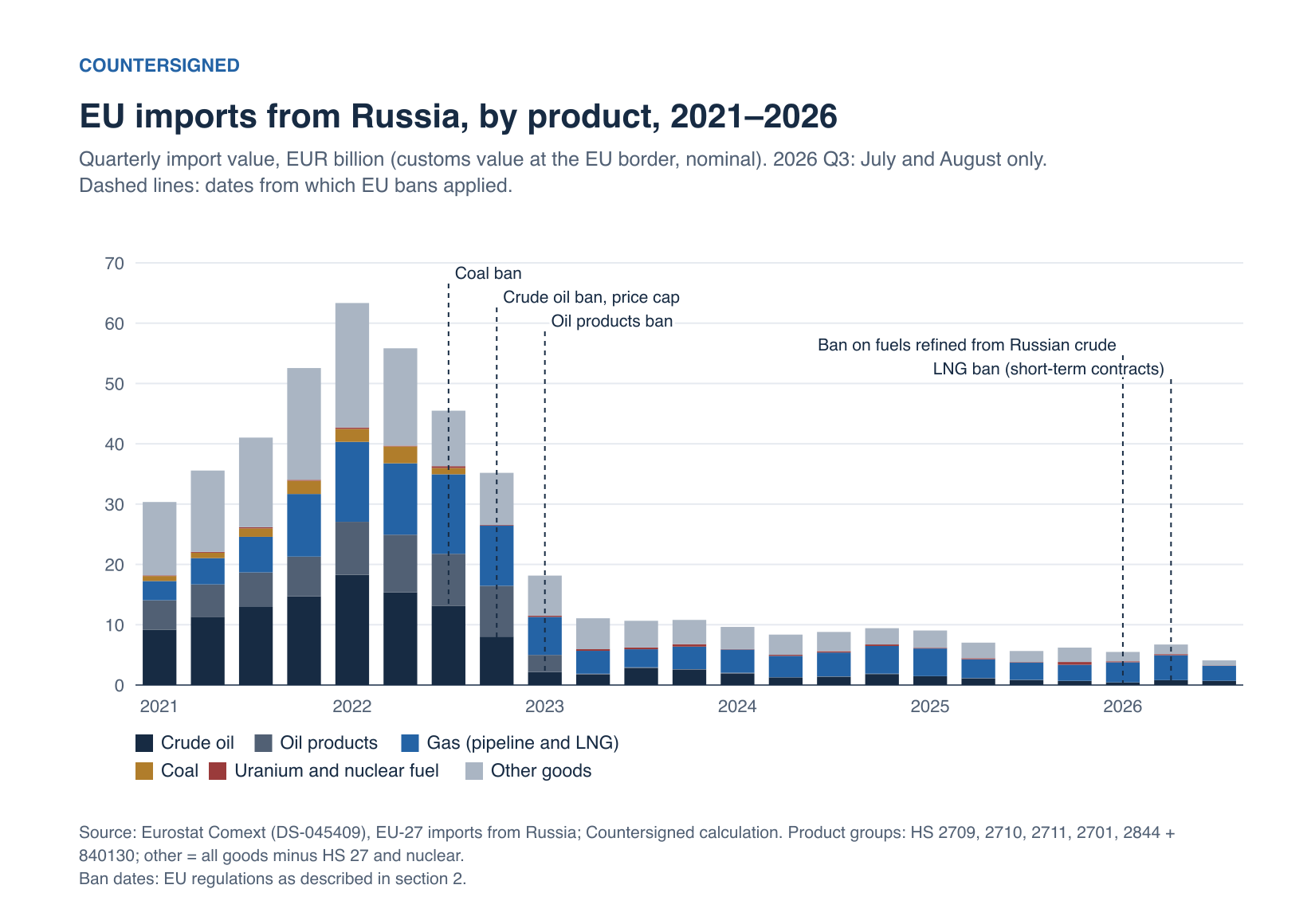
- Broad sense: the whole policy of breaking with Russian energy, including EU bans on Russian coal, oil and liquefied natural gas and a 2026 law phasing out Russian gas (section 2). EU imports of Russian mineral fuels (coal, oil, gas and related products) fell from EUR 104.0 billion in 2021 to 17.4 billion in 2025, by Countersigned’s calculation from customs data D01. In this report’s assessment, the largest cost, in 2022, followed Russia’s own pipeline-gas cuts rather than an EU decision, and wholesale gas prices had already doubled in 2021 (moderate confidence: no held study apportions the price rise) (S1500; S1495; D08).
- Narrow sense: EU restrictive measures in law, adopted under Article 215 of the Treaty on the Functioning of the EU S662. Pipeline gas was not among them in 2022, and no held source attributes the 2022 gas price rise to EU sanctions, though none rules out a part (S865; S992). In Russia they act through oil discounts and dearer imports (S880; S938); its output in 2025 matched the International Monetary Fund’s (IMF) pre-war forecast, by Countersigned’s calculation D09.
2. The facts the analysis rests on
What was imposed, and under which law
From February 2022 to July 2026 the European Union (EU) adopted 21 numbered sanctions packages S167. On 12 October 2026 the Council added what it calls the “largest-ever package of listings”, asset freezes on 1,569 individuals and entities, which it does not number (S167; S1488).
The EU banned Russian coal from 10 August 2022 S663. It banned Russian seaborne crude oil from 5 December 2022 and oil products from 5 February 2023, with an exemption for crude delivered by pipeline (S662; S146). Under the price cap, firms in the participating states may ship, insure or finance Russian oil sold to other countries only at or below a set price S664. The 21st package of 23 July 2026 suspended the cap’s automatic adjustment until 15 July 2027, citing “exceptional disturbances” in oil markets (S174; S167). The 19th package banned imports of Russian liquefied natural gas (LNG), gas shipped in liquid form, from 25 April 2026, and from 1 January 2027 under long-term contracts S179.
EU sanctions have not covered Russian pipeline gas (S865; S1078). The first prohibition of its import is in Regulation (EU) 2026/261 of 26 January 2026, a trade and energy law, not based on Article 215 (S615; S662). It bans imports from 18 March 2026 for new contracts, with later dates for existing ones (section 6) S615. Sanctions need a foreign-policy decision agreed by all 27 governments, then a regulation under Article 215 (S308; S627); energy and trade laws, and emergency measures under Article 122, need only a qualified majority, weighted by population, in which no single government has a veto (S618; S1192).
Executive Order 14066 of 8 March 2022 prohibited US imports of Russian oil, LNG and coal, according to the Congressional Research Service S1193, and the Treasury designated Rosneft and Lukoil, Russia’s two largest oil companies, on 22 October 2025 S203. In October 2026 the United States eased some measures, leaving sanctions under earlier executive orders in place (S149; S723) (section 3.7).
What Russia did itself
Gazprom, Russia’s state-controlled gas exporter, halted supplies to Poland and Bulgaria on 27 April 2022 S1501. Flows through Nord Stream 1 fell to about 20 per cent of capacity on 27 July, according to German regulators S1500. On 31 August the Russian side stopped deliveries citing “alleged maintenance”, which the Bundesnetzagentur, Germany’s energy regulator, found “technically not comprehensible” (our translation) S1495. Russian pipeline gas fell from 39 per cent of the gas inflows into the EU and the UK tracked by the Bruegel institute in the second half of 2021 to 18.6 per cent in 2022 and 5.8 per cent in 2025, according to Countersigned’s calculation D18.
What money flowed: three measures kept apart
- Import value is what buyers declared to customs. By Countersigned’s calculation from Eurostat data, valued at the EU border including transport and insurance, in nominal euros, EU imports from Russia fell from EUR 163.6 billion in 2021 to 27.9 billion in 2025 D01. The customs data record almost no Russian gas for Germany or Austria D01 and so, in this report’s assessment, understate payments for pipeline gas (moderate confidence: no held source explains the gap).
- Russian export revenue is an estimate of what Russian sellers received, made by the Centre for Research on Energy and Clean Air (CREA), a non-profit research organisation in Finland S563 that recommends closing “gaps in sanctions” S050. CREA’s term “G7+” covers the G7, the EU, Australia, New Zealand, Norway and Switzerland (S325; S351). Summing CREA’s country figures, Countersigned puts Russia’s fossil-fuel export revenue from 24 February 2022 to 14 October 2026 at EUR 1,165 billion; China accounted for about 31 per cent, the EU for 20, India for 16 and Türkiye for 12 D13.
- Russian budget revenue is what oil and gas taxes brought the federal budget, as reported by Russia’s Finance Ministry. It fell by 24 per cent, from RUB 11.13 trillion in 2024 to RUB 8.48 trillion in 2025, “as oil prices fell while the rouble appreciated”, according to a news report of the ministry’s preliminary data (S081; S1514) (2026: section 3.7).
What happened to Russia’s economy
In April 2022 the IMF expected Russian output to fall by 8.5 per cent that year; the fall was 1.4 per cent D09. Growth in 2023–2024 came largely from war spending, according to BOFIT, the Bank of Finland’s research institute, and the research group Re:Russia (S405; S931); it slowed to 1 per cent in 2025 S404.
3. How it connects
3.1 From gas to prices, interest rates and industry
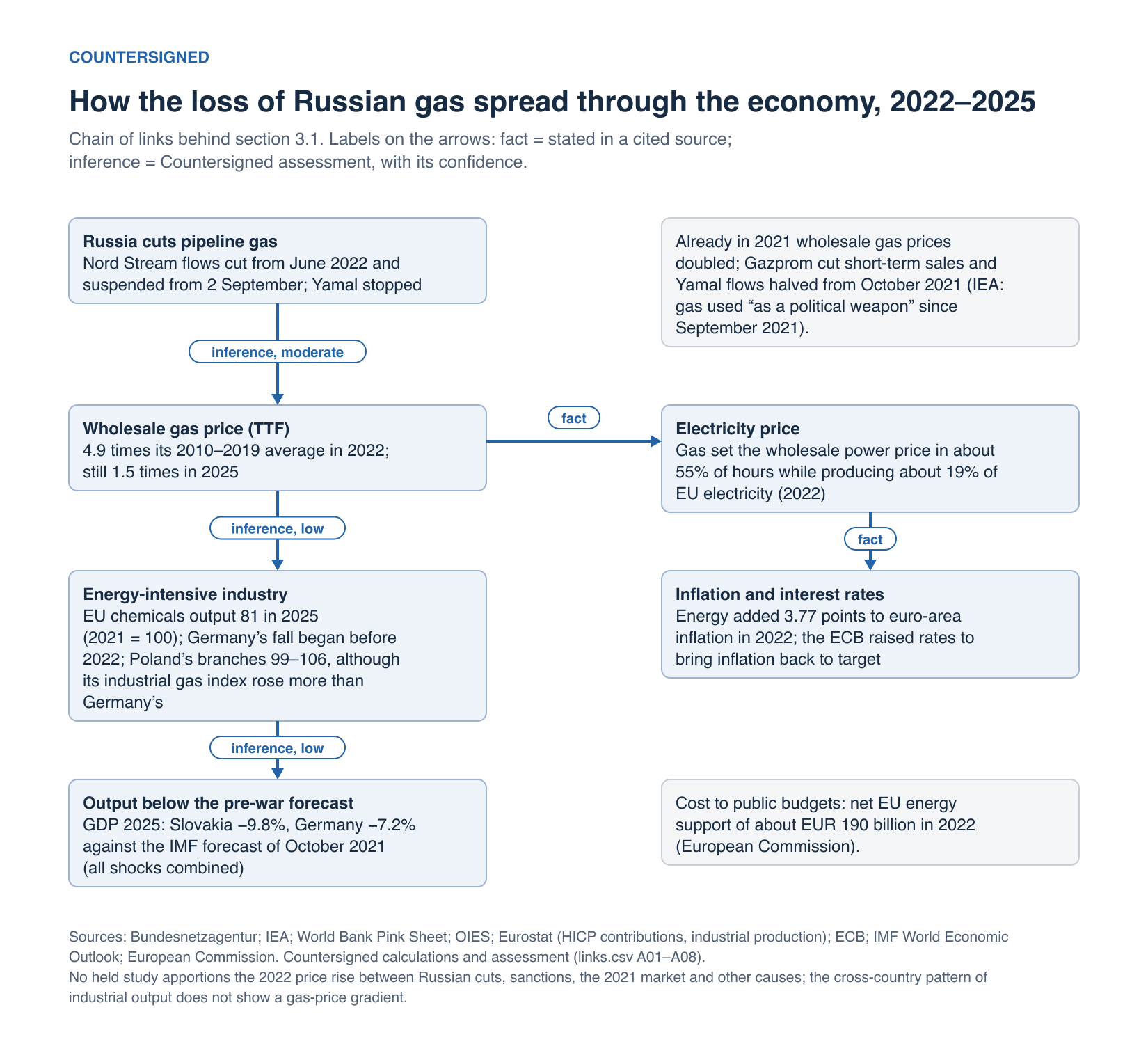
By Countersigned’s calculation, wholesale gas prices peaked in August 2022, when Nord Stream flows were cut (D08; S1500); their rise to twice the 2010–2019 average in 2021 coincided in part with lower Russian supply: in late 2021 Gazprom reduced short-term sales, according to the International Energy Agency (IEA) S991, and Yamal-route flows more than halved in October 2021, by Countersigned’s calculation, for reasons no held source gives for that fall D18.
In this report’s assessment, Russia cut its pipeline deliveries in 2022, and no EU sanction covered pipeline gas that year (high confidence: German regulators date the cuts; two held sources state that EU sanctions did not cover Russian gas, a third that they were not meaningful) (S1500; S865; S1078; S622). In this report’s assessment, the cuts, with low storage, were the main driver of the 2022 price rise (moderate confidence: they preceded the August peak, and the IEA found that together they created “artificial scarcity” S992, but no held study quantifies their share).
In 2022 gas plants, with around 19 per cent of EU electricity, set the wholesale price in about 55 per cent of trading hours (Oxford Institute for Energy Studies, OIES) S1211; energy added 3.77 percentage points to euro-area inflation, by Countersigned’s calculation D04; the European Central Bank (ECB) raised rates to curb inflation S457; and governments spent a net 1.2 per cent of EU GDP cushioning prices (European Commission) S059.
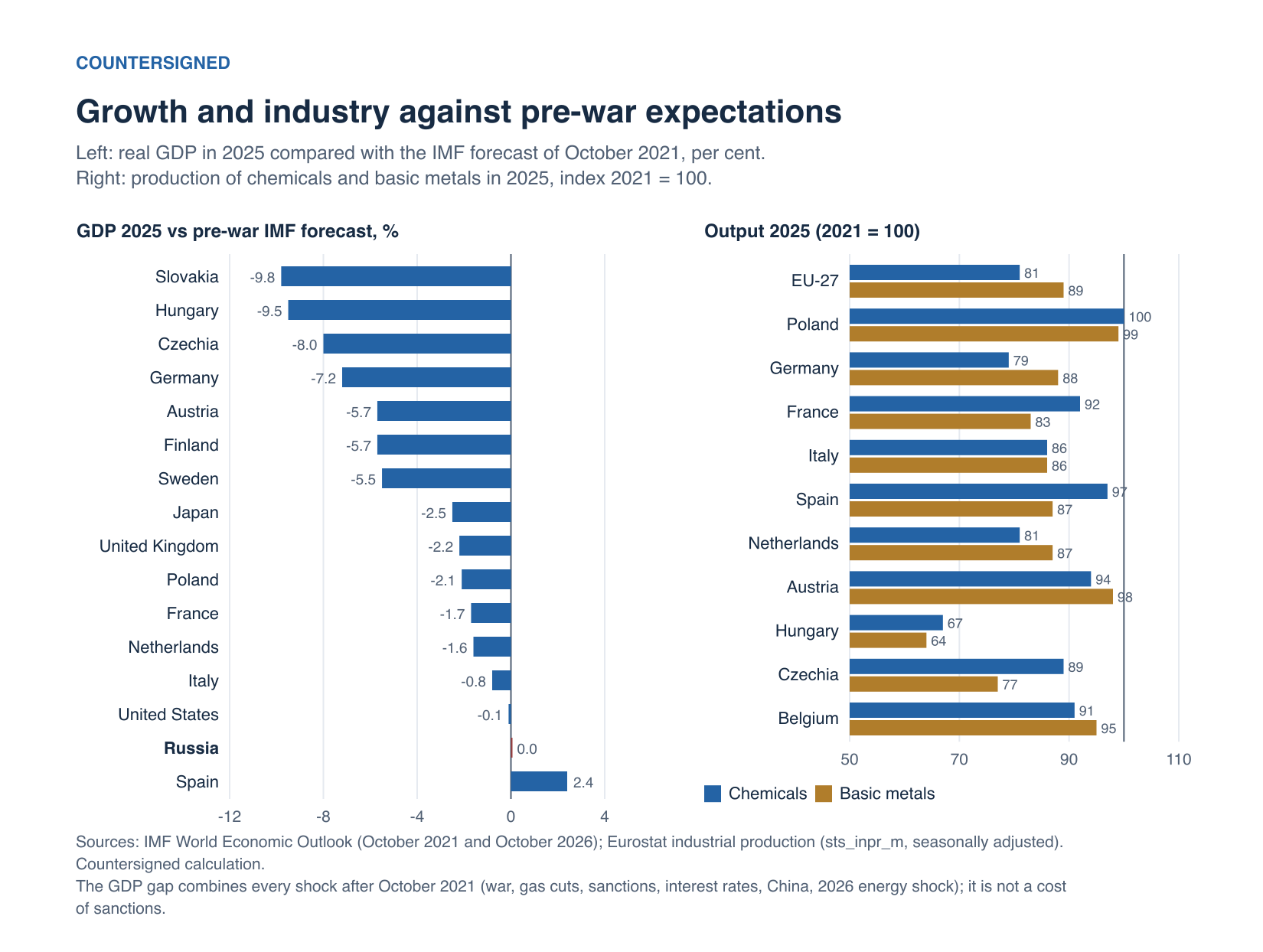
By Countersigned’s calculation, EU chemical output stood at 81 in 2025 and German at 79 (2021 = 100), against 101 for EU manufacturing D05. The head of the ifo Institute ties German cuts to the end of Nord Stream gas and dearer energy, but notes that output had been falling “for some time” (our translation) S1352; by Countersigned’s calculation, Poland, with industrial gas further above its long-run price (index 205 against Germany’s 193, national currency, though cheaper in euros per kWh) D03, kept its energy-intensive branches at 99 to 106 D05. In this report’s assessment, dearer gas and power contributed to the German fall alongside older trends and lost competitiveness “especially against China” (German Council of Economic Experts; our translation) S1357 (moderate confidence: no held source quantifies each cause S1358); that gas prices explain the EU-wide fall has low confidence, given Poland.
Real GDP in 2025 was 9.8 per cent below the IMF’s pre-war forecast in Slovakia, 7.2 in Germany and 0.1 in the United States, by Countersigned’s calculation D09; in this report’s assessment, these gaps are consistent with the shocks above but do not measure them (low confidence: each gap combines every shock since 2021 and forecast error).
The chain would break if a study attributed most of the 2022 price rise to other causes, or showed energy-intensive output falling as much where gas prices did not rise.
3.2 Vetoes and the choice of legal basis
EU sanctions need unanimity, including at the six-monthly renewal of those against Russia (S308; S802).
Regulation 2026/261, which phases out Russian gas, was adopted through the ordinary legislative procedure with the European Parliament, where, as the Hungarian news site Telex put it, “there can be no veto” (S615; S618). Because the regulation was adopted as energy and trade law (section 2), no single government could block it. Whether that was the reason for the choice of legal basis is not established: no Commission text stating the motive is held.
Since December 2025 Regulation (EU) 2025/2600, adopted by qualified majority under Article 122(1), against the votes of Slovakia and Hungary, has kept Russia’s central-bank assets blocked, so a single veto at the six-monthly renewal can no longer free them (S666; S1192; S627). In this report’s assessment, both measures were thus adopted by qualified majority on legal bases other than sanctions (moderate confidence: both legal bases are contested).
Hungary (Case C-46/26) and Slovakia (Case C-398/26) argue before the EU Court of Justice that the gas regulation is in substance a sanction (S701; S702). In this report’s assessment, if the Court agreed, Article 215 and unanimity would apply, putting the arrangement at risk (moderate confidence: these are the applicants’ pleas, and no judgment is held). The asset regulation is contested in commentary: two researchers, Til Leichsenring and Julia Popp, argue that it “violates the Treaties” S1192, while the Commission defended it S627. Russia’s central bank says it challenged the regulation at the EU General Court on 27 February 2026 S1208; no judgment is held.
The chain would break if a judgment held that either measure required unanimity.
3.3 Russian oil by a detour
By Countersigned’s calculation from UN Comtrade data, India’s imports of Russian crude rose from USD 2.3 billion in 2021 to 25.5 billion in 2022 and 45.4 billion in 2025, and Türkiye’s imports of all goods from Russia from USD 29.0 billion to 58.8 billion in 2022 D12. In this report’s assessment, the invasion, and then the EU embargo and price cap, redirected Russian crude to India and, by CREA’s estimates D13, Russian oil to Türkiye (moderate confidence: more than half of India’s increase to 2025 came in 2022, before the embargo took effect S146; Bruegel notes that companies in advanced countries reduced their trade with Russia S524). China, the largest of the three buyers already in 2021, raised its imports of all goods from Russia from USD 79.6 billion to 124.0 billion in 2025, which the held data cannot separate from its own demand and prices D12.
Some of that crude may have returned as fuel refined in third countries, which EU statistics do not record as Russian S350. Assuming that each refinery’s output contains Russian crude in proportion to its intake S859, CREA estimates that half of the EUR 18 billion of oil products that G7+ states (section 2) bought from six Indian and Turkish refineries in the invasion’s third year was made from Russian crude S325. In this report’s assessment, part of the fuel bought by G7+ buyers thus paid indirectly for Russian crude, for EU buyers until their ban of 21 January 2026, which exempts listed partner countries and net crude exporters S176 (moderate confidence: this rests on CREA’s estimate and its mixing assumption). The United States, by contrast, has licensed transactions in Russian-origin diesel until 7 April 2027 S149.
After a US tariff on India from August 2025 S1475 and US sanctions on Rosneft and Lukoil, India’s Russian crude imports fell significantly in November 2025, according to Carnegie India S020; in this report’s assessment, the US measures probably contributed (moderate confidence: one month of data cannot exclude prices or refinery maintenance). Executive Order 14389 ended the tariff on 20 February 2026 (S729; S1475).
The chain would break if refinery-level origin data showed a much smaller Russian share, or if the redirection proved unrelated to discounts after the invasion.
3.4 The price cap and the shadow fleet
The KSE Institute at the Kyiv School of Economics, a Ukrainian think tank, defines the shadow fleet as tankers “not owned, managed, or insured by an entity in the sanctions coalition”, to which the cap therefore does not apply S359. Its tracker shows shadow tankers carrying 70 per cent of Russia’s seaborne crude exports in February and May 2026 and 75 per cent in April (S355; S354; S353). The US Treasury, which conceived the cap, had said in May 2023 that it “is achieving both goals” of restricting Russia’s oil revenue and maintaining supply (S816; S880). A working paper by economists at the Federal Reserve Bank of Dallas found the cap’s own effect on the Russian oil export price “negligible” once it had facilitated the use of Western shipping services S880. In this report’s assessment, tankers outside Western services now carry most Russian seaborne crude beyond the cap’s reach (high confidence: this follows from the cap’s definition and the 2026 shares carried).
One possibility, not established by the sources held, is that this fleet of older tankers endangers undersea infrastructure in the Baltic. In December 2024 Finland detained the tanker Eagle S, which customs officials suspected was part of Russia’s shadow fleet, on suspicion of damaging undersea cables S367. No finding is held.
The chain would break if most Russian crude were shown still to move with Western services at or below the cap.
3.5 China as Russia’s supplier
According to KSE analyses cited by the Center for Strategic and International Studies (CSIS), a US think tank, export controls more than halved the value of Russia’s imports of components and equipment important for weapons production, but China came to account for approximately 75 per cent of reported exports of these goods to Russia, at a premium reaching approximately 300 per cent in 2025, against a base the source does not define S938. Estimates of the fall in these imports range from 10 per cent to more than half, for different goods and periods (S015; S017; S890).
One possibility, not established by the sources held, is that dependence on one supplier gives China leverage over Russia. CSIS leaves open whether the premium “created new leverage” S938, and no held source records China using such leverage.
The chain would break if Russia were shown to have diversified its suppliers, or China not to have used its position.
3.6 The immobilised assets
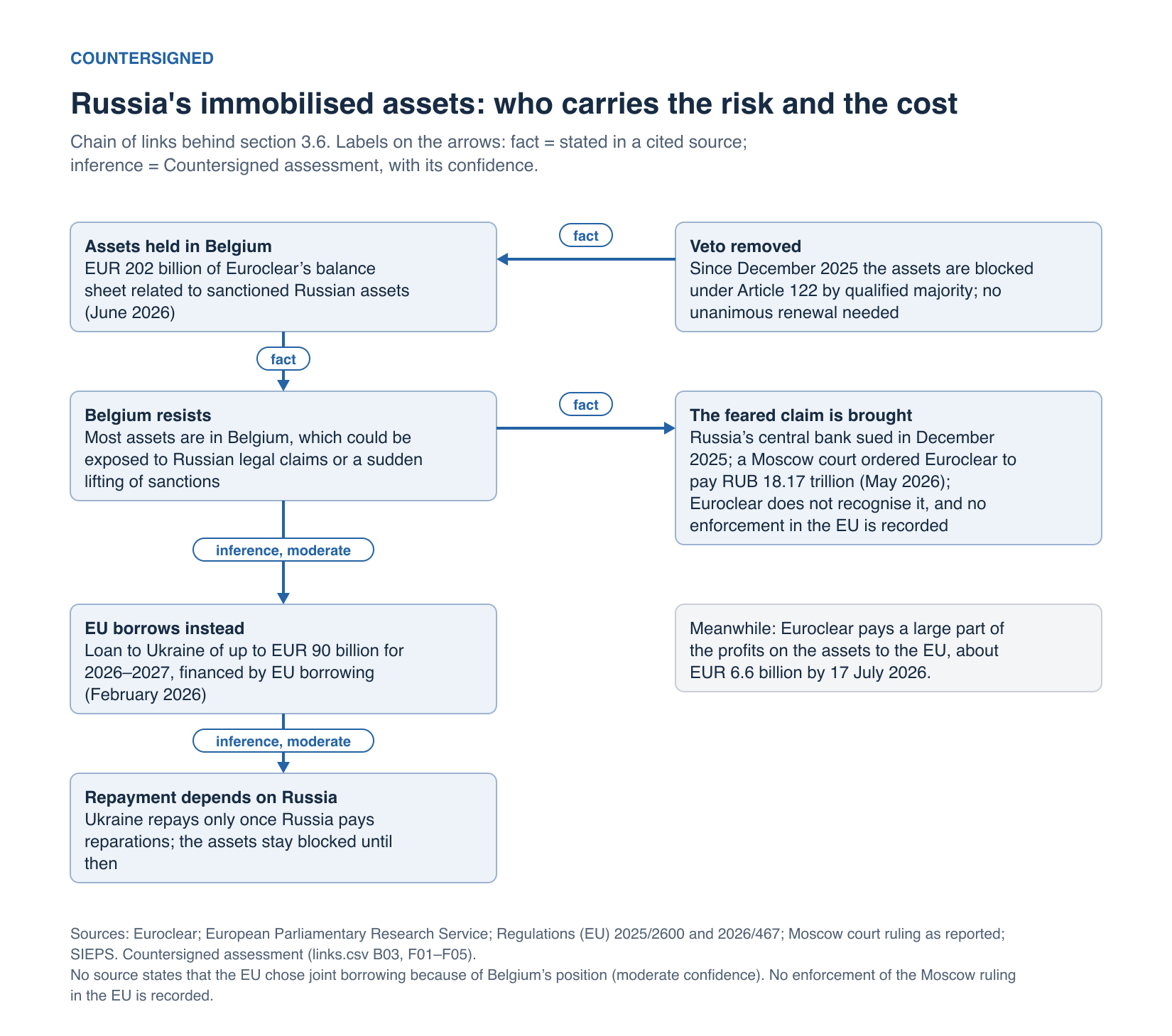
Most Russian central-bank assets immobilised in the EU are held at Euroclear, a Belgian securities firm (S627; S623), where EUR 202 billion of the balance sheet related to sanctioned Russian assets at the end of June 2026 S075. According to the European Parliament’s research service (EPRS), EU leaders could not agree in October 2025 on using them mainly because of Belgium’s reticence: Belgium could be left exposed to Russian legal claims or a sudden lifting of sanctions S1204.
Russia’s central bank sued Euroclear in Moscow, and on 15 May 2026 a court there ordered it to pay RUB 18.17 trillion (S078; S075); Euroclear does not recognise the court’s jurisdiction and, according to the Ukrainian news site UNN citing Reuters, has sued in Belgium to block enforcement (S075; S1209): a claim of the kind Belgium feared was brought while the assets were only immobilised, and no held source records its enforcement. In this report’s assessment, using the assets could add to Belgium’s exposure, by an amount the held sources do not show (low confidence: EPRS names the risk without measuring it).
EU leaders chose joint borrowing instead, not proceeding “at this stage” with an asset-backed loan, according to Euroclear S076; Regulation (EU) 2026/467 lends Ukraine up to EUR 90 billion (S1203; S032). In this report’s assessment, Belgium’s reticence contributed to that choice (moderate confidence: no source states that the choice was made because of it; Italy and Bulgaria also backed Belgium S709).
The loan becomes due only when Ukraine receives reparations S1203, and the asset regulation lapses only when Russia has ended the war and paid reparations, among other conditions S666. In this report’s assessment, the assets thus stay blocked until reparations while the financing rests on EU borrowing (moderate confidence: 25 member states agreed that the Union “should reserve its right to make use of them to repay the loan”, so their final use is open S1203). Euroclear had paid about EUR 6.6 billion of their profits to the EU by July 2026 S075.
The chain would break if a provision assigned the borrowing cost to the assets, or if the Russian claim were enforced nowhere and abandoned.
3.7 The war involving Iran, oil and Russian revenue
The war involving Iran, from 28 February 2026, disrupted shipping through the Strait of Hormuz S660, and Brent, the international benchmark crude oil, averaged USD 94.0 per barrel in January–September 2026, against 69.1 in 2025, by Countersigned’s calculation D08. In this report’s assessment, the disruption raised oil prices (moderate confidence: the order in time fits, and the IMF raised its 2026 forecast for Russia citing higher oil prices during the war, bne IntelliNews reported S409; the main alternative, OPEC+ supply decisions, was not examined, so the test of this link is incomplete).
The IEA estimated that Russia’s oil export revenue “nearly doubled, from $9.7 billion to $19 billion” in March 2026 “as global oil prices surged” S1375. Export volumes fell, and much of the fall reflects Ukrainian strikes on refineries and oil terminals, according to BOFIT S925; sanctions compound the damage by restricting access to replacement equipment, according to an Oil & Gas Journal report of IEA analysis S414. Oil and gas budget revenue fell by 17.2 per cent in January–September 2026, according to preliminary data from the Finance Ministry. The ministry attributed the drop partly to a lower average dollar exchange rate and to its fuel-price damping mechanism, which paid domestic refineries more compensation as world fuel prices rose (S1520; S155). The two figures measure different things over different periods (section 2).
The OIES ties the TTF peak of EUR 83.53 per megawatt hour in mid-September 2026 to the war S1213. The ECB raised its rates on 11 June and 10 September 2026, citing the war in the Middle East; neither decision refers to sanctions (S1408; S458).
At the same time, the United States eased some measures. It and the United Kingdom had temporarily relaxed sanctions on Russian oil earlier in 2026, BOFIT notes S1516; besides the diesel licence (section 3.3), on 16 October 2026 it waived the duties of the Graham Act, a sanctions law, certifying that this “is in the national interests of the United States” S723. Other possible motives, none established by the sources held, are set out as readings in section 5.
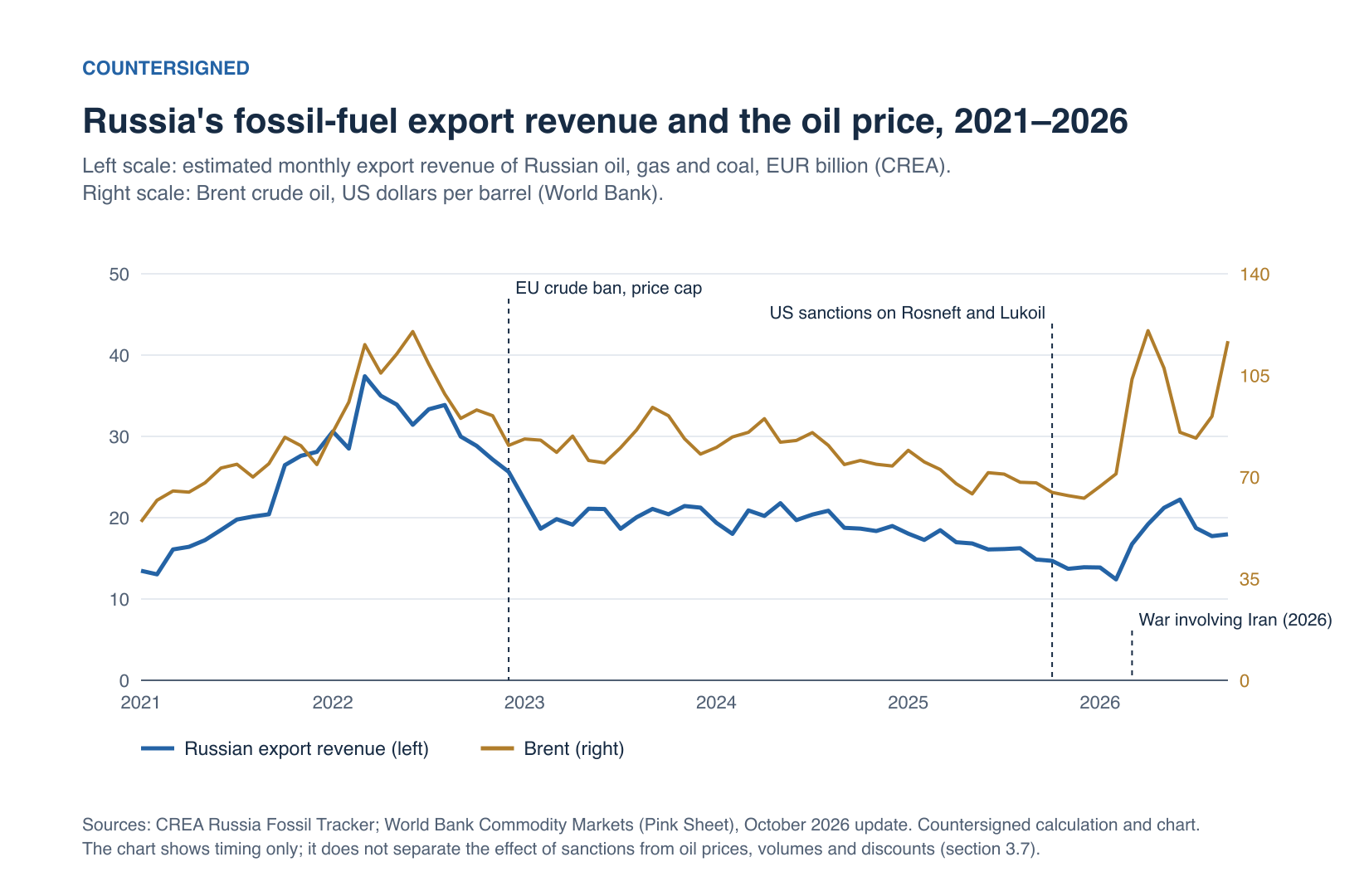
The chain would break if the 2026 price rise were shown to have begun before the war or to have had another main cause.
4. Did the sanctions limit the war?
The short answer. In this report’s assessment, sanctions partly raised the cost of the war and did not collapse Russia’s economy; their effect on its military capabilities and on ending the war cannot be determined from the sources gathered for this report. Among the limits were the EU’s dependence on Russian energy and partners outside the coalition (moderate confidence; low for the effect on capacity).
The stated aims
G7 leaders pledged in April 2022 to raise the war’s cost and erode Russia’s military capabilities S951; the US Treasury linked sanctions to a peace process in October 2025 S026; the Council of the EU sought in April 2026 to “further cripple Russia’s economy and war machine” S1489. France’s finance minister, Bruno Le Maire, promised on 1 March 2022 “the collapse of the Russian economy” (AFP) S571, he later called his language “inappropriate” S572.
What the sources show
For an effect: export controls more than halved Russia’s imports of components important for weapons, though China came to supply about three-quarters at a premium of about 300 per cent in 2025, base undefined (KSE, via the US think tank CSIS) S938. A Federal Reserve Bank of Dallas working paper attributes a USD 32 discount a barrel on Urals crude in March 2023, against January 2022, to the 2022 embargo S880; a discount persists (section 6), and BOFIT finds sanctions still restrict finance and technology, though Russia has mitigated some effects S925.
Against it: output in 2025 matched the IMF’s pre-war forecast, by Countersigned’s calculation D09, with growth in 2023–2024 driven largely by war spending (BOFIT) S405, and reserves, including assets immobilised abroad, rose from USD 630.6 billion in December 2021 to 769.0 billion in August 2026, mainly because the value of gold holdings rose D15. CSIS expects a high production tempo in selected weapons S1321, and North Korea sent over 20,000 containers of munitions from September 2023, according to one of the eleven UN member states in the Multilateral Sanctions Monitoring Team S010.
A RUSI commentary by Oliver Ruth (January 2025) concluded that sanctions hindered Russia’s capabilities by raising procurement costs, conceding they appear to have “very little efficacy” as allies subvert them S940. KSE, which judges sanctions effective, puts lost potential oil earnings in March 2022–August 2025 at USD 159 billion (published by Latvia’s Financial Intelligence Unit) S441. A regression by the Stockholm institute SITE for Sweden’s National Institute of Economic Research found 2022 growth 6 to 11 per cent below expectation, without attributing this to sanctions S971; economists at the EBRD development bank found two rerouting channels offset under 10 per cent of the trade sanctions’ impact, though substitution exceeded 50 per cent for numerous products S376.
Money for the war
In this report’s assessment, Russia’s oil and gas budget revenue follows mainly the oil price and the rouble (S081; S155); sanctions act through discounts S880, and BOFIT judged that new sanctions hit oil exports hard in 2025 S404 (moderate confidence: no source converts the discount into budget revenue). The deficit, set at RUB 3.786 trillion in the 2026 budget law and 4.828 trillion in the mid-July plan S1518, reached RUB 5.2 trillion, 2.2 per cent of GDP, in January–September, by preliminary Finance Ministry estimates (Trading Economics) S1520. SIPRI puts military spending at 20 per cent of all government spending in 2025 S044; defence, security and law enforcement, a wider category, take 38 per cent of planned 2026 federal spending S024. The Polish think tank OSW found a 4 per cent nominal cut in defence funding planned in the 2026 budget law, with more for internal security, and a government that has “effectively reached the limits of its fiscal capacity” but could allocate more to the war if needed S024; federal spending rose by 14.5 per cent in January–September S1520. One possibility, not established by the sources, is that this strain will limit war spending.
Behaviour and terms
Russia’s stated terms of June 2024 and June 2025 require Ukrainian forces to leave four regions and Ukraine to stay out of military alliances (S1180; S1268). In this report’s assessment, Russia has treated sanctions as a bargaining item (high confidence for 2024 and March 2025: Kremlin texts): its June 2024 terms entail “the removal of all Western sanctions” S1180, and a Kremlin account of March 2025 talks with the United States made two agreed points conditional on lifting sanctions on the Russian Agricultural Bank and others S1282. Russia thus asks for relief in a settlement while keeping these two core demands.
Why not more
In this report’s assessment, the EU’s dependence on Russian energy set the pace of the energy measures (moderate confidence: meeting its own needs before sanctioning kept revenue flowing to Russia, Bruegel found in late 2022, though this “may soon start to change” S827). In this report’s assessment, partners outside the coalition limited the effect on revenue (moderate confidence: they are among Russia’s largest buyers D13) and, as suppliers, on capacity (low confidence: the offset is not measured; the one estimate held puts two rerouting channels under 10 per cent S376). A study of the offsets would change this.
- Energy-price concerns and temporary easing: the G7 designed the price cap to reduce Russian revenues while limiting the war’s impact on energy prices S814; in 2026 the United States and the United Kingdom temporarily eased oil sanctions (BOFIT) S1516.
- Unanimity and carve-outs: Hungary held up a renewal for weeks in January 2025 S802; separately, diamonds stayed out of the first 11 packages, protecting Belgium’s trade (bne IntelliNews) (S314; S315).
- Evasion: shadow tankers carried 70 to 75 per cent of Russia’s seaborne crude in February, April and May 2026, and 72 per cent of EU-listed tankers loaded at least once after listing in August 2024–June 2026, by KSE Institute estimates (sections 3.4, 6).
- Time: the effect was “unfolding more slowly than predicted initially” (Portela and Kluge, EU Institute for Security Studies, October 2022) S829.
- Russian adaptation: war spending, accumulated resources and companies’ schemes to circumvent sanctions drove growth (BOFIT; Re:Russia) (S925; S931).
What follows
In this report’s assessment, against each aim:
- Raising the cost of the war: partial (moderate confidence: military output is not measured; a measure of it would change this).
- Eroding military capabilities: unresolved: output is not measured, and China and North Korea filled gaps; a measure of output linked to sanctions would change this.
- Ending the war or changing Russia’s terms: unresolved: the two core terms were the same in June 2024 and June 2025, and the outcome without sanctions cannot be observed; changed terms after relief would change this.
- The collapse of the Russian economy: not met (high confidence: output matched the pre-war forecast, above and section 2); a collapse of output would change this.
5. The same facts, different readings
The four readings below are not ranked, and more than one can hold at once; only facts that fit some readings and not others can tell them apart. Of the discriminating tests, only the dated record of the 2022 gas cuts can be applied now. It shows that no EU sanction covered pipeline gas in 2022, so gas sanctions cannot have caused the 2022 price shock, but it does not settle the part of other sanctions, or of Russia’s own counter-sanctions against entities of SEFE, a former Gazprom subsidiary under German trusteeship (S992; S1036). The other tests await evidence (section 6).
Reading 1: slow attrition
On this reading, sanctions work slowly, lowering what Russia earns and raising what it pays; in this report’s assessment, the oil discount and dearer imports in section 4 fit the reading (moderate confidence: they show higher costs, not cumulative damage).
The reading does not explain Russian output, which in 2025 matched the IMF’s pre-war forecast, by Countersigned’s calculation D09 (section 1), with growth in 2023–2024 driven largely by war spending, according to BOFIT (section 2). What would discriminate is whether higher costs reduced military production; no held source measures it.
Reading 2: Europe harmed itself
On this reading, the costs fell mainly on the sanctioning economies: higher gas prices, lower chemicals output and GDP gaps against the IMF’s pre-war forecast (section 3.1), 9.5 per cent in Hungary by Countersigned’s calculation (D02; D05; D09). In this report’s assessment, these facts support the reading only if the energy shock is counted as a cost of the policy (moderate confidence: the GDP gaps combine every shock since the forecast, and the pattern is uneven).
The reading does not explain the timing, the test set out above: wholesale gas prices had already doubled in 2021 (sections 1, 3.1), and in this report’s assessment the 2022 loss of pipeline gas resulted from Russia’s own decisions, not EU sanctions on gas, although Gazprom blamed sanctions for the Nord Stream turbines and the Yamal stop followed Russian counter-sanctions (high confidence: the official record dates the cuts) (S1500; S992).
Reading 3: the break with Russian energy matters more than the sanctions
On this reading, the lasting change is Europe’s exit from Russian energy, partly under law other than sanctions law (sections 2, 3.2). The United States supplied 58 per cent of EU LNG imports in 2025, according to ACER, the EU agency of energy regulators S084. Studies from 2025 mostly expected no large return of Russian gas (S645; S647; S646). In this report’s assessment, these facts fit the reading (moderate confidence: the exit is common to all four readings, and the studies pre-date the regulation and the 2026 energy shock).
The reading does not explain persistence in two member states. By Countersigned’s calculation from Eurostat customs data, Hungary imported EUR 4.5 billion of Russian mineral fuels in 2025, more than in 2021 (values also reflect prices), and Slovakia EUR 2.6 billion, less than in 2021 D01. Both are tied by contracts or exemptions: MVM holds Gazprom Export contracts for 4.5 billion cubic metres a year to 2036 S1133; Slovakia warned of arbitration over its long-term contracts S700; and Hungary obtained a US exemption in November 2025, of disputed length (S542; S543). Both voted against the gas phase-out S700 and argue in court that it is in substance a sanction (S701; S702): this weakens the reading only for the two states, but contests the distinction on which it rests. The discriminating test, whether Russian gas returns after a ceasefire, lies ahead.
Reading 4: sanctions as a bargaining chip
On this reading, sanctions matter most as something to trade in talks. Russia asks for their removal as part of a settlement (section 4), and Western drafts treat relief as staged and decided case by case (S121; S963). According to the Polish think tank OSW, US Secretary of State Marco Rubio justified holding back new sanctions in August 2025 by concern that Russia could leave the talks S1265. In this report’s assessment, these facts fit the reading (moderate confidence: the drafts are known from leaks and press renderings, and Rubio’s own words are not held).
One possibility, not established by the sources held, is that the US diesel licence and Graham Act waiver of October 2026 belong to the same pattern (S149; S723): both coincided with reported US efforts to revive peace talks S1280, and the licence of 9 October followed a demand by the Kremlin spokesperson Dmitry Peskov, reported on 28 September, that Russian diesel reach markets “without any sanctions, restrictions” S164. Two other explanations are possible, neither established: the 2026 oil-price shock, during which both came (S660; D08); or a difference between Congress, which passed the Graham Act, and the President, who waived its duties and sanctions on implementing it S723.
The reading does not explain Russia’s war aims: the held record links no change in them to sanctions (section 4). In this report’s assessment, this neither supports the reading nor tests it, as no relief has been granted under a settlement (moderate confidence: Russian decision-making cannot be observed); the discriminating test, relief followed by changed Russian terms, cannot be run yet.
6. Scenarios
The four scenarios below are conditional and carry no probabilities. In this report’s assessment, each is consistent with drivers drawn from sourced texts (moderate confidence: the drivers are documented, but how they combine is a judgment).
Scenario 1: ceasefire with partial relief
The United States has begun to ease (sections 3.3, 3.7), and Western drafts treat relief as staged (section 5); the Graham Act waiver of 16 October has no end date S723. Ukraine’s President Volodymyr Zelensky said on 17 October 2026 that European partners agreed “no sanctions can be lifted from Russia until Putin stops the killings” S1281. A reversal of the US licences and waivers would weaken this scenario’s drivers; the scenario itself rests on a ceasefire that no held source describes.
Scenario 2: frozen conflict, sanctions held
Most EU sanctions depend on renewal by unanimity, according to the US Congressional Research Service (2024), so one government can block them (S1193; S627); the asset regulation and the gas phase-out rest on other legal bases (section 3.2). A failed EU renewal would refute this scenario.
Scenario 3: escalation with secondary pressure
Measures against third countries that buy Russian oil have been used: the US tariff on India over its Russian oil purchases ran from August 2025 to February 2026 (section 3.3). The order implementing the Graham Act raises duties by 100 per cent on goods from the five largest importers of Russian crude and gas that make new purchases, then waives them S723. A lasting US withdrawal from secondary measures would refute this scenario.
Scenario 4: erosion
In August 2024–June 2026, 431 of 596 EU-designated tankers (72 per cent) loaded at Russian ports at least once after designation, according to the KSE Institute S352, a total for the whole period, not a trend. The exemption from the EU oil ban for crude delivered by pipeline no longer applies to Germany, Poland and Czechia, but still covers Hungary and Slovakia (S180; S1122). The discount of Urals crude to the Brent benchmark stayed at about USD 20–25 a barrel through July 2026, according to BOFIT S1518. In this report’s assessment, a discount of that size shows that the oil measures still bite (moderate confidence: the Federal Reserve Bank of Dallas paper in section 4 attributes the discount of March 2023 to the 2022 embargo, but covers an earlier period). Fewer exemptions and falling loadings by listed tankers would refute this scenario.
Indicators to watch
- EU renewals of sanctions (scenario 2).
- The Commission’s review of the asset regulation, due by 31 December 2026, then yearly S666 (scenario 2).
- Rulings in C-46/26 and C-398/26 on the gas phase-out (S701; S702) (section 3.2) (scenario 2).
- Gas-ban dates for long-term contracts: Russian LNG from 1 January 2027, pipeline gas from 30 September 2027, or 1 November 2027 in some member states S615.
- The expiry of General License 135 on 7 April 2027, and any further US waivers S149 (scenarios 1 to 3).
- The Urals discount to Brent: a narrowing discount would point to scenario 4, a widening one to scenarios 2 or 3.
- Russian budget revenue from oil and gas, not export revenue (section 3.7).
- EU imports from Russia in Eurostat’s Comext customs data, available to August 2026 D01 (scenarios 1 and 4).
In this report’s assessment, the 2026 energy shock moves several of these indicators at once (high confidence: oil and gas prices enter revenue and import values) (S1375; S1213).
7. Contested claims in brief
Claims are given in typical wording, not quoted; “not supported” means the sources held contain no evidence for a claim, not that every element has been disproved.
- “Sanctions hurt Europe more than Russia.” — Cannot be tested with the evidence held. Estimates for Russia (section 4) and costs for Europe (section 3.1) measure different things; no study held compares them on one measure.
- “The EU paid Russia more for fuel than it gave Ukraine.” — Depends on definitions. Cumulative totals support it: Reuters reported more than EUR 213 billion of EU imports of Russian energy since 2022 (CREA’s estimate of Russian export revenue) against EUR 167 billion of EU aid allocated (Kiel Institute) (S562; S563); yearly totals since 2023 do not, according to Kyiv Post S563.
- “Sanctions caused Germany’s energy crisis.” — Not supported as stated. The EU did not sanction Russian pipeline gas in 2022, when Russia cut deliveries itself (S865; S1078; S992) (sections 2, 3.1). In this report’s assessment, no held source attributes the 2022 price rise to EU sanctions, or rules out a part for them (moderate confidence) (S992; S994).
- “Russia’s economy is growing, so sanctions fail” / “Sanctions will collapse Russia’s economy.” — Both overstated. France’s finance minister, Bruno Le Maire, said on 1 March 2022, as reported by AFP: “We will bring about the collapse of the Russian economy” S571; Russian output fell by 1.4 per cent in 2022 D09. Output alone does not test declared aims such as raising the cost of the war (section 4) S951.
- “Sanctions caused a food crisis in Africa.” — Overstated. The European Commission, a party to the sanctions, stated in July 2022 that Russian agricultural products were not targeted, though some potash imports were restricted S1096; a peer-reviewed study by researchers at the International Food Policy Research Institute named the war and sanctions without separating them, and no held source measures the share of sanctions S1089.
- “The United States profits from the sanctions through LNG.” — Partly true. The US share of EU LNG imports (section 5) measures market share, not profit; EU buyers turned to LNG as Russia cut pipeline supplies in 2022, according to the think tank IEEFA S1504.
- “Without sanctions the war would have ended sooner.” — Cannot be tested with the evidence held (section 4).
8. Method and limits
The full fact base, with every figure, calculation and source, and a glossary, is in the evidence dossier published with this report.
Sources and figures. The dossier cites 344 stored sources and 15 datasets. Countersigned calculated by script from the original datasets; money amounts are nominal.
Links and checks. Each link between facts carries one of four labels: a fact from a named source; a Countersigned calculation; an inference by this report, with high, moderate or low confidence, or unresolved; or a hypothesis, possible but not established. Separate AI agents checked each of the 70 links against the stored sources; 54 were revised or added after the checks and two adversarial editorial reads. Each sourced fact is tied to a verbatim passage that a script located in the stored copy, and each calculation to a script’s output.
Limits.
- No held study apportions the 2022 rise in European energy prices among its causes (sections 1, 3.1) (S464; S1338).
- A gap against a pre-war forecast combines every shock since the forecast; it is not a cost of sanctions D09.
- EU customs data record almost no Russian gas imports for Germany or Austria, although CREA attributes large gas revenue to them (D01; D13).
- Data for 2026 are affected by the energy shock that followed the outbreak of the war involving Iran (S660; S1366; S1213).
- Russian statistics have been restricted since 2022 (S422; S920), and Russia’s Ministry of Finance could not be reached; budget figures come from BOFIT and news reports of the ministry’s data.
Review. Approved for publication by the responsible editor on 23 October 2026. The text was drafted with AI assistance (Claude); every factual sentence of the main report and of the dossier was checked by separate AI agents against stored sources or calculation outputs. No independent human fact-check has taken place, and external specialist review is not part of Countersigned’s model. The publisher, Łukasz Ostrowski, is responsible for the publication. Corrections: countersigned.org/en/corrections.
Sources and exact reference points
Titles are given as published, sometimes shortened or with a short description added; they are not findings of this report. Exact passages relied on for each claim are recorded in the case register.
- D01 · ec.europa.eu — Eurostat Comext DS-045409 extract: EU and member-state trade with Russia (imports by product: all, HS 27, coal, crude, products, gas, LNG, pipeline gas, uranium, nuclear fuel, fertilisers, aluminium, nickel, palladium, steel semis; exports all products), monthly 2019-01 to 2026-08, value in euro and quantity — Eurostat (2026-10-16 (dataset update stamp))
- D02 · ec.europa.eu — Eurostat household gas (nrg_pc_202, bands D1-D3) and electricity (nrg_pc_204, band DC) prices, half-yearly 2010-S1 to 2026-S1 — Eurostat (retrieved 2026-10-19)
- D03 · ec.europa.eu — Eurostat non-household gas (nrg_pc_203, band I3) and electricity (nrg_pc_205, band IC) prices, half-yearly 2010-S1 to 2026-S1 — Eurostat (retrieved 2026-10-19)
- D04 · ec.europa.eu — Eurostat HICP annual rates and contributions (prc_hicp_manr/ctrb to 2025-12; ECOICOP v2 prc_hicp_minr/ctr to 2026-09) — Eurostat (retrieved 2026-10-19)
- D05 · ec.europa.eu — Eurostat industrial production index sts_inpr_m (C, C17, C20, C23, C24, B-D), SCA, 2021=100, monthly 2015-01 to 2026-08 — Eurostat (retrieved 2026-10-19)
- D08 · thedocs.worldbank.org — World Bank Commodity Markets Pink Sheet, monthly historical prices (updated 2 October 2026) — World Bank (retrieved 2026-10-19)
- D09 · api.imf.org — IMF World Economic Outlook vintages: October 2026, April 2026, October 2025 (data portal API) and October 2021 / April 2022 forecasts from the WEO Historical Forecasts Database (browser extract) — IMF (retrieved 2026-10-19)
- D12 · comtradeapi.un.org — UN Comtrade (public preview API): annual imports from Russia, 2019-2025, reporters JP, KR, GB, CH, NO, CA, AU, US, IN, CN, TR, selected HS codes — United Nations Statistics Division (UN Comtrade) (retrieved 2026-10-19)
- D13 · api.russiafossiltracker.com — CREA Russia Fossil Tracker data: Russian fossil-fuel export revenue by destination and commodity, monthly 2022-02 to 2026-10, cumulative since 24 February 2022 — Centre for Research on Energy and Clean Air (CREA) (retrieved 2026-10-19)
- D15 · www.cbr.ru — Bank of Russia key rate (daily 2019-2026), international reserves (monthly) and inflation (monthly) series — Bank of Russia (retrieved 2026-10-19)
- D18 · doi.org — Bruegel datasets: national energy-support policies tracker (to January 2023) and European natural gas imports (daily 2021-07 to 2026-06; discontinued July 2026) — Bruegel (retrieved 2026-10-19)
- S010 · msmt.info — Unlawful Military Cooperation including Arms Transfers between North Korea and Russia (MSMT/2025/1) — Multilateral Sanctions Monitoring Team (2025-05-29)
- S015 · carnegieendowment.org — Behind the Scenes: China’s Increasing Role in Russia’s Defense Industry — Carnegie Endowment for International Peace (2024-05)
- S017 · kse.ua — Russia Pays China a Growing Premium for War-Critical Technology - Russian CHP Imports Tracker for Q2 2026 — KSE Institute (Kyiv School of Economics) (2026-07-03)
- S020 · carnegieendowment.org — The Impact of U.S. Sanctions and Tariffs on India’s Russian Oil Imports — Carnegie Endowment for International Peace (2025-11)
- S024 · www.osw.waw.pl — Russia’s 2026 budget: mounting financial challenges and economic stagnation — OSW Centre for Eastern Studies (Poland) (2025-12-09)
- S026 · home.treasury.gov — Treasury Sanctions Major Russian Oil Companies, Calls on Moscow to Immediately Agree to Ceasefire — U.S. Department of the Treasury (OFAC) (2025-10-22)
- S032 · www.consilium.europa.eu — Council finalises €90 billion support loan to Ukraine — Council of the EU (Consilium) (2026-04-23)
- S044 · www.sipri.org — Trends in World Military Expenditure, 2025 (SIPRI Fact Sheet) — SIPRI (2026-04)
- S050 · energyandcleanair.org — Fourth year of full-scale invasion: Russian fossil fuel revenues tank to 27% below pre-invasion levels — CREA (2026-02-24)
- S059 · data.consilium.europa.eu — Temporary solidarity contribution — Council document ST 9076 2025 INIT — Council of the EU (2025)
- S075 · cf.euroclear.com — Euroclear: results for the first half year ended 30 June 2026 — Euroclear (2026-07-17)
- S076 · cf.euroclear.com — Euroclear: results for the year ending 31 December 2025 (cf mirror) — Euroclear (2026-02-04)
- S078 · meduza.io — Euroclear rejects Moscow ruling seeking massive damages, keeps Russian assets frozen — Meduza (2026-05-19)
- S081 · www.oilandgas360.com — Russia’s oil and gas budget revenue falls 24% to lowest since 2020 — Oil & Gas 360 (republished BOE Report item; bylines Korsunskaya and Soldatkin, agency not named in text) (2026-01)
- S084 · acer.europa.eu — Analysis of the European LNG market developments 2026 — ACER (EU Agency for the Cooperation of Energy Regulators) (2026)
- S121 · www.axios.com — Trump’s full 28-point Ukraine-Russia peace plan — Axios (2025-11-20)
- S146 · ec.europa.eu — Eurostat: Imports of energy products down in Q1 2023 (embargo dates) — Eurostat (2023-07-04)
- S149 · ofac.treasury.gov — OFAC general licence on Russian-origin diesel (PDF) — U.S. Department of the Treasury, OFAC (2026-10-09)
- S155 · www.thestar.com.my — The Star / Xinhua: Russia’s oil and gas revenues fall 17.2 pct in Jan-Sept — The Star (Xinhua) (2026-10-10)
- S164 · www.hellenicshippingnews.com — Hellenic Shipping News (Platts, TASS): Russia says sanctions should be lifted for it to satisfy international diesel demand — Hellenic Shipping News (2026-09-28)
- S167 · www.consilium.europa.eu — Timeline - Packages of sanctions against Russia since February 2022 — Council of the EU (2026-10-12 (latest entry in the timeline))
- S174 · eur-lex.europa.eu — Regulation - 2026/1848 - EN - EUR-Lex (CELEX 32026R1848) — Council of the EU / EUR-Lex (2026-07-23)
- S176 · eur-lex.europa.eu — Regulation 2025/1494 full text HTML (L_202501494) — Council of the EU / EUR-Lex (2025-07-19)
- S179 · eur-lex.europa.eu — Council Regulation (EU) 2025/2033 (19th package) — Council of the EU / EUR-Lex (2025-10-23)
- S180 · eur-lex.europa.eu — Consolidated Regulation (EU) No 833/2014 as of 2026-07-24 (English text via CELLAR; scout found the German page) — EUR-Lex (Publications Office) (2026-07-24)
- S203 · content.govdelivery.com — Treasury Sanctions Major Russian Oil Companies; Calls on Moscow to Immediately Agree to Ceasefire — US Department of the Treasury (2025-10-22)
- S308 · euobserver.com — The EU’s Russia veto problem has moved from Orban to Bulgaria’s Radev — EUobserver (2026-06-27)
- S314 · www.intellinews.com — Belgium’s diamonds win exemptions in Washington and Brussels — bne IntelliNews (2026-08-13)
- S315 · eunews.it — Lobby belga dei diamanti: gigante russo Alrosa fuori dall’ottavo pacchetto — Eunews (2022-10-05)
- S325 · energyandcleanair.org — EU imports of Russian fossil fuels in third year of invasion surpass financial aid sent to Ukraine — CREA (2025-02-24)
- S350 · novayagazeta.eu — The billion-euro loophole (Novaya Gazeta Europe, citing CREA) — Novaya Gazeta Europe (2026-06-24)
- S351 · www.gtreview.com — G7 still importing Russian-origin fuel due to ‘refining loophole’ (GTR) — GTR (2026-02-25)
- S352 · sanctions.kse.ua — KSE Russian Shadow Fleet Tracker Jul26 (June data) — KSE Institute (2026-08)
- S353 · sanctions.kse.ua — KSE Russian Shadow Fleet Tracker JUN26 (May data) — KSE Institute (2026-07)
- S354 · institute.kse.ua — KSE shadow fleet tracker May 2026 — KSE Institute (2026-06)
- S355 · sanctions.kse.ua — KSE Shadow fleet tracker MAR26 — KSE Institute (2026-04)
- S359 · kse.ua — Assessing Russia’s shadow fleet: initial build-up and links to the global shadow fleet — KSE Institute (2024-06-10)
- S367 · www.marineinsight.com — Finland detains Russian oil tanker over Baltic cable damage — Marine Insight (2024-12)
- S376 · ideas.repec.org — Decision to Leave: Economic Sanctions and Intermediated Trade (AEA P&P 115) — Chupilkin, Javorcik, Peeva, Plekhanov (2025)
- S404 · www.suomenpankki.fi — BOFIT forecast for Russia 2026-2028: economic growth at last year’s level in 2026 (press release) — Bank of Finland (2026-03-30)
- S405 · www.suomenpankki.fi — BOFIT forecast for Russia 2025-2027: GDP growth to slow sharply (press release) — Bank of Finland (2025-03-24)
- S409 · www.intellinews.com — IMF the first to improve Russia’s growth outlook on Iran war windfall — bne IntelliNews (2026-04-15)
- S414 · www.ogj.com — IEA: Ukrainian drone campaign degrades Russian refining resilience — Oil & Gas Journal (reporting IEA) (2026-09-14)
- S422 · worldcrunch.com — Disappearing data: how Russia has buried key wartime statistics — Worldcrunch (2025-08-18)
- S441 · www.fid.gov.lv — The cost of war: how sanctions are reshaping Russia’s future (KSE Institute / Latvian FIU) — Latvian FIU / KSE Institute (2025-12)
- S457 · www.ecb.europa.eu — ECB Economic Bulletin Issue 7 2022 — European Central Bank (2022)
- S458 · www.ecb.europa.eu — Economic Bulletin Issue 6 2026 — European Central Bank (2026)
- S464 · www.elibrary.imf.org — Medium-term Macroeconomic Effects of Russia’s War in Ukraine and Energy Security (IMF WP/24/039) — IMF (2024)
- S524 · bruegel.org — Emerging countries have replaced most of Russia’s lost trade with advanced economies — Bruegel (2024-03-21)
- S542 · telex.hu — Rubio says Hungary given exemption from sanctions on Russian oil and gas for a year — Telex (2025-11-13)
- S543 · kyivindependent.com — Rubio confirms Hungary received only 1 year sanctions waiver on Russian oil, gas — Kyiv Independent (2025-11)
- S562 · www.bairdmaritime.com — FEATURE: Europe’s energy ties with Russia clash with Ukraine war stance — Baird Maritime (Reuters-type feature) (2025)
- S563 · www.kyivpost.com — European Aid to Ukraine Undercut by Russian Fossil Fuel Imports Through 2025 — Kyiv Post (2025)
- S571 · guardian.ng — France says sanctions will cause ‘collapse’ of Russian economy — Guardian Nigeria (AFP) (2022-03-01)
- S572 · www.thecitizen.co.tz — France, Russia clash after Paris evokes ‘economic war’ — The Citizen (AFP) (2022-03)
- S615 · eur-lex.europa.eu — Regulation (EU) 2026/261 (Russian gas phase-out; amends Reg 2017/1938) — European Parliament and Council (EUR-Lex) (2026-02-02 (OJ; adopted 2026-01-26))
- S618 · telex.hu — Hungary challenges EU ban on Russian gas at EU Court of Justice — Telex (2026-02-02)
- S622 · www.osw.waw.pl — End of Russian gas imports to the EU closer than ever — OSW (Centre for Eastern Studies) (2026-01-16)
- S623 · sieps.se — Article 122 TFEU - the legal workaround to freeze Russian assets and possible repercussions — SIEPS (2025)
- S627 · www.euronews.com — EU triggers emergency clause to indefinitely immobilise Russian assets — Euronews (2025-12-11)
- S645 · think.ing.com — What a potential restart of Russian gas flows could look like — ING Think (2025-03)
- S646 · www.realinstitutoelcano.org — The end of the war in Ukraine and the future of the EU-Russia energy relation — Real Instituto Elcano (2025-04-10)
- S647 · www.kcl.ac.uk — Return of Russian gas to Europe increasingly unlikely — King’s College London (2025-09-10)
- S660 · www.imo.org — IMO: Statement on US-Iran agreement — International Maritime Organization (2026-06-15)
- S662 · eur-lex.europa.eu — Council Regulation (EU) 2022/879 of 3 June 2022 amending Regulation (EU) No 833/2014 (sixth package: crude oil and petroleum products embargo) — Council of the EU (2022-06-03)
- S663 · eur-lex.europa.eu — Council Regulation (EU) 2022/576 of 8 April 2022 amending Regulation (EU) No 833/2014 (fifth package: coal) — Council of the EU (2022-04-08)
- S664 · eur-lex.europa.eu — Council Regulation (EU) 2022/1904 of 6 October 2022 amending Regulation (EU) No 833/2014 (eighth package: price cap basis) — Council of the EU (2022-10-06)
- S666 · eur-lex.europa.eu — Council Regulation (EU) 2025/2600 on immobilisation of Russian central bank assets (Article 122 TFEU) — Council of the EU (2025-12)
- S700 · data.consilium.europa.eu — Council document 5289/26 ADD 2 REV 1: Statements by Bulgaria, Hungary and Slovakia on the Regulation on phasing out Russian natural gas imports — Council of the European Union (2026-01-21)
- S701 · eur-lex.europa.eu — Case C-46/26: Action brought on 2 February 2026 – Hungary v European Parliament, Council of the European Union — Court of Justice of the European Union / EUR-Lex (2026-03-16)
- S702 · eur-lex.europa.eu — Case C-398/26: Action brought on 24 April 2026 – Slovak Republic v European Parliament and Council of the European Union — Court of Justice of the European Union / EUR-Lex (2026-06-15)
- S709 · www.europarl.europa.eu — Financing Ukraine in 2026 and 2027: Reparations loan, revision of long-term EU budget or alternative solution? — European Parliamentary Research Service (EPRS) (2025-12-17)
- S723 · www.whitehouse.gov — Executive Order: Implementing the Lindsey O. Graham Sanctioning Russia and Iran Act of 2026 — The White House (2026-10-16)
- S729 · www.whitehouse.gov — Executive Order 14389 of February 20 2026: Ending Certain Tariff Actions — The White House (2026-02-20)
- S802 · europeannewsroom.com — Hungary lifts veto on renewal of EU sanctions on Russia — dpa / European Newsroom (2025-01-28)
- S814 · www.gov.uk — G7 Finance Ministers’ Statement on the united response to Russia’s war of aggression against Ukraine — G7 Finance Ministers / GOV.UK (2022-09-02)
- S816 · home.treasury.gov — The Price Cap on Russian Oil: A Progress Report — U.S. Department of the Treasury (2023-05-18)
- S827 · www.bruegel.org — How have sanctions impacted Russia? (Bruegel Policy Contribution Issue No. 18/22) — Maria Demertzis, Benjamin Hilgenstock, Ben McWilliams, Elina Ribakova, and Simone Tagliapietra / Bruegel (2022-10-12)
- S829 · www.iss.europa.eu — Slow-acting tools: Evaluating EU sanctions against Russia after the invasion of Ukraine (EUISS Brief No. 11) — Clara Portela and Janis Kluge (SWP) / European Union Institute for Security Studies (EUISS) (2022-10-19)
- S859 · energyandcleanair.org — Fact sheet: Australia’s imports of oil products refined from Russian crude twice their aid to Ukraine — Centre for Research on Energy and Clean Air (CREA) (2025-07-24)
- S865 · www.europarl.europa.eu — EU sanctions against Russia 2025: State of play, perspectives and challenges — European Parliamentary Research Service (EPRS) (2025-02)
- S880 · www.dallasfed.org — The Impact of the 2022 Oil Embargo and Price Cap on Russian Oil Prices (Working Paper No. 2401) — Lutz Kilian, David Rapson, Burkhard Schipper (Federal Reserve Bank of Dallas) (2025-01-20)
- S890 · kse.ua — Challenges of Export Controls Enforcement — KSE Institute (2024-01-25)
- S920 · www.themoscowtimes.com — Russia Limits Access to Key Economic and Demographic Data Amid Downturn Concerns — The Moscow Times (citing Promsvyazbank analytics and Rosstat) (2025-08-01)
- S925 · www.bofit.fi — BOFIT Forecast for Russia 2026–2028 (2/2026) — Bank of Finland Institute for Emerging Economies (BOFIT) (2026-10-05)
- S931 · re-russia.net — A Cancelled Manoeuvre: The Challenges Facing Economic and Fiscal Policy in 2026 — Oleg Vyugin (Re:Russia) (2026-04-17)
- S938 · www.csis.org — Russia’s Turn to China Under Sanctions: Sanctions Decay, Substitution Elasticity, and the Challenge of Sustaining Pressure — Center for Strategic and International Studies (CSIS) (2026-10-09)
- S940 · www.rusi.org — The Impact of Sanctions and Alliances on Russian Military Capabilities — Royal United Services Institute (RUSI) (2025-01-10)
- S951 · www.g7.utoronto.ca — G7 Leaders’ Statement (Berlin, 7 April 2022) — Group of Seven (G7) (2022-04-07)
- S963 · www.pravda.com.ua — Full text of Europe’s counter-proposal to US ‘peace plan’ released — Oleh Pavliuk and Kateryna Tyshchenko (Ukrainska Pravda / Reuters) (2025-11-23)
- S971 · www.hhs.se — The Russian Economy in the Fog of War — Stockholm Institute of Transition Economics (SITE) (2024-09-03)
- S991 · iea.blob.core.windows.net — Gas Market Report, Q1-2022 — International Energy Agency (IEA) (2022-01-31)
- S992 · iea.blob.core.windows.net — Gas Market Report, Q4-2022 — International Energy Agency (IEA) (2022-10-03)
- S994 · www.acer.europa.eu — European gas market trends and price drivers (2023 Market Monitoring Report) — ACER and CEER (2023-10-24)
- S1036 · ec.europa.eu — State Aid SA.105001 (2022/N) – Germany – Recapitalisation of SEFE GmbH (C(2022) 9982 final) — European Commission (2022-12-20)
- S1078 · www.bruegel.org — The European Union-Russia energy divorce: state of play — Bruegel (2024-02-22)
- S1089 · pmc.ncbi.nlm.nih.gov — The Ukraine war and rising commodity prices: Implications for developing countries — Channing Arndt et al. (Global Food Security, vol. 36, 2023; via PMC) (2023-03-01)
- S1096 · finance.ec.europa.eu — Agrifood trade and EU sanctions — European Commission (DG FISMA) (2022-09-19)
- S1122 · molgroup.info — MOL Group Integrated Annual Report 2024 — MOL Hungarian Oil and Gas Public Limited Company (2025-01-17)
- S1133 · mvm.hu — MVM Energetika Zártkörűen Működő Részvénytársaság Base Prospectus (April 27, 2026) — MVM Energetika Zrt. (MVM Group) (2026-04-27)
- S1180 · en.kremlin.ru — Meeting with Foreign Ministry senior officials (14 June 2024 Speech by President Vladimir Putin) — President of Russia (Kremlin.ru) (2024-06-14)
- S1192 · verfassungsblog.de — From Security to Economics: Freezing Russian Assets under Article 122(1) TFEU Violates the Treaties — Til Leichsenring and Julia Popp / Verfassungsblog (2025-12-23)
- S1193 · www.everycrsreport.com — U.S. Sanctions on Russia: Legal Authorities and Related Actions (CRS Report R48052) — Cory Welt and Dianne E. Rennack / Congressional Research Service (2024-04-26)
- S1203 · eur-lex.europa.eu — Regulation (EU) 2026/467 of the European Parliament and of the Council of 24 February 2026 implementing enhanced cooperation on the establishment of the Ukraine Support Loan — European Parliament and Council of the European Union (EUR-Lex) (2026-02-24)
- S1204 · www.europarl.europa.eu — Financing Ukraine in 2026 and 2027 — European Parliamentary Research Service (EPRS) (2025-12-18)
- S1208 · interfax.com — Court upholds Central Bank of Russia’s claim for 200 bln euros against Euroclear in full — Interfax (2026-05-15)
- S1209 · unn.ua — Euroclear filed a lawsuit against Russia demanding to block the compensation of 220 billion euros — UNN / Reuters (2026-06-30)
- S1211 · www.oxfordenergy.org — Unpacking the Hormuz Crisis: Implications for energy markets and the energy transition (Oxford Energy Forum, Issue 149) — Oxford Institute for Energy Studies (OIES) (2026-05-01)
- S1213 · www.oxfordenergy.org — Quarterly Gas Market Review (October 2026) — Oxford Institute for Energy Studies (OIES) (2026-10-01)
- S1265 · www.osw.waw.pl — Alaska summit: a victory for Putin, concessions from Trump — OSW Centre for Eastern Studies (2025-08-18)
- S1268 · newsukraine.rbc.ua — Renunciation of territories and neutrality: Media reveals full text of Russia’s memorandum — RBC-Ukraine (citing TASS) (2025-06-02)
- S1280 · www.aa.com.tr — US floats unfreezing some Russian assets to restart Ukraine peace talks: Report — Anadolu Agency (citing Financial Times) (2026-10-15)
- S1281 · en.interfax.com.ua — Zelenskyy on possible unfreezing of Russian assets for negotiations: Issue under Europe’s control — Interfax-Ukraine (2026-10-17)
- S1282 · en.kremlin.ru — Main outcomes of the Russia and United States expert groups meeting — President of Russia (en.kremlin.ru) (2025-03-25)
- S1321 · www.csis.org — Rebuilding to Reconquer: Can Russia’s Defense Firms Deliver? — Center for Strategic and International Studies (CSIS) (2026-07-14)
- S1338 · www.oxfordenergy.org — What Drives International Gas Prices in Competitive Markets? Four Fallacies and a Hypothesis — Oxford Institute for Energy Studies (Mike Fulwood) (2024-10-05)
- S1352 · www.ifo.de — ifo Standpunkt 254: Industriestandort Deutschland — ifo Institut (Clemens Fuest) (2023-10-20)
- S1357 · www.sachverstaendigenrat-wirtschaft.de — Jahresgutachten 2024/25: Versäumnisse angehen, entschlossen modernisieren — Sachverständigenrat zur Begutachtung der gesamtwirtschaftlichen Entwicklung (2024-11-13)
- S1358 · www.sachverstaendigenrat-wirtschaft.de — Jahresgutachten 2025/26: Perspektiven für morgen schaffen – Chancen nicht verspielen — Sachverständigenrat zur Begutachtung der gesamtwirtschaftlichen Entwicklung (2025-11)
- S1366 · economy-finance.ec.europa.eu — Balancing inflation, output and fiscal sustainability: policy responses to energy shocks — European Commission (DG ECFIN) (2026-05-21)
- S1375 · iea.blob.core.windows.net — Oil Market Report - April 2026 — International Energy Agency (IEA) (2026-04-14)
- S1408 · www.ecb.europa.eu — Economic Bulletin Issue 4, 2026 — European Central Bank (ECB) (2026-06-25)
- S1475 · www.whitehouse.gov — Fact Sheet: President Donald J. Trump Addresses Threats to the United States by the Government of the Russian Federation — The White House (Donald J. Trump) (2025-08-06)
- S1488 · www.consilium.europa.eu — Council press release, 12 October 2026: EU agrees largest-ever package of listings (1,569 individuals and entities in Russia’s military-industrial complex) — Council of the EU (2026-10-12)
- S1489 · www.consilium.europa.eu — Council press release, 23 April 2026: 20th package of sanctions against Russia — Council of the EU (2026-04-23)
- S1495 · www.bundesnetzagentur.de — Lagebericht Gasversorgung 31.08.2022 — Bundesnetzagentur (2022-08-31)
- S1500 · www.bundesnetzagentur.de — Market Monitoring key report 2023 (Developments in the electricity and gas markets) — Bundesnetzagentur / Bundeskartellamt (2023)
- S1501 · www.entsog.eu — Summer Supply Review 2022 (SO0047-23) — ENTSOG (2023-04)
- S1504 · ieefa.org — Global LNG Outlook 2023-27 — IEEFA (2023-02)
- S1514 · www.bofit.fi — Russian economy lost steam in 2025 (BOFIT Weekly 7/2026) — BOFIT (Bank of Finland) (2026-02)
- S1516 · www.bofit.fi — Russian economy stabilising after weak start of the year (BOFIT Weekly 23/2026) — BOFIT (2026-06)
- S1518 · www.bofit.fi — Weak first half for Russian economy; EU expands sanctions (BOFIT Weekly 31/2026) — BOFIT (2026-07-31)
- S1520 · tradingeconomics.com — Russia Government Budget Gap Widens in January-September — Trading Economics (2026-10)