Key findings
- Statehood. Before 1917 the territory of present-day Ukraine was at times home to state entities of its own – the Principality of Galicia-Volhynia and the Cossack Hetmanate – and from 1917 to 1920 to an independent people’s republic. The Russian Empire deliberately suppressed the Ukrainian language. Putin’s thesis that Russians and Ukrainians are “one people” is a political position; the Centre for Eastern Studies (OSW) in Warsaw sees it as a simplified repetition of the historiography of the Tsarist empire (sections 2 and 3).
- Crimea. According to the archival records, the transfer of Crimea to the Ukrainian Soviet Republic in 1954 followed the Soviet procedures of the time; in 1992 Russia’s then Supreme Soviet declared it void without naming any provision that had been violated. The events of 1954 are not decisive for Crimea’s status today: after 1991 Russia recognised Ukraine’s existing borders in several treaties, most recently in 2003 (section 4).
- How the war came about. Since 1991, relations have been shaped by disputes over gas, over the fleet in Sevastopol and over Ukraine’s ties with the West. After the fall of President Yanukovych, Russia annexed Crimea in 2014; in the Donbas, between 14,200 and 14,400 people had died by the end of 2021. On 24 February 2022 Russia began a full-scale invasion of Ukraine, which the UN General Assembly deplored “in the strongest terms” as aggression (sections 5 to 7).
- Causes. The evidence most strongly supports a combination of causes: long-standing Russian opposition to Ukraine’s ties with the West, but also territorial demands and a claim to decide Ukraine’s course that goes beyond security interests, together with domestic political motives and a misjudgement of Ukrainian resistance. Decisions by the West and by Ukraine help to explain the timing of the escalation, not the attack itself. This assessment is made with medium confidence (section 8).
- Supporters. Ukraine is supported by dozens of states; in 2025 Europe largely replaced the American aid that had ended. Russia receives ammunition, missiles and soldiers from North Korea, drone technology from Iran and goods with both civilian and military uses, mainly from China; buyers of its oil – above all China and India, but until the end of 2025 also the EU, with 6 per cent of the crude oil – help to finance the war (sections 9 to 11).
- Societies. According to Gallup, 69 per cent of Ukrainians wanted the war to end through negotiations as quickly as possible in July 2025. According to the Kyiv International Institute of Sociology, 57 per cent rejected a withdrawal from the Donbas in exchange for security guarantees in mid-February 2026; in March 2026, however, 61 per cent would approve an agreement with territorial compromises, EU membership and security guarantees. In Russia, according to the Levada Center (August 2026), 68 per cent support the actions of the Russian armed forces in Ukraine and 59 per cent favour peace negotiations; polls conducted under censorship are of only limited value (section 12).
- Corruption and money. Corruption is a serious problem in both countries. The audit reports examined contained no evidence for the claim that most Western aid has disappeared; according to the Center for Strategic and International Studies (CSIS) in Washington, 90 per cent of American military aid is spent in the United States. What is documented are large individual cases uncovered by Ukrainian authorities themselves, up to the resignation of the head of the Presidential Office in 2025. Among the largest legal winners are arms manufacturers in Europe, the United States and Russia, whose sales rose in 2024, most strongly in Europe and Russia; the sources do not allow a ranking of all those who profit (section 13).
- Situation and outlook. In September 2026 Russia is advancing slowly, there is no ceasefire, and new talks are planned for October. This report assesses it as very unlikely (20 per cent) that a general ceasefire will hold for at least 30 days by the end of September 2027 (sections 14 to 16).
Method and review. Evidence cutoff: 24 September 2026. Around 470 sources were downloaded and analysed locally, chiefly original documents, court decisions, UN reports, research from different schools of thought and opinion polls. Every quotation and every figure was checked against the stored source text. The publisher approved this edition on 28 September 2026; external specialist review is not part of the Countersigned model. Details: “Method and evidence limits”.
1. The war in brief
Russia has been waging war against Ukraine since 2014. In February and March 2014 it took over the Crimean peninsula (section 4); in April 2014 an armed conflict with Russian-backed forces began in the Donbas, in the east of Ukraine (section 6). On 24 February 2022 Russia attacked the whole of Ukraine. The UN General Assembly deplored “in the strongest terms the aggression by the Russian Federation against Ukraine” in violation of the UN Charter (S110); Russia itself speaks of a “special military operation”.
In early 2026 Russia controlled around 20 per cent of Ukraine’s territory (S336; S128). Since February 2022 the UN human rights mission has verified the killing of at least 16,431 civilians; the actual number is probably considerably higher (S116; S117). The number of soldiers killed on both sides is estimated at several hundred thousand (section 7). At the end of 2025, 5.86 million people were living abroad as refugees and 3.7 million were displaced within their own country (S186).
This report uses the terms “annexation” and “invasion” because the UN General Assembly declared the 2014 referendum in Crimea invalid and described the annexation of further regions in 2022 as an “attempted illegal annexation” (S515; S111). Russian terms are given in quotation marks and attributed to their originators. The same standards apply to all sides: claims made by governments – Russian and Ukrainian alike – are marked as claims and, where possible, tested against independent evidence.
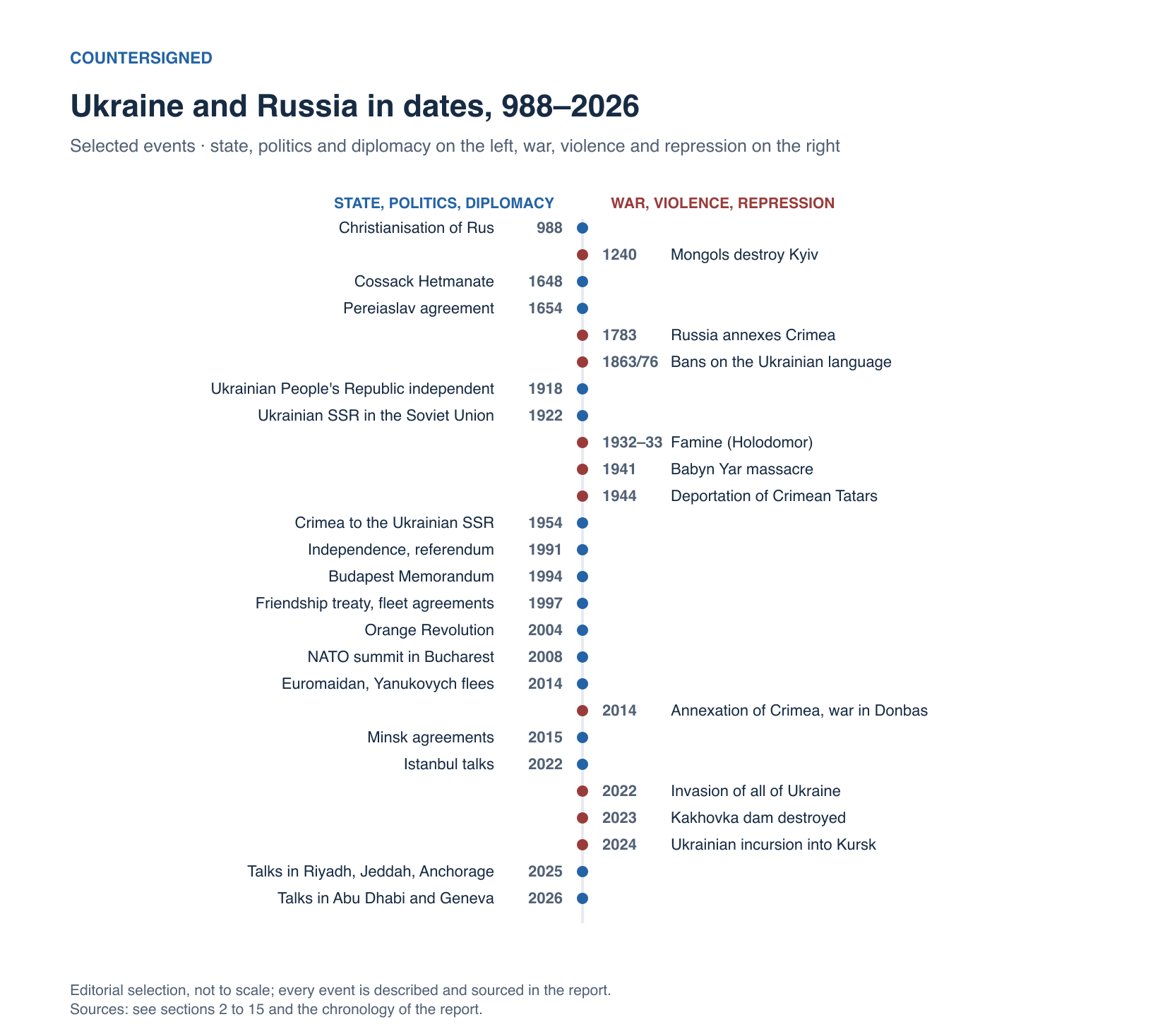
2. Ukraine as a state before 1917
Whether a Ukrainian state has existed, and since when, is not a purely academic question. In July 2021 the Russian president, Vladimir Putin, wrote that Russians and Ukrainians were “one people – a single whole” (S020). This section shows which political entities existed on the territory of present-day Ukraine before 1917 and how independent they were. In doing so, it distinguishes between a state, an autonomous territory within a larger empire, and a province without institutions of its own.
Kyivan Rus and the dispute over its legacy
In the 9th century, Varangians from Scandinavia subjugated the East Slavic tribes and thereby laid the foundations of the state known as Kyivan Rus (S001). In 988, under Prince Volodymyr, Christianity became the state religion (S001). At the height of its power, Rus stretched from the Carpathians to the Volga and from the Black Sea to the Baltic. It later broke up into rival principalities: in 1169 Andrei Bogoliubskii, the prince of Vladimir-Suzdal in the north-east, sacked the city of Kyiv, and the Mongol invasion of 1236 to 1240 destroyed the state (S001).
Who owns this legacy is disputed. The territory of Rus was home both to tribes regarded as ancestors of the Ukrainians and to tribes from which Russians and Belarusians emerged (S001). The Russian historian Mikhail Pogodin argued that the population of the Kyiv region had fled north from the Mongols and formed the Russian people. The Ukrainian historian Mykhailo Hrushevsky countered that the Ukrainians were indigenous to their lands and that the Principality of Galicia-Volhynia was the successor to the Kyivan state. In the 1930s the Communist Party of the Soviet Union had its own version of history drawn up: Rus had been founded by a single “old-Rus’” nationality, from which Ukrainians, Russians and Belarusians developed only in the 14th and 15th centuries (S001). In 2021 Putin wrote that Russians, Ukrainians and Belarusians are all “descendants of Ancient Rus”, bound together by a language that is now called Old Russian (S020).
Between Lithuania, Poland and Moscow
In the west, the Principality of Galicia-Volhynia survived the fall of Kyivan Rus. Roman Mstyslavych had founded it in 1199, and his dynasty ruled it until 1340; after that, Lithuania and Poland contended for the territory (S004). Under the Union of Lublin of 1 July 1569, which joined Poland and Lithuania, the Ukrainian territories of Podlachia, Volhynia and Podilia, together with the Bratslav and Kyiv regions, passed from the Grand Duchy of Lithuania to the Polish Crown (S007).
A Cossack war against Poland gave rise in 1648 to the Hetmanate, a Cossack state with its own institutions: a general military assembly, the hetman as head of state, a council of officers, a chancellery and a supreme court of appeal (S012). Because Hetman Bohdan Khmelnytsky needed an ally against Poland, he negotiated from January 1654 in Pereiaslav with envoys of the Muscovite tsar. As a result, Ukraine became a protectorate of the tsar – that is, a territory under his protection – but kept a freely elected hetman and its independence in internal and external affairs (S008).
What was agreed at Pereiaslav remains disputed to this day, partly because no official written version of the agreement has survived. Historians have interpreted it as a real union, a personal union, vassalage, a protectorate, full incorporation or a military alliance (S011). The Ukrainian leadership under Khmelnytsky regarded it as a temporary political and military alliance; historians, mostly Russian, see it as the voluntary incorporation of Ukraine into Russia (S008). In 1954 the Soviet “Theses” for the 300th anniversary spoke of the “reunification of Ukraine and Russia” (S011). Putin writes that in 1653 Moscow decided to take its “brothers in faith” under its patronage, and that the assembly at Pereiaslav confirmed this decision in January 1654 (S020).
In practice, Moscow curtailed the Hetmanate’s independence step by step. In 1764 the Russian government abolished the office of hetman, and in 1782 it replaced the Cossack regiments with Russian administrative districts (S012).
Under two empires
In the 19th century, Ukrainians lived mainly in two empires, the Russian Empire and Austria. The two empires dealt with the Ukrainian national movement in very different ways.
In the Russian Empire, the interior minister, Pyotr Valuev, issued a secret instruction in 1863 that barred the approval of religious and educational books in Ukrainian, as well as books intended for a general readership; only works of literature remained permitted. A separate “Little Russian” language, the instruction stated, “did not, does not and cannot exist” (S016). “Little Russian” was the official term for Ukrainian. The Ems Ukase, a decree signed by Tsar Alexander II on 30 May 1876, went further: it banned the printing of original works and translations in Ukrainian, the import of Ukrainian publications from abroad, and theatre performances and public readings in the language (S014). With minor changes, it remained in force until 1905 (S016). Putin acknowledges these bans but points to the “historical context”: in his account, they were adopted against the backdrop of dramatic events in Poland and of the Polish national movement’s desire to exploit the “Ukrainian issue” for its own ends (S020).
Austria had taken Galicia from Poland in 1772 and acquired Bukovina two years later; Transcarpathia already belonged to the Hungarian crown (S019). There, the Ukrainians, at the time usually called Ruthenians, were able to organize politically and culturally. In 1848 the Supreme Ruthenian Council was formed and published the first Ukrainian-language newspaper; in 1868 the Prosvita educational society was founded; and in 1907 universal male suffrage strengthened Ukrainian representation in the parliament in Vienna (S019). Before the First World War, the Ukrainians of Galicia had a broad educated class and institutions of their own, in marked contrast to the situation in the Russian-ruled part of Ukraine (S019).
Interim assessment
In this report’s assessment, the sources reviewed show the following. Before 1917, state entities of their own existed at times on the territory of present-day Ukraine: the Principality of Galicia-Volhynia until 1340, and the Hetmanate from 1648 to 1782, which was bound to Moscow from 1654 onwards and whose legal status is disputed. Kyivan Rus is a shared heritage claimed by Ukrainians, Russians and Belarusians alike. The Russian Empire deliberately suppressed the Ukrainian language, whereas it was able to flourish in Austrian Galicia.
The “one people” thesis is a political position that rests on a particular reading of this history. The Centre for Eastern Studies (OSW), a state-funded research institute in Warsaw, concluded that Putin repeats, in simplified form, the basic assumptions of the official 19th-century historiography of the Russian Empire, passes over events that are inconvenient for Russia and presents many others in a one-sided or distorted way (S022). The historian Timothy Snyder considers the history of Ukraine “rather normal”; what is unusual, in his view, is the intense and mostly distorting attention that other states pay to it (S025).
3. The struggle for statehood and the Soviet era (1917–1991)
The Ukrainian People’s Republic, 1917–1920
On 17 March 1917 a Ukrainian council, the Central Rada, was founded in Kyiv; it developed into a revolutionary parliament (S027). Its fundamental decrees were called Universals. The Third Universal proclaimed the Ukrainian People’s Republic on 20 November 1917 as part of a federal Russia. After war with the Bolsheviks had broken out, the Fourth Universal – dated 22 January 1918 but actually adopted on 25 January – declared the republic an independent, sovereign state (S026). On 9 February 1918 the Central Powers concluded peace with it at Brest-Litovsk; Ottokar Czernin had previously recognized the republic’s independence on their behalf (S032).
The republic remained contested. At the end of April 1918, conservative circles with German backing had General Pavlo Skoropadsky proclaimed hetman; his “Ukrainian State” replaced the People’s Republic until a Directory restored it in December 1918 (S028). In the west, a Ukrainian National Council had founded the West Ukrainian People’s Republic in Lviv in November 1918, and the new republic had to defend itself against Poland. On 22 January 1919 its union with the Ukrainian People’s Republic was proclaimed in Kyiv (S028; S033). After an alliance with Poland in April 1920, the army of the People’s Republic withdrew to Poland on 21 November 1920; the government continued its work in exile (S028). Between the two world wars, the territories that the Ukrainian national movement regarded as Ukrainian were divided between the Soviet Union, Poland, Czechoslovakia and Romania (S042).
The Ukrainian Socialist Soviet Republic, which had emerged under Bolshevik rule, was one of the four republics whose delegates founded the Soviet Union in Moscow on 30 December 1922 (S035). Putin sees this as the origin of today’s Ukraine: “modern Ukraine is entirely the product of the Soviet era”, shaped to a significant extent “on the lands of historical Russia”, and “Russia was robbed” (S020).
Famine, war and violence
In 1932 and 1933 millions of people died of starvation in Soviet Ukraine. The demographer Oleh Wolowyna puts the population losses of Soviet Ukraine in the years 1932 to 1934 at four to five million; according to preliminary results of a more comprehensive study that he cites, there were 3.9 million excess deaths and 600,000 lost births. The historian Andrea Graziosi gives 3.5 to 3.8 million deaths in Ukraine out of six to seven million famine victims in the Soviet Union as a whole (S038). The grain delivery quotas imposed in the course of the forced collectivization of agriculture clearly discriminated against Ukraine (S038). In addition, there were measures aimed specifically at the republic: villages that failed to meet their quotas were placed on “blacklists”, and a directive issued by Stalin and Molotov on 22 January 1933 was intended to prevent starving peasants from leaving the republic (S038).
Whether the famine was a genocide is disputed among historians. Robert Conquest took the view that Stalin intended it. R. W. Davies and Stephen Wheatcroft, by contrast, see a leadership that failed to cope with a crisis that was partly caused by its own wrong decisions but was nonetheless unexpected (S038). An economic study, published in revised form in 2023 as a working paper of the US National Bureau of Economic Research, finds that mortality across the whole Soviet Union rose with the share of ethnic Ukrainians in the population, and attributes up to 92 per cent of famine deaths in Ukraine to a policy directed against Ukrainians (S036). The Ukrainian parliament has recognized the famine – in Ukrainian, Holodomor (“killing by hunger”) – as a genocide. A declaration prepared at the United Nations for the 70th anniversary called it a national tragedy of the Ukrainian people, without equating it with genocide (S038).
In the Second World War, Ukraine became one of the main theatres of Germany’s war of annihilation. At the Babyn Yar ravine near Kyiv, SS and police units, aided by auxiliaries, murdered 33,771 Jews on 29 and 30 September 1941, according to their own reports; the ravine remained a killing site for two years (S046).
Ukrainian nationalists also committed mass crimes. From 1943 to 1945, the faction of the Organization of Ukrainian Nationalists led by Stepan Bandera (OUN-B) and its military arm, the Ukrainian Insurgent Army (UPA), killed Polish civilians in Volhynia and Eastern Galicia (S041). Polish researchers estimate the number of Polish victims at about 100,000, of whom 40,000 to 60,000 died in Volhynia, and the number of Ukrainian victims of Polish reprisals at 10,000 to 12,000 (S041). The political scientist Ivan Katchanovski regards a figure of about 35,000 Poles killed in Volhynia in 1943 as more reliable than estimates of around 60,000 (S043). In 2016 the Polish parliament classified the killings as genocide. According to an overview by the Kyiv Independent, Ukrainian historians, by contrast, speak of mutual ethnic cleansing, and Western historians of ethnic cleansing (S044).
The Soviet republic and the road to independence
Although it was part of the Soviet Union, the Ukrainian SSR was one of the founding members of the United Nations in 1945 (S527). On 16 July 1990 its parliament declared the republic’s state sovereignty. The declaration described the republic’s territory as inviolable and announced the intention of becoming a permanently neutral state that belongs to no military blocs and neither accepts, produces nor acquires nuclear weapons (S052). On 24 August 1991 the parliament, the Verkhovna Rada, declared Ukraine’s independence and stated that its territory was “indivisible and inviolable” (S049). To confirm this decision, it scheduled a referendum for 1 December 1991 (S050). With a turnout of 84.16 per cent, 90.32 per cent voted for independence; in Crimea the figure was 54.19 per cent and in Sevastopol 57.07 per cent (S523).
4. Crimea: Khrushchev’s gift or a legally valid transfer?
In the debate about Crimea, two questions are often conflated. The first is historical: was the transfer of the peninsula from the Russian to the Ukrainian Soviet Republic in 1954 proper under the Soviet law of the time? The second is a matter of international law: what has determined the status of Crimea since Russia and Ukraine became independent states in 1991? This section deals with the two questions separately.
Background
Crimea had been part of the Russian Empire since 1783 (S062). Crimean Tatars had lived there for centuries. On 11 May 1944 the Soviet State Defense Committee accused them collectively of treason and ordered that all Tatars be banished from Crimea and resettled permanently as “special settlers” in the Uzbek Soviet Republic, which was to take in 140,000 to 160,000 people (S056). In the 1950s Crimea had about 1.1 million inhabitants, of whom around 75 per cent were Russians and 25 per cent Ukrainians (S062).
The 1954 transfer
The Presidium of the Communist Party of the Soviet Union approved the transfer on 25 January 1954 (S062). Decisions followed by the Presidiums of the Supreme Soviets of the Russian Republic on 5 February and of the Ukrainian Republic on 13 February (S412; S062). On 19 February 1954 the Presidium of the Supreme Soviet of the USSR, the all-Union parliament, approved the “joint submission” of the two republics, citing the common economy, the territorial proximity and the close economic and cultural ties between Crimea and Ukraine (S416). On 26 April 1954 the Supreme Soviet of the USSR confirmed this decree by law and amended Articles 22 and 23 of the Soviet constitution accordingly (S415). Article 18 of the constitution then in force stipulated that the territory of a Union republic could not be altered without its consent (S062).
The interpretation of the transfer as a gift can already be found in the Soviet justification: one of the two official rationales published in 1954 called it a “noble act on the part of the Russian people” to mark the 300th anniversary of the “reunification of Ukraine with Russia” at Pereiaslav (S062). The historian Mark Kramer, director of the Cold War Studies Program at Harvard University, considers neither official rationale convincing. He sees the transfer above all as a means for Nikita Khrushchev to strengthen Soviet control over Ukraine and to secure the support of the Ukrainian party leadership in his power struggle with the prime minister, Georgy Malenkov (S062).
Judgments on the legality of the transfer differ. After examining the documents, Kramer concludes that it was carried out in accordance with the 1936 constitution, since both republics had given their consent; it is wrong, in his view, to describe it as unconstitutional or illegal. At the same time, he observes that the Soviet legal system was “mostly a fiction” (S062). Russia’s then Supreme Soviet, by contrast, declared on 21 May 1992 that the Russian Presidium’s 1954 decision had been void “from the moment of its adoption”, on the grounds that it had violated the constitution of the Russian Republic and the legislative procedure; the resolution does not name any single provision that was violated. At the same time, it records that subsequent legislation of the Russian Republic had “constituted” the transfer itself (S412). In 2014 Putin said the decision had been made “in clear violation of the constitutional norms that were in place even then”, “behind the scenes” and on Khrushchev’s personal initiative (S510); in 2021 he wrote of a “gross violation of legal norms that were in force at the time” (S020).
After 1991: what counts in law
A different set of documents is decisive for the present status of Crimea. In the referendum of 20 January 1991, 93 per cent of voters supported making Crimea an autonomous republic again (S068); on 12 February 1991 the parliament of the Ukrainian SSR restored the Autonomous Republic of Crimea within Ukraine by law (S433). As noted above, a majority in Crimea also voted for Ukrainian independence in December 1991 (S523).
On 8 December 1991 the leaders of Russia, Ukraine and Belarus founded the Commonwealth of Independent States (CIS) in Minsk. In Article 5 of the founding agreement they undertook to recognize and respect each other’s territorial integrity and the inviolability of existing borders; the Alma-Ata Declaration of 21 December 1991, signed by eleven republics, restated this principle (S418). Even the 1992 Russian parliamentary resolution that declared the 1954 decision void referred to a Russian-Ukrainian treaty of 19 November 1990 in which both sides had renounced territorial claims, and called for the Crimea question to be settled through negotiations between the two states with the participation of Crimea (S412).
In the Budapest Memorandum of 5 December 1994, Russia, the United Kingdom and the United States undertook to respect the independence, sovereignty and existing borders of Ukraine and to refrain from the threat or use of force against it. In return, Ukraine acceded to the Treaty on the Non-Proliferation of Nuclear Weapons as a state without nuclear weapons and undertook to remove all nuclear weapons from its territory (S516). Whether the memorandum is legally binding is disputed; the international lawyer Thomas D. Grant describes it as a document that takes the form of an international agreement and whose commitments were meant seriously (S060).
On 31 May 1997 the two states signed a treaty of friendship in Kyiv, in Article 2 of which they undertook to respect each other’s territorial integrity and confirmed the inviolability of existing borders. The State Duma ratified it in December 1998 and the Federation Council in February 1999; it entered into force on 1 April 1999 (S421). Three days before the treaty, on 28 May 1997, the two states had already concluded an agreement on the stationing of the Russian Black Sea Fleet on Ukrainian territory; in 2010, in Kharkiv, it was extended by 25 years from 2017 (S427). A treaty on the course of the common state border followed on 28 January 2003 (S425).
2014: annexation
According to the findings of the European Court of Human Rights, Russia exercised effective control over Crimea from 27 February 2014 (S431). In April 2014 Putin acknowledged that “the Russian servicemen did back the Crimean self-defence forces” (S393). After a referendum on 16 March 2014 (S515), the Russian government and the Crimean leadership signed a treaty on 18 March on the peninsula’s accession to the Russian Federation (S062). In a speech the same day, Putin defended the step. He noted that the Crimean leadership had invoked the right of peoples to self-determination set out in the UN Charter, as well as the Kosovo precedent, and he adopted these arguments as his own: Ukraine had exercised the right to self-determination, he said, yet the residents of Crimea were being denied it. He described the change of power in Kyiv as a coup: “Nationalists, neo-Nazis, Russophobes and anti-Semites executed this coup.” Ukraine’s accession to NATO, Putin said, would have brought the alliance’s navy to Sevastopol (S510). On 2 April 2014 Russia terminated the fleet agreement by law (S429).
The Council of Europe’s Venice Commission, a body of constitutional lawyers, found on 21 March 2014 that the Ukrainian constitution did not permit a local referendum on secession. It also found that the circumstances – the massive presence of (para)military forces, a preparation period of only ten days, and a question that offered no option of voting for the existing status – did not allow a vote in line with European democratic standards (S075). In Resolution 68/262 of 27 March 2014, the UN General Assembly declared that the referendum had no validity and could not form the basis for any change in the status of Crimea and Sevastopol, and called on all states not to recognize any such change (S515). On 25 June 2024 the European Court of Human Rights found unanimously that Russia has exercised effective control over Crimea since 27 February 2014, that Russian law cannot be regarded there as “law” within the meaning of the European Convention on Human Rights, and that Russia is responsible for a systematic pattern of human rights violations (S431). According to the Court’s summary, the judgment contains no decision on sovereignty over Crimea.
Assessment
In this report’s assessment, the answer to the opening question has two parts. Whether the 1954 transfer was proper under Soviet law can be answered in the affirmative with medium confidence: the formal decisions of both republics and of the Union are on record, including a constitutional law. However, Russia’s Supreme Soviet in 1992 and President Putin in 2014 and 2021 alleged procedural defects without naming any single provision that had been violated; the 1992 resolution itself acknowledges that subsequent Russian laws had enshrined the transfer. In a one-party state whose law Kramer himself describes as “mostly a fiction”, the question also has limited significance. The reading of the transfer as a generous gift goes back to the official Soviet justification of 1954.
For the present status of Crimea, 1954 is not decisive. After 1991 Russia recognized the existing borders of Ukraine, which then included Crimea, in several treaties – in Minsk and Alma-Ata in 1991, in Budapest in 1994, in the 1997 treaty of friendship and in the 2003 border treaty – and it settled the stationing of its fleet in Crimea by treaty with Ukraine. Even the 1992 Russian parliamentary resolution called for negotiations, not for the return of the peninsula. The UN General Assembly and the Venice Commission deny the validity of the 2014 referendum, and the European Court of Human Rights does not accept Russian law in Crimea as law within the meaning of the European Convention on Human Rights. Russia, for its part, invokes the right of the inhabitants of Crimea to self-determination. This assessment is held with high confidence; it would change only if documents showed that Russia had made its post-1991 recognition of the borders conditional on a settlement of the Crimea question.
5. Independent Ukraine and Russia (1991–2013)
In the first two decades after 1991, the two states governed their relations through treaties but clashed repeatedly over energy, the fleet in Sevastopol and the question of whether Ukraine should join the West. The border and security commitments of these years – the Budapest Memorandum of 1994, the Friendship Treaty of 1997 and the Border Treaty of 2003 – are described in Section 4.
Gas as a means of pressure
Ukraine bought Russian natural gas, and its pipeline network also carried Russian gas to Europe (S089). On 1 January 2006 the Russian company Gazprom halted deliveries to Ukraine. The dispute lasted four days, and on three of them less gas reached Europe – Hungary, for example, at times lost up to 40 per cent of its Russian supplies (S088). The energy expert Jonathan Stern of the Oxford Institute for Energy Studies noted that neither Gazprom nor the Russian government had made any political demands. The conflict was nevertheless political, he wrote, in the sense that a price agreement would probably have been reached had Viktor Yushchenko not won the 2004–05 presidential election (S088).
The dispute escalated again in January 2009. Russia stopped deliveries to Ukraine on 1 January and, from 7 January, also cut off completely its exports through Ukraine to 16 EU member states and Moldova. Gas began to flow again only on 20 January, after both sides had signed ten-year contracts. Countries in south-eastern Europe that depended entirely on Russian gas were cut off for 13 days, and parts of the Balkans faced a humanitarian emergency (S089). The authors of a study by the Oxford Institute considered Gazprom’s legal and contractual arguments to be the stronger ones. In their view, however, the decisions that led to the complete interruption of supplies to Europe were taken by the Russian government – “almost certainly personalized to Prime Minister Putin” – and neither side paid attention to the damage it was causing (S089).
The Orange Revolution
The 2004 presidential election was contested by Prime Minister Viktor Yanukovych and opposition leader Viktor Yushchenko (S091). The election observation mission of the OSCE, the Organization for Security and Co-operation in Europe, found that the first round and the run-off of 21 November 2004 fell short of a considerable number of international standards; there were documented reports that Yanukovych’s campaign had misused state resources (S091). After mass protests that became known as the Orange Revolution (S107), the Supreme Court of Ukraine declared the result of the run-off invalid on 3 December and ordered a repeat vote. In the observers’ assessment, this vote on 26 December brought Ukraine “substantially closer” to meeting the standards (S091); Yushchenko won (S088).
The NATO question
Moscow accuses the West of breaking a promise not to expand NATO eastwards. At the heart of the matter is a conversation on 9 February 1990: US Secretary of State James Baker told Mikhail Gorbachev that if the United States kept a presence in a united Germany belonging to NATO, there would be no extension of NATO’s jurisdiction “one inch to the east” (S100). What this assurance meant is disputed. The National Security Archive, a document collection at George Washington University, regards it as one of a whole series of Western assurances given in 1990 and 1991 that, in its reading, did not concern East Germany alone; the only thing set down in writing, however, was a special status for the territory of East Germany in the Two Plus Four Treaty of 12 September 1990 – the treaty on German unity between the two German states and the four victorious powers of the Second World War (S099). The former US diplomat Kirk Bennett counters that the assurance applied only to East Germany. He cites Gorbachev himself, who said in 2014 that the topic of “NATO expansion” “was not discussed at all” at the time – while also complaining that the West had violated the spirit of the agreements (S101).
At the Munich Security Conference on 10 February 2007, Putin said that NATO expansion “represents a serious provocation” and asked against whom it was intended and what had become of the assurances given after the dissolution of the Warsaw Pact (S512). At its summit in Bucharest on 3 April 2008, NATO declared that Ukraine and Georgia “will become members of NATO”. It did not, however, grant either country the next step towards membership, a Membership Action Plan, and left that decision to the foreign ministers (S094). In August of the same year, Russia and Georgia went to war. A commission of inquiry set up by the EU and led by the Swiss diplomat Heidi Tagliavini found in 2009 that Georgia had “fired the first shot” with its attack on Tskhinvali on 7 August; at the same time, it documented numerous violations of international law by Russia before, during and after the war (S104).
Between Moscow and Brussels (2010–2013)
Under President Yanukovych, Ukraine changed course. In the Kharkiv Agreement of 21 April 2010, he extended the basing of Russia’s Black Sea Fleet in Sevastopol from 2017 to 2042; in return, Russia granted a gas price discount equal to the annual rent of USD 97 million. Parliament approved the agreement by 236 of 450 votes amid protests; critics saw it as a breach of the constitutional ban on foreign military bases (S085). A law of 1 July 2010 made non-aligned status a principle of foreign policy and removed the goal of NATO membership; EU membership remained an objective (S086).
Ukraine was negotiating an Association Agreement with the EU that would have opened up trade to a large extent. In the summer of 2013, Russian customs classified all Ukrainian exports as belonging to a “high risk category”, which in effect brought them to a halt for several weeks. A study by economists led by Michael Emerson concluded in 2014 that Russia’s trade measures from July to October 2013 contributed to Yanukovych’s decision not to sign the agreement (S108). On 21 November 2013, the Ukrainian government suspended preparations for the signing, citing “reasons of national security” and shrinking trade with Russia (S105). The decision set off protests on a scale not seen since the Orange Revolution (S107). They became known as the Euromaidan.
6. Maidan, Crimea and Donbas (2013–2021)
From protest to a change of power
The protests on Independence Square in Kyiv, the Maidan, lasted from November 2013 to February 2014. According to the Office of the UN High Commissioner for Human Rights (OHCHR), 108 protesters and other individuals as well as 13 law enforcement officers were killed in the violence in Kyiv and several other cities. The Office of the Prosecutor of the International Criminal Court found indications that violence against protesters had been “actively promoted or encouraged” by the Ukrainian authorities (S385). The investigations remained deficient: a panel of experts appointed by the Council of Europe criticised the obstructive attitude of the Interior Ministry and found insufficient evidence to determine whether a third party had been involved (S392).
It is disputed who fired the shots on 20 February 2014, when at least 48 protesters were killed on the Maidan. The political scientist Ivan Katchanovski (University of Ottawa) argues in a working paper that has not been peer-reviewed that the massacre was a “false flag operation”: in his account, “concealed shooters and spotters were located in at least 20 Maidan-controlled buildings or areas” (S548). In October 2023, after a trial that had been under way since 2016, a Kyiv district court convicted three former officers of the Berkut special police who are in Russia in absentia of murdering protesters – sentencing one to life imprisonment and two to 15 years each – and convicted a fourth only of abuse of power; it acquitted a fifth. In many cases it could not be established which officer had shot which protester; both the prosecution and the defence announced appeals (S549). Whether a “third party” was also involved remained, according to the Council of Europe panel, an “open question” (S392). In this report’s assessment, the involvement of Berkut officers in the killings has been established by a court of first instance; the sources reviewed do not support the thesis of an operation planned by the opposition, but neither do they rule out the involvement of other shooters.
On 21 February 2014, President Yanukovych and opposition leaders signed an agreement. It provided for the 2004 Constitution to be restored within 48 hours and for a new president to be elected no later than December 2014; the foreign ministers of France, Germany and Poland and a special envoy of the Russian president were present (S389). On 22 February, Yanukovych left Kyiv and resurfaced a few days later in southern Russia (S394). On the same day, parliament declared that he had withdrawn from exercising his constitutional powers “in an unconstitutional manner” and called new elections for 25 May 2014 (S390). Russia describes this change of power as a coup to this day (S510).
Crimea
As described in Section 4, Russia took control of Crimea from 27 February 2014 onwards. In April 2014 the OHCHR reported soldiers in uniforms without insignia who were widely believed to have come from Russia (S383). In early March, Putin called them “local self-defense units” (S394). A year later he said in a documentary that he had ordered special forces of the GRU military intelligence service, marines and commandos to be deployed “under the guise of reinforcing security for our military facilities in Crimea” (S394).
The war in Donbas
In April 2014 an armed conflict broke out in eastern Ukraine (S401) between the government and groups calling themselves the “people’s republics” of Donetsk and Luhansk. Igor Girkin, a Russian citizen who commanded the separatists in Donbas under the name Strelkov, said in November 2014: “I was the one who pulled the trigger of this war.” Had his unit not crossed the border, he said, everything would have “fizzled out” (S396).
Russia justified its actions as protection of the Russian-speaking population. In April 2014 the OHCHR found that there had been some attacks on ethnic Russians in the east, but that these were “neither systematic nor widespread”; in Crimea there had been no evidence of such attacks before the referendum. Greatly exaggerated reports of attacks by Ukrainian nationalists had been used systematically to create a climate of fear, and media monitors recorded a significant increase in propaganda on Russian television (S383). There was also violence between supporters and opponents of the new government. In Odesa, 48 people died on 2 May 2014 in clashes between pro-unity and pro-federalism groups; many suffocated in the House of Trade Unions, and most of the victims were supporters of federalisation. The OHCHR found that the police did not intervene and that the fire brigade arrived only after 45 minutes despite repeated emergency calls, that by then only activists from the pro-federalism camp had been prosecuted, and that the investigations suffered from institutional deficiencies and procedural irregularities (S385).
On 17 July 2014, Malaysia Airlines passenger flight MH17 was shot down over the contested area, killing all 298 people on board (S401). An international team of investigators established in 2016 that a missile from a Buk air defence system had been fired from an area then controlled by pro-Russian fighters; the launcher had been brought in from Russia and taken back there afterwards (S402). In 2022 a court in The Hague sentenced Girkin and two other men to life imprisonment in absentia and acquitted a fourth. It found that Russia had “exercised overall control” over the “Donetsk People’s Republic” from mid-May 2014, which made the conflict an international armed conflict; who gave the order to fire could not be established (S533).
The OHCHR estimates that between 14,200 and 14,400 people were killed in this war from 14 April 2014 to the end of 2021: at least 3,404 civilians, including the victims of MH17, about 4,400 members of the Ukrainian armed forces and about 6,500 members of armed groups. Most of the civilians died in 2014 and 2015; in 2021 the number was 25 (S386).
Minsk: a ceasefire without peace
A first protocol was signed in Minsk in September 2014 (S442), followed in February 2015 by a “Package of measures”, which the UN Security Council endorsed on 17 February 2015. It provided for a ceasefire, the withdrawal of heavy weapons, local elections under Ukrainian law, a constitutional reform granting special status to parts of the Donetsk and Luhansk regions and – only after that – the return of control over the border to Ukraine (S514). It was never fully implemented, and the fighting continued to claim lives until 2021 (S386). According to the Russian news agency TASS, former Chancellor Angela Merkel told the German weekly Die Zeit in 2022 that Minsk had been an attempt to give Ukraine time; Putin called this disappointing (S410). The EU’s EUvsDisinfo service countered that Merkel had meant preventing an immediate takeover of the whole of Ukraine by Russia, and that Russia and its proxies had implemented neither the ceasefire nor the withdrawal of heavy weapons (S411). The text of the interview itself was not accessible for this report.
Zelensky, the Normandy format and the military build-up (2019–2021)
In February 2019, President Petro Poroshenko signed a constitutional amendment committing Ukraine to membership of NATO and the EU (S224). In the same year, the actor and comedian Volodymyr Zelensky stood in the presidential election, which could not be held in Crimea or in the parts of Donbas controlled by armed groups (S538). As president, he met Macron, Merkel and Putin in Paris on 9 December 2019 in the so-called Normandy format, the negotiating group of Germany, France, Russia and Ukraine. They agreed on a full ceasefire by the end of the year, an “all for all” exchange of prisoners and the incorporation into Ukrainian law of the formula, named after the then German Foreign Minister Frank-Walter Steinmeier, for implementing the political provisions of Minsk (S307).
In the spring of 2021, according to the information group Janes, Russia moved at least 14 combat units from the Urals and Siberia to the Ukrainian border and to Crimea – possibly the largest unannounced troop movement since 2014. The deputy head of the Kremlin administration, Dmitry Kozak, declared that Moscow could “come to the defence” of its citizens in the separatist areas, where Russia had issued more than 650,000 passports since 2019 (S540). In July 2021 came Putin’s article on the “historical unity” of Russians and Ukrainians (Section 2), and in December 2021 the draft treaties in which Moscow demanded security guarantees from the West (Section 8).
7. The full-scale invasion (2022–2026)
The attack and the failure outside Kyiv
On 21 February 2022, Russia recognised the “people’s republics” of Donetsk and Luhansk as independent; on 24 February it launched an invasion from the north, east and south, which Putin called a “special military operation” (S336). On 2 March 2022 the UN General Assembly deplored “in the strongest terms the aggression by the Russian Federation against Ukraine” as a violation of the prohibition of the use of force in the UN Charter, and demanded a complete withdrawal (S110). On 16 March the International Court of Justice ordered, by 13 votes to 2, that Russia immediately suspend its military operations; the Court had no evidence before it for the Russian allegation that genocide had been committed on Ukrainian territory (S112). Russia did not comply with the order.
The attempt to encircle Kyiv failed (S152). At its peak in March 2022, Russia held about 27 per cent of Ukraine’s territory (S336). After the withdrawal from the north, the crimes committed under occupation came to light. The OHCHR documented the killing of 441 civilians by Russian armed forces in 102 localities in the Kyiv, Chernihiv and Sumy regions between 24 February and 6 April 2022, including 73 confirmed cases in Bucha alone; of 100 killings it examined in more detail, it classified 57 as summary executions (S387). In Mariupol, a Russian strike destroyed the maternity hospital on 9 March; an OSCE mission described this as a war crime. According to the mission, about 300 people died in the attack on the city’s theatre on 16 March, where reportedly up to 1,300 people had taken shelter; it found no indication supporting the Russian account that the Ukrainian Azov battalion had blown up the building. The mission found clear patterns of violations of international law by Russian forces and also raised concerns about Ukraine’s treatment of prisoners of war (S121).
Annexation and counter-offensives
In the second half of 2022, Ukrainian counter-offensives in the Kharkiv region and around Kherson recaptured about 74,000 square kilometres, according to an estimate by the Institute for the Study of War (ISW); the share of the country under Russian control fell to about 19 per cent (S336). From 23 to 27 September 2022, Russia held “referendums” in the occupied parts of the Donetsk, Luhansk, Zaporizhzhia and Kherson regions (S111) and on 30 September signed treaties incorporating them into Russia. The regions were annexed within their full administrative boundaries, amounting to about 18 per cent of Ukraine and including large areas that Russian troops did not control at all (S133). Putin said that the people living there “have become our citizens, forever” (S138). The UN General Assembly declared the annexation invalid under international law (S111).
Since 2023 the war has been a war of attrition. In June 2023 the Kakhovka dam was breached; the UN Environment Programme described much of the damage as irreversible (S124). On 24 June 2023, the Wagner private army under Yevgeny Prigozhin occupied the military headquarters in Rostov-on-Don and marched towards Moscow, but called off the mutiny after a few hours (S135). Russia captured Soledar, Bakhmut and, in 2024, Avdiivka; in the same year Ukraine made a surprise advance into Russia’s Kursk region (S336). In April 2025, Russia’s Chief of the General Staff, Valery Gerasimov, confirmed for the first time that North Korean soldiers had provided “significant assistance” in retaking the Kursk region (S131).
Drones, energy and slow territorial gains
The war is increasingly being fought with drones. The independent conflict-monitoring project ACLED counted 6,000 air and drone strikes in 2023, almost 16,000 in 2024 and more than 29,000 in 2025; Russia now produces the Shahed-type drones, originally supplied by Iran, itself (S336). More than 1,900 Russian attacks have targeted Ukraine’s energy supply since the start of the war (S336). Because of the attacks on the electricity supply, the International Criminal Court in 2024 issued arrest warrants for former Defence Minister Sergei Shoigu, Chief of the General Staff Gerasimov and two commanders; it regarded attacks on the electricity supply since October 2022 as possible war crimes and crimes against humanity (S119; S120). Already in March 2023 it had issued arrest warrants for Putin and the children’s rights commissioner Maria Lvova-Belova over the alleged unlawful deportation of Ukrainian children to Russia (S118). An arrest warrant is not a conviction. Ukraine, for its part, struck four bases of Russia’s strategic air force with 117 drones on 1 June 2025; according to Ukrainian statements, more than 40 aircraft were hit (S130).
According to an estimate by the Center for Strategic and International Studies (CSIS) in Washington, Russia captured about 3,600 square kilometres in 2024 and about 4,800 in 2025, and controlled about 20 per cent of Ukraine at the end of 2025 (S128). In early December 2025, Moscow announced the capture of the city of Pokrovsk (S337).
The human toll
By mid-2026, the UN Human Rights Monitoring Mission in Ukraine had verified at least 16,431 civilians killed, including 803 children, and 48,613 injured; the actual figures, it said, were likely considerably higher. Of these casualties, 87 per cent occurred in areas under Ukrainian control (S116; S117).
Military losses can only be estimated; in the assessment of CSIS, both sides have incentives to inflate or reduce figures for political reasons. CSIS estimated in February 2026 that from February 2022 to December 2025 Russia suffered nearly 1.2 million military casualties – killed, wounded and missing – including 275,000 to 325,000 dead, and Ukraine 500,000 to 600,000, including 100,000 to 140,000 dead (S128). In March 2025 the independent Russian outlet Re:Russia estimated 170,000 to 190,000 Russian military deaths, based on the list of named fatalities compiled by Mediazona and the BBC and on an analysis of inheritance registers (S127). All of these figures are estimates with a high degree of uncertainty.
8. Why? Competing explanations
Why Russia annexed Crimea in 2014 and attacked the whole of Ukraine in 2022 is the most contested question in this report. The answers depend on which sources are given weight. This section first sets out the official Russian justification in its own words, then the main explanations offered by researchers, and tests them against evidence that can distinguish between them.
The official Russian justification
In his speech of 21 February 2022, Putin said that “modern Ukraine was entirely created by Russia or, to be more precise, by Bolshevik, Communist Russia”. He claimed that Ukraine intended to build its own nuclear weapons and recalled the 1990 promise that NATO would not expand “one inch to the east” (S136). On 24 February he said the purpose of the “special military operation” was “to protect people who, for eight years now, have been facing humiliation and genocide perpetrated by the Kiev regime”, to “demilitarise and denazify Ukraine” and to bring those responsible to trial. NATO expansion and a hostile “anti-Russia” taking shape on “our historical land” had crossed a “red line”. “It is not our plan to occupy the Ukrainian territory,” he said (S137).
On 17 December 2021, Moscow had already published draft treaties. The United States was to undertake “to prevent further eastward expansion” of NATO and to deny accession to former Soviet republics, and was not to develop military cooperation with them (S140). The draft for NATO would have prohibited troops and weapons in states that had joined after May 1997, as well as any NATO military activity in Ukraine, Eastern Europe, the Caucasus and Central Asia (S143). The United States and NATO offered talks on arms control and confidence-building measures but maintained that NATO remained open to new members (S436). Steven Pifer of the Brookings Institution saw in the unacceptable demands and their rapid publication a risk that the Kremlin wanted a rejection to use as a pretext for an attack, but also considered it possible that they were an opening bid (S143).
Some of the claims in the official justification can be tested. In March 2022 the International Court of Justice had no evidence before it of genocide against the population of Donbas (S112); the UN human rights mission had already found in 2014 that attacks on Russian speakers were neither systematic nor widespread (S383), and for 2021 it counted 25 civilians killed in the entire conflict area (S386). The claim that no occupation was planned is contradicted by the annexation of four regions in September 2022 (S133).
Explanations in the research literature
Security and NATO enlargement. The political scientist John Mearsheimer, a representative of the realist school, wrote in 2014 that the United States and its allies “share most of the responsibility for the crisis”. The root of the conflict, in his view, was NATO enlargement, compounded by EU enlargement and Western democracy promotion. Putin’s response had been “defensive, not offensive”, and Mearsheimer called the ouster of Yanukovych an illegal overthrow (S145). A 2023 study by the American institute Defense Priorities took the same view and recommends armed neutrality for Ukraine (S456). The British political scientist Richard Sakwa, in his book “Frontline Ukraine”, traces the crisis back to an asymmetric post-Cold War order that excluded Russia; according to a reviewer, he portrays Russia as a power that wants to preserve the status quo, not as a revisionist state (S149). In support of this explanation, Russia has long described NATO enlargement as a threat (S512), NATO held out the prospect of membership to Ukraine in 2008 without opening a path to it (S094), and the demands of December 2021 centred on NATO (S140). The Ukrainian negotiator Davyd Arakhamia said in 2023 that in the 2022 negotiations neutrality “was the most important thing” for Russia, and everything else merely political “seasoning” (S155).
Domestic politics and the preservation of power. The political scientist and former US ambassador in Moscow Michael McFaul countered Mearsheimer that Russian foreign policy had changed “as a result of Russian internal political dynamics”, not because of American policy (S146). The political scientist Stephen Sestanovich of the Council on Foreign Relations wrote that Ukrainian politicians had stressed again and again that NATO membership was not on the agenda, and that the removal of Yanukovych by a unanimous parliamentary vote, in which deputies of his own party also took part, had not been a coup; Mearsheimer explicitly disagreed with him (S146). The political analyst Tatiana Stanovaya describes, in 2026, a war policy that in case of doubt opts for escalation and tougher demands (S454).
Imperial claim and identity. A third interpretation places the core of the matter in Putin’s view that Ukraine is not a state in its own right. The evidence for this lies in his own texts: the thesis of “one people” from 2021, the statement that “Russia was robbed” (S020), the reference to “our historical land” (S137) and the pledge that the inhabitants of the annexed regions “have become our citizens, forever” (S138). In 2022 a study in a Polish academic journal judged Mearsheimer’s theses unsuited to explaining the attacks of 2014 and 2022 (S148).
Miscalculation. According to a November 2022 report by the British Royal United Services Institute (RUSI), Russia planned to conquer Ukraine within ten days, occupy the country and annex it by August 2022; its strategic objective was “the subjugation of the Ukrainian state”. The plan was based on surveys by the FSB, Russia’s domestic intelligence service, which showed a politically apathetic society. The authors, two of whom were themselves involved on the Ukrainian side, describe their report as testimony rather than an academic study, because their sources are classified (S151).
What the evidence can distinguish
Some facts fit poorly with a purely security-based explanation. When Russia took over Crimea in February and March 2014, Ukraine had been non-aligned by law since 2010 (S086), and, according to Sestanovich, NATO accession was not on the agenda (S146). Only in December 2014, after the annexation of Crimea and the start of the fighting in Donbas, did parliament renounce non-alignment (S547); for the 2022 attack, this argument therefore does not suffice on its own. Commenting in 2022 on the planned NATO accession of Finland, a direct neighbour of Russia, Putin said that “we do not have such problems with Sweden and Finland as we have, regrettably, with Ukraine” and that there were no territorial disputes with them (S441); Finland’s accession in 2023 was followed by announcements of “counter-measures”, but not by war (S437). Realist authors counter that, after its setbacks in Ukraine and in view of Western security assurances to Finland and Sweden, Russia could not have risked a war with NATO (S456). In 2022 Russia annexed territory that it did not control (S133), and in June 2024 it set as the condition for a ceasefire the withdrawal of the Ukrainian army from these regions within their full boundaries, together with neutrality, “demilitarisation and denazification” and the lifting of sanctions (S511). Such territorial demands go beyond what security interests alone could justify.
Other facts support the security interpretation. In Istanbul in March and April 2022, the two sides negotiated over a permanently neutral Ukraine with international security guarantees, under which the question of Crimea would have been left open for 15 years (S152). At the same time, up to mid-April Russia was demanding a veto over these guarantees and a ceiling of 85,000 troops for the Ukrainian army, whereas Ukraine wanted 250,000 (S152).
Decisions by Ukraine and the West also form part of the explanation. In 2008 NATO promised a membership that it did not deliver (S094); in 2019 Ukraine committed itself to NATO in its constitution (S224); at the end of 2021 the Western states rejected the core of Russia’s demands (S436). Why the 2022 talks failed is disputed. Samuel Charap (RAND Corporation) and Sergey Radchenko (Johns Hopkins University) name several reasons – Western reluctance, the outrage after Bucha, Kyiv’s growing confidence after the Russian withdrawal, and overly ambitious goals – and find no single “smoking gun” (S152). Putin blames the then British Prime Minister Boris Johnson, who dismisses this as “total nonsense” (S152; S157). Arakhamia confirmed that after Istanbul Johnson had advised Ukraine to keep fighting, but denied that he had forced Kyiv to do so; as the reasons, he cited the constitutional commitment to NATO and a lack of trust in Russian promises (S155).
Assessment
The explanations are not mutually exclusive. In this report’s assessment, the evidence most strongly supports a combination: Russia has long rejected Ukraine’s ties to the West as a threat, but its territorial demands, the plan described by RUSI to subjugate the Ukrainian state and Putin’s own statements about Ukraine as “historical land” point beyond this to a claim to decide Ukraine’s fate. Domestic political motives and a serious misjudgement of Ukrainian resistance were additional factors. Decisions by the West and Ukraine – the 2008 promise of membership without a path to it, the 2019 constitutional amendment and the rejection of Russia’s demands at the end of 2021 – help to explain the timing of the escalation, but not the attack itself. The security interpretation alone does not explain why Russia took over Crimea in 2014, when Ukrainian NATO accession was not on the agenda, and why in 2022 it annexed territory it did not hold; the imperial interpretation alone does not explain why Russia negotiated in Istanbul over a settlement without recognition of Crimea. This assessment is made with medium confidence. It would change if internal Russian documents became available showing which goals the leadership actually pursued.
9. Who supports Ukraine – how and why
Ukraine is supported by dozens of states – the Kiel Institute for the World Economy tracks 41 donor countries (S161) – with weapons, money, humanitarian aid, sanctions against Russia and the reception of refugees. How much this amounts to depends on how it is counted. The Kiel Institute distinguishes between commitments and “allocated” aid, meaning aid that has been delivered or earmarked for delivery in specific packages; it values weapons at market prices and, when in doubt, at the higher end (S166; S162).
From America to Europe
By May 2024 the United States had committed more than USD 52 billion in military aid. It was financed mainly through supplementary budgets; a large part went to replenishing Pentagon stocks that had been handed over to Ukraine, or to paying for contracts with the American defence industry (S171). This changed under President Donald Trump. After a public row with Zelensky in the Oval Office, Washington temporarily suspended weapons deliveries and intelligence sharing in early March 2025 (S188; S189). On 30 April 2025 the two states signed an agreement on a joint reconstruction fund (S172); under it, Ukraine retains full ownership of its natural resources, and the fund is managed by both sides on an equal footing (S173). Since July 2025, European and other allies have been buying American weapons for Ukraine through the NATO mechanism PURL (Prioritized Ukraine Requirements List, a list of priority equipment needs); by July 2026, 29 states had paid in USD 6.7 billion (S175).
According to the Kiel Institute, American aid fell by 99 per cent in 2025. Compared with the average for 2022 to 2024, Europe increased its allocations by 59 per cent for financial and humanitarian aid and by 67 per cent for military aid, so that total aid remained roughly at the level of previous years. Military aid is concentrated among a few states: northern and western Europe, above all Scandinavia, Germany and the United Kingdom, provided around 95 per cent of it (S543). In the first half of 2026, European donors bought at least EUR 3 billion worth of military aid from American defence companies; financial and humanitarian aid was, on a monthly average, 41 per cent lower than in the previous year (S542).
The European Union
By its own account, the EU and its member states have supported Ukraine with EUR 193.3 billion since 2022 (S180). This includes the “Ukraine Facility”, worth up to EUR 50 billion for 2024 to 2027 (S167), and EUR 6.4 billion for weapons from the European Peace Facility (S178). In October 2024 the G7 states, the group of seven major Western industrialised countries, agreed on loans of around USD 50 billion, to be repaid from the proceeds of frozen Russian state assets (S183). The Europeans went no further: in December 2025 a “reparations loan”, which would have drawn on the frozen assets themselves, failed, partly because of opposition from Belgium. Instead, the European Council decided on an interest-free loan of EUR 90 billion for 2026 and 2027, financed through joint EU borrowing; Czechia, Slovakia and Hungary were exempted from the guarantees (S475). Disbursement is tied to conditions, including the rule of law and the fight against corruption (S476).
Refugees
According to the UN Refugee Agency, in December 2025 there were 5.86 million refugees from Ukraine worldwide, around 5.3 million of them in Europe; 3.7 million people were displaced within the country (S186). At the end of January 2026, 4.38 million people from Ukraine held temporary protection in the EU, most of them in Germany (1.26 million), Poland (966,000) and Czechia (397,000) (S187).
Motives
The supporters justify their aid by the protection of Ukraine’s sovereignty and of their own security. On 27 February 2022, German Chancellor Olaf Scholz spoke of a “Zeitenwende”, a turning point in history: anyone who reads Putin’s writings, he said, can no longer doubt that Putin “wants to build a Russian empire”. He announced a special fund of EUR 100 billion for the Bundeswehr, Germany’s armed forces (S235). According to Kiel Institute figures, Germany has so far supported Ukraine with around EUR 25 billion, and it plans military aid of EUR 11.5 billion for 2026 (S236). Besides these declared motives, analysts point to self-interest: a considerable share of the money is spent in the donor countries (Section 13), and in 2024 the Washington-based CSIS saw aid to Ukraine as the greatest opportunity since the Second World War to strengthen the American defence industry (S287). Under President Trump, the United States moved the end of the fighting and stability in its relations with Russia to the fore (Section 11). This report does not separately assess the motives of other donors, such as Poland and the Baltic states.
- United States: over USD 52 bn in military aid committed; 99% decline in 2025; since then sales via PURL; as of: May 2024 (S171); 2025 (S543)
- EU and member states: EUR 193.3 bn in total; EUR 90 bn loan for 2026–27; as of: Jan. 2026 (S180); Apr. 2026 (S476)
- G7: around USD 50 bn in loans repaid from proceeds of Russian assets; as of: Oct. 2024 (S183)
- NATO states via PURL: USD 6.7 bn for US weapons; as of: July 2026 (S175)
- Germany: around EUR 25 bn; EUR 11.5 bn in military aid planned for 2026; as of: May 2026 (S236)
- Host countries: 4.38 million people with protection status in the EU; as of: Jan. 2026 (S187)
10. Who supports Russia – how and why
Russia has fewer supporters than Ukraine, but some particularly important ones.
North Korea supplies ammunition, missiles and soldiers. The Multilateral Sanctions Monitoring Team, a group of states that tracks the UN sanctions against North Korea, reported in May 2025 that in 2024 alone North Korea had supplied up to nine million rounds of artillery and rocket ammunition and at least 100 ballistic missiles, which were fired at Ukraine, and that it had sent more than 11,000 soldiers at the end of 2024. In return, Russia supplied air defence systems, among other things; both violate UN Security Council resolutions (S191). According to Ukrainian and South Korean estimates, a total of 14,000 to 15,000 North Korean soldiers came to the Kursk region; in 2026 a North Korean missile unit began to set up in western Russia (S496). The treaty concluded by the two states in June 2024 obliges each of them, in the event of an armed attack on the other, to “immediately provide military and other assistance” (S193).
Iran supplied Shahed-type combat drones, which are now produced in Alabuga in Tatarstan; 6,000 drones were planned there by September 2025 (S199). In September 2024 the United States, the United Kingdom, France and Germany accused Iran of also supplying short-range missiles; Tehran called this “completely baseless and false” and states that it sold drones only months before the war (S201). The Russian-Iranian treaty of January 2025 contains no obligation of mutual assistance, only a commitment not to support anyone who attacks the other party (S196).
China: The sources reviewed do not document any Chinese weapons deliveries. China is, however, the most important supplier of goods that can be used for both civilian and military purposes. A commission of the US Congress estimates that in 2023 most of the goods of particular importance for Russian weapons production came from China, as much as 89 per cent by some estimates (S203). In 2024, US officials said that China was “taking a systematic effort to support Russia’s war effort” (S206). The sources reviewed contain no official Chinese statement on these supplies; in the assessment of the Carnegie Endowment, supplying components rather than finished weapons allows China to support Russia while claiming “plausible deniability” (S206). According to calculations by the Kyiv School of Economics, in 2025 Russia paid a mark-up of around 300 per cent for such goods from China (S208). Politically, the two states had declared on 4 February 2022, three weeks before the invasion, that their friendship had “no limits”, and had spoken out against further NATO enlargement (S513).
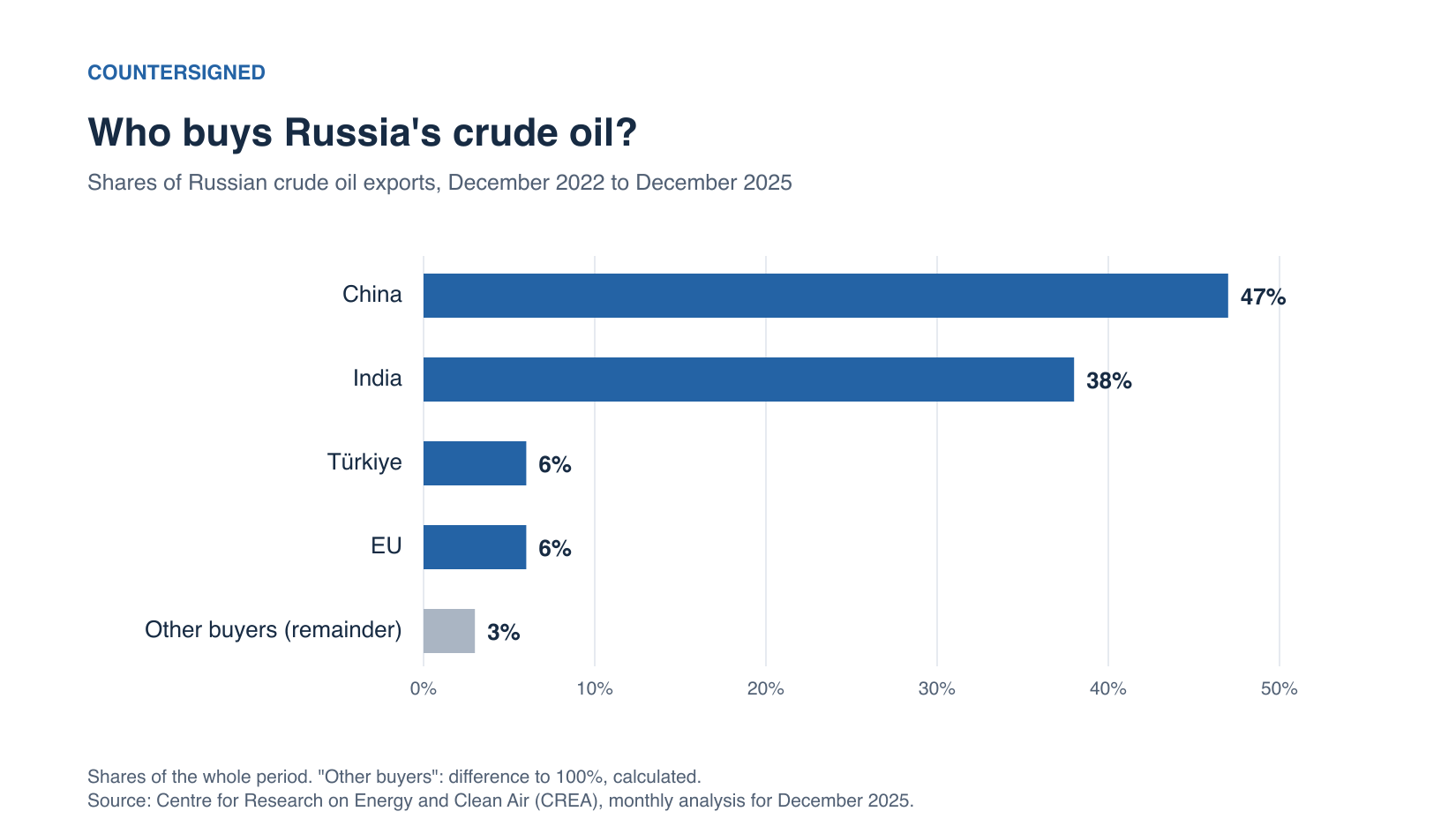
Buyers of Russian energy finance the war indirectly. According to data from the Centre for Research on Energy and Clean Air (CREA), from December 2022 to December 2025 China bought 47 per cent of Russia’s crude oil exports, India 38 per cent, and Turkey and the EU 6 per cent each; in December 2025 Russia earned EUR 500 million a day from fossil fuels (S212). Some of the oil is shipped past the sanctions by a “shadow fleet” of mostly old tankers; according to the KSE Institute of the Kyiv School of Economics, 155 such tankers left Russian ports in August 2025 alone, 86 per cent of them more than 15 years old (S213). The share of Russian oil in India’s imports rose from about 2.5 per cent before the war to around 36 per cent; on 27 August 2025 the United States therefore imposed an additional 25 per cent tariff on India over these oil purchases, on top of a general 25 per cent tariff already in force, and in October 2025 it imposed sanctions on the Russian oil companies Rosneft and Lukoil (S214). Sanctioned Western goods reach Russia via neighbouring states such as Kyrgyzstan; the EU has therefore placed banks in Central Asia on its sanctions list (S501).
Belarus allowed Russia to advance through its territory into northern Ukraine in early 2022; in June 2023 Putin announced the stationing of tactical nuclear weapons in Belarus (S211).
The motives differ. North Korea receives air defence and military experience (S191); China shares Russia’s opposition to NATO enlargement (S513); and India justifies its oil purchases by its supply interests, while Prime Minister Modi at the same time urged Putin in August 2026 to “move from endless war to the end of war” (S495).
11. Geopolitical aims
Russia, in its 2021 National Security Strategy, sees itself threatened by Western “hegemony” and by attempts to isolate it and to dilute “traditional values” (S219). Its conditions for ending the war – neutrality for Ukraine, the cession of four regions within their full borders, “demilitarisation” and the lifting of sanctions – are set out in Section 8 (S511).
Ukraine, in its 2022 “Peace Formula”, demands the restoration of its internationally recognized borders, the withdrawal of all Russian troops, a special tribunal for the crime of aggression, compensation, and security guarantees until it joins NATO (S226); membership of the EU and NATO has been enshrined in its constitution since 2019 (S224).
The United States, in its National Security Strategy of December 2025, declares a swift end to the fighting and the restoration of “strategic stability” with Russia to be a core interest. Europe is to take “primary responsibility for its own defense”, and NATO is no longer to be perceived as a “perpetually expanding alliance”. The Brookings Institution notes that the document does not mention Russia’s responsibility for the aggression (S229; S230).
The Europeans have reoriented their defence policy. Through the “ReArm Europe” plan, the EU aims to mobilize up to EUR 800 billion for defence (S232). In a “Coalition of the Willing”, 26 states pledged in September 2025 to take part, after a ceasefire, in a reassurance force on the ground, at sea or in the air (S238). At a meeting of this coalition in Paris in January 2026, France and the United Kingdom pledged to send troops to Ukraine after a ceasefire; the United States supports security guarantees and is to lead the monitoring of a truce (S239). Hungary’s Prime Minister, Viktor Orbán, by contrast, rejects EU membership for Ukraine because it would bring the war into the EU, and in early 2026 he temporarily blocked the EU loan (S462; S461). In 2023 the Slovak head of government, Robert Fico, called Ukraine “one of the most corrupt countries in the world” (S460).
China, in its position paper of February 2023, calls for respect for the sovereignty of all countries, but at the same time for abandoning the “Cold War mentality” and for refraining from expanding military blocs; it rejects unilateral sanctions (S241). Turkey closed the Turkish Straits to warships in February 2022, mediated the only direct talks and the grain deal in 2022, and at the same time maintains “managed cooperation” with Russia (S243).
12. What Ukrainians and Russians think
Polling in wartime is difficult. In Ukraine, only people in the areas controlled by the government are surveyed (S485); in Russia, many respondents are afraid to express political views (S267). The following figures should therefore be read as indications of moods and trends, not as precise measurements.
Ukraine
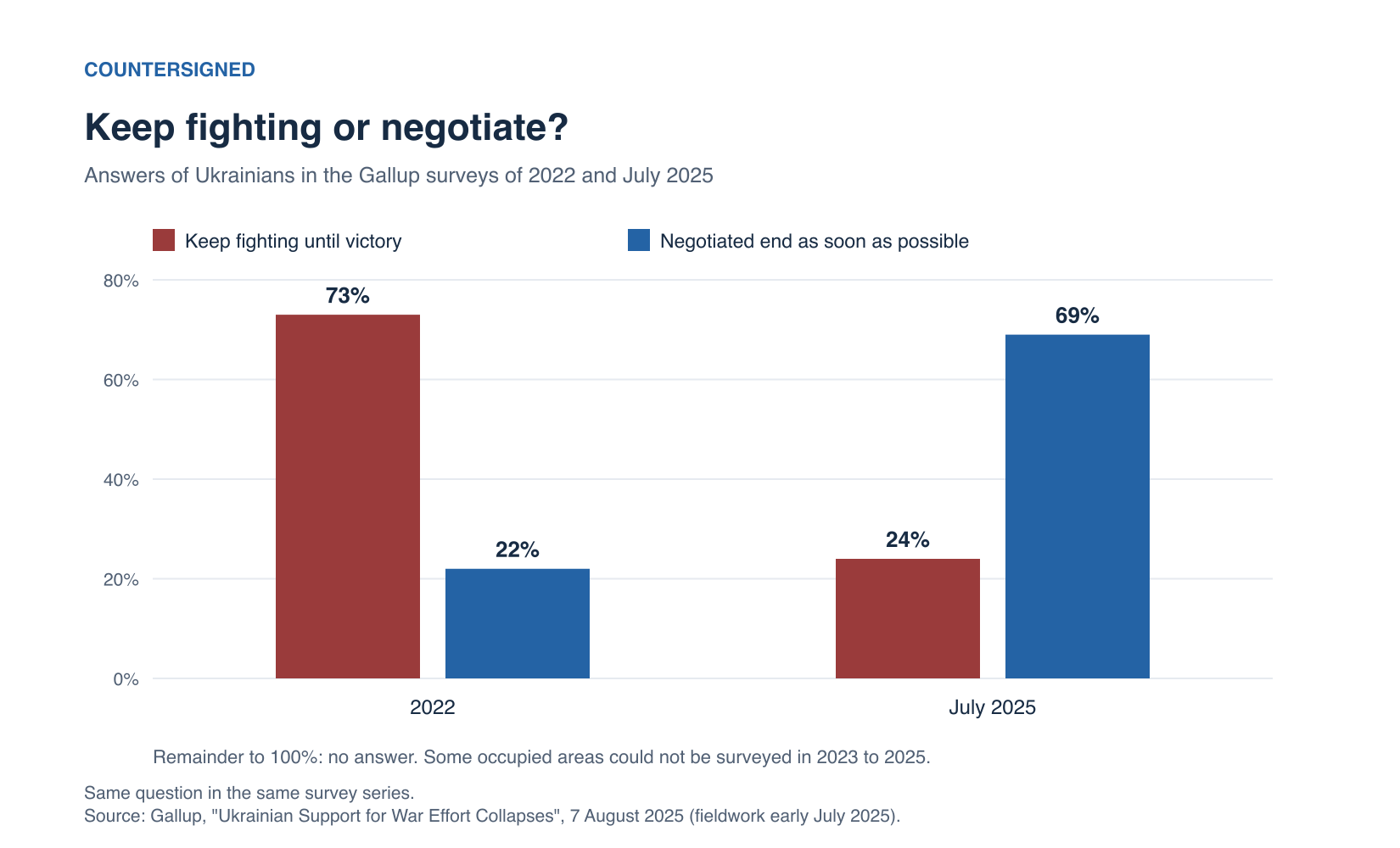
Willingness to make concessions has grown but remains limited. In the telephone surveys of the Kyiv International Institute of Sociology (KIIS), 87 per cent still rejected any cession of territory in February 2023 (S246). In May and June 2025, 52 per cent were categorically opposed to territorial concessions, while 38 per cent were prepared to accept some loss of territory (S485). In mid-February 2026, 57 per cent considered a withdrawal from the remaining part of Donbas in exchange for security guarantees from the United States and Europe categorically unacceptable, while 36 per cent would accept it (S486). How much the wording matters was shown by a KIIS survey in early March 2026: 61 per cent would approve, and 10 per cent would reject, an agreement that provides not only for “territorial compromises” but also for EU membership in 2027, reliable security guarantees and reconstruction; the rest would not vote or were undecided (S486). According to Gallup, in July 2025, 69 per cent wanted a negotiated end to the war as soon as possible and 24 per cent wanted to keep fighting until victory – in 2022 the ratio was almost the reverse (S258). In early September 2026, 54 per cent trusted President Zelensky and 41 per cent did not (S487).
Russia
The independent Levada Center, which is subject to restrictions as a “foreign agent” (S267), found in August 2026 that 68 per cent support the actions of the Russian armed forces in Ukraine and 21 per cent do not. Fifty-nine per cent favour peace negotiations, eight percentage points fewer than in February, and 31 per cent favour continuing the fighting; 55 per cent expect the war to last more than another year (S489). In answer to a different question in January 2026, the same share, 59 per cent, said that Russia should intensify its strikes if peace was not possible, while 21 per cent favoured concessions (S491). According to a survey by Russian Field, 83 per cent would support a peace agreement signed by Putin; majorities named as mandatory conditions the recognition of Donbas as Russian, Ukraine’s renunciation of NATO membership and the lifting of sanctions (S263).
How reliable such figures are is disputed. The “Chronicles” project counts as “consistent supporters of the war” only those respondents who support the war, reject a withdrawal without the war aims having been achieved and give the military priority in the budget; their share ranged from 12 to 22 per cent between February 2023 and January 2024 (S269). Researchers point to socially desirable answers and to fear of expressing political views: in a Levada survey, 26 per cent said they were afraid to answer political questions (S267; S274).
13. Corruption, control of the money and who profits from the war
Many claims are made about corruption in connection with the war. This section separates four questions that are often conflated in public debate: where the money goes; what oversight bodies have found; which corruption cases are documented, in Ukraine and in Russia; and who profits legally from the war. Corruption here means the abuse of entrusted power for private gain; a suspicion or an indictment is not a verdict.
Where the money goes
On 2 February 2025 President Zelensky said that of roughly USD 175 billion in American aid, Ukraine had received only about USD 75 billion. The Center for Strategic and International Studies (CSIS) answered the question of the “missing” USD 100 billion as follows: Congress appropriated USD 175.2 billion in aid “as a result of the war”, but 90 per cent of military aid and about 60 per cent of all funds are spent in the United States itself, about 25 per cent in Ukraine and 15 per cent globally – on replacing weapons handed over, training Ukrainian soldiers, reinforcing American forces in Europe and humanitarian aid. The CSIS analyst Mark F. Cancian wrote that “no money is missing” (S286). The Congressional Research Service lists USD 45.8 billion for replacing stocks handed over to Ukraine and USD 31.8 billion for new weapons; this money financed, for example, munitions plants in Texas, Pennsylvania and Iowa and a USD 4.5 billion contract with Lockheed Martin for Patriot missiles (S288).
Budget support, which Ukraine uses to pay salaries and pensions, runs largely through the World Bank’s PEACE project. By 2025 the project had disbursed more than USD 41 billion, USD 32 billion of it from the United States. The World Bank reimburses only expenditure it has checked and found eligible, and has the accounts examined by an independent audit firm (S283). The EU, too, ties its loans to reforms and to the fight against corruption (S476).
What the auditors found
In January 2024 the Pentagon’s Inspector General found that serial-number inventories for weapons worth USD 1.005 billion – 59 per cent of the deliveries subject to enhanced monitoring – were overdue. Whether weapons had been diverted lay outside the scope of the evaluation (S277). A senior Pentagon official had told Congress in February 2023 that the United States did not believe weapons were being diverted (S472). An article for the Washington-based Center for International Policy noted in 2024 that there was no evidence of diversion through criminal activity, but that the risk could rise once the fighting ends (S473). The audit reports reviewed therefore do not support claims that Western weapons are being sold on the black market on a large scale; nor, however, is the whereabouts of every weapon fully documented.
Documented corruption cases in Ukraine
Corruption is a long-standing problem in Ukraine; in 2021 the European Court of Auditors found that EU programmes against grand corruption had produced “still insufficient results” (S282). Major cases have also come to light during the war. In 2023 Ukraine’s Accounting Chamber, the national audit office, confirmed that the Ministry of Defence had bought food at inflated prices, and put the funds used unproductively at 7.4 billion hryvnia (UAH, Ukraine’s currency), about USD 205 million (S296). In January 2024 the Security Service of Ukraine (SBU) formally named five people as suspects in the embezzlement of about UAH 1.5 billion intended for mortar rounds from the company Lviv Arsenal (S297). In August 2023 Zelensky dismissed all regional heads of the military recruitment offices after evidence emerged of self-enrichment and of help given to men of conscription age to leave the country illegally (S298).
The largest case so far came to light in November 2025. In “Operation Midas”, the National Anti-Corruption Bureau of Ukraine (NABU) investigated a network inside the state nuclear power company Energoatom that allegedly extorted 10 to 15 per cent of contract values from suppliers; at least USD 100 million is said to have been embezzled in this way. The alleged organiser, Zelensky’s former business partner Tymur Mindich, left the country hours before the searches; seven people were charged (S289). Justice Minister Herman Halushchenko and Energy Minister Svitlana Hrynchuk had to leave office (S291). On 28 November 2025 the head of the Office of the President, Andriy Yermak, resigned after a search; he had not been charged at that point (S290).
How resilient Ukraine’s oversight institutions are became apparent in July 2025. On 22 July parliament passed a law placing NABU and the Specialised Anti-Corruption Prosecutor’s Office under the Prosecutor General. After protests in many cities and “deep concern” expressed by the European Commission, parliament restored their independence on 31 July with no votes against (S293; S467).
Corruption in Russia
Major corruption cases in the military have also come to light in Russia. On 1 July 2025 a Moscow court sentenced the former Deputy Defence Minister Timur Ivanov to 13 years in prison for embezzlement and money laundering; the investigative reporting platform OCCRP sees the case as part of a broader crackdown inside the Defence Ministry (S294; S295). Putin himself acknowledged in June 2023 that the state had paid the Wagner mercenary group more than 86 billion rubles within a year and that Prigozhin’s catering company had earned 80 billion rubles supplying the army; he said he hoped “that nobody stole anything, or at least did not steal much” (S457). In Transparency International’s Corruption Perceptions Index, Russia scores 22 out of 100 points and ranks 157th of 182 countries (S545).
Who profits legally
Arms manufacturers on both sides are among the biggest legal winners; the sources do not allow a ranking of all those who profit. According to the Stockholm International Peace Research Institute (SIPRI), the arms revenues of the 100 largest producers rose by 5.9 per cent in 2024 to a record USD 679 billion. European companies grew by 13 per cent to USD 151 billion, which SIPRI attributes to the war in Ukraine and the perceived threat from Russia; American companies grew by 3.8 per cent to USD 334 billion; the Russian groups Rostec and United Shipbuilding grew by 23 per cent to USD 31.2 billion, and Ukraine’s state-owned defence group by 41 per cent to USD 3 billion (S299; S300). For comparison: in December 2025 Russia earned around EUR 500 million a day from exporting fossil fuels (S212); intermediaries, buyers of discounted oil and operators of the “shadow fleet” also profit from this (Section 10).
Who raised concerns
Criticism of how the aid was used came mainly from three directions. In 2023 the Slovak prime minister, Robert Fico, called Ukraine “one of the most corrupt countries in the world” and demanded guarantees against misappropriation (S460); Hungary’s Viktor Orbán also cites corruption among his reasons for opposing Ukraine’s accession to the EU (S462). In the United States, FBI Director Kash Patel called on Congress in March 2025 to investigate “where this money has gone” (S465). The European Commission and the G7 ambassadors, for their part, backed the independence of Ukraine’s anti-corruption agencies in July 2025 (S467; S470).
In this report’s assessment, the following conclusions emerge. Corruption is a serious problem in both countries. The audit reports reviewed contained no evidence for the claim that most Western aid disappeared in Ukraine; most American aid was not spent in Ukraine at all. What is documented, by contrast, are individual large cases uncovered by Ukrainian authorities themselves – which shows both the scale of the problem and the effectiveness of oversight.
14. Diplomacy 2014–2026: who talked to whom, and with what result
- 17 April 2014 – Geneva: USA, EU, Ukraine, Russia: Disarmament of illegal groups, an amnesty and a constitutional process agreed; Russia did not consider itself bound (S303; S305)
- Sept. 2014 / Feb. 2015 – Minsk: Trilateral Contact Group (Ukraine, Russia, OSCE), Normandy format: Ceasefire and package of measures; never fully implemented (S514)
- 9 Dec. 2019 – Paris: Macron, Merkel, Putin, Zelensky: Prisoner exchange, ceasefire until the end of the year (S307)
- March–May 2022 – Belarus, Istanbul: Russia, Ukraine: Communiqué on neutrality; talks broken off by 17 May 2022 (S152; S310)
- July 2022 – July 2023 – UN, Turkey: grain deal: About 33 million tonnes exported; Russia let the deal expire (S313; S312)
- Since 2022 – UAE, Turkey and others: prisoner exchanges: 1,994 prisoners via the UAE alone by Sept. 2024 (S316)
- 15–16 June 2024 – Bürgenstock: summit without Russia: Communiqué on nuclear safety, food and prisoners (S317)
- 18 Feb. 2025 – Riyadh: USA and Russia: First direct talks, without Ukraine (S319)
- 11 March 2025 – Jeddah: USA and Ukraine: Ukraine accepted a 30-day ceasefire provided Russia followed suit; Putin “agreed with the proposal” in spirit but set conditions (S320; S323)
- May–July 2025 – Istanbul: Russia, Ukraine: Prisoner exchanges, no ceasefire (S324; S325)
- 15 Aug. 2025 – Anchorage: Trump, Putin: No ceasefire (S326; S327)
- Nov.–Dec. 2025 – US plan of 28, later about 20 points: Negotiations in Geneva and Moscow; no agreement (S328; S330)
- 6 Jan. 2026 – Paris: “Coalition of the Willing”: Security guarantees for the period after a ceasefire (S449)
- Feb. 2026 – Abu Dhabi, Geneva: USA, Ukraine, Russia: Progress on individual issues, no agreement (S445)
- Sept. 2026 – US envoys in Moscow and Kyiv: Three-way talks for October 2026 agreed in principle (S345)
The overview covers negotiating formats with published outcomes; this report does not assess individually the mediation offers of single states that produced no such outcomes.
Since 2014 the parties to the conflict and third countries have negotiated in a succession of new formats. After the annexation of Crimea, the United States, the EU, Ukraine and Russia agreed in Geneva in April 2014 on the disarmament of illegal groups; in the assessment of the Centre for Eastern Studies (OSW), however, Russia did not regard itself as a party bound by the agreement (S305). The Minsk agreements of 2014 and 2015 brought a fragile ceasefire, but no political settlement (Section 6).
After the invasion, the two sides negotiated directly in spring 2022 (Section 8). In April 2022 Russia’s foreign minister, Sergei Lavrov, accused Ukraine of backing away from the commitments made in Istanbul and called the reports from Bucha a “provocation” (S311). According to an analysis by the German Institute for International and Security Affairs (Stiftung Wissenschaft und Politik, SWP), the two sides remained irreconcilable on security guarantees and on the status of Crimea and the Donbas; by 17 May 2022 both had officially withdrawn (S310). The grain deal brokered by the UN and Turkey, by contrast, was a success: by July 2023 about 33 million tonnes of goods had been exported through three Ukrainian ports, before Russia let the agreement expire and demanded, among other things, that its agricultural bank be reconnected to the SWIFT payment system (S313).
Under President Trump, diplomacy shifted. Russian and American delegations met in Riyadh in February 2025, without Ukraine (S319). In March 2025, in Jeddah, Ukraine accepted an American proposal for an immediate 30-day ceasefire, provided Russia agreed; the United States then resumed weapons deliveries and intelligence sharing (S320). Putin said that he “agreed with the proposal” in spirit, but demanded a number of concessions before any implementation; Russia made even a limited agreement for the Black Sea conditional on the lifting of sanctions (S323). In May 2025 Russia and Ukraine talked directly in Istanbul for the first time in three years; a prisoner exchange was agreed (S324). A second round in early June also failed to produce a ceasefire; Russia offered only a pause of two to three days in some sections of the front to recover the bodies of the fallen (S325). At the summit in Anchorage on 15 August 2025, Putin insisted on eliminating “the primary causes” of the conflict; Trump stated that “there’s no deal until there’s a deal” (S326).
The American 28-point plan of November 2025 provided for Crimea, Luhansk and Donetsk to be recognised as de facto Russian, for the Ukrainian army to withdraw from the rest of Donetsk region and be capped at 600,000 troops, for NATO membership to be ruled out, for sanctions to be lifted, for a comprehensive amnesty and for elections within 100 days (S328). After counter-proposals from Ukraine and Europe it was cut to about 20 points, but not published (S330). In February 2026 Lavrov described the new version as an attempt by Zelensky and Europe to override the American initiative (S445). After a six-month pause, during which the military confrontation between the United States, Israel and Iran also delayed planned talks, the US envoys Steve Witkoff and Jared Kushner visited Moscow and Kyiv in early September 2026. Russia showed no willingness to compromise; Zelensky said the territorial question could only be resolved at the level of heads of state (S345).
15. The situation in September 2026
The front. In the assessment of the Institute for the Study of War (ISW), Russia’s 2026 spring and summer offensive has not achieved an operational breakthrough. In August 2026 Russian forces advanced an average of 2.91 square kilometres per day; at that pace they would need until October 2032 to capture the remaining 19 per cent of Donetsk region. They have been fighting for the city of Kostiantynivka since October 2025. At the same time, Russia is attacking in the Sumy, Kharkiv and Zaporizhzhia regions (S333; S334). These figures are estimates by the American institute.
Air war and energy. Russia is increasingly using jet-powered drones, which are hard to intercept, and since the end of August 2026 has also been attacking Kyiv during the day (S334); the Russian Defence Ministry announced “massive strikes” against Ukraine’s energy supply (S340). The UN human rights mission counted at least 372 civilians killed and 2,349 injured in August 2026; from January to August 2026 casualty figures were 55 per cent higher than in the same period of the previous year (S482). The Russian-occupied Zaporizhzhia nuclear power plant, shut down since September 2022, lost its external power supply on 20 August 2026 for the 26th time in the war and ran on emergency diesel generators for almost three weeks (S341; S342).
Diplomacy. There is no general ceasefire. According to ISW, the Kremlin rejected even a limited ceasefire for energy facilities in September 2026; Russia only partly observed a pause in attacks on Kyiv and Moscow during the visit of the US envoys (S335; S333). Three-way talks in the United Arab Emirates are planned for October 2026; the Kremlin rejected a meeting between Zelensky and Putin at the G20 summit (S345).
Politics and the economy. Martial law is in force in Ukraine; in July 2026 it was extended again by 90 days from 2 August 2026 (S546). Ukraine’s draft budget for 2027 allocates almost 44 per cent of economic output to defence and security (S375) and depends on USD 91.6 billion in foreign financing, USD 32.6 billion of which has not yet been pledged (S373). In Russia, the ruling party United Russia won 57 per cent of the party-list vote in the State Duma election in September 2026, according to a partial count (S349). The budget deficit reached 5.8 trillion rubles by August, more than planned; the draft budget for 2027 raises taxes on investment income, dividends and online trade (S505; S370). The EU adopted its 21st sanctions package in July 2026 (S354).
16. Forecast for the next twelve months
Forecasts about wars are uncertain. This section therefore names five precisely defined events, states for each how likely it is to occur by 30 September 2027, and names the signs that would change the assessment. The probabilities are this report’s assessments, not measurements. The terms used correspond to fixed ranges: extremely unlikely 1–10 per cent, very unlikely 10–25 per cent, unlikely 25–45 per cent, about as likely as not 45–55 per cent, likely 55–75 per cent, very likely 75–90 per cent, almost certain 90–99 per cent.
What others expect
In 2026 the US intelligence agencies judged that Russia had the upper hand, saw little reason to stop fighting as long as it was gaining ground, and was confident that it could force a settlement on its terms; American peace efforts could change this (S377). Estonia’s foreign intelligence service sees Russia’s willingness to talk as an attempt to buy time, puts Russian losses at about one million killed and severely wounded, and expects Russian economic output to decline in 2026, but not to collapse (S378). The European Council on Foreign Relations outlines as a favourable case a stable front without a peace treaty, protected by European guarantees, and as an unfavourable case a repeatedly broken ceasefire followed by a new Russian attack (S367). Betting markets are not currently a suitable yardstick: the markets on the Polymarket platform accept any publicly announced ceasefire agreed by both sides and most recently showed contradictory values (S360; S359; S358).
Five events by 30 September 2027
For each event the report gives the probability, the source by which it will be decided whether the event has occurred, the rationale and the evidence confidence. Evidence confidence must be distinguished from probability: it indicates how well founded the assessment is.
- A general ceasefire holds for at least 30 days – very unlikely, 20%. This means a ceasefire agreed by both governments along the entire front that holds for at least 30 days without either government declaring it ended (decided by statements from both governments). Talks are resuming and the strain on both sides is growing; but Russia insists on Ukraine’s withdrawal from the territories it claims and in September 2026 rejected even a limited energy ceasefire; a majority of Ukrainians reject a withdrawal from the Donbas. Evidence confidence: moderate. More likely if Russia drops its demand for the whole of Donetsk region or the three-way talks agree a timetable; less likely if there are new large-scale attacks on the energy supply in winter.
- An agreement settles the status of the disputed territories – extremely unlikely, 5%. Decided by the signed treaty text. The territorial question is the main point of contention in all drafts so far; Zelensky wants it resolved only at the level of heads of state. Evidence confidence: moderate. More likely only once a meeting between the two presidents has been agreed.
- Russian forces control the whole of Donetsk region – extremely unlikely, 5%. Decided by ISW situation maps. At the August 2026 pace, Russia would need until 2032 by military means; the only faster route would be a negotiated Ukrainian withdrawal, but even the US plan of November 2025 provided for a demilitarised zone in the vacated territory. Evidence confidence: high for the military route, because the rate of advance is well documented; low for the negotiated route. More likely in the event of a breakthrough at Kostiantynivka or an agreement on a Ukrainian withdrawal.
- Putin and Zelensky meet in person – very unlikely, 15%. Decided by statements from both presidential offices. The Kremlin rejects a meeting outside Moscow. Evidence confidence: low, because it depends on individual decisions. More likely if the Kremlin agrees to a venue outside Moscow.
- At least 100 civilians killed in August 2027 – very likely, 80%. Decided by the monthly report of the UN human rights monitoring mission. Largely the counterpart of event 1: without an effective ceasefire the figure is likely to be well above 100; in August 2026 it was 372. Evidence confidence: moderate; depends almost entirely on event 1.
Likely developments
In this report’s assessment, the most likely course is a continued war of attrition with slow Russian territorial gains, heavy air attacks in winter 2026/27 and negotiations without result. A ceasefire along the front line becomes more likely if Russia drops its demand for a withdrawal from the whole of Donetsk region, if the United States exerts considerable pressure on one of the sides, if Russia’s public finances deteriorate markedly, or if Ukraine declares itself ready to make territorial concessions in return for reliable security guarantees. A collapse of the Ukrainian front or a domestic political upheaval in Russia is possible, but the sources reviewed contain no concrete signs of either.
The main indicators to watch are: the course of the planned three-way talks; the daily Russian rate of advance; the number of air attacks on energy facilities; the disbursement of the EU loan and American arms sales; the Russian budget deficit and recruitment; and the Ukrainian public’s attitude to territorial questions.
Method and evidence limits
Question and period. The report asks how the conflict between Russia and Ukraine arose and developed, what explains it, who supports which side and why, what the two societies want, what role diplomacy and money play, what the current situation is and what is likely to happen in the next twelve months. It covers history from Kyivan Rus onwards, with a focus on the years 1991 to 2026. The editorial cutoff is 24 September 2026.
Sources. Some 550 sources were registered, of which around 470 could be downloaded with usable content and analysed locally. The core consists of original documents (decrees, treaties, resolutions, court decisions), reports by the United Nations and the OSCE, full texts of government speeches and statements, historical and political-science research from different schools of thought, audit reports by oversight bodies, data from research institutes, and opinion polls. For events in 2026 the report also relies on press reports, which are named in each case.
Procedure. Each source was downloaded once and thereafter read only locally. A factual claim was entered in an evidence register only after the cited passage had been found by machine in the stored source text; every figure in the text was checked against this register. The most sensitive passages were additionally compared with the source sentence by sentence in separate AI checking runs, and the errors found in the process were corrected. Interpretations are attributed to their authors. The report’s own assessments are marked as such and given a confidence level; the forecast gives probabilities for precisely defined events.
Limits. Internal documents of the Russian leadership are not accessible; statements about its motives rest on public statements, actions and analyses. Military casualty figures are estimates; the warring parties’ figures for their opponent’s losses are unsubstantiated. Assessments of the military situation by the Institute for the Study of War come from an American institute and are identified as such. Polls in Russia are subject to censorship and fear; in Ukraine, people in the occupied territories cannot be surveyed. Some sources were not fully accessible, including the wording of Angela Merkel’s 2022 interview with “Die Zeit” and the full text of the European Court of Human Rights’ judgment on Crimea. The motives of individual donor states and offers of mediation without published results were not analysed separately. Quotations from English-language sources are given in their original wording; quotations from Russian-, Ukrainian- and Spanish-language sources are the report’s own translations, with the original wording held in the evidence register.
How the report was made and reviewed. Research, drafting and review were carried out by the AI system Claude (Anthropic) on behalf of and under the responsibility of Łukasz Ostrowski, the responsible editor. External specialist review is not part of the Countersigned model. Corrections can be reported to the editors at countersigned.org/en/corrections.
Contested claims – what the evidence shows
- “Ukraine was never a state” – Incorrect: there were Ukrainian state entities before 1917 and an independent republic in 1917–1920; the Ukrainian SSR was a founding member of the UN (sections 2 and 3).
- “Crimea was an illegal gift from Khrushchev” – Disputed as regards 1954; irrelevant to its status today, because Russia recognised the borders by treaty after 1991 (section 4).
- “The West promised not to expand NATO eastwards” – Partly: there were verbal assurances in 1990; whether they went beyond East Germany is disputed; only the status of East Germany was set down in writing (section 5).
- “The Maidan was a coup organised by the West” – Not supported by evidence: Yanukovych was removed by parliament after he fled; whether the removal was constitutional is disputed; the sources reviewed do not show that Western states directed events (sections 6 and 8).
- “The people killed on the Maidan were shot by opposition gunmen” – Not supported by evidence: in 2023 a Kyiv court convicted Berkut police officers of murdering protesters; according to the Council of Europe panel, whether other gunmen were also involved remained an open question (section 6).
- “Russian speakers in the Donbas were victims of genocide” – Not supported by evidence: the International Court of Justice saw no evidence of this in 2022; the UN counted 25 civilians killed in 2021 in the entire conflict area (sections 6 and 8).
- “Russia had not planned an occupation” – Undermined by the annexation of four regions in 2022; the British institute RUSI reports, on the basis of classified sources, that annexation was planned from the outset (sections 7 and 8).
- “Boris Johnson prevented peace in Istanbul” – Not supported as the sole cause: the talks failed for several reasons; Johnson’s role is disputed (section 8).
- “Minsk was only a manoeuvre to gain time” – Cannot be conclusively verified: Merkel’s wording was not accessible; the Russian news agency TASS and the EU’s EUvsDisinfo service read it in opposite ways; Minsk was not implemented (section 6).
- “Most Western aid disappears through corruption” – Not supported by evidence: audit reports found no evidence of large-scale diversion; most US aid was spent in the United States (section 13).
- “Western weapons are being sold on the black market” – Not supported by evidence: no evidence of diversion through criminal activity; there are gaps in the records used to monitor the weapons (section 13).
- “Russia is only concerned with protecting the people of the Donbas” – Not supported by evidence: Russia demands four regions within their full boundaries, neutrality and the “demilitarisation” of Ukraine, and is also attacking in Sumy, Kharkiv and Zaporizhzhia (sections 8 and 15).
- The warring parties’ figures for the other side’s losses – Cannot be independently verified; the report gives independent estimates as ranges (section 7).
Chronology
- 882 Prince Oleh takes power in Kyiv.
- 988 Christianisation of Rus.
- 1240 The Mongols destroy Kyiv.
- 1569 Union of Lublin: Ukrainian lands pass to the Polish Crown.
- 1648 Uprising under Khmelnytsky; emergence of the Hetmanate.
- 1654 Pereiaslav agreement with the Tsar of Muscovy.
- 1764/1782 Abolition of the office of hetman and of the Hetmanate’s administration.
- 1783 Russia annexes Crimea.
- 1863/1876 Valuev Circular and Ems Decree against the Ukrainian language.
- 1918 Declaration of independence of the Ukrainian People’s Republic.
- 1922 Founding of the Soviet Union, with the Ukrainian SSR as a member.
- 1932–1933 Famine (Holodomor).
- 1941 Mass murder at Babyn Yar.
- 1943–1945 Killings of Poles in Volhynia and Eastern Galicia.
- 1944 Deportation of the Crimean Tatars.
- 1954 Transfer of Crimea to the Ukrainian SSR.
- 1991 Declaration of independence (24 August), referendum (1 December), founding of the Commonwealth of Independent States (CIS).
- 1994 Budapest Memorandum.
- 1997 Russia–Ukraine friendship treaty; fleet agreement.
- 2004 Orange Revolution.
- 2006, 2009 Gas disputes.
- 2008 NATO summit in Bucharest; war in Georgia.
- 2013–2014 Euromaidan; Yanukovych flees; annexation of Crimea; start of the war in the Donbas; downing of MH17; in December 2014 renunciation of non-aligned status.
- 2014–2015 Minsk agreements.
- 2019 Constitutional amendment on NATO and the EU; election of Zelensky; Normandy summit in Paris.
- 2021 Russian military build-up; Putin’s article on “historical unity”; Russian draft treaties.
- 2022 Invasion (24 February); Bucha and Mariupol; Istanbul talks; grain deal; annexation of four regions.
- 2023 International Criminal Court arrest warrant for Putin; breach of the Kakhovka dam; Wagner mutiny.
- 2024 Ukrainian advance into the Kursk region; North Korean soldiers; peace summit at the Bürgenstock.
- 2025 Talks in Riyadh, Jeddah, Istanbul and Anchorage; Operation “Midas”; US peace plan.
- 2026 Paris Declaration on security guarantees; talks in Abu Dhabi and Geneva; EU loan of EUR 90 billion; new US mediation in September.
Glossary
- Annexation – the unilateral incorporation of another state’s territory into one’s own state.
- Budapest Memorandum – a 1994 agreement in which Russia, the United Kingdom and the United States assured Ukraine that they would respect its borders when it gave up nuclear weapons.
- Donbas – the industrial and coal-mining region in eastern Ukraine, chiefly the Donetsk and Luhansk regions.
- Hetmanate – the Ukrainian Cossack state from 1648 to 1782, led by an elected hetman.
- Holodomor – Ukrainian for “killing by starvation”: the famine of 1932–33 in Soviet Ukraine.
- ISW – Institute for the Study of War, a Washington-based institute that analyses the military situation daily.
- Kyivan Rus – a medieval state centred on Kyiv (9th–13th centuries) that Ukrainians, Russians and Belarusians all claim as part of their heritage.
- Martial law – emergency law in force in Ukraine during the war, regularly extended by parliament.
- Minsk agreements – ceasefire and peace plans for the Donbas from 2014 and 2015.
- NABU – National Anti-Corruption Bureau of Ukraine, an independent investigative agency.
- NATO – the North Atlantic defence alliance; a “Membership Action Plan” is the formal preparatory step towards joining.
- Normandy format – a negotiating group made up of Germany, France, Russia and Ukraine.
- OSCE – Organization for Security and Co-operation in Europe; it monitored elections and the ceasefire in the Donbas.
- PURL – a NATO procedure through which allies buy American weapons for Ukraine.
- Shadow fleet – tankers that carry Russian oil past sanctions under changing or false flags.
- Zeitenwende – German for “turning point”: the term used in Chancellor Scholz’s speech of 27 February 2022 for the reorientation of German security policy.
Sources and exact reference points
- S001 · www.encyclopediaofukraine.com — Kyivan Rus’ — Mykhailo Zhdan; Canadian Institute of Ukrainian Studies (CIUS), Internet Encyclopedia of Ukraine (1988)
- S004 · www.encyclopediaofukraine.com — Galicia-Volhynia, Principality of — Canadian Institute of Ukrainian Studies (CIUS), Internet Encyclopedia of Ukraine (1989)
- S007 · www.encyclopediaofukraine.com — Lublin, Union of — Canadian Institute of Ukrainian Studies (CIUS), Internet Encyclopedia of Ukraine (1993)
- S008 · www.encyclopediaofukraine.com — Pereiaslav Treaty of 1654 — Canadian Institute of Ukrainian Studies (CIUS), Internet Encyclopedia of Ukraine (1993)
- S011 · armstronghistoryjournal.wordpress.com — False Friends: The Pereiaslav Agreement of 1654 and Competing Narratives in Russian and Ukrainian Historiographies — Armstrong Undergraduate Journal of History (2025-10-21)
- S012 · www.encyclopediaofukraine.com — Hetman state — Canadian Institute of Ukrainian Studies (CIUS), Internet Encyclopedia of Ukraine (1989)
- S014 · www.encyclopediaofukraine.com — Ems Ukase — Canadian Institute of Ukrainian Studies (CIUS), Internet Encyclopedia of Ukraine (undated)
- S016 · ewjus.com — East/West: Journal of Ukrainian Studies article (ISSN 2292-7956) — East/West: Journal of Ukrainian Studies (2017)
- S019 · www.britannica.com — Ukraine - Habsburg Monarchy, Western Ukraine, Galicia — Encyclopaedia Britannica (2026-09-24)
- S020 · en.kremlin.ru — Article by Vladimir Putin ‘On the Historical Unity of Russians and Ukrainians’ — President of Russia (official site, kremlin.ru) (2021-07-12)
- S022 · www.osw.waw.pl — Putin’s article: ‘On the historical unity of Russians and Ukrainians’ — OSW Centre for Eastern Studies (Warsaw, Poland) (2021-07-13)
- S025 · news.harvard.edu — Upending Putin’s Russia-Ukraine myth — Harvard Gazette (report on Timothy Snyder’s Petryshyn Lecture) (2022-02)
- S026 · www.encyclopediaofukraine.com — Universals of the Central Rada — Internet Encyclopedia of Ukraine (CIUS, University of Toronto/Alberta) (1993)
- S027 · www.encyclopediaofukraine.com — Central Rada — Internet Encyclopedia of Ukraine (CIUS) (1984)
- S028 · www.encyclopediaofukraine.com — Struggle for Independence (1917-20) — Internet Encyclopedia of Ukraine (CIUS) (1989)
- S032 · www.encyclopediaofukraine.com — Brest-Litovsk, Peace Treaty of — Internet Encyclopedia of Ukraine (CIUS) (1984)
- S033 · en.wikisource.org — Unification Act (Act Zluky), 22 January 1919 - full translated text — Wikisource (digitized translation) (1919-01-22)
- S035 · www.marxists.org — The Formation of the Union of the Soviet Republics (report to the 10th All-Union Congress of Soviets, 30 December 1922) — Marxists Internet Archive (primary Soviet-era text by J.V. Stalin) (1922-12-30)
- S036 · www.nber.org — The Causes of Ukrainian Famine Mortality, 1932-33 (NBER Working Paper w29089) — National Bureau of Economic Research (2023-05)
- S038 · holodomor.ca — Holodomor Scholarship (survey essay) — Holodomor Research and Education Consortium (HREC), University of Alberta (2016-09-26)
- S041 · zbrodniawolynska.pl — Volhynian Massacres - Basic Information — Polish state commemorative portal “zbrodniawolynska.pl” (80th-anniversary project, government-linked) (2013-06-26)
- S042 · czasopisma.upjp2.edu.pl — Genocide in Volhynia and Eastern Galicia 1943-1944 — “The Person and the Challenges” journal, Pontifical University of John Paul II in Krakow (2013)
- S043 · preprints.apsanet.org — Ethnic Cleansing, Genocide or Ukrainian-Polish War in Volhynia? — American Political Science Association (APSA Preprints) (2020-09)
- S044 · kyivindependent.com — Volhynian Massacre - the Achilles heel of Ukrainian-Polish relations — Kyiv Independent (2024-09-01)
- S046 · encyclopedia.ushmm.org — Mass Shootings at Babyn Yar (Babi Yar) — United States Holocaust Memorial Museum, Holocaust Encyclopedia (2024-02-02)
- S049 · en.wikisource.org — Act of Declaration of Independence of Ukraine, 24 August 1991 (full text) — Wikisource (digitized text/translation) (1991-08-24)
- S050 · web.archive.org — Act of Declaration of Independence of Ukraine - archived official English translation — Verkhovna Rada of Ukraine (official text, archived copy via Wayback Machine) (1991-08-24)
- S052 · web.archive.org — Declaration of State Sovereignty of Ukraine - archived official English rendering — Verkhovna Rada of Ukraine (official text, archived copy via Wayback Machine) (1990-07-16)
- S056 · soviethistory.msu.edu — Decree No. 5859ss (annotated English translation) — Seventeen Moments in Soviet History, Michigan State University (1944-05-11)
- S060 · journals.pan.pl — The Budapest Memorandum of 5 December 1994: political commitment or legal obligation (legal analysis) — Thomas D. Grant, Polish Academy of Sciences journal (Polish Yearbook of International Law) (2014)
- S062 · www.wilsoncenter.org — Why Did Russia Give Away Crimea Sixty Years Ago? — Mark Kramer, Wilson Center (CWIHP e-dossier) (2014)
- S068 · www.rferl.org — Restoration Of Crimean Autonomy Marked In Ukraine — Radio Free Europe/Radio Liberty (2011-01-20)
- S075 · docs-venice.coe.int — CDL-AD(2014)002 - Opinion on whether the decision taken by the Supreme Council of the Autonomous Republic of Crimea to organise a referendum … is compatible with constitutional principles — Venice Commission, Council of Europe (2014-03-21)
- S085 · www.encyclopediaofukraine.com — Kharkiv Pact — Internet Encyclopedia of Ukraine, Canadian Institute of Ukrainian Studies, University of Toronto (2025)
- S086 · www.kyivpost.com — Yanukovych signs law declaring Ukraine’s non-aligned status — Kyiv Post (2010-07)
- S088 · www.oxfordenergy.org — The Russian-Ukrainian gas crisis of January 2006 — Jonathan Stern, Oxford Institute for Energy Studies (2006-01)
- S089 · www.oxfordenergy.org — The Russo-Ukrainian gas dispute of January 2009: a comprehensive assessment — Jonathan Stern, Simon Pirani, Katja Yafimava, Oxford Institute for Energy Studies (2009)
- S091 · aceproject.org — OSCE/ODIHR Ukraine presidential election final report (all three rounds) — OSCE/ODIHR (mirrored via ACE Electoral Knowledge Network) (2005-05-11)
- S094 · www.nato.int — Bucharest Summit Declaration — North Atlantic Treaty Organization (2008-04-03)
- S099 · nsarchive.gwu.edu — NATO Expansion: What Gorbachev Heard — National Security Archive (GWU), Svetlana Savranskaya (2017-12-12)
- S100 · nsarchive.gwu.edu — Memorandum of conversation between Mikhail Gorbachev and James Baker in Moscow — National Security Archive (GWU) (1990-02-09)
- S101 · www.the-american-interest.com — What Gorbachev Did Not Hear — Kirk Bennett, The American Interest (2018-03-12)
- S104 · carnegieendowment.org — The Still-Topical Tagliavini Report — Carnegie Endowment for International Peace (2015-09)
- S105 · www.osw.waw.pl — Ukraine withdraws from signing the Association Agreement in Vilnius: the motives and implications — OSW Centre for Eastern Studies (Warsaw) (2013-11-27)
- S107 · jamestown.org — Failure to Sign Association Agreement with EU Triggers Violence in Ukrainian Capital — Jamestown Foundation (2013-12)
- S108 · aei.pitt.edu — Russia’s Punitive Trade Policy Measures towards Ukraine — Archive of European Integration (University of Pittsburgh) working paper (2014-09)
- S110 · documents.un.org — UN General Assembly Resolution ES-11/1, “Aggression against Ukraine” (full text) — UN General Assembly (2022-03-02)
- S111 · documents.un.org — UN General Assembly Resolution ES-11/4, “Territorial Integrity of Ukraine: Defending the Principles of the Charter” (full text PDF) — UN General Assembly (2022-10-13)
- S112 · www.icj-cij.org — ICJ, Allegations of Genocide (Ukraine v. Russian Federation), Order on Provisional Measures — International Court of Justice (2022-03-16)
- S116 · ukraine.ohchr.org — HRMMU: “Civilian Casualties Soar in Ukraine in the First Half of 2026 Amid Escalating Attacks and Intensifying Use of Deadly Weapons” — UN Human Rights Monitoring Mission in Ukraine (HRMMU) (2026-07-14)
- S117 · ukraine.ohchr.org — HRMMU: “Four Years Since the Full-Scale Invasion of Ukraine” fact sheet — UN Human Rights Monitoring Mission in Ukraine (HRMMU) (2026-02-16)
- S118 · www.icc-cpi.int — ICC press release: “Situation in Ukraine: ICC judges issue arrest warrants against Vladimir Vladimirovich Putin and Maria Alekseyevna Lvova-Belova” — International Criminal Court (2023-03-17)
- S119 · www.hrw.org — Human Rights Watch: “New ICC Warrants Issued for Ukraine Crimes” (Shoigu and Gerasimov) — Human Rights Watch (2024-06-26)
- S120 · kyivindependent.com — Kyiv Independent: “Breaking: International Criminal Court issues arrest warrants for Russia’s Shoigu, Gerasimov” — The Kyiv Independent (2024-06-25)
- S121 · cdn.osce.org — OSCE Moscow Mechanism, Report on violations of international humanitarian and human rights law, war crimes and crimes against humanity committed in Ukraine — OSCE (Moscow Mechanism mission of experts) (2022-04-13)
- S124 · www.unep.org — UNEP: “Rapid Environmental Assessment of Kakhovka Dam Breach Ukraine, 2023” — UN Environment Programme (2023)
- S127 · re-russia.net — Re:Russia: “Cargo 200 Thousand: For each kilometre of Ukrainian territory captured during the 2024 offensive, Russia sacrificed the lives of 30 military personnel” — Re:Russia (independent Russian analytical project) (2025-03-04)
- S128 · www.csis.org — CSIS: “Russia-Ukraine War in 10 Charts” — Center for Strategic and International Studies (CSIS) (2026-02-24)
- S130 · www.csis.org — CSIS: “How Ukraine’s Spider Web Operation Redefines Asymmetric Warfare” — CSIS (2025-06)
- S131 · www.nbcnews.com — NBC News: “Russia confirms North Korean troops are in Ukraine and claims Kursk region is retaken” — NBC News (2025-04)
- S133 · www.osw.waw.pl — OSW Centre for Eastern Studies: “Russia announces the annexation of four regions of Ukraine” — OSW (Centre for Eastern Studies, Poland) (2022-10-03)
- S135 · www.npr.org — NPR: “Russia’s brush with mutiny is over. But Putin is still damaged by Wagner Group” — NPR (2023-06-24)
- S136 · en.kremlin.ru — Address by the President of the Russian Federation, 21 February 2022 (recognition of Donetsk and Luhansk) — President of Russia (kremlin.ru) (2022-02-21)
- S137 · en.kremlin.ru — Address by the President of the Russian Federation, 24 February 2022 (announcement of the invasion) — President of Russia (kremlin.ru) (2022-02-24)
- S138 · www.en.kremlin.ru — Signing of treaties on accession of Donetsk and Lugansk people’s republics and Zaporozhye and Kherson regions to Russia — President of Russia (kremlin.ru) (2022-09-30)
- S140 · comw.org — Treaty between the United States of America and the Russian Federation on security guarantees (draft, 17 December 2021) — full text mirror — Project on Defense Alternatives (comw.org), mirroring the Russian MFA text (2021-12-17)
- S143 · www.brookings.edu — Russia’s Draft Agreements with NATO and the United States: Intended for Rejection? — Brookings Institution (2022-01)
- S145 · www.mearsheimer.com — Why the Ukraine Crisis Is the West’s Fault (author’s open copy) — John J. Mearsheimer (author’s own site) (2014-08-18)
- S146 · www.foreignaffairs.com — Faulty Powers: Who Started the Ukraine Crisis? — Michael McFaul, Stephen Sestanovich; Foreign Affairs (2014-10-17)
- S148 · apcz.umk.pl — Copernicus Journal of Political Studies, 2022 No. 1-2 (pp. 5-22) — Copernicus Journal of Political Studies (Nicolaus Copernicus University) (2022)
- S149 · www.opendemocracy.net — Book review: Richard Sakwa, ‘Frontline Ukraine: Crisis in the Borderlands’ — openDemocracy (2015-02-11)
- S151 · static.rusi.org — Preliminary Lessons in Conventional Warfighting from Russia’s Invasion of Ukraine: February-July 2022 — Mykhaylo Zabrodskyi, Jack Watling, Oleksandr V. Danylyuk, Nick Reynolds; RUSI (2022-11-30)
- S152 · www.foreignaffairs.com — The Talks That Could Have Ended the War in Ukraine — Samuel Charap, Sergey Radchenko; Foreign Affairs (2024-04)
- S155 · www.pravda.com.ua — Head of Ukraine’s leading party claims Russia proposed ‘peace’ in exchange for neutrality — Ukrainska Pravda (2023-11-24)
- S157 · www.kyivpost.com — ‘Total Nonsense’ - Boris Johnson Denies Accusations of Sabotaging Ukraine Peace Deal — Kyiv Post (2024-01-11)
- S161 · www.kielinstitut.de — Ukraine Support Tracker (topic dossier and interactive tracker) — Kiel Institute for the World Economy (IfW Kiel) (2026-08-13)
- S162 · www.kielinstitut.de — Ukraine Support Tracker Data (Release 30v2, with Dataset Documentation and working paper links) — Kiel Institute for the World Economy (2026-06)
- S166 · www.kielinstitut.de — Ukraine Support Tracker – Methodological Update & New Data (Research Note) — Kiel Institute for the World Economy (2024-06-05)
- S167 · www.europarl.europa.eu — State of play: EU support to Ukraine (EPRS briefing) — European Parliamentary Research Service (European Parliament) (2025)
- S171 · www.congress.gov — U.S. Security Assistance to Ukraine Since 2022 (CRS In Focus IF12040) — Congressional Research Service (2024-05-22)
- S172 · home.treasury.gov — Treasury Announces Agreement to Establish United States-Ukraine Reconstruction Investment Fund — U.S. Department of the Treasury (2025-04-30)
- S173 · www.csis.org — What to Know About the Signed U.S.-Ukraine Minerals Deal — Center for Strategic and International Studies (2025)
- S175 · www.globalsecurity.org — A year of PURL: nearly $7 billion for deliveries of critical weapons to Ukraine — Ukraine Ministry of Defense (mirrored by GlobalSecurity.org) (2026-07-23)
- S178 · www.consilium.europa.eu — EU military support for Ukraine (European Peace Facility) — Council of the European Union (2026-08-12)
- S180 · enlargement.ec.europa.eu — Commission presents a financial support package for Ukraine for 2026–2027 — European Commission (DG NEAR) (2026-01-14)
- S183 · www.g7italy.it — G7 Leaders’ Statement on Extraordinary Revenue Acceleration (ERA) Loans — G7 (Italian G7 Presidency) (2024-06)
- S186 · data.unhcr.org — Ukraine Situation: UNHCR’s 2026 plans and financial requirements — UNHCR (2026)
- S187 · ec.europa.eu — Temporary protection for 4.38 million in January 2026 — Eurostat (European Commission) (2026-03-10)
- S188 · www.defensenews.com — Trump administration pauses flow of intelligence to Ukraine — Defense News (2025-03-05)
- S189 · www.cnn.com — Trump officials say US paused intelligence sharing with Ukraine but signal it may not last long after fiery meeting — CNN (2025-03-05)
- S191 · msmt.info — Unlawful Military Cooperation including Arms Transfers between North Korea and Russia (MSMT/2025/1) — Multilateral Sanctions Monitoring Team (2025-05-29)
- S193 · www.transcend.org — Full Text of Russia-North Korea Comprehensive Strategic Partnership Treaty — KCNA text, republished by Transcend Media Service (2024-06-19)
- S196 · president.ir — Treaty on the Comprehensive Strategic Partnership between the Islamic Republic of Iran and the Russian Federation — Office of the President of Iran (2025-01-17)
- S199 · isis-online.org — Visible Progress at Russia’s Shahed Drone Production Site — Institute for Science and International Security (ISIS) (2024-04-23)
- S201 · www.aljazeera.com — Is Iran supplying ballistic missiles to Russia for the Ukraine war? — Al Jazeera (2024-09-11)
- S203 · www.uscc.gov — China’s Facilitation of Sanctions and Export Control Evasion — U.S.-China Economic and Security Review Commission (2025-11)
- S206 · carnegieendowment.org — Behind the Scenes: China’s Increasing Role in Russia’s Defense Industry — Carnegie Endowment for International Peace (2024-05)
- S208 · kse.ua — Russia Pays China a Growing Premium for War-Critical Technology - Russian CHP Imports Tracker for Q2 2026 — KSE Institute (Kyiv School of Economics) (2026-07-03)
- S211 · www.aljazeera.com — ‘Something big taking place’: Why has Russia sent more nukes to Belarus? — Al Jazeera (2026-05-22)
- S212 · energyandcleanair.org — December 2025 - Monthly analysis of Russian fossil fuel exports and sanctions — Centre for Research on Energy and Clean Air (CREA) (2025-12)
- S213 · kse.ua — Russian Oil Tracker - September 2025: Export revenues declined, but the shadow fleet offsets the losses — KSE Institute (Kyiv School of Economics) (2025-10)
- S214 · carnegieendowment.org — The Impact of U.S. Sanctions and Tariffs on India’s Russian Oil Imports — Carnegie Endowment for International Peace (2025-11)
- S219 · rusmilsec.blog — National Security Strategy of the Russian Federation 2021 (English translation, full text) — rusmilsec.blog (unofficial translation) (2021-07)
- S224 · www.rferl.org — Ukraine President Signs Constitutional Amendment On NATO, EU Membership — RFE/RL (2019-02-19)
- S226 · senegal.mfa.gov.ua — Peace Formula of the President of Ukraine — Ministry of Foreign Affairs of Ukraine (embassy mirror) (2022-11)
- S229 · www.whitehouse.gov — National Security Strategy of the United States of America (December 2025) — The White House (2025-12-04)
- S230 · www.brookings.edu — Breaking down Trump’s 2025 National Security Strategy — Brookings Institution (2025-12)
- S232 · commission.europa.eu — Future of European defence (White Paper for European Defence – Readiness 2030) — European Commission (2025-03-19)
- S235 · germanhistorydocs.org — Zeitenwende: Policy Statement by Chancellor Olaf Scholz (27 February 2022) — German History in Documents and Images (GHI) (2022-02-27)
- S236 · www.osw.waw.pl — A new Ostpolitik? Ukraine as a priority of the Merz government — OSW Centre for Eastern Studies (2026-05-13)
- S238 · uk.diplomatie.gouv.fr — Coalition of the Willing pledges Ukraine security guarantees — Ministry for Europe and Foreign Affairs of France (French Embassy UK mirror) (2025)
- S239 · www.aljazeera.com — US backs security guarantees for Ukraine, as France and UK pledge troops — Al Jazeera (2026-01-06)
- S241 · www.mfa.gov.cn — China’s Position on the Political Settlement of the Ukraine Crisis — Ministry of Foreign Affairs of the People’s Republic of China (2023-02-24)
- S243 · carnegieendowment.org — Managing Montreux: Turkey and the Russia-Ukraine War in the Black Sea — Carnegie Endowment for International Peace (2026-07)
- S246 · kiis.com.ua — Dynamics of readiness for territorial concessions for the earliest possible end to the war: results of a telephone survey conducted on February 14-22, 2023 — Kyiv International Institute of Sociology (KIIS) (2023-02-23)
- S258 · news.gallup.com — Ukrainian Support for War Effort Collapses — Gallup (2025)
- S263 · www.russiamatters.org — Levada Poll Shows Rising Support for Peace Talks, But Devil In Details — Russia Matters (Harvard Belfer Center) (2026)
- S267 · postsocialism.substack.com — Total Recall? How Russian Polling Manufactures Consent and Fools the West — Postsocialism (independent analyst commentary) (2026-04-24)
- S269 · www.chronicles.report — Chronicles 12 (survey conducted January 23-29, 2024) — Chronicles project (independent Russian pollster; Alexei Minyaylo and co-founders) (2024)
- S274 · www.cambridge.org — The ‘rally’ falters: Russian public opinion and the war in Ukraine — European Political Science (Cambridge University Press), peer-reviewed (2026)
- S277 · www.dodig.mil — Evaluation of the DoD’s Enhanced End-Use Monitoring of Defense Articles Provided to Ukraine (DODIG-2024-043) — DoD Office of Inspector General (2024-01-10)
- S282 · www.eca.europa.eu — Special Report 23/2021: Reducing grand corruption in Ukraine: several EU initiatives, but still insufficient results — European Court of Auditors (2021-09-23)
- S283 · www.worldbank.org — The PEACE Project: Factsheet — World Bank (2025-09-25)
- S286 · www.csis.org — Where Is the Missing $100 Billion in U.S. Aid for Ukraine? — CSIS (2025-02-11)
- S287 · www.csis.org — How Supporting Ukraine Is Revitalizing the U.S. Defense Industrial Base — CSIS (2024-04-18)
- S288 · www.congress.gov — Defense Production for Ukraine: Background and Issues for Congress (R48182) — Congressional Research Service (2024-09-16)
- S289 · www.osw.waw.pl — Operation Midas: the largest corruption scandal within Zelensky’s inner circle — OSW Centre for Eastern Studies (Poland) (2025-11-13)
- S290 · www.osw.waw.pl — Hell has frozen over: Head of the Office of the President of Ukraine Andriy Yermak resigns — OSW Centre for Eastern Studies (Poland) (2025-12-01)
- S291 · theins.press — “Midas” vs. Mindich: How Ukraine’s NABU executed the biggest anti-corruption operation in its history - and why the EU is getting involved — The Insider (2025)
- S293 · zmina.info — Ukrainian parliament supported the return of NABU and SAP independence — ZMINA (Ukrainian human rights NGO) (2025)
- S294 · www.themoscowtimes.com — Ex-Deputy Defense Minister Timur Ivanov Sentenced to 13 Years in Prison — The Moscow Times (2025-07-01)
- S295 · www.occrp.org — Former Russian Deputy Defense Minister Sent to Prison Amid Wartime Corruption Crackdown — OCCRP (2025-07)
- S296 · www.pravda.com.ua — Ukraine’s Audit Office confirms food procurement fraud went on in Defence Ministry during Reznikov’s tenure — Ukrainska Pravda (reporting Accounting Chamber findings) (2023-10-31)
- S297 · unn.ua — SBU exposes scheme of Ministry of Defense officials and Lviv Arsenal managers who stole almost UAH 1.5 billion for the purchase of shells — UNN (Ukrainian news agency, reporting SBU statement) (2024-01)
- S298 · www.rferl.org — Ukraine To Dismiss All Heads Of Regional Military Recruitment Offices Amid Corruption Concerns — RFE/RL (2023-08-11)
- S299 · www.sipri.org — SIPRI Top 100 arms producers see combined revenues surge as states rush to modernize and expand arsenals — Stockholm International Peace Research Institute (SIPRI) (2025-12)
- S300 · www.sipri.org — SIPRI Fact Sheet: The SIPRI Top 100 Arms-Producing and Military Services Companies 2024 — Stockholm International Peace Research Institute (SIPRI) (2025-12)
- S303 · geneva.usmission.gov — Text of the Geneva Statement on Ukraine released by the US, EU, Ukraine and Russia — U.S. Mission to International Organizations in Geneva (2014-04-18)
- S305 · www.osw.waw.pl — The Geneva (dis)agreement on Ukraine — OSW Centre for Eastern Studies (Poland) (2014-04-24)
- S307 · www.elysee.fr — Paris “Normandie” summit — Office of the President of France (Élysée) (2019-12-09)
- S310 · www.swp-berlin.org — Peace Talks Between Russia and Ukraine: contents and consequences of the Istanbul communique — Stiftung Wissenschaft und Politik / SWP Berlin (Germany) (2022-11)
- S311 · www.globalsecurity.org — ukraine 220407 sputnik03 (Russian state-media account of Istanbul talks) — Sputnik (Russian state media, mirrored via GlobalSecurity.org) (2022-04-07)
- S312 · news.un.org — UN chief regrets Russia’s decision to withdraw from grain deal — UN News (United Nations) (2023-07-17)
- S313 · www.osw.waw.pl — Russia’s game with the West: Moscow withdraws from the grain deal — OSW Centre for Eastern Studies (Poland) (2023-07-18)
- S316 · www.aljazeera.com — Russia and Ukraine exchange 103 prisoners each in deal mediated by UAE — Al Jazeera (2024-09-14)
- S317 · www.eda.admin.ch — Summit on Peace in Ukraine: Joint Communique on a Peace Framework — Federal Department of Foreign Affairs, Switzerland (2024-06-16)
- S319 · www.globalsecurity.org — Upon HRH the Crown Prince’s Directives, Riyadh Hosts Russia-US Talks — Saudi Press Agency (mirrored via GlobalSecurity.org) (2025-02-18)
- S320 · www.state.gov — Joint Statement on the United States-Ukraine Meeting in Jeddah — U.S. Department of State (2025-03-11)
- S323 · www.cnn.com — Moscow sets far-reaching conditions for implementing US-brokered Black Sea ceasefire — CNN (2025-03-25)
- S324 · commonslibrary.parliament.uk — Developments in Ukraine peace talks (April to June 2025) — House of Commons Library, UK Parliament (2025-06-09)
- S325 · kyivindependent.com — Ukraine, Russia conclude talks in Istanbul, a 1,200-for-1,200 prisoner exchange is in the works, Zelensky says — The Kyiv Independent (2025-06-02)
- S326 · rollcall.com — Press Conference: Donald Trump and Vladimir Putin Hold a Joint Press Event - August 15 2025 (transcript) — Roll Call Factba.se (verbatim transcript service) (2025-08-15)
- S327 · www.justsecurity.org — Trump, Zelenskyy, European Leaders in White House Meeting: Progress Toward a Deal? — Just Security (2025-08-18)
- S328 · www.axios.com — Trump’s full 28-point Ukraine-Russia peace plan — Axios (2025-11-20)
- S330 · www.themoscowtimes.com — Witkoff and Kushner Meet With Putin to Discuss Trump’s Ukraine Peace Plan — The Moscow Times (independent Russian-founded outlet, published in exile) (2025-12-02)
- S333 · www.criticalthreats.org — Russian Offensive Campaign Assessment, September 6, 2026 — Institute for the Study of War / Critical Threats Project (2026-09-06)
- S334 · www.criticalthreats.org — Russian Offensive Campaign Assessment, September 1, 2026 — Institute for the Study of War / Critical Threats Project (2026-09-01)
- S335 · www.kyivpost.com — ISW Russian Offensive Campaign Assessment, September 23, 2026 — Kyiv Post (reporting ISW/CTP assessment) (2026-09-23)
- S336 · www.aljazeera.com — Mapping Russian attacks and territorial gains across Ukraine — Al Jazeera (2026-02-24)
- S337 · aljazeera.com — Russia says it captured Pokrovsk, a key logistics hub in eastern Ukraine — Al Jazeera (2025-12-02)
- S340 · www.cnbc.com — Ukraine war: Russia preparing massive strikes on energy infrastructure — CNBC (2026-08-31)
- S341 · www.iaea.org — Update 365 - IAEA Director General Statement on Situation in Ukraine — International Atomic Energy Agency (2026)
- S342 · www.globalsecurity.org — Update 366 - IAEA Director General Statement on Situation in Ukraine — IAEA (mirrored by GlobalSecurity.org) (2026-09-11)
- S345 · commonslibrary.parliament.uk — Ukraine: A new push for peace — House of Commons Library (UK Parliament) (2026)
- S349 · meduza.io — Russia’s election commission says five parties are on track to enter the State Duma. Ruling United Russia had 57.19% with results in from more than a third of precincts. — Meduza (independent Russian-language outlet, published in exile) (2026-09-21)
- S354 · eu-sanctions-compliance-helpdesk.europa.eu — EU Sanctions: 21st package of restrictive measures against Russia — European Commission / EU Sanctions Compliance Helpdesk (2026-07-23)
- S358 · polymarket.com — Russia x Ukraine ceasefire by end of 2027? (Polymarket prediction market page) — Polymarket (2026-05-07)
- S359 · polymarket.com — Russia x Ukraine ceasefire by June 30, 2027? (Polymarket prediction market page) — Polymarket (2026-05-07)
- S360 · polymarket.com — Russia x Ukraine ceasefire by end of 2026? (Polymarket prediction market page) — Polymarket (undated)
- S367 · ecfr.eu — Preventing the next war: A European plan for Ukraine — European Council on Foreign Relations (ECFR) (2025-06-20)
- S370 · www.themoscowtimes.com — Finance Ministry Unveils 2027 Budget Draft With Fresh Tax Hikes to Fund War Deficit — The Moscow Times (2026-09-24)
- S373 · www.kyivpost.com — Ukraine’s Draft 2027 State Budget Envisages UAH 1.67 Trillion Deficit, KSE Institute Says — Kyiv Post, citing KSE Institute (2026-09-24)
- S375 · hromadske.ua — Ukraine plans to spend nearly 44% of GDP on defense in 2027 — Hromadske (2026-09-16)
- S377 · archive.dni.gov — 2026 Annual Threat Assessment (unclassified report) — Office of the Director of National Intelligence (ODNI) (2026-03)
- S378 · valisluureamet.ee — International Security and Estonia 2026 — Estonian Foreign Intelligence Service (Välisluureamet) (2026)
- S383 · www.ohchr.org — Report on the Human Rights Situation in Ukraine (15 April 2014) — OHCHR / UN Human Rights Monitoring Mission in Ukraine (2014-04-15)
- S385 · www.ohchr.org — Accountability for killings in Ukraine from January 2014 to May 2016 (thematic report) — OHCHR (2016-07)
- S386 · ukraine.un.org — Conflict-related civilian casualties in Ukraine (as of 31 December 2021, rev. 27 January 2022) — OHCHR (2022-01-27)
- S387 · www.ohchr.org — OHCHR Thematic Report on Killings (7 December 2022) — OHCHR (2022-12-07)
- S389 · www.globalsecurity.org — Ukraine: Yanukovych signs deal on ending crisis, Rada passes law returning to 2004 Constitution — Voice of Russia/RFE wire (mirrored by GlobalSecurity.org) (2014-02-21)
- S390 · zakon.rada.gov.ua — Resolution No. 757-VII: On the Self-Removal of the President of Ukraine from the Performance of Constitutional Powers and the Calling of Early Presidential Elections — Verkhovna Rada of Ukraine (2014-02-22)
- S392 · archive.kyivpost.com — International report finds numerous failures in Maidan murders investigation — Kyiv Post (2015-03-31)
- S393 · en.kremlin.ru — Direct Line with Vladimir Putin (17 April 2014 transcript) — President of Russia (Kremlin.ru) (2014-04-17)
- S394 · www.rferl.org — From ‘Not Us’ To ‘Why Hide It?’: How Russia Denied Its Crimea Invasion, Then Admitted It — RFE/RL (2019-02-27)
- S396 · www.themoscowtimes.com — Russia’s Igor Strelkov: I Am Responsible for War in Eastern Ukraine — The Moscow Times (2014-11-21)
- S401 · news.un.org — Dutch Safety Board’s final report on flight MH17 crash in Ukraine welcomed by UN — UN News (2015-10-13)
- S402 · www.prosecutionservice.nl — JIT presentation of first results of the MH17 criminal investigation (28 September 2016) — Netherlands Public Prosecution Service (Joint Investigation Team) (2016-09-28)
- S410 · tass.com — Merkel confirms that Minsk agreements were meant to give Ukraine ‘more time’ — TASS (2022-12-07)
- S411 · euvsdisinfo.eu — Disinfo: Merkel admitted that the Minsk agreements were a ruse to rearm Ukrainian armed forces — EUvsDisinfo (European External Action Service) (2022-12)
- S412 · ru.wikisource.org — Постановление ВС РФ от 21.05.1992 N 2809-1 “О правовой оценке решений высших органов государственной власти РСФСР по изменению статуса Крыма, принятых в 1954 году” — Wikisource, reproducing Vedomosti SND i VS RF publication (1992-05-21)
- S415 · ru.wikisource.org — Закон СССР от 26.04.1954 О передаче Крымской области из состава РСФСР в состав Украинской ССР (Wikisource copy) — Wikisource (1954-04-26)
- S416 · base.garant.ru — Указ Президиума ВС СССР от 19.02.1954 “О передаче Крымской области из состава РСФСР в состав УССР” — base.garant.ru (1954-02-19)
- S418 · www.justsecurity.org — Agreements establishing the Commonwealth of Independent States (Minsk and Alma-Ata, December 1991) - PDF compilation — Just Security (hosting PDF of the CIS founding instruments) (1991-12-21)
- S421 · resource.history.org.ua — Договір про дружбу, співробітництво і партнерство між Україною і Російською Федерацією - full text reproduction — Institute of History of Ukraine, NAS of Ukraine (Encyclopedia of the History of Ukraine resource base) (1997-05-31)
- S425 · kremlin.ru — Договор между Российской Федерацией и Украиной о российско-украинской государственной границе - official presidential-site copy — Президент России (kremlin.ru), official treaty-text supplement (not a speech) (2003-01-28)
- S427 · base.garant.ru — Соглашение о статусе и условиях пребывания Черноморского флота РФ на территории Украины (Киев 28 мая 1997 г.) с изменениями и дополнениями по состоянию на 21.04.2010 г. — base.garant.ru (1997-05-28)
- S429 · prg.kz — Соглашение о статусе и условиях пребывания Черноморского флота РФ на территории Украины (с изменениями и дополнениями по состоянию на 21.04.2010) — PRG.kz (CIS-region legal-text portal, Kazakhstan) (1997-05-28)
- S431 · hudoc.echr.coe.int — Grand Chamber judgment - multiple violations in case brought by Ukraine against Russia concerning Crimea (press release) — European Court of Human Rights - Registrar (HUDOC press-release PDF) (2024-06-25)
- S433 · ru.krymr.com — 20 января 1991 года: референдум преткновения (итоги референдума о статусе Крымской АССР) — Crimea.Realities / Krym.Realii (RFE/RL Ukrainian-Russian-language service) (2016-01-21)
- S436 · larepublica.pe — Filtran la respuesta de EE.UU. y la OTAN a Rusia sobre acuerdos de desarme — La Republica (Peru) (2022-02-02)
- S437 · edition.cnn.com — Kremlin prepared to respond “tactically and strategically” to Finland’s NATO accession — CNN (2023-04-04)
- S441 · www.globalsecurity.org — Kremlin press-pool transcript excerpt, Ashgabat, 29 June 2022 (mirrored by GlobalSecurity.org) — GlobalSecurity.org (mirroring Kremlin press pool remarks) (2022-06-29)
- S442 · www.osce.org — Protocol on the results of consultations of the Trilateral Contact Group, signed in Minsk, 5 September 2014 — OSCE (Organization for Security and Co-operation in Europe) (2014-09-05)
- S445 · kyivindependent.com — Ukraine, Russia hold US-mediated Geneva talks focused on ‘practical issues,’ negotiations to resume Feb. 18 — The Kyiv Independent (2026-02)
- S449 · www.elysee.fr — Paris Declaration - Robust Security Guarantees for a Solid and Lasting Peace in Ukraine — Elysee / Office of the President of France (2026-01-06)
- S454 · carnegieendowment.org — Russia Is Approaching a Political Crossroads — Carnegie Endowment for International Peace (Carnegie Russia Eurasia Center) (2026-07)
- S456 · www.defensepriorities.org — Assessing realist and liberal explanations for the Russo-Ukrainian war — Defense Priorities (2023-06-07)
- S457 · kyivindependent.com — Putin claims Wagner Group was fully funded by state — Kyiv Independent (2023-06-27)
- S460 · www.euronews.com — Orban opposes the EU’s 50 billion support plan for Ukraine while Fico raises corruption concern — Euronews (2023-10-27)
- S461 · www.aljazeera.com — EU leaders slam Hungary’s Orban for blocking Ukraine aid package — Al Jazeera (2026-03-19)
- S462 · instituteofgeoeconomics.org — Orban in the Public Eye: Anti-Ukraine Argument for Delegitimising Brussels — Institute of Geoeconomics (IOG) (2026-01-31)
- S465 · kyivindependent.com — US FBI Director calls on Congress to investigate Ukraine aid transparency — Kyiv Independent (2025-03)
- S467 · www.eurointegration.com.ua — European Commission deeply concerned about controversial law on anti-corruption agencies, awaits explanation from Kyiv — European Pravda / Eurointegration.com.ua (2025-07-23)
- S470 · www.eurointegration.com.ua — G7 ambassadors welcome Zelenskyy’s statement on NABU and SAPO and offer assistance — European Pravda / Eurointegration.com.ua (2025-07-24)
- S472 · breakingdefense.com — Pentagon watchdog raps ‘delinquent’ tracking of over $1B in high-tech weapons to Ukraine — Breaking Defense (2024-01-11)
- S473 · internationalpolicy.org — Maintaining Transparency in US Security Assistance to Ukraine — Patrick Bodovitz, Center for International Policy (Security Assistance Monitor) (2024-10-17)
- S475 · www.osw.waw.pl — A bitter compromise over the EU’s financial assistance to Ukraine — OSW Centre for Eastern Studies (Poland) (2025-12-19)
- S476 · www.consilium.europa.eu — Council finalises €90 billion support loan to Ukraine — Council of the EU (Consilium) (2026-04-23)
- S482 · ukraine.ohchr.org — Protection of Civilians in Armed Conflict — August 2026 — UN Human Rights Monitoring Mission in Ukraine (OHCHR) (2026-09-16)
- S485 · kiis.com.ua — Динамика готовности до територіальних поступок та роль інтерпретації «територіальних поступок» (Dynamics of readiness for territorial concessions and the role of interpreting ‘territorial concessions’) — Kyiv International Institute of Sociology (KIIS) (2025-06-10)
- S486 · kiis.com.ua — Сприйняття можливого референдуму щодо мирної угоди (Perception of a possible referendum on a peace agreement), survey of 1–8 March 2026 — Kyiv International Institute of Sociology (KIIS) (2026-03)
- S487 · kiis.com.ua — Динаміка довіри Президенту В. Зеленському, survey of 21 August–10 September 2026 (Dynamics of trust in President Zelenskyy) — Kyiv International Institute of Sociology (KIIS) (2026-09-17)
- S489 · www.levada.ru — Конфликт с Украиной в августе 2026 года (Conflict with Ukraine in August 2026: attention, support, attitude to negotiations) — Levada Center (Левада-Центр) (2026-09-01)
- S491 · www.levada.ru — Ukraine conflict in January 2026: attention, support for Russian armed forces, ideas on negotiations (English) — Levada Center (Levada Center) (2026-02-04)
- S495 · www.cnbc.com — Indian Prime Minister Modi asks Putin to end Ukraine war amid U.S. tariff threat on Russian oil — CNBC (2026-09-01)
- S496 · www.defensenews.com — How North Korean forces are bolstering Russia’s war against Ukraine — Defense News (2026-08-07)
- S501 · thediplomat.com — EU Sanctions Envoy Asks Kyrgyzstan to Stop Helping Russia Dodge Sanctions — The Diplomat (2026-02)
- S505 · ua.news — Russia will set its budget deficit for 2027 at 2% of GDP, or 4.8 trillion rubles — UA.News (2026-09)
- S510 · en.kremlin.ru — Address by President of the Russian Federation (18 March 2014, Crimea) — President of Russia (2014-03-18)
- S511 · en.kremlin.ru — Meeting with senior staff of the Foreign Ministry (14 June 2024) — President of Russia (2024-06-14)
- S512 · en.kremlin.ru — Speech and the Following Discussion at the Munich Conference on Security Policy (10 February 2007) — President of Russia (2007-02-10)
- S513 · en.kremlin.ru — Joint Statement of the Russian Federation and the People’s Republic of China on the International Relations Entering a New Era (4 February 2022) — President of Russia (2022-02-04)
- S514 · documents.un.org — UN Security Council resolution 2202 (2015) with Package of Measures annex — United Nations Security Council (2015-02-17)
- S515 · documents.un.org — UN General Assembly resolution 68/262 Territorial integrity of Ukraine — United Nations General Assembly (2014-03-27)
- S516 · documents.un.org — Memorandum on security assurances in connection with Ukraine’s accession to the NPT (A/49/765) — United Nations (1994-12-19)
- S523 · web.archive.org — Ukrainian Weekly, 8 December 1991 (referendum results report) — The Ukrainian Weekly (archived) (1991-12-08)
- S527 · www.un.org — Growth in United Nations membership — United Nations (undated)
- S533 · data.rechtspraak.nl — MH17 criminal case: judgment against I. Girkin (English), District Court of The Hague, 17 November 2022, ECLI:NL:RBDHA:2022:14037 — District Court of The Hague (Rechtspraak open data) (2022-11-17)
- S538 · web.archive.org — OSCE/ODIHR report on Ukraine presidential election 2019 — OSCE/ODIHR (2019)
- S540 · www.theguardian.com — Kremlin officials say Russia will not stand aside if Kyiv launches assault (9 April 2021) — The Guardian (2021-04-09)
- S542 · www.kielinstitut.de — Ukraine Support Tracker: Europe leads on aid – US weapons remain key (press release, 13 August 2026) — Kiel Institute for the World Economy (2026-08-13)
- S543 · www.kielinstitut.de — Europe Steps Up: Ukraine Support After Four Years of War (Kiel Policy Brief 02/2026) — Trebesch, C.; Nishikawa, T. (Kiel Institute) (2026)
- S545 · www.transparency.org — Corruption Perceptions Index: Russia (country page) — Transparency International (2026)
- S546 · zakon.rada.gov.ua — Указ Президента України № 596/2026 «Про продовження строку дії воєнного стану в Україні» (13 липня 2026) — President of Ukraine (via Verkhovna Rada legislation database) (2026-07-13)
- S547 · zakon.rada.gov.ua — Закон України № 35-VIII «Про внесення змін до деяких законів України щодо відмови України від здійснення політики позаблоковості» (23 грудня 2014) — Verkhovna Rada of Ukraine (2014-12-23)
- S548 · web.archive.org — The ‘Snipers’ Massacre’ on the Maidan in Ukraine (SSRN abstract, archived copy) — Ivan Katchanovski, University of Ottawa (SSRN working paper) (2015-09-05)
- S549 · kyivindependent.com — EuroMaidan murders case: Why is the verdict criticized, and why is it about Russia? — Oleg Sukhov, Kyiv Independent (2023-10-24)