Key findings
Germany in focus · Comparisons with Poland, France, Italy and Austria · Evidence cutoff: 12 October 2026 · Follow-up to the report of 10 September 2026
Crude did not stay flat; which Brent price you watch decides what you see. The physical Brent price recorded by the US Energy Information Administration rose from 106 dollars a barrel on 8 September to 131 on 15 September and 135 on 2 October; the futures contract quoted on trading platforms peaked near 109. Over the third quarter as a whole, the German competition authority finds crude 2.7 cents a litre cheaper than in the second while pump prices rose 18 to 21 cents. S02 S75 S325
German pump prices set records in September and fell on 1 October because of a tax cut. September averaged 2.266 euros per litre for E10 and 2.386 for diesel. The energy tax cut of 14.04 cents, worth 16.7 cents at the pump, runs to 31 December and costs about 2.5 billion euros; first readings show 13 to 16 cents reaching motorists. S30 S233 S325 S227
The diesel margin, not crude, drove the September rise. Wholesale diesel stood a record 93.4 cents per litre above crude on 16 September; experts of the European Central Bank, as reported by Euronews, put refining costs and margins at about 0.41 euros per litre of diesel in late September, a fifth of the pump price. Russia’s export ban, the heating season and a Rhine at record lows all narrowed supply. S325 S311 S317
Gulf exports recovered in volume, only partly through the strait, and not safely. Middle East crude exports exceeded their pre-war average on 14 days in September through costly detours, while flows through Hormuz were about 40 percent below normal in early October. A drone attack on 10 September halted the Saudi bypass pipeline for twelve days, and attacks and harassment of tankers reached their highest weekly count since the war began, by media counts compiled by Euronews. S161 S178 S154 S156 S179
The “diesel deal” is a US licence and an announcement, not an agreement. On 9 October the US Treasury authorised transactions in Russian-origin diesel until 7 April 2027 and President Trump announced deliveries totalling 4.8 million tonnes. The Kremlin confirmed only a “willingness”; Russia’s own export ban runs to 31 October; a 2022 US statute bans these imports and the licence does not mention it; the volume is perhaps 5 to 6 percent of supply to the year’s end, by one analyst’s estimate reported by CNN. For Europe nothing changes in law. S59 S145 S262 S266 S256
Four of five countries subsidise fuel in October; Italy’s cut has lapsed. Germany cuts tax; Poland cuts VAT and excise, caps prices daily and has legislated a windfall tax on fuel sellers; Austria cuts tax and orders a 3.5-cent margin reduction; France paid 100 euros to low-income commuters and has announced a second payment; Italy’s cut expired on 5 October. Studies of Germany’s 2022 cut found most of it reached motorists on average, a share that fell over time. S277 S276 S254 S291 S299 S225
Assessment and limits. Supply disruption, a weaker euro and an exceptional diesel margin appear to explain most of the September rise; the October fall is mainly the tax cut. Whether station margins also widened is contested and before pending proceedings; no finding of unlawful conduct is made. Editorial review and release are by the publisher; no independent review takes place.
1. What changed since September
Two crude-oil prices, not one. Brent is quoted in two series, and in September they diverged, so the price shown on a trading platform differed from the one in this report. The September report used the US Energy Information Administration’s (EIA) series “Europe Brent Spot Price FOB”, the price of physical North Sea cargoes for prompt delivery. Trading platforms quote the ICE Brent futures contract, a financial contract for delivery in a later month. In September 2026 the two diverged: the EIA reports that the futures price “peaked on September 15 at $109/b while spot prices reached as high as $132/b around the same time”. S75 The gap measures how scarce prompt physical barrels were. This report keeps the spot series for continuity and names the series in every figure.
Brent and WTI spot prices in US dollars per barrel (EIA), the Brent futures price as reported, and dollars per euro (ECB reference rate):
- 1 September: Brent spot 96.02; WTI 91.48; 1.1590 dollars per euro.
- 8 September: Brent spot 106.12; WTI 94.21; 1.1614.
- 15 September: Brent spot 130.80, futures about 109 at the September peak (EIA); WTI 107.02; 1.1539.
- 29 September: Brent spot 113.96, futures about 103 at the close (ADAC); WTI 96.16; 1.1355.
- 2 October: Brent spot 135.51; WTI 97.89; 1.1225.
- 6 October: Brent spot 125.44, futures about 100 at the close (ADAC); WTI 96.24; 1.1269.
Sources: S02 S03 S22 S75 S31 S171. The EIA puts the September average for Brent spot at 114 dollars a barrel, 23 dollars above August; its daily page showed 130.18 dollars at the close of 8 October. S40 S01 WTI, the US benchmark, rose less and ended the period where it began. The euro fell from 1.1614 dollars on 8 September to 1.1206 on 9 October, its weakest since May 2025 according to the ADAC. S22 S171 At the EIA spot price a litre of Brent crude was therefore worth 57.5 euro cents on 8 September, 71.3 cents on 15 September, 75.9 cents on 2 October and 70.0 cents on 6 October (dollars per barrel ÷ dollars per euro ÷ 159 litres).
German pump prices rose through September and fell on 1 October. The European Commission’s Monday observations for Germany show petrol (Euro-super 95) at 2.331 euros per litre on 7 September and 2.345 on 28 September, and diesel at 2.328 and 2.437, with a diesel peak of 2.457 on 21 September. On 5 October, after the tax cut described in section 4, petrol stood at 2.196 and diesel at 2.254. S08 The ADAC’s September averages were 2.266 euros for E10 (petrol with up to 10 percent ethanol) and 2.386 for diesel, about 12 and 16 cents above August; the highest daily averages were 2.314 euros for E10 on 16 September and 2.471 for diesel on 17 September. S30 The Bundeskartellamt’s fuel-price monitoring unit, the Markttransparenzstelle für Kraftstoffe, puts the third-quarter averages at 2.227 euros for E5 (up to 5 percent ethanol), 2.170 for E10 and 2.234 for diesel, 18.2, 18.2 and 21 cents above the second quarter. S325
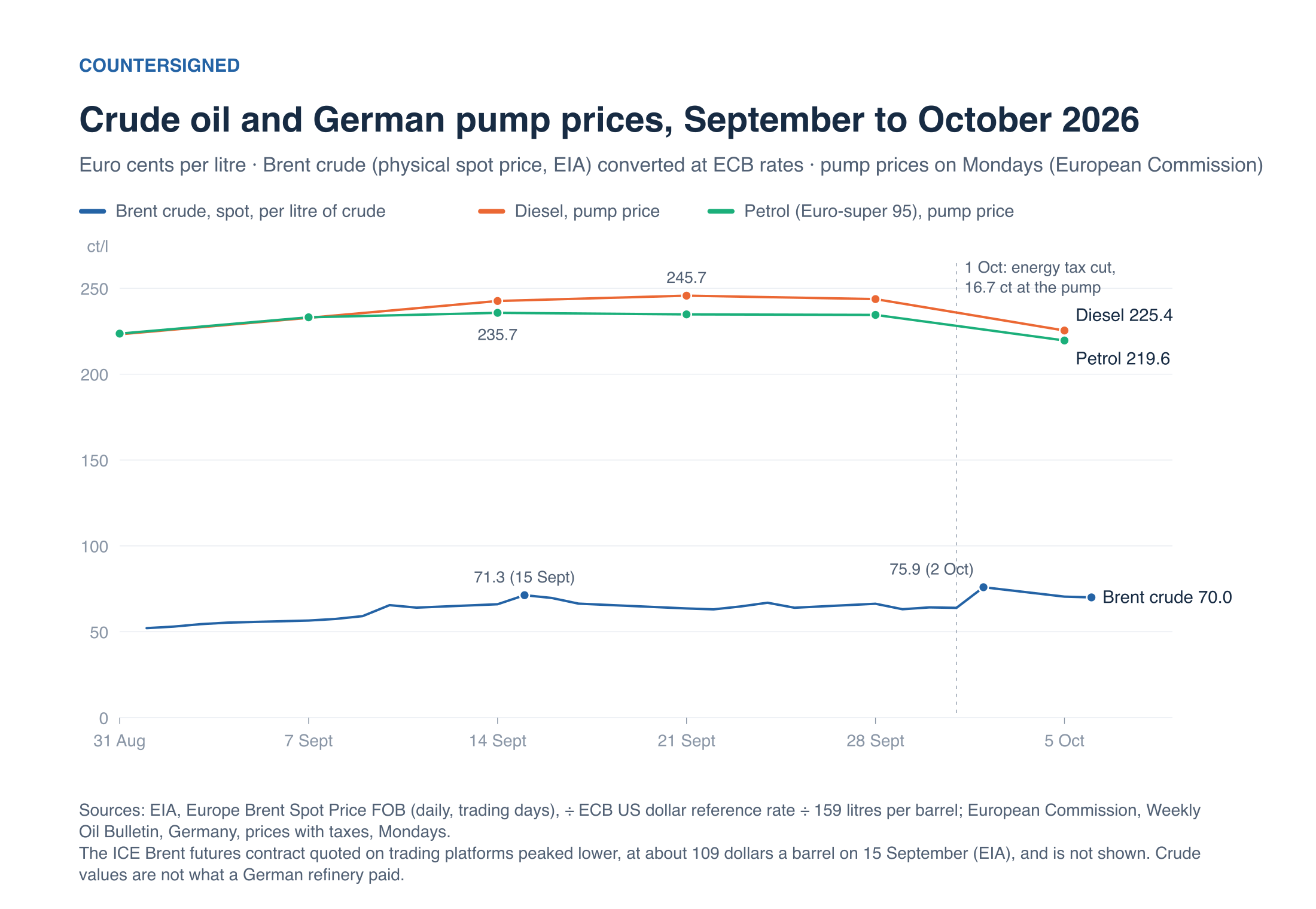
Whether crude explains the rise depends on the window. Over the quarter it does not: the Bundeskartellamt calculates that a litre of crude cost 0.498 euros on average in the third quarter, 2.7 cents less than in the second, while pump prices rose by 18 to 21 cents. S325 Within September it does, in part: between 31 August and the mid-September peak the regulator records rises of 14.8 cents per litre for petrol and 25.6 cents for diesel at the pump, of 11.5 and 22.7 cents at the refinery and wholesale level, and of about 9.1 cents for crude. S325 Diesel rose far more than petrol at every stage; section 4 takes this up.
The part of the price that is not tax. Removing 19 percent value added tax, the statutory energy tax and the Commission’s carbon-pricing component leaves the amount that pays for crude, refining, transport, station operation and the earnings of every business in the chain. For petrol it was 115.6 cents per litre on 7 September and 116.8 cents on 28 September; for diesel 132.4 and 141.6 cents. S08 S10 S09 On 5 October, with the reduced energy tax applied, it was 118.3 cents for petrol and 140.2 for diesel, and the share of the pump price going to public charges had fallen from 50.4 and 43.1 percent on 7 September to 46.1 and 37.8 percent. S08 S233 A caution: the Commission’s published “price without taxes” for Germany on 5 October still deducts the full energy tax, so it understates the business share of the October price by 14.04 cents; the figures above correct for this. S08 S09
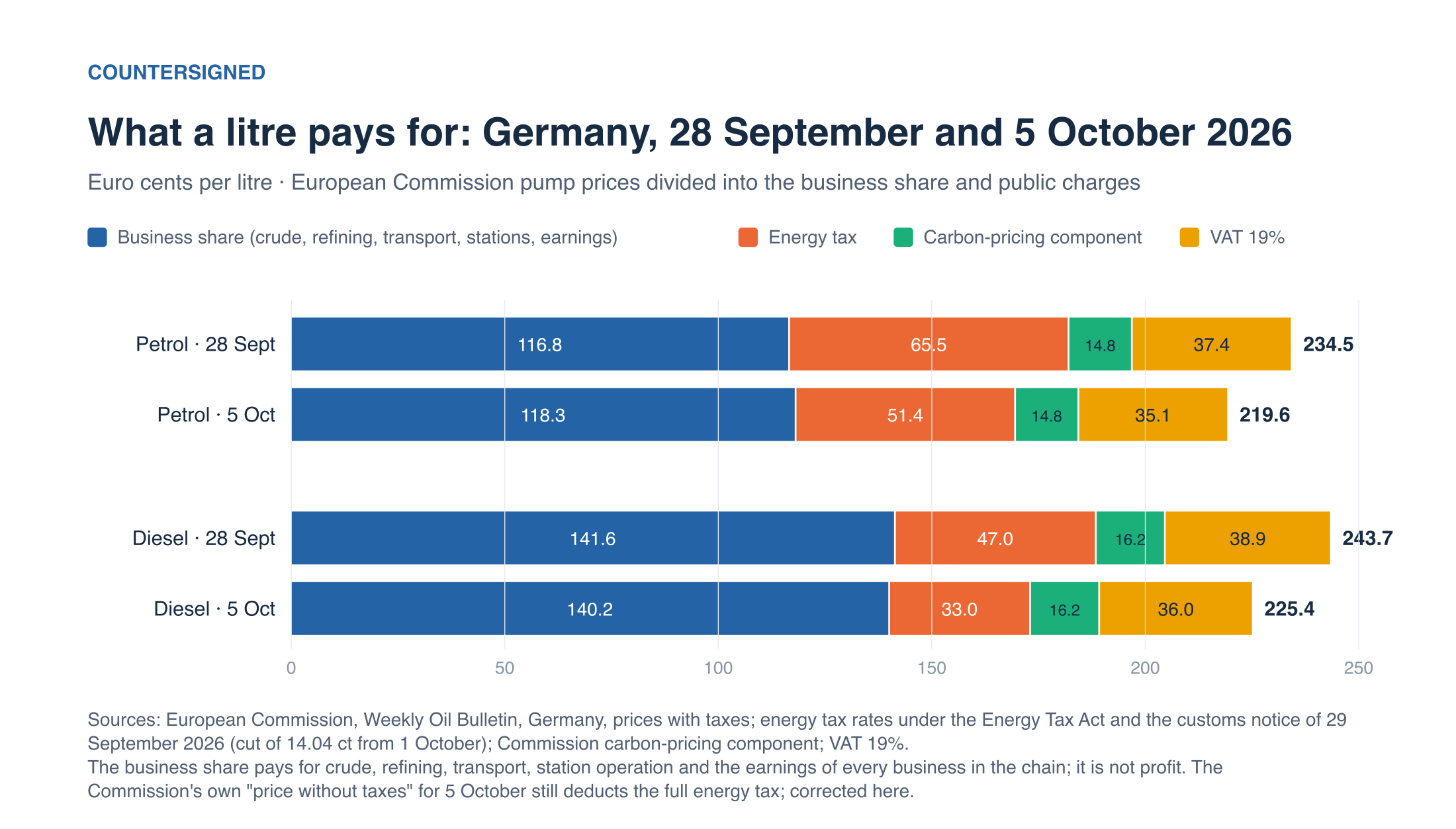
Across the European Union the weighted average was 2.043 euros per litre for petrol and 2.108 for diesel on 7 September, and 2.006 and 2.149 on 5 October. S08 Germany’s prices remain in the upper range; the regulator notes that “auch die Nettopreise ohne Steuern und Abgaben sind vergleichsweise hoch” (“the net prices without taxes and levies are also comparatively high”, translation), while adding that the gaps to some countries narrow considerably once taxes are removed. S302
2. Supply routes: the Gulf one month on
The September report described a Gulf oil trade cut off from its normal route. The Strait of Hormuz, the passage between Iran and the Arabian peninsula through which most Gulf oil normally leaves, carried 21.6 million barrels a day of crude and petroleum liquids in the last quarter of 2025 and 4.9 million in the second quarter of 2026, according to the EIA’s August outlook as reported by Hellenic Shipping News. S56 The month since then brought three developments at once: more oil left the region, the main bypass was attacked, and attacks on ships increased.
More oil, by other routes. The ship-tracking firm Kpler, cited by Reuters, counted crude exports from the Middle East above their pre-war average of about 18 million barrels a day on 14 days in September. These totals include oil shipped through Hormuz, via the Red Sea and by transfer between ships off Oman, and exclude vessels sailing with transponders switched off. S161 S160 Vortexa, a second tracking firm, put the 14-day average for crude and condensate (a light oil from gas fields) at 18.6 million barrels a day and attributed most of the increase to Saudi Arabia. S161 The strait itself carried far less than before the war: Kpler data reported by CNBC and relayed by Al Jazeera put crude through Hormuz at 8.5 million barrels a day in the week to 7 October, about 40 percent below normal. S178 Lloyd’s List Intelligence counted at least 477 transits by vessels not linked to Iran in September, the highest monthly number since the war began at the end of February. S48 The EIA assesses that Gulf production shut in by the closure, that is halted because it could not be exported, averaged 4.8 million barrels a day in September, down from 10.9 million at the May peak, and assumes 4.5 million for the fourth quarter. S40
The workarounds are expensive. Vortexa reported ship-to-ship transfers of about 6 million barrels a day since late August, each taking nearly ten days instead of five to seven, and war-risk insurance for a Hormuz transit, 0.15 to 0.25 percent of a ship’s value before the war, stood at between 3 and 10 percent after the strikes of late February, according to the broker Marsh. S158 S184 S183
The Saudi bypass was knocked out, then partly restored. The East–West pipeline carries crude from the eastern fields to Yanbu on the Red Sea and had become the main way around Hormuz. On the morning of 10 September it was hit by drones in the Riyadh and Medina regions; the Saudi Energy Ministry said on 11 September, as quoted by Al Jazeera, that “the pipeline was stopped as a precaution”, and the Foreign Ministry attributed the drones to Iraqi territory. S155 S154 Before the attack the line was moving more than 5 million barrels a day of exports, the EIA estimates, against a designed capacity of about 7 million. S40 S55 Flows partially resumed on 22 September, exports from Yanbu restarted after a 17-day halt, and on 28 September the line was reported to be running at about 3.5 million barrels a day by industry sources cited by a financial news aggregator; Saudi Aramco and the ministry did not disclose the rate. S40 S156 S52 Saudi crude exports through Hormuz rose to about 3.6 million barrels a day in September from about 0.9 million in August, according to Kpler, whose analyst Matt Smith told CNBC that the increase followed the pipeline outage and “likely also signals a greater confidence in using the Strait of Hormuz”. S156
Iran’s pressure on shipping increased. Between 28 September and 5 October at least 12 attacks, attempted attacks or harassment incidents against tankers and gas carriers were recorded in the strait, according to media counts compiled by Euronews, the highest weekly number since the war began on 28 February; Lloyd’s List Intelligence counted at least 13 attacks from 28 September. S179 S48 The United Kingdom Maritime Trade Operations centre (UKMTO), the Royal Navy’s liaison point for merchant shipping, reported at least one attack a day in the strait or the Gulf of Aden from 2 October. S161 On 9 October Iran’s Islamic Revolutionary Guard Corps claimed a strike on a gas carrier using what it called an unauthorised route and said that enforcement “would no longer be geographically limited to the waterway”. S180 S179 US Central Command reports that its blockade of Iranian ports, reimposed in mid-July, has turned around 135 ships and destroyed ten tankers linked to Iran. S178
What this means for prices. The EIA raised its forecast for the Brent spot price in the fourth quarter by 14 dollars to 105 dollars a barrel, explaining that “the attacks on the East-West pipeline in Saudi Arabia highlight the potential for continued volatility in physical oil flows” and that “extreme tightness in diesel markets” adds to crude demand. S40 The risk premium, the part of the price that pays for the chance of further disruption, is an estimate rather than an observation; no bank or institute estimate dated September or October was found. The seven OPEC+ countries with voluntary output adjustments met on 4 October and “decided to maintain September 2026 required production for November 2026”. S47
3. The United States–Russia diesel arrangement
On Friday 9 October 2026 President Trump wrote on his social-media platform, as quoted by the Associated Press and dpa, that, in a telephone call with President Putin, he had arranged for Russia to supply more than 300,000 tonnes of diesel “immediately”, a further 500,000 tonnes in November, one million tonnes “immediately thereafter” and three million tonnes “within a short period of time”. S257 S67 The same day the US Treasury’s Office of Foreign Assets Control (OFAC) issued General License No. 135, which authorises “all transactions … that are related to the sale, delivery, offloading, or importation, including importation into the United States, of diesel fuel of Russian Federation origin” until 12:01 a.m. eastern daylight time on 7 April 2027, but no debit to a US account of the Russian central bank, the National Wealth Fund or the Ministry of Finance. S59 S60
What the primary texts contain. There is no signed bilateral document. The Kremlin’s statement says that “the Russian side confirmed its willingness to supply oil and petroleum products to the US market and global markets at large”; the presidential aide Yury Ushakov spoke of “the preparation of large-scale economic initiatives, including possible supplies of Russian oil products”. Neither text mentions tonnages or dates; the figures appear in the Ushakov transcript only in a journalist’s question quoting Trump’s post. S145 S144 The White House had not responded to the Associated Press’s questions about who would pay for the diesel or when it would arrive, and no presidential order or fact sheet on the arrangement had appeared on the White House’s list of presidential actions, whose last entry at retrieval on 12 October was dated 7 October. S257 S73
Three obstacles stand between the announcement and deliveries. First, Russia’s own ban. On 30 September the Russian government extended its ban on diesel exports by producers to 31 October, with the ban for non-producers running to 31 January 2027, citing the domestic market and the harvest. S262 Two days earlier the Kremlin spokesman, Dmitry Peskov, had said that for international markets to be supplied “diesel must be able to reach them without barriers, that is, without any sanctions, restrictions, and so on”. S264 Second, a US statute. The Ending Importation of Russian Oil Act of April 2022 bans imports of Russian products classified under chapter 27 of the US tariff schedule, which includes diesel, and provides for its termination only by a presidential certification to Congress, subject to consultation and review periods, that Russia has, among other conditions, reached an agreement to withdraw its forces that Ukraine accepts. S266 The licence does not name this Act, and no primary text found explains how the two relate; the trade publication Ship & Bunker describes the licence as a “temporary executive waiver”. S59 S63 Third, quantity. The announced schedule adds up to 4.8 million tonnes. S63 The first two tranches, 800,000 tonnes or about 6 million barrels, are “about a day and a half worth of US demand”, CNN reported, citing the EIA; Dan Pickering of Pickering Energy Partners put the whole at “perhaps a 5%-6% increase in supply between now and year end” and “not a needle mover for global diesel markets”. Russia’s ban had cut roughly 800,000 barrels a day from the world market from July, according to the same report. S256
What it changes for Europe. Nothing in law. The European Union’s ban on seaborne imports of Russian refined products has applied since 5 February 2023; no change to it or to the price cap on services for Russian products sold to third countries was found in the sources held, and a US licence is not an EU legal act. S19 S63 S66 The Chancellor’s spokesman said that the government “holds to the sanctions decisions against Russia and is working with the European partners on further sanctions” (translation). S67 If Russian diesel does reach the world market, Europe would feel it only indirectly, through the global diesel balance that sets wholesale prices in Rotterdam; the only quantified assessments found describe the effect as small.
How to read the term “diesel deal”. The documents support the following description: a unilateral US sanctions licence valid for six months, an announced Russian supply schedule confirmed by Russia only as a “willingness”, and no change to the European embargo. Whether any cargo moves depends first on Moscow lifting its own export ban. For the period of this report the arrangement affected expectations rather than supply: diesel futures fell about 4 percent on the day of the announcement. S256
4. What happened to the October tax cut, and to margins
The cut. From 1 October to 31 December 2026 the German energy tax on petrol and diesel is reduced by 14.04 cents per litre, to 514.10 euros per 1,000 litres for petrol and 330.00 euros for diesel, the customs administration announced on 29 September; with value added tax the full effect at the pump is 16.7 cents per litre. S233 The Bundestag voted on 25 September and the Bundesrat approved the same day; the government puts the cost at about 2.5 billion euros, shared equally between the federal government and the Länder. S325 S93 S237 The energy tax is levied when fuel leaves the refinery or tax warehouse, so the cut lowers wholesale prices; it does not touch the price of crude, and nothing in the law obliges companies to pass it on. The president of the Bundeskartellamt, Andreas Mundt, appealed to the industry to pass it on “möglichst vollständig und schnell” (“as completely and quickly as possible”, translation) and added that “eine rechtliche Verpflichtung … besteht allerdings nicht” (“there is, however, no legal obligation”, translation). S325
How much reached the pump in the first week. The share of a tax cut that shows up in the pump price is called pass-through. The regulator’s monitoring unit recorded that prices fell by about 7 to 8 cents at midnight on 1 October, were more than 18 cents below the previous evening by early morning, and that daily averages for E5, E10 and diesel on 1 October were “knapp 13 Cent/Liter” (“just under 13 cents per litre”, translation) below those of 30 September. S325 The ADAC found on 7 October that E10 had fallen by 13.2 cents and diesel by 17.6 cents within a week and saw “eine deutlichere Lücke” (“a clearer gap”, translation) for E10 against the possible 17 cents. S171 The ifo Institute’s first estimate, reported by dpa, was that stations passed on 15 of the 17 cents for diesel, “gut 16” (“a good 16”, translation) cents for E5 and 15 cents for E10 in the first five days, with full pass-through on 1 October and a shortfall at the weekend; its tracker publishes weekly results from 14 October. S227 S228 The industry association en2x stated that “die Tankstellengesellschaften geben die Steuersenkung vollständig weiter” (“the station companies are passing the tax cut on in full”, translation) and that rising procurement costs work against the tax effect without removing it. S306 The methods differ: ifo compares German with French prices, the ADAC looks at German prices alone. S227
What the May–June cut taught. The same 14.04-cent cut applied from 1 May to 30 June 2026. The regulator estimated that 13.8 cents per litre (82.6 percent) reached diesel buyers and 13.0 cents (77.8 percent) reached E5 buyers over the whole period, that stations widened their average gross margin by almost 3.3 cents for diesel and 1.9 cents for E5 against the first quarter, and that the shortfall lay “eher auf der Preissetzung der Tankstellenebene als auf der des Großhandels” (“more in pricing at station level than at wholesale level”, translation). S303 The DIW estimates that “über 200 Millionen Euro” (“over 200 million euros”) of the roughly 1.6 billion euros stayed with the oil companies, with more of the shortfall in the final three weeks than in the first six. S215 UNITI, the federation of mid-sized energy traders, comparing German and French prices, found 99.8 percent pass-through for diesel and 98.9 percent for E5 in May and reads the two-month average as complete pass-through. S196 S195 The estimates differ in method and period: the regulator’s and the DIW’s follow the shortfall week by week, UNITI’s is a two-month average against French prices.
Margins: the diesel story. The Bundeskartellamt’s third-quarter report finds that the gap between wholesale and crude prices widened again from early July and reached “neue Höchststände” (“new highs”): 93.4 cents per litre for diesel on 16 September and 66.3 and 64.7 cents for E5 and E10 on 4 September, with the caution that such gaps are volatile and should be read over several days. S325 The European Central Bank’s experts estimated, as reported by Euronews, that refining costs and margins contributed 0.41 euros per litre to the euro-area diesel price in the third week of September, about 19 percent of the pump price, against 0.17 euros or 8 percent for petrol, and expected the diesel margin to peak in October; in February the monthly average had been 0.10 euros. S311 S230 The US EIA reports that distillate and jet fuel crack spreads, the difference between those fuels’ prices and crude, “almost tripled their year-ago levels” in the third quarter. S75
Three forces narrowed diesel supply at once. Russia’s export ban removed about 800,000 barrels a day from the world market from July (section 3). S256 The heating season began with heating oil, a close relative of diesel, at record prices: German producer prices for light heating oil were 65.3 percent above August 2025. S309 And the Rhine ran at record lows: the gauge at Kaub read 16 centimetres at 05:00 on 12 October against the previous record low of 25 centimetres in October 2018; in the third quarter barges could pass the Kaub narrows only with reduced loads or not at all, and the regulator records price differences of up to 11.9 cents (E5) and 10.3 cents (diesel) between regions, with the west dearer than the south. S317 S325 Shell lowered its third-quarter utilisation guidance to 93 to 97 percent, from 93 to 101 and against 102 percent in the second quarter, naming “Low Rhine water levels impacting Rheinland refinery utilisation”. S188
Rockets and feathers. Whether pump prices rise faster than they fall has been studied for Germany with conflicting results. Frondel, Horvath, Kihm and Vance, using daily prices from more than 5,000 stations, found the classic pattern before the price-transparency portal of 2013 and its reverse afterwards. S78 Asane-Otoo and Dannemann, using 12,804 stations for 2014 to 2018, concluded that “the pattern of rockets and feathers is the norm rather than the exception” and that averaging station data over time hides it. S79 S80 The ECB’s July blog notes that earlier euro-area studies were inconclusive but that “more recent work suggests that the pass-through could be slower on the way down”. S230 Five weeks of Monday observations cannot settle the question for 2026. They do show that the gap opened in September at the refinery and wholesale stage, not only at the pump, which is where the Bundeskartellamt’s proceedings are directed.
Competition oversight. The Bundeskartellamt’s proceedings against the operators of Germany’s refineries, running since the spring, continue; the authority is evaluating the companies’ answers to its information requests and has surveyed several hundred station operators covering more than 90 percent of the network. Mundt: “Ob tatsächlich ein kartellrechtlich relevanter Missbrauch vorliegt, werden die laufenden Verfahren dann zeigen.” (“Whether there is in fact an abuse relevant under competition law is something the pending proceedings will show”, translation.) S302 The government intends a fuel price cap on the Luxembourg or Belgian model, a regulated maximum price recalculated from wholesale quotations, by 1 January 2027, the economics ministry saying there would be no cap “um jeden Preis” (“at any price”); the regulator warns that a cap set too high could become “ein Orientierungspunkt für den Markt” (“a reference point for the market”) and one set too low could discourage supply; the industry rejects a cap. S237 S325 S305
5. State fuel subsidies in five countries
This report counts as a fuel subsidy any public measure that lowers the consumer price of fuel or compensates fuel costs: a tax cut, a per-litre rebate, a price cap or a direct payment. In October 2026 four of the five countries examined had such a measure in force or announced; Italy’s had just lapsed.
Germany: a tax cut. Energy tax on petrol and diesel reduced by 14.04 cents per litre (16.7 cents with VAT) from 1 October to 31 December 2026 (section 4). S233 S10 Cost about 2.5 billion euros, half each for the federal budget and the Länder; the May–June cut cost about 1.6 billion. S237 S215 S228 A price cap is planned for 1 January 2027.
Poland: a VAT cut, an excise cut, a daily price ceiling and a windfall tax to pay for them. The “Ceny Paliwa Niżej” (fuel prices down) package runs for the third time from 3 October to 31 December 2026. VAT on petrol and diesel is 8 percent instead of 23; excise is 1,239 złoty per 1,000 litres for petrol and 880 for diesel against 1,529 and 1,180 before the package, according to the Finance Ministry. S277 S278 S283 The Minister of Energy publishes a maximum retail price every day, calculated from the average wholesale prices of the largest suppliers plus taxes and a defined selling cost; the prices announced on 2 October for the start of the package were 6.73 złoty per litre for 95-octane petrol and 7.88 for diesel. S279 S285 The excise cut rests on an act of 18 September 2026 that introduces a windfall tax on fuel sellers: 60 percent of the revenue earned above a reference margin, which is the seller’s 2025 margin plus 20 percent and at least 2 percent, for March 2026 to March 2027. The act enters into force on 1 November; its authorisation for the excise cut applied from 2 October, the day after publication. S276 The Finance Ministry puts the cost of the reduced VAT at about 2.9 billion złoty for January to August and the combined effect of the package at about 4.7 billion; no official cost for the third edition had been published at the cutoff. S216 S283 S284
Austria: a tax cut tied to a margin order. For October 2026 the mineral oil tax is 415 euros per 1,000 litres for petrol and 330 for diesel, set by a finance ministry ordinance of 30 September under a new provision that allows a cut of up to 67 euros per 1,000 litres per month in October and November 2026. S240 S239 The tax ordinance applies only if the government also issues a price ordinance, and it did: from 1 October at noon suppliers must cut the net selling price of diesel and E10 by 3.5 cents per litre, may raise prices only in line with the previous day’s product quotations and must pass falls on, with daily reports to the regulator E-Control; motorway stations are exempt. S254 S252 Coalition speakers and the economics minister presented the package as a relief of about 12 cents per litre including VAT over October and November; the finance ministry puts the lost tax for October at “rund 55 Millionen Euro”. S248 S244
France: a targeted payment, not a per-litre cut. The “indemnité carburant” for workers who drive at least 15 kilometres to work or 8,000 kilometres a year, with a reference income of at most 16,880 euros per household unit of the French income-tax system, was raised from 50 to 100 euros by a decree of 28 May for April to September 2026. S290 S291 On 22 September the government announced a second payment of 100 euros for October to December, extended the eligible group from 3 million to up to 5.5 million people, raised the tax-free employer fuel bonus to 1,000 euros and prolonged aid for farmers (15 cents per litre of off-road diesel) and construction (20 cents) to 31 December; the minister for public accounts, David Amiel, put the additional measures at 450 million euros, and the economy ministry records a shortfall of 407 million euros in fuel-tax revenue to 20 September. S291 S292
Italy: a cut that expired. Excise cuts took effect on 19 March 2026, the day after a decree-law set the rate for petrol and diesel at 472.90 euros per 1,000 litres, down from 672.90 according to the consumer association Codacons, at an estimated cost of 417.4 million euros. S296 S106 Further decrees reduced and extended the measure; the last, published in the Gazzetta Ufficiale on 17 September, set diesel at 622.90 euros per 1,000 litres from 26 September to 5 October at a cost of 111.8 million euros. S297 The cut, worth 6.1 cents per litre at the end, expired at the end of 5 October; the ministerial decree meant to replace it had not appeared in the official gazette. S299
What the comparison shows. Per litre, the German and Austrian cuts (16.7 and about 12 cents including VAT) are smaller than Poland’s package: when its first edition started, pump prices fell by about 1.0 to 1.1 złoty per litre, or 13 to 14 percent, according to portal data cited by the Finance Ministry. S283 Only Poland and Austria pair the cut with a price instrument, and only Poland has legislated a tax on fuel sellers’ profits to finance it. France pays households rather than lowering the price. Italy let its cut lapse. Every measure is temporary, and every one ends on or before 31 December 2026.
6. Where subsidy money goes
A fuel tax cut is paid to the state by the companies that release fuel from refineries and tax warehouses, not to motorists; whether it reaches the pump is an empirical question, and “pass-through” is the share of the cut that shows up in the price motorists pay. Germany’s 2022 cut has been studied by several research teams, four of whose studies are cited here, and their results frame what can be expected of the current one.
The 2022 precedent. From 1 June to 31 August 2022 Germany cut fuel taxes by an amount worth 35.16 cents per litre at the pump for petrol and 16.71 cents for diesel, VAT included. S225 The ifo Institute’s first assessment, comparing German with French prices up to mid-June, found 100 percent pass-through for diesel and 85 percent for petrol; its Dresden branch, using five control countries over the whole three months, found that “Mineralölfirmen durchschnittlich 100% der Steuersenkung weitergegeben haben” (“oil companies passed on 100% of the tax cut on average”, translation), but not in the weeks just after the start and just before the end. S123 S15 Dovern and colleagues found complete pass-through for petrol and “at least partial pass-through” for diesel, declining in August. S117 The RWI’s Frondel, Thiel and Vance, with daily prices from virtually all German and French stations, found average pass-through of 87 percent for diesel and 71 percent for petrol, “dropping to 50% by the final month”, lower in high-income regions and where stations had few competitors, and calculated that about 61 percent of the relief went to households with above-median incomes; the cut cost about 3.1 billion euros. S225 S17
Two lessons follow. Averaged over the whole period, most studies find that most or all of the cut reached motorists; measured over time, the studies found the share lower towards the end of the period, and ifo Dresden also found a shortfall in the first weeks.
2026 so far. For May and June the regulator found 82.6 percent pass-through for diesel and 77.8 percent for E5, the DIW estimates that more than 200 million euros stayed with the companies, and the industry finds complete pass-through (section 4). For October the first week’s readings lie between 13 and 16 cents of the 16.7, with the gap largest for E10; the ifo tracker gives weekly estimates from 14 October. S303 S215 S195 S325 S227 S228
Who receives the relief. A per-litre cut follows consumption. The DIW calculates the value of three months of a 17-cent cut at 0 euros for a household without a car, about 27 euros for an average petrol car, 57 euros for a commuter driving 30 kilometres each way in a small car and 128 euros for a heavy driver in a large one, and concludes that “ein Tankrabatt verteilt damit von Haushalten ohne Pkw zu Haushalten mit hohem Kraftstoffverbrauch um” (“a fuel rebate thus redistributes from households without a car to households with high fuel consumption”, translation). S215 The RWI’s 61 percent for above-median incomes in 2022 points the same way. S225 Poland’s package is different in kind: a price ceiling reaches every buyer, and a tax on sellers’ excess margins is meant to pay for it (section 5).
The state’s own take. Value added tax is charged on the full pump price, so at 19 percent a 10-cent increase before VAT adds 1.9 cents of VAT. In April 2026 ZDF calculated from ADAC data that VAT per litre was 6.3 cents (petrol) and 9.6 cents (diesel) above the 2025 average and put the gross gain at more than 400 million euros a month, of which more than 100 million would be reclaimed by businesses entitled to deduct VAT, while only 47 percent of the additional VAT accrues to the federal budget; the Finance Ministry said its models showed no net federal gain from higher fuel prices. S229 The ministry’s report on August receipts shows VAT up 8.7 percent on a year earlier but states that the cash figures cannot be broken down by product; energy tax receipts, fixed per litre, were 13.4 percent lower, which the ministry attributes to the May–June cut reaching the accounts with a lag. S199 The ECB notes that euro-area excise duties fell about 8 percent from late February because of temporary cuts, most of which expired in June. S230 The net effect of high prices on German public finances cannot be established from the published figures; what is established is the gross cost of the cuts, 1.6 billion euros for May–June and about 2.5 billion for October–December. S215
7. Who gains, who loses
Revenue, margin, earnings and cash flow are different things. A margin is the difference between a selling price and a cost; earnings are what remains after all costs and tax; a government’s receipts rise with prices only where the tax is a percentage of the price. No figure below allocates a profit to a litre sold in Germany; the public accounts do not allow it.
Refiners and integrated oil companies. The third quarter was, by the companies’ own early indications, exceptional for refining. Shell told investors on 7 October that its indicative refining margin for July to September was 42 dollars a barrel against 24 in the second quarter, while guiding that marketing earnings would be lower and that utilisation would fall to 93 to 97 percent because of low Rhine water at its Rheinland refinery; full results follow on 29 October. S188 Repsol reported to the Spanish market regulator, according to the news site Democrata citing the filing, a refining margin indicator of 36.2 dollars a barrel, four times the 8.8 dollars of a year earlier, with Brent, which Repsol gives as the European reference, averaging 97.0 dollars in the quarter. S189 Equinor said, as reported by OilPrice.com, that its marketing, midstream and processing division would earn more than its 400 million dollar guidance, citing “unusually strong European refining margins”. S190 These are global, segment-level figures from companies with an interest in how prices are explained. They establish that refining was very profitable in the quarter; they do not establish how much of a German litre’s price was profit.
Producer states. Saudi Arabia’s Ministry of Finance reported oil revenue of 185.1 billion riyals for the second quarter of 2026, before the period studied here, 22 percent more than a year earlier, alongside a deficit of 34.3 billion riyals; its third-quarter report had not been published at the cutoff. S204 Russia’s federal budget took 5.471 trillion roubles from oil and gas in the first nine months of 2026, 17.2 percent less than a year earlier, according to the Finance Ministry as reported by Xinhua, which attributed the fall to a lower dollar exchange rate and higher compensation payments to domestic refineries; the ministry’s own pages could not be retrieved. S134 Russia’s fossil-fuel export revenue fell 8 percent month on month in August to 604 million euros a day, according to the think tank CREA as cited by The National. S259 For Russia, higher world prices did not translate into higher budget receipts, for the reasons its ministry gives.
Public budgets. Germany’s federal energy tax receipts were 13.4 percent lower in August 2026 than a year earlier; VAT receipts rose 8.7 percent, but the ministry states that the cash figures do not allow the effect of fuel prices to be separated (section 6). S199 The gross costs of the five countries’ measures are given in section 5.
Consumers and businesses that buy fuel. German consumer prices for fuels were 27.7 percent higher in August 2026 than a year earlier, with diesel up 6.4 percent on the month and petrol 2.1 percent; the September flash estimate put overall inflation at 3.3 percent and energy at 14.9 percent, with final figures due on 13 October. S34 S35 Euro-area energy inflation reached 18.8 percent in the September flash estimate. S207 For hauliers, the industry association BGL wrote to the Chancellor on 16 September that diesel had risen by about 60 cents a litre net since the escalation in the Middle East, adding 1,800 euros a month for a truck driving 10,000 kilometres and 1.08 million euros a year for a fleet of 50, and that a VAT cut gives businesses that reclaim the VAT they pay hardly any direct relief, because VAT is a pass-through item for them. S210 Whether hauliers can pass these costs to their customers was not established from a primary source.
Where the evidence is silent. No held source shows a loss at a German refinery or station in the period. The regulator’s May–June estimate that stations widened gross margins and the industry’s claim of full pass-through are the only evidence on retail; neither is a profit figure. Independent station operators may have fared differently from company-owned networks, but no disclosure allows that to be shown.
8. What to watch next
The indicators below are dated and sourced so that readers can check them; the scenarios are conditional statements, not forecasts, and no probability is attached to them.
Indicators
- 13 to 16 October: Destatis final September consumer prices (13), OPEC’s monthly report (13), the ifo tracker’s first weekly October estimate and the IEA’s monthly report (14), Eurostat’s full September inflation (16). S35 S228 S208
- 20 to 22 October: the Arbeitskreis Steuerschätzungen, Germany’s official tax-revenue forecasting group, meets. S221
- 28 to 30 October: Equinor (28), Shell and Repsol (29) and BP (30) publish third-quarter results, replacing the indications in section 7 with reported segment figures. S190 S188 S189 S141
- 31 October: Russia’s export ban for diesel producers expires unless extended; Austria’s October tax ordinance lapses. 1 November: the seven OPEC+ countries meet again. 30 November: the legal basis for an Austrian November cut ends. S262 S240 S47 S239
- 31 December: Germany’s energy tax cut and Poland’s current VAT and excise cuts end; Germany’s planned price cap is aimed at 1 January 2027. 7 April 2027: the US licence for Russian diesel expires. S233 S277 S237 S59
- Continuously: the Kaub gauge on the Rhine, the Commission’s weekly bulletin and UKMTO incident reports. S317 S29
Conditional scenarios
- If Russia relaxes its diesel export ban and cargoes move under the US licence, the global diesel balance eases at the margin; the only quantified estimates put the effect at a few percent of supply, and Europe would feel it only through Rotterdam wholesale prices. S256
- If attacks on shipping continue at the late-September rate or the Saudi pipeline is hit again, the EIA’s assumption of a gradual recovery of Gulf exports behind its 105-dollar fourth-quarter forecast fails and prices stay higher for longer. S40
- If the German cut expires on 31 December as legislated, the experience of 1 July suggests a jump of the order of the tax change: the regulator recorded increases of 16.9 cents for petrol and 19.1 cents for diesel between 28 June and 1 July. S303
- If diesel refining margins peak in October as the ECB’s experts expected and then fall, the pre-tax diesel price would fall faster than crude; whether the pump price follows at the same speed is the asymmetry question of section 4. S311
An update is planned after the company results and the regulator’s next quarterly report.
9. Method, evidence limits and sources
Scope and cutoff. This report covers 10 September to 12 October 2026, with Germany as the price anchor and Poland, France, Italy and Austria as comparison countries. The evidence cutoff is 12 October 2026, the date of the last data retrieval; observations carry their own dates. The September report provides the background on how a litre’s price is built and is not repeated.
How the evidence was gathered. Every source cited was downloaded once into the case file and read from that copy, with hash and retrieval time recorded; 283 of 325 registered sources are held locally. Sources that refused automated retrieval, among them the Federal Law Gazette, the Bundestag’s document server and the Russian Finance Ministry, are recorded as such and not cited as read; a mirror, a customs notice or a press-agency account stands in, and the text says so. Figures from the Commission’s Weekly Oil Bulletin, the EIA’s daily series and the ECB’s exchange rates were extracted from the published files and recomputed; the Commission’s German “price without taxes” for October was corrected for the tax cut it had not yet applied (section 1).
What the data can and cannot show. Two Brent series are used and named each time; neither is the price a German refinery paid. Weekly Monday observations cannot show daily pass-through; the regulator’s and the ifo Institute’s daily analyses are quoted for that. Margins are differences between prices at successive stages and are never called profit; company figures are global, segment-level and partly indicative. Pass-through estimates depend on method and period and are presented side by side rather than averaged. Counts of attacks on shipping come from a commercial intelligence service and media compilations; the primary UKMTO notices were not retrievable. Press accounts are used where they carry an official statement or a named analyst’s figure, and are marked as such.
Interests. Oil companies, industry associations (en2x, UNITI, BGL), the ADAC, producer states and governments all have an interest in how fuel prices are explained; their statements are attributed, not adopted. The Bundeskartellamt’s proceedings against refinery operators were pending at the cutoff, and no finding of unlawful conduct is made or implied.
Review and AI use. Research, retrieval, calculations, drafting, translation and figures were carried out with AI assistance (Claude Code). Each material statement was registered with its source and locator and checked against the local copy by a separate AI agent before the text was finalised; the register and the verification record are kept in the case file. Editorial review and release are by the publisher, Łukasz Ostrowski. No external or independent specialist review takes place for this publication, and none is pending. No company, government or expert was contacted. Translations of quotations were made with AI assistance under the publisher’s responsibility and are labelled.
Sources. The list below gives every source cited, with the passage, table or page relied on. Numbers missing from the sequence belong to sources retrieved for the research but not cited.
Sources and exact reference points
All sources were retrieved between 12 September and 12 October 2026 and read in the copies held in the case file; the retrieval date of each is recorded in the register. Each entry names the publisher and the passage, table or page relied on.
-
S01 · eia.gov — EIA Today in Energy: daily prices (crude, products, crack spreads). updated daily; snapshot at retrieval. Official daily price table; snapshot, not an average.
-
S02 · eia.gov — EIA Europe Brent spot price FOB, daily. updated weekly. Official daily spot series.
-
S03 · eia.gov — EIA Cushing WTI spot price FOB, daily. updated weekly. Official daily spot series.
-
S08 · energy.ec.europa.eu — EC Weekly Oil Bulletin: prices history 2005 to date. weekly. Official weekly history; basis of the September report’s weekly series.
-
S09 · energy.ec.europa.eu — EC Oil Bulletin: duties and taxes file. irregular. Excise, VAT and other indirect tax entries by country.
-
S10 · gesetze-im-internet.de — EnergieStG section 2: energy tax rates. consolidated text. Statutory rates for petrol and diesel.
-
S15 · ifo.de — ifo Dresden berichtet 5/2022: Tankrabatt pass-through 2022. 2022. Full-period 2022 pass-through estimate with method.
-
S17 · rwi-essen.de — RWI press release 2024: Weitergabe des Tankrabatts 2022. 2024. 87% diesel and 71% E10 over the 2022 relief period; regional variation.
-
S19 · ec.europa.eu — Eurostat: Imports of energy products down in Q1 2023 (embargo dates). 4 July 2023. EU embargo dates on Russian crude (5 Dec 2022) and products (5 Feb 2023).
-
S22 · ecb.europa.eu — ECB euro reference exchange rates: daily history (CSV in zip). updated daily. Official daily USD per EUR reference rates.
-
S29 · energy.ec.europa.eu — EC Weekly Oil Bulletin landing page. updated weekly. Lists the current weekly files and their dates.
-
S30 · presse.adac.de — ADAC press release: Benzin und Diesel erreichen im September Hoechstwerte. 1 October 2026. September 2026 monthly averages for E10 and diesel.
-
S31 · presse.adac.de — ADAC press release: Benzin und Diesel etwas guenstiger. about 30 September 2026. Weekly ADAC price statement before the 1 October tax cut.
-
S34 · destatis.de — Destatis press release 320: consumer prices August 2026. 10 September 2026. Official CPI with fuel component for August 2026.
-
S35 · destatis.de — Destatis press release 348: inflation rate September 2026, flash estimate. 30 September 2026. Flash estimate with energy component.
-
S40 · eia.gov — EIA Short-Term Energy Outlook, October 2026 (PDF). October 2026. Official outlook with Gulf disruption, shut-in volumes and Brent forecast.
-
S47 · opec.org — OPEC press release, 4 October 2026: seven countries reaffirm production levels. 4 October 2026. Primary OPEC+ decision for November 2026.
-
S48 · lloydslistintelligence.com — Lloyd’s List Intelligence: Strait of Hormuz brief, 8 October 2026. 8 October 2026. Named tanker-tracking transit counts with dates.
-
S52 · roic.ai — Roic.ai: Saudi Arabia restarts key oil route as Yanbu loadings resume. 28 September 2026. Dated throughput figures for East-West pipeline restart.
-
S55 · tribune.com.pk — Express Tribune: Saudi East-West pipeline precautionary shutdown. 12 September 2026. Quotes Saudi Energy Ministry statement on drone attack and shutdown.
-
S56 · hellenicshippingnews.com — Hellenic Shipping News: EIA raises Brent outlook on Hormuz constraints (August STEO relay). 11 August 2026. Relays EIA Q2 2026 Hormuz flow figures.
-
S59 · ofac.treasury.gov — OFAC general licence on Russian-origin diesel (PDF). October 2026. Primary text of the licence implementing the announced arrangement.
-
S60 · ofac.treasury.gov — OFAC recent actions. updated continuously. Official listing of licences and actions by date.
-
S63 · shipandbunker.com — Ship & Bunker: US lifts sanctions on Russian diesel for six months after Trump-Putin call. 9 October 2026. Licence designation, exclusions, EU and UK context.
-
S66 · diplomacyandlaw.com — Diplomacy and Law: Trump-Russia diesel deal, legal analysis. 9-10 October 2026. Argues the licence does not repeal the statutory import ban.
-
S67 · infranken.de — inFranken: Trump kuendigt grosse Diesellieferungen aus Russland an. 9 October 2026. German-language account for the DE edition.
-
S73 · whitehouse.gov — White House: presidential actions index. updated continuously. Check for any presidential action on Russian diesel.
-
S75 · eia.gov — EIA Today in Energy: refinery margins update (id 68245). 2026. EIA analysis of Q3 2026 refining margins.
-
S78 · rwi-essen.de — RWI publication page: Increased market transparency in Germany’s gasoline market. 2019. Institutional record and PDF link.
-
S79 · ideas.repec.org — Asane-Otoo and Dannemann: Rockets and feathers in the German retail fuel market (The Energy Journal 43(6)). 2022. Counter-evidence: asymmetry remains the norm 2014-2018.
-
S80 · ideas.repec.org — Asane-Otoo and Dannemann: working paper version. pre-2022. Open working paper of the above.
-
S93 · verkehrsrundschau.de — Verkehrsrundschau: Tankrabatt 2026 beschlossen, bis zu 17 Cent weniger pro Liter. 26 September 2026. Per-litre effect of the October-December cut.
-
S106 · avvenire.it — Avvenire: Dl carburanti in Gazzetta, taglio accise in vigore (DL 33/2026). 18 March 2026. First Italian excise cut and cost.
-
S117 · ideas.repec.org — Dovern, Frank, Glas, Mueller, Perico Ortiz: Estimating pass-through rates for the 2022 tax reduction on fuel prices in Germany (Energy Economics 126). 2023. Peer-reviewed 2022 pass-through estimate.
-
S123 · ifo.de — ifo: Oelkonzerne geben Tankrabatt zu 85 bis 100 Prozent weiter. 2022. ifo summary of Fuest, Neumeier, Stoehlker 2022.
-
S134 · thestar.com.my — The Star / Xinhua: Russia’s oil and gas revenues fall 17.2 pct in Jan-Sept. 10 October 2026. September 2026 oil and gas revenue.
-
S141 · bp.com — BP: investors page. updated. Q3 2026 trading statement expected mid-October.
-
S144 · en.kremlin.ru — Kremlin: Comment by Aide to the President Yury Ushakov following Vladimir Putin’s telephone conversation with US President Donald Trump. 9 October 2026. Russian-side primary readout of the call.
-
S145 · en.kremlin.ru — Kremlin: Statement by President of Russia Vladimir Putin. 9 October 2026. Putin statement on the day of the call.
-
S154 · aljazeera.com — Al Jazeera: Saudi Arabia says East-West pipeline hit by drones launched from Iraq. 11 September 2026. Relays the Energy Ministry statement (pipeline stopped as a precaution) and the Foreign Ministry statement (drones from Iraq).
-
S155 · okaz.com.sa — Okaz: Energy Ministry source on the attack on the East-West pipeline (Arabic). 11 September 2026. Fixes the attack as the morning of Thursday 10 September 2026 in the Riyadh and Medina regions.
-
S156 · hellenicshippingnews.com — Hellenic Shipping News: Saudi Arabia resumes Yanbu oil exports after pipeline repair. 29 September 2026. Shipments resumed after a 17-day halt; Kpler via CNBC: Saudi crude via Hormuz 3.6 mb/d in September vs about 0.9 in August; Aramco and ministry did not disclose the rate.
-
S158 · gcaptain.com — Reuters via gCaptain: Gulf of Oman ship-to-ship oil transfers reach limit as Saudi exports surge. 25 September 2026. Kpler (Panagiotis Krontiras): Saudi via Hormuz 3.6 mb/d in September; Vortexa (Emma Li): STS about 6 mb/d since late August; Aramco sold more than 60 million bbl for STS off Sohar; VLCC rate USD 1.27 million per day (LSEG).
-
S160 · aljazeera.com — Reuters via Al Jazeera: Middle East oil exports surpass pre-war levels despite tensions, data shows. 5 October 2026. Kpler: pre-war average 18 mb/d (Mar 2025-Feb 2026); 19.5-22.5 mb/d on 24 and 27-29 September; crude 18.5 mb/d on 1 October; IRGC’s Fadavi claims 3-4 mb/d; UKMTO at least one attack a day since 2 October.
-
S161 · gcaptain.com — Reuters (Florence Tan) via gCaptain: Middle East oil exports top pre-war levels for part of September but tanker attacks increase. 5 October 2026. Kpler 7-day average 18.3 mb/d on 30 September, above pre-war on 14 days in September; Vortexa (Xavier Tang) 14-day average 18.6 mb/d, increase mostly from Saudi Arabia.
-
S171 · presse.adac.de — ADAC press release: Tankrabatt nicht vollstaendig weitergegeben. 7 October 2026. E10 2.126 (-13.2 ct w/w), diesel 2.233 (-17.6 ct); Brent about USD 100 at previous close.
-
S178 · aljazeera.com — Al Jazeera: Hormuz attacks intensify as efforts to end war on Iran stall. 11 October 2026. IRGC claims; CENTCOM tallies (135 ships turned around, 10 Iran-linked tankers destroyed since mid-July); Kpler 8.5 mb/d crude transit week to 7 October, about 40% below normal; talks deadlocked.
-
S179 · euronews.com — Euronews: Iran’s IRGC strikes tanker and threatens to target vessels beyond Hormuz. 9 October 2026. IRGC claim of hitting MV Sun Shine; UKMTO reports 8-9 October; 12 incidents 28 September to 5 October.
-
S180 · tehrantimes.com — Tehran Times: IRGC reports fire aboard LPG carrier in Strait of Hormuz, warns against unauthorized transit. 9 October 2026. Iranian-side account of the IRGC Navy statement.
-
S183 · insurancebusinessmag.com — Insurance Business: Trump says Hormuz is clear, the insurance market disagrees. 26 August 2026. War-risk premium 3-8% of hull value (Marsh 3-10% peak; pre-war about 0.25%).
-
S184 · insurancebusinessmag.com — Insurance Business Asia: Hormuz war-risk rates face fresh pressure as Iran-US clashes resume. 2 September 2026. Marsh (Marcus Baker) 3-10%; pre-war 0.15-0.25%.
-
S188 · shell.com — Shell plc: Q3 2026 quarterly update note (PDF). 7 October 2026. Primary tables: indicative refining margin, utilisation, marketing guidance.
-
S189 · democrata.es — democrata.es: Repsol multiplies its refining margin by four in the third quarter to USD 36.2 per barrel. 6 October 2026. Repsol Q3 2026 refining margin indicator USD 36.2/bbl vs 8.8 a year earlier.
-
S190 · oilprice.com — OilPrice.com: Europe’s fuel squeeze is turning into a Q3 windfall for Equinor. 7 October 2026. Equinor expects MMP result above guidance on strong European refining margins; results 28 October.
-
S195 · uniti.de — UNITI Pressemitteilung: Bilanz Tankrabatt. 30 June 2026. Industry association’s own pass-through analysis for May-June 2026.
-
S196 · uniti.de — UNITI Pressemitteilung: Weitergabe Tankrabatt. 1 June 2026. Industry claim of 99.8% diesel and 98.9% E5 pass-through in May.
-
S199 · bundesfinanzministerium.de — BMF Monatsbericht September 2026: Steuereinnahmen im August 2026. September 2026. August 2026 energy tax and VAT receipts.
-
S204 · mof.gov.sa — Saudi Ministry of Finance: quarterly budget performance report Q2 FY2026 (PDF). 2026. Primary behind the Q2 oil revenue figure.
-
S207 · ec.europa.eu — Eurostat: Euro area annual inflation up to 3.8% (September 2026 flash). 2 October 2026. Flash HICP September 2026: euro area 3.8%, energy 18.8%; Germany 3.3%, Italy 4.1%, France 3.4%.
-
S208 · ec.europa.eu — Eurostat: Euro area annual inflation up to 3.2% (August 2026 final). 17 September 2026. August final: energy 14.3%.
-
S210 · bgl-ev.de — BGL: Offener Brief an den Bundeskanzler zur Dieselpreisexplosion (PDF). 16 September 2026. Cost figures per truck and fleet as attributed by press.
-
S215 · diw.de — DIW aktuell 125 (PDF). 21 September 2026. PDF of the same paper.
-
S216 · gov.pl — Ministerstwo Finansow: szacunkowe wykonanie budzetu panstwa styczen-sierpien 2026. 15 September 2026. VAT revenue Jan-Aug 218.8 bn PLN; cost of the fuel VAT cut Jan-Aug about 2.9 bn PLN; CPN excise and VAT effect about 4.7 bn PLN.
-
S221 · bundesfinanzministerium.de — BMF: Steuerschaetzungen und Steuereinnahmen (index). rolling. 171st Steuerschaetzung meeting 20-22 October 2026.
-
S225 · rwi-essen.de — Frondel, Thiel, Vance: Heterogeneous pass-through over space and time, the case of Germany’s fuel tax discount (Ruhr Economic Papers 1087, PDF). 2024. Study behind the 2024 RWI release: 87% diesel, 71% petrol; about 50% in the last month; 61% of relief to above-median incomes.
-
S227 · infranken.de — inFranken (dpa): ifo, Tankrabatt bisher nur teilweise weitergegeben. 7 October 2026. First ifo read of the October cut: diesel 15 of 17 ct, E5 almost 16 ct, E10 15 ct in five days.
-
S228 · ifo.de — ifo Tankrabatt-Tracker (web page). updated weekly from 14 October 2026. Publisher of record for the October 2026 pass-through tracker.
-
S229 · zdfheute.de — ZDFheute: Mehrwertsteuer, profitiert der Staat von hohen Kraftstoffpreisen?. 20 April 2026. Only quantified VAT estimate found: extra VAT 6.3 ct/l petrol, 9.6 ct/l diesel (ZDF from ADAC data); ZDF calculation over EUR 400 m a month gross; BMF says no net gain.
-
S230 · ecb.europa.eu — ECB blog: From well to pump, how fuel prices are formed. 31 July 2026. Euro-area excise cuts and VAT in pump prices; margin contributions; pass-through from crude is fast and complete in levels.
-
S233 · zoll.de — Zoll Fachmeldung: Voruebergehende Senkung der Energiesteuer (1 October to 31 December 2026). 29 September 2026. Publisher of record for the reduced rates 514.10 and 330.00 EUR per 1000 l; exclusions under sections 47a and 56 EnergieStG.
-
S237 · zdfheute.de — ZDFheute: Tankrabatt ab 1. Oktober, Bundesregierung gibt gruenes Licht. 22 September 2026. About EUR 2.5 bn total, split half Bund and half Laender; Spritpreisdeckel aimed for 1 January 2027.
-
S239 · ris.bka.gv.at — RIS: BGBl. I Nr. 82/2026 (signed PDF). 30 September 2026. Authentic text of the act.
-
S240 · ris.bka.gv.at — RIS: BGBl. II Nr. 289/2026, Treibstoffpreisabfederungsverordnung Oktober 2026 (signed PDF). 30 September 2026. Authentic ordinance text: petrol 415 and diesel 330 EUR per 1000 l for October 2026.
-
S244 · bmf.gv.at — BMF Oesterreich: WFA Treibstoffpreisabfederungsverordnung Oktober 2026 (PDF). October 2026. Impact assessment stating the fiscal cost.
-
S248 · parlament.gv.at — Parlamentskorrespondenz PK0874: Nationalrat gibt gruenes Licht fuer erweiterte Spritpreisbremse. 28 September 2026. Debate record: 6.7 ct tax cut, 3.5 ct margin cap, up to 12 ct combined; inflation-dampening estimate.
-
S252 · bundeskanzleramt.gv.at — Bundeskanzleramt: Ministerratsvortrag 64/16 MRV, Verordnung zur Margenbegrenzung bei Treibstoffen (PDF). 29-30 September 2026. Cabinet paper on the margin ordinance (3.5 ct/l from 1 October).
-
S254 · ris.bka.gv.at — RIS: BGBl. II Nr. 288/2026 (signed PDF). 30 September 2026. Probably the Preisgesetz margin ordinance for October.
-
S256 · kioncentralcoast.com — CNN via KION: Trump deal for Russian diesel sparks anger in Ukraine and doubts among analysts. 9 October 2026. Named analysts: Dan Pickering (5-6% supply increase, ‘not a needle mover’), Gregory Brew, Richard Nephew; Zelensky quotes.
-
S257 · fortune.com — Fortune (AP): Trump says US to get diesel from Russia. 9 October 2026. AP text with Treasury and White House passages (readable copy; the AJC copy S61 is partly scrambled).
-
S259 · thenationalnews.com — The National: Trump lifts US sanctions on Russian diesel amid price surge. 9 October 2026 (updated 11 October). Licence carve-outs; Schumer and Beyer criticism; CREA data.
-
S262 · interfax.com — Interfax: Russia extends diesel export ban for producers to 31 October. 30 September 2026. Producers’ diesel export ban extended to 31 October 2026; non-producers to 31 January 2027.
-
S264 · hellenicshippingnews.com — Hellenic Shipping News (Platts, TASS): Russia says sanctions should be lifted for it to satisfy international diesel demand. 28 September 2026. Peskov: diesel must reach markets without sanctions or restrictions.
-
S266 · congress.gov — Congress.gov: Ending Importation of Russian Oil Act, Public Law 117-109 (text). 8 April 2022. Section 2 import ban on chapter 27 products; section 3 termination procedure.
-
S276 · api.sejm.gov.pl — Dz.U. 2026 poz. 1287: ustawa o podatku od nadzwyczajnych zyskow ze zbycia paliw cieklych (text PDF). 1 October 2026. Text of the windfall-tax act.
-
S277 · api.sejm.gov.pl — Dz.U. 2026 poz. 1288: rozporzadzenie MFiG z 2.10.2026 zmieniajace rozporzadzenie w sprawie obnizonych stawek VAT (text PDF). 2 October 2026. VAT 8% on fuels 3 October to 31 December 2026.
-
S278 · api.sejm.gov.pl — Dz.U. 2026 poz. 1289: rozporzadzenie MFiG z 2.10.2026 w sprawie obnizenia stawek akcyzy na niektore paliwa silnikowe (text PDF). 2 October 2026. Excise PLN 1,239 per 1000 l petrol and 880 diesel, 3 October to 31 December 2026.
-
S279 · api.sejm.gov.pl — Monitor Polski 2026 poz. 964: obwieszczenie Ministra Energii z 2.10.2026 w sprawie maksymalnej ceny paliw (text PDF). 2 October 2026. Maximum prices 6.73 / 7.59 / 7.88 PLN per litre.
-
S283 · api.sejm.gov.pl — Ministerstwo Finansow: odpowiedz na interpelacje 18392 (wplywy VAT, koszt CPN), 30 July 2026 (PDF). 30 July 2026. VAT cost 31 March to 30 June about PLN 2,947 m; excise effect PLN 0.7-0.8 bn a month.
-
S284 · api.sejm.gov.pl — Ministerstwo Energii: odpowiedz na interpelacje 3587 (laczny koszt CPN), 3 August 2026 (PDF). 3 August 2026. Excise cost about PLN 1.825 bn (30 March to 15 June); VAT about PLN 2,947 m.
-
S285 · api.sejm.gov.pl — Ministerstwo Energii: odpowiedz na interpelacje 16089 (bezpieczenstwo paliwowe, CPN), 6 June 2026 (PDF). 6 June 2026. How the maximum price is set; excise cut 28-29 gr/l.
-
S290 · fhf.fr — Decret no 2026-417 du 28 mai 2026 modifiant le decret no 2026-333 (indemnite carburant), JORF 30 mai 2026 (FHF mirror PDF). 30 May 2026. Amount raised from EUR 50 to 100; eligibility RFR per part up to EUR 16,880.
-
S291 · connaissancedesenergies.org — Connaissance des energies (AFP): Carburants, l’aide aux grands rouleurs prolongee et elargie. 23 September 2026. 22 September announcement: up to 5.5 million beneficiaries; David Amiel gives EUR 450 m for the additional measures.
-
S292 · economie.gouv.fr — economie.gouv.fr: video, les mesures d’aide et de soutien face a la hausse des prix des carburants. 22 September 2026. Government page on the aid measures.
-
S296 · certifico.com — Decreto-legge 18 marzo 2026, n. 33 (Gazzetta Ufficiale n. 64), copy hosted by Certifico. 18 March 2026. Art. 2: excise 472.90 EUR per 1000 l; cost EUR 417.4 m 2026.
-
S297 · gazzettaufficiale.it — Gazzetta Ufficiale: decreto-legge 17 settembre 2026, n. 162, art. 1. 17 September 2026. Diesel excise 572.90 (18-25 September) and 622.90 EUR per 1000 l (26 September to 5 October); costs.
-
S299 · open.online — Open: Niente accise mobili, da oggi il gasolio costa 6 centesimi in piu al litro. 6 October 2026. Discount ended; the MEF-MASE decree for accise mobili did not appear; Eni caps; station adoption.
-
S302 · bundeskartellamt.de — Bundeskartellamt Pressemitteilung: Kraftstoff-News Sonderausgabe zu den Kraftstoffpreisen im August 2026. 8 September 2026. Publisher-of-record page behind S14.
-
S303 · bundeskartellamt.de — Bundeskartellamt Pressemitteilung: Quartalsbericht MTS-K Q2/2026. 10 July 2026. Press release with S13: pass-through 82.6% diesel, 77.8% E5; station margins; 12-Uhr-Regel.
-
S305 · en2x.de — en2x Pressemitteilung: Branche lehnt Preisdeckel ab. 21 September 2026. Industry rejection of the planned price cap; Frontier Economics study cited.
-
S306 · en2x.de — en2x Pressemitteilung: Energiesteuer auf Benzin und Diesel wird gesenkt. 30 September 2026. Industry says the cut is passed on in full; rising procurement costs offset part.
-
S309 · destatis.de — Destatis press release 328: Erzeugerpreise im August 2026. 18 September 2026. Producer prices: light heating oil +65.3%, fuels +37.7% year on year.
-
S311 · de.euronews.com — Euronews Deutsch: Rekordpreise fuer Kraftstoff in der EU, EZB sieht Diesel-Margen im Oktober auf Hoechststand. 19 September 2026. Euro-area margin contribution about 0.41 EUR/l diesel (19% of pump price) and 0.17 petrol in third week of September; ECB expects diesel peak in October.
-
S317 · elwis.de — ELWIS: Pegel Kaub (live gauge page). snapshot 12 October 2026. Primary gauge reading (16 cm at 05:00 on 12 October).
-
S325 · bundeskartellamt.de — Bundeskartellamt Kraftstoff-News Q3/2026 (MTS-K), PDF. 2 October 2026. Full PDF of the Q3/2026 report; S168 holds only the landing page.