Evidence dossier of the Countersigned report “Sanctions against Russia since 2022”. It holds the full text checked sentence by sentence against stored sources on 19 October 2026, with every figure and source; the main report draws on it. It is not written for continuous reading.
Key findings
- Sanctions raised Russia’s costs without ending the war, and the evidence held supports no single figure for their cost to the West. Russia’s 2025 output matched the IMF’s pre-war forecast. Europe’s largest cost, in 2022, followed Russia’s own gas cuts (sections 7–9).
- The EU adopted 21 numbered packages and, on 12 October 2026, 1,569 listings that the Council does not number. Seaborne crude was banned from December 2022; pipeline gas was not sanctioned, but an energy and trade law of 2026 phases out Russian gas by 2027. Rosatom as a company, pipeline crude for Hungary and Slovakia, and food and fertilisers remain outside sanctions or only partly covered (section 3).
- Coalition states kept paying Russia, at a steeply falling rate. EU imports of Russian mineral fuels fell from EUR 104.0 billion in 2021 to EUR 17.4 billion in 2025. Customs data record almost no Russian gas for Germany and Austria, although CREA attributes large gas revenue to them. Russia supplied 25.8 per cent of US reactor owners’ enrichment purchases in 2025 (sections 5, 12).
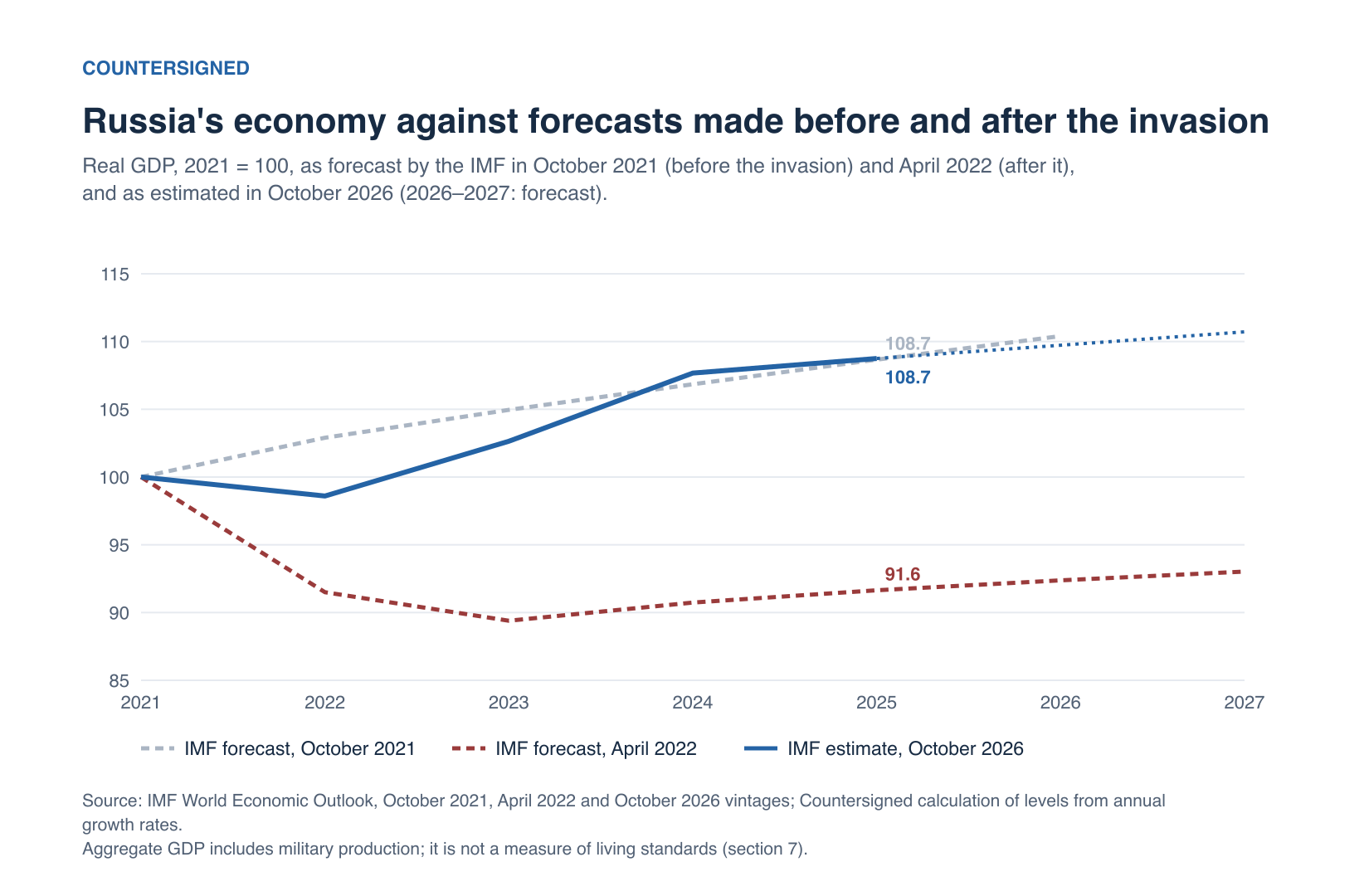
- Russia’s economy did not collapse; sanctions act through oil discounts, dearer imports and restricted technology. Output fell by 1.4 per cent in 2022, not by the 8.5 per cent the IMF expected; growth in 2023–2024 came largely from war spending. Budget oil and gas revenue follows mainly the oil price and the rouble, in this report’s judgment (section 7).
- Russia treats sanctions relief as a bargaining item, but the held record links no change in its war aims to sanctions (moderate confidence) (section 8).
- Europe’s 2022 energy shock followed Russia’s own pipeline cuts; the part played by sanctions cannot be isolated. In 2022 the European wholesale gas price (TTF) averaged 4.9 times its 2010–2019 level. GDP in 2025 was 9.8 per cent below the pre-war forecast in Slovakia and 7.2 per cent in Germany, gaps that combine every shock since 2021 (high confidence that the cuts were Russia’s decisions, moderate that they drove the largest cost) (section 9).
- By CREA’s estimates, China, India and Türkiye took about 31, 16 and 12 per cent of Russia’s fossil-fuel export revenue since the invasion, and the EU 20 per cent. No held source isolates the effect of sanctions on poorer importers (section 10).
- Russia’s immobilised central-bank assets no longer depend on unanimous renewal; the EU lends Ukraine up to EUR 90 billion from its own borrowing instead (section 11).
- Declarations and practice diverged mostly in pace, not direction; Hungary is the exception. Among the six states whose leaders’ declarations are held, the widest gaps appear in France and the United States (moderate confidence) (section 12).
- Whether a settlement with Russia would have cost less cannot be settled with the evidence held. A settlement on Russia’s terms would probably not have removed rearmament costs (low confidence) (section 13).
Scope and method: sanctions by the EU, the United States, the United Kingdom, Japan and other aligned states, February 2022 to 19 October 2026. The report draws on 344 stored sources and 15 datasets; computed figures are Countersigned’s calculations. Import value, Russian export revenue and budget revenue are kept apart. Russian statistics are restricted, and 2026 data are affected by the 2026 energy shock (method note).
Review status: approved for publication by the responsible editor on 23 October 2026. Drafted with AI assistance and checked sentence by sentence against stored sources by AI agents and scripts; no independent human fact-check or specialist review (method note).
1. Sanctions in brief: scope and how to read this report
In this report a sanction is a restriction imposed under a sanctions law to pressure a state or named persons and companies. Russia faces five kinds:
- Listings: asset freezes, bans on making money available and, for individuals, EU travel bans S1488.
- Financial measures, such as the 2014 EU curbs on large state-controlled banks raising money in EU markets S669; central-bank reserves are in section 11.
- Trade bans and export controls, such as the EU ban on dual-use goods (items with civilian and military uses) for military use in Russia S669.
- Services bans, such as the UK ban on shipping Russian oil to third countries unless sold at or below the price cap, a ceiling price for Western shipping, insurance and finance S735.
- Secondary sanctions on third-country firms that deal with Russia, such as a 2019 US law on foreign pipe-laying vessels (section 2) S786.
Who imposes them
The EU acts through Council foreign-policy decisions and regulations (S696; S668), the United States through presidential orders and laws (S751; S754), and the UK through regulations under its 2018 sanctions act S736. Canada, Switzerland, Japan and Australia also apply measures (S1253; S239; S549).
Some EU restrictions rest on trade or energy law instead: extra duties on Russian fertilisers and farm goods (Regulation 2025/1227) S340 and the phase-out of Russian gas (Regulation 2026/261) S615. The line is disputed: Hungary called the gas regulation a “de facto sanction” and has asked the EU Court of Justice to annul it (S700; S701).
How to read this report
- Three money measures are kept separate: import value (what buyers paid at the EU border), Russian export revenue (research groups’ estimates of what Russian sellers received) and Russian budget revenue (oil and gas taxes reported by Russia’s Finance Ministry).
- Two other causes are kept apart: Russia’s own pipeline gas cuts of 2022, a product the EU had not sanctioned (section 9) S865, and the 2026 energy shock that followed the outbreak of the war involving Iran (sections 7 and 9).
- Package names follow the Council: packages 1 to 21 S167, and the unnumbered “largest-ever package of listings” of 12 October 2026, covering 1,569 individuals and entities S1488.
- Confidence labels (high, moderate, low or unresolved) mark main judgments, with the limiting factor.
Two earlier Countersigned reports are linked, not retold (sections 8, 11 and 13).
2. Starting point: sanctions 2014–2021 and dependence in 2021
The measures of 2014–2019
On 17 March 2014 the EU froze the funds of persons it held responsible for undermining Ukraine’s territorial integrity S668, and on 23 June 2014 it banned imports of goods from Crimea and Sevastopol S246. Regulation 833/2014 of 31 July 2014 barred dealings in new securities of over 90 days’ maturity from large state-controlled banks, banned dual-use exports for military use, and ruled out licences for oil technology for deep-water, Arctic and shale projects S669.
A US executive order of 6 March 2014 blocked the property of persons undermining Ukraine S751. The Countering America’s Adversaries Through Sanctions Act of 2017 made such orders law S754. The Protecting Europe’s Energy Security Act of December 2019 required sanctions on foreign persons providing pipe-laying vessels for Nord Stream 2 or TurkStream S786.
What research found
A 2023 literature review by the Bank of Finland Institute for Emerging Economies (BOFIT), a secondary source, reports that “all studies suggest” sanctions lowered Russia’s growth, “but the contribution of the oil price decline was more substantial” S768. Estimated effects on GDP range from marginal to 1.5 per cent per year, and separating the two is “particularly difficult” S768. A study cited there found that listed firms lost roughly a quarter of operating revenue against similar firms S768. This report judges that the 2014 measures weighed less on Russia’s economy than the oil price fall (moderate confidence: the studies struggle to separate the two).
Nord Stream 2 and Russia’s preparation
On 16 November 2021 Germany’s energy regulator, the Bundesnetzagentur, suspended certification of the Swiss-based Nord Stream 2 operator until it moved assets and staff to a German subsidiary S789. Only short trade-press items, of 22 and 23 February 2022, record that Germany then halted certification after Moscow recognised Ukraine’s breakaway regions (S279; S280).
In June 2021 Finance Minister Anton Siluanov announced that the National Wealth Fund, the state’s savings fund, would swap its dollar assets for other currencies “to avoid the risks of further US sanctions”, in BOFIT’s summary S275. No held source records its completion. Section 7 gives Russia’s end-2021 reserves.
Dependence in 2021
In 2021 the EU imported goods worth EUR 163.6 billion from Russia, according to Countersigned’s calculation from Eurostat trade data D01. Mineral fuels made up EUR 104.0 billion, including crude oil EUR 48.2 billion, oil products EUR 22.6 billion, gas EUR 23.8 billion and coal EUR 5.3 billion D01. The gas figure is incomplete: Comext records almost no Russian gas imports for Germany (EUR 0.06 billion) or Austria (section 5) D01. In the second half of 2021, Russian pipeline gas supplied 39 per cent of the gas inflows into the EU and UK tracked by the Bruegel institute, according to Countersigned’s calculation from its data D18. Russia also supplied 19.7 per cent of the natural uranium delivered to EU utilities (counting uranium in enriched products), 25.0 per cent of conversion and 31 per cent of enrichment, two steps in making nuclear fuel, according to the EU’s Euratom Supply Agency (S265; D16).
3. The waves of sanctions, 2022–2026
From February 2022 to July 2026 the European Union (EU) adopted 21 numbered sanctions packages, and on 12 October 2026 an unnumbered set of listings, asset freezes on named persons and companies (S167; S1488).
2022: finance, technology, coal and oil
Between 25 February and 2 March 2022 the EU listed Vladimir Putin and Sergey Lavrov, banned exports of dual-use goods (with civilian and military uses) and transactions with the Central Bank of Russia, closed its airspace to Russian aircraft and banned seven Russian banks from SWIFT, the banks’ payment-message network (S167; S670).
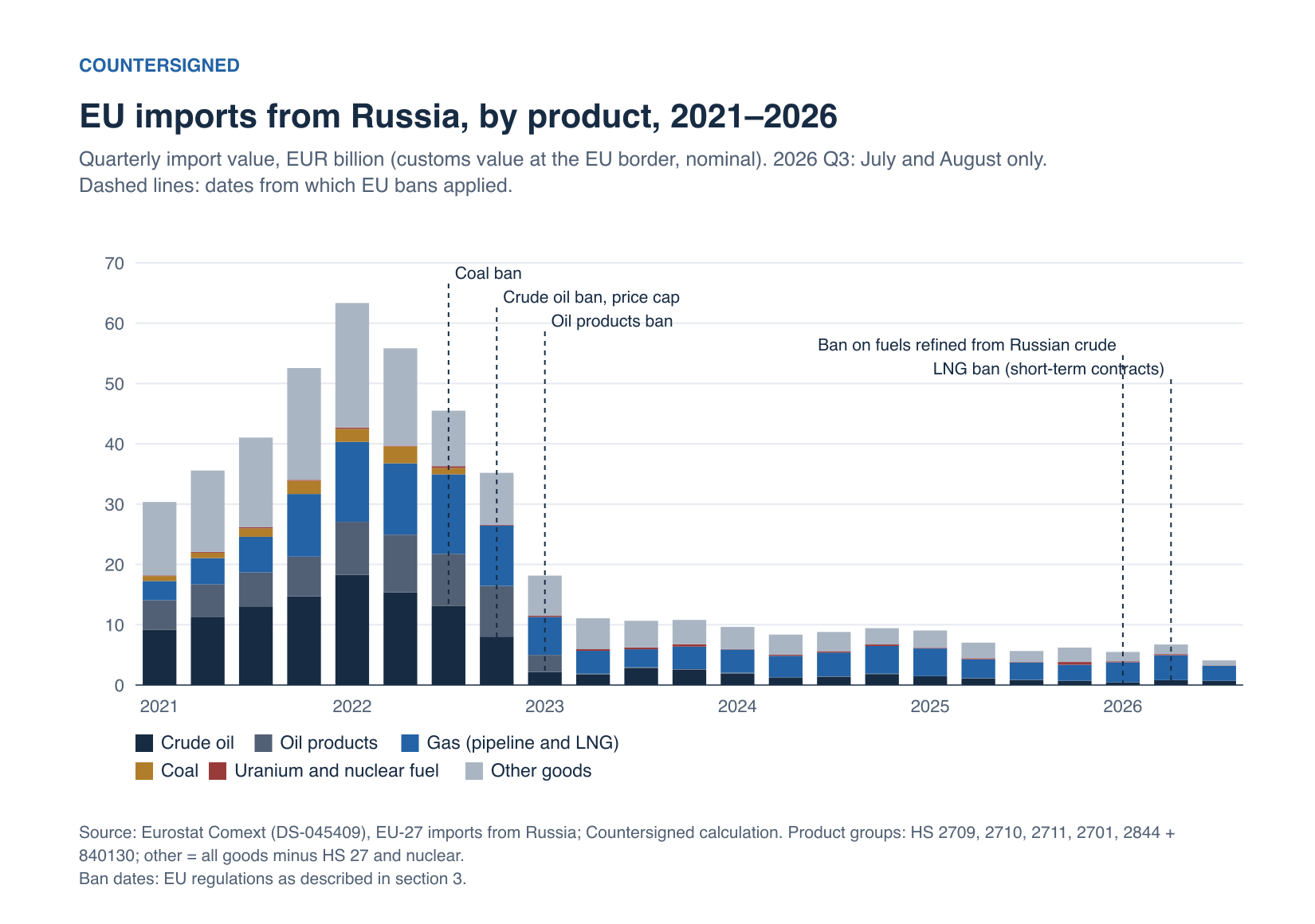
Regulation (EU) 2022/576 of 8 April 2022 banned imports of Russian coal, allowing existing contracts until 10 August 2022 S663. Regulation (EU) 2022/879 of 3 June 2022 banned imports of Russian crude oil and oil products: seaborne crude from 5 December 2022, oil products from 5 February 2023 (S662; S146). Crude oil delivered by pipeline is exempt until the Council decides that the ban applies to it S662.
Under the price cap, firms in the participating states may ship, insure or finance Russian oil going to other countries only if it is sold at or below a set price. Regulation (EU) 2022/1904 of 6 October 2022 created this exemption for a cap “agreed by the Price Cap Coalition” (S664) of the Group of Seven (G7) leading industrial economies, the EU and Australia S186; its stated aims included “limiting Russian oil revenues” S664. A Council decision of 3 December 2022 set the cap S154 at USD 60 per barrel of crude oil from 5 December 2022 (S176; S816). From 5 February 2023, according to the US Treasury, caps of USD 100 per barrel applied to products such as diesel and USD 45 to fuel oils (S186; S816).
In the United States, Executive Order 14066 of 8 March 2022 prohibited imports of Russian oil, oil products, liquefied natural gas (LNG, gas shipped in liquid form) and coal, according to the Congressional Research Service S1193; the Ending Importation of Russian Oil Act of 8 April 2022 banned imports of all Russian energy products S166.
2023–2024: circumvention, LNG, uranium and banks
The 11th package of 23 June 2023 allowed the Council to take “last-resort” measures banning exports of sensitive goods to a third country through which circumvention, the routing of banned trade, persists S665. In June 2024 the 14th package banned the reloading of Russian LNG in EU ports for shipment to non-EU destinations; reloading for other member states remained allowed S673.
Executive Order 14114 of 22 December 2023 S722 exposed foreign banks to US sanctions for transactions or services involving Russia’s military-industrial base, according to the Treasury’s Office of Foreign Assets Control (OFAC) S206. A US law of 13 May 2024 banned imports of Russian low-enriched uranium, a reactor fuel, from 11 August 2024, with waivers until 1 January 2028 at the latest (S724; S1241). On 21 November 2024 the Treasury designated Gazprombank and more than 50 other Russian banks, blocking their assets (S067; S1193).
2025–2026 in the EU: lower caps, gas and the largest listings
The 18th package lowered the crude cap to USD 47.6 per barrel from 3 September 2025 (S167; S176) and made it dynamic: it is reset to stay 15 per cent below the average price of Urals, Russia’s main export crude, in the previous 22 weeks S172. According to the Commission, the first reset set it at USD 44.10 from 1 February 2026 S172. Citing “exceptional disturbances” in oil markets, the 21st package of 23 July 2026 suspended the automatic adjustment until 15 July 2027 (S174; S167).
Since 21 January 2026 the EU has banned imports of oil products refined in third countries from Russian crude; importers must prove the crude’s origin unless the product comes from a listed partner country S176. The 19th package banned imports of Russian LNG from 25 April 2026, and from 1 January 2027 under long-term contracts concluded before 17 June 2025 S179.
On 12 October 2026 the Council adopted what it calls the “largest-ever package of listings”, 1,569 individuals and entities in Russia’s military-industrial complex (S167; S1488). The Council does not number it.
Regulation (EU) 2026/261 of 26 January 2026, which phases out Russian gas, is a trade and energy law rather than a sanction: it rests on the energy and trade articles of the Treaty on the Functioning of the EU (Articles 194(2) and 207 TFEU) S615, not on Article 215, the basis of the EU’s Russia sanctions (S675; S662). It bans imports of Russian pipeline gas and LNG from 18 March 2026 S615. Under contracts concluded before 17 June 2025 the ban applies to LNG from 25 April 2026 (short-term contracts) or 1 January 2027 (long-term), and to pipeline gas from 17 June 2026 or 30 September 2027 (1 November 2027 where the Commission finds gas storage targets at risk) S615. Hungary (C-46/26, filed 2 February 2026) and Slovakia (C-398/26, filed 24 April 2026) contest its legal basis at the EU Court of Justice (S701; S702); the held records show filings, not judgments (section 14).
The United States, 2025–2026: in both directions
On 22 October 2025 the Treasury designated Rosneft and Lukoil to “degrade the Kremlin’s ability to raise revenue for its war machine” S203. Other US decisions included exemptions and reversals:
- Hungary: a one-year exemption from US sanctions on Russian oil and gas from November 2025, according to a press report quoting Secretary of State Marco Rubio; the Hungarian government claimed no time limit S543. No OFAC text is held.
- Japan: a US licence for the Sakhalin-2 project, extended until 18 June 2026, which Interfax describes as allowing oil exports to Japan and Jiji Press as an LNG import permit; no Treasury text is held (S235; S552).
- India: an extra 25 per cent tariff, announced by the White House on 6 August 2025 “due to India’s direct or indirect importation of Russian Federation oil” S1475. Executive Order 14389 of 20 February 2026 ended the duties imposed by Executive Order 14329 of 6 August 2025 S729.
- Diesel: General License 135 of 9 October 2026 authorises transactions in Russian-origin diesel, including imports into the United States, until 7 April 2027, excluding only debits to US accounts of Russia’s central bank, National Wealth Fund and Ministry of Finance S149.
On 16 October 2026 President Donald Trump issued an order implementing the Lindsey O. Graham Sanctioning Russia and Iran Act of 2026, which he had signed on 18 September 2026 S723. The order raises duties on goods from Russia “by 500 percent ad valorem” (of their value), and by 100 per cent on goods from the five largest importers of Russian crude oil and gas if they knowingly make new purchases from 18 October 2026, and then states: “I hereby waive the application of any duties provided for in sections 112 and 113 of the Graham Act or this order” S723. The waiver has no end date; its stated basis is a certification to Congress that it “is in the national interests of the United States” S723 (the accompanying report is not held). Sanctions under earlier executive orders remain S723.
The United Kingdom and what remains outside sanctions
The United Kingdom acts under its Russia (Sanctions) (EU Exit) Regulations 2019 S736, including a maritime services ban that applies the price cap S735.
Outside sanctions, or only partly covered, at the cutoff:
- Nuclear fuel: some Rosatom entities are under EU sanctions, but “there is no outright ban on the company’s operations in Europe”, according to the think tank RUSI, which urges sanctions on Rosatom as a whole S856.
- Food and fertilisers: EU sanctions do not prohibit buying Russian agricultural products where no sanctioned person is involved, according to the Commission in 2022 S1096. Since July 2025 fertilisers and some farm goods carry extra customs duties under a trade law S340.
- National exemptions: pipeline crude oil, no longer for Germany, Poland and Czechia S180; and Sakhalin-2 oil for Japan, exempted from the price cap by the EU until 31 March 2028, according to the law firm Steptoe S200.
4. Why not faster? Explanations tested
This section tests seven explanations for the staged pace of energy measures (section 3): what each predicts, what the evidence shows and how much it explains.
Physical dependence and infrastructure
If dependence set the pace, exemptions should cluster where alternatives were hardest to find, and in part they did. The oil embargo agreed by EU leaders on 30 May 2022 gave Czechia, Hungary and Slovakia a “temporary” exemption for crude delivered by the Druzhba pipeline (S302; S801). Slovakia, which is landlocked, says it lacks direct access to terminals for liquefied natural gas (LNG) and oil S700. Nuclear fuel is covered in sections 3 and 5.
Yet a web summary by the energy research group CREA of its report with the Center for the Study of Democracy found “no technical and economic reasons” for maintaining the “sanctions exemption for Central Europe” S800. In gas, Russia cut supplies itself in 2022 S1495 (section 9); EU imports of LNG then rose by 89 per cent in the third quarter, according to the European Commission S1499. Dependence explains where exemptions were granted better than how long they lasted.
Oil prices: a cap rather than a ban
Fear of an oil-price shock predicts measures that keep Russian oil on the market while cutting Russia’s income. In September 2022 the finance ministers of the Group of Seven (G7) large economies announced plans for a price cap: firms in their countries could ship, insure or finance Russian oil only if it was sold at or below a set price, a measure “specifically designed to reduce Russian revenues” while “limiting the impact of Russia’s war on global energy prices” S814. This explains the choice of instrument; its designers state the motive.
Vetoes, sector interests and legal limits
EU sanctions require a unanimous decision S308, so if vetoes set the pace, delays should follow specific objections; several did. The sixth package took “almost a month” to agree, according to the Warsaw-based Centre for Eastern Studies S801. Hungary’s Prime Minister, Viktor Orbán, blocked the six-monthly renewal for several weeks until he received EU assurances on energy security in January 2025 S802. By June 2026, according to an EUobserver opinion article, Hungary had “changed government and lifted its long-standing objection”, but Bulgaria’s Prime Minister, Rumen Radev, said Sofia would veto the 21st package S308 (outcomes: section 3).
Other exemptions protected a national industry. Russian diamonds stayed out of the first 11 packages, according to the news service bne IntelliNews S314; the Antwerp World Diamond Centre, an industry association that warned a total embargo could cost 10,000 jobs, pushed to keep the Russian miner Alrosa off the eighth (our translation) S315. No held source measures what these carve-outs were worth to Russia.
In legal terms, when the EU adopted its regulation of January 2026 phasing out Russian gas, Slovakia warned of arbitration over long-term contracts and Hungary called it a “de facto sanction”; these are positions, not court findings (S1133; S700). The Court of Justice’s Paks II judgment of 11 September 2025 (C-59/23 P) does not concern sanctions: it annulled the Commission’s approval of Hungarian state aid for two new reactors on state-aid and public procurement grounds S1134.
Expectations in 2022 and the German gas test
Forecasts in spring 2022 expected a deep fall in Russia’s output. In April 2022 the International Monetary Fund (IMF) forecast that Russia’s gross domestic product (GDP) would fall by 8.5 per cent in 2022; its October 2026 figure for that year is a fall of 1.4 per cent, according to Countersigned’s tabulation of IMF forecasts D09 (political declarations: section 12).
Germany offers a test of the cost argument. Estimates of the cost of a stop of Russian gas or energy differed widely:
- The Leopoldina, the national academy of sciences (8 March 2022): the economy “could manage a stop” even at short notice, with bottlenecks in winter; no GDP figure S807.
- Rüdiger Bachmann and eight co-authors (7 March 2022): a short-run fall in GDP of 0.5 to 3 per cent S803.
- The Joint Economic Forecast for the economy ministry (April 2022, press summary): with an energy supply stop, growth of 1.9 instead of 2.7 per cent in 2022 and a 2.2 per cent contraction in 2023 S806.
- Tom Krebs for the research institute ZEW: a short-run fall of 3.2 to 8 per cent of GDP in its baseline S809.
- An IMF working paper (Lan, Sher and Zhou, July 2022): GDP about 1.5 per cent lower in 2022 and 2.7 per cent lower in 2023 S811.
On 8 March 2022 the economy minister, Robert Habeck, called the Leopoldina’s calculation “abstrakt” (“abstract”) and warned that if an embargo broke supply chains, it would mean “schwere Schädigungen des wirtschaftlichen Kreislaufs, über Arbeitslosigkeit, über große gesellschaftliche Schäden” (“severe damage to the economic cycle, unemployment, great social harm”; our translation), according to the news agency dpa S295.
German GDP grew by 1.8 per cent in 2022 and fell by 0.3 per cent in 2023, according to the 2024 joint forecast the authors cite S804; current Eurostat data give growth of 1.9 per cent and a fall of 1.0 per cent (section 9.4) D06. Two of the March 2022 authors, Benjamin Moll and Moritz Schularick, wrote with Georg Zachmann that the economy “even avoided slipping into a recession” (S803; S812); their later paper speaks of “a technical mini-recession” and credits imports from third countries and a fall of about 20 per cent in gas use S813. Their discussant, Tarek Hassan, largely agreed but stressed that “good policy” was key S287.
The test shows that the highest estimates did not materialise. It does not show what an EU embargo would have cost: the 2022 shock followed Russia’s own cut S1495, and the March 2022 estimate assumed that fiscal and monetary policy would cushion demand S803 (section 9).
Evaluations and assessment
Clara Portela and Janis Kluge, in a brief for the EU Institute for Security Studies titled “Slow-acting tools”, found in October 2022 that the effect of sanctions was “unfolding more slowly than predicted initially” S829; Maria Demertzis and colleagues at Bruegel linked continued Russian revenue to the EU’s strategy of “first meeting its own energy needs and only then sanctioning” S827.
In the actors’ own accounts, energy dependence and the sequencing that followed from it set the pace of the energy measures; price-cap designers, exemption-seeking governments and evaluators all cite dependence (above). Vetoes and sector interests account for delays of weeks and specific carve-outs (above; section 3); legal limits explain little; expectations remain untested (moderate confidence: the evidence is mainly the actors’ own statements, and no held study weighs the explanations against each other).
5. What coalition states paid Russia: oil, gas, coal, uranium and more
Payments by coalition states to Russia fell steeply after 2022 but did not stop.
What is counted
Here “coalition states” are the 27 EU member states and eight other sanctioning states (section 3): the United States, the United Kingdom, Japan, South Korea, Switzerland, Norway, Canada and Australia.
Three money measures are kept apart. The first is import value: what buyers declared to customs. For the EU it comes from Comext, the trade database of Eurostat, the EU’s statistical office, which values imports “CIF” (cost, insurance and freight): at the EU border, including transport and insurance, in nominal euros D01. For other states it comes from the UN database Comtrade, in US dollars; a missing entry may mean zero, confidential or unreported trade D12.
The second is Russian export revenue, estimated by the Centre for Research on Energy and Clean Air (CREA), a non-profit research organisation in Finland S563 that recommends closing “loopholes, circumventions and gaps in sanctions” S050. CREA values shipment volumes from ship-tracking data with a model that links past customs prices to spot prices, and assigns pipeline gas to countries by assuming that each is a “perfect ‘gas mixer’” S834. The third measure, Russian budget revenue, is covered in section 7.
Calendar 2022, and every cumulative total from 2022, includes January and February 2022, before the invasion. Comext data for 2026 cover January to August.
The EU: what was bought and by whom
According to Countersigned’s calculation from Eurostat data, EU imports from Russia were (CIF, EUR billion) D01:
- All goods: 163.6 in 2021, 202.5 in 2022, 50.8 in 2023, 36.3 in 2024 and 27.9 in 2025.
- Mineral fuels (customs chapter 27: coal, oil, gas and related products): 104.0, 147.2, 29.4, 22.6 and 17.4.
- Gas, by pipeline and as liquefied natural gas (LNG): 23.8 in 2021, 48.3 in 2022 and 13.2 in 2025, of which LNG 7.4.
- Crude oil: 48.2, 54.8 and 4.0 in the same three years; refined products 22.6, 35.4 and 0.2.
- Coal: 5.3 in 2021, 6.0 in 2022 and practically zero from 2023.
From 2022 to August 2026 Russian mineral fuels cost EU buyers EUR 228.5 billion D01. In January–August 2026 they cost EUR 11.9 billion, against 13.0 billion a year earlier, at prices also raised by the war involving Iran (section 9) (D01; S563).
Eurostat’s reported 90 per cent fall in imports from the first quarter of 2022 to the fourth quarter of 2025, relayed by the Sofia Globe, matches Countersigned’s quarterly totals (EUR 64.6 billion, then 6.2 billion) (S330; D01). The Commission’s trade department gives EUR 20 billion for 2025 mineral fuels, against 17.4 billion here, without stating its product grouping S333.
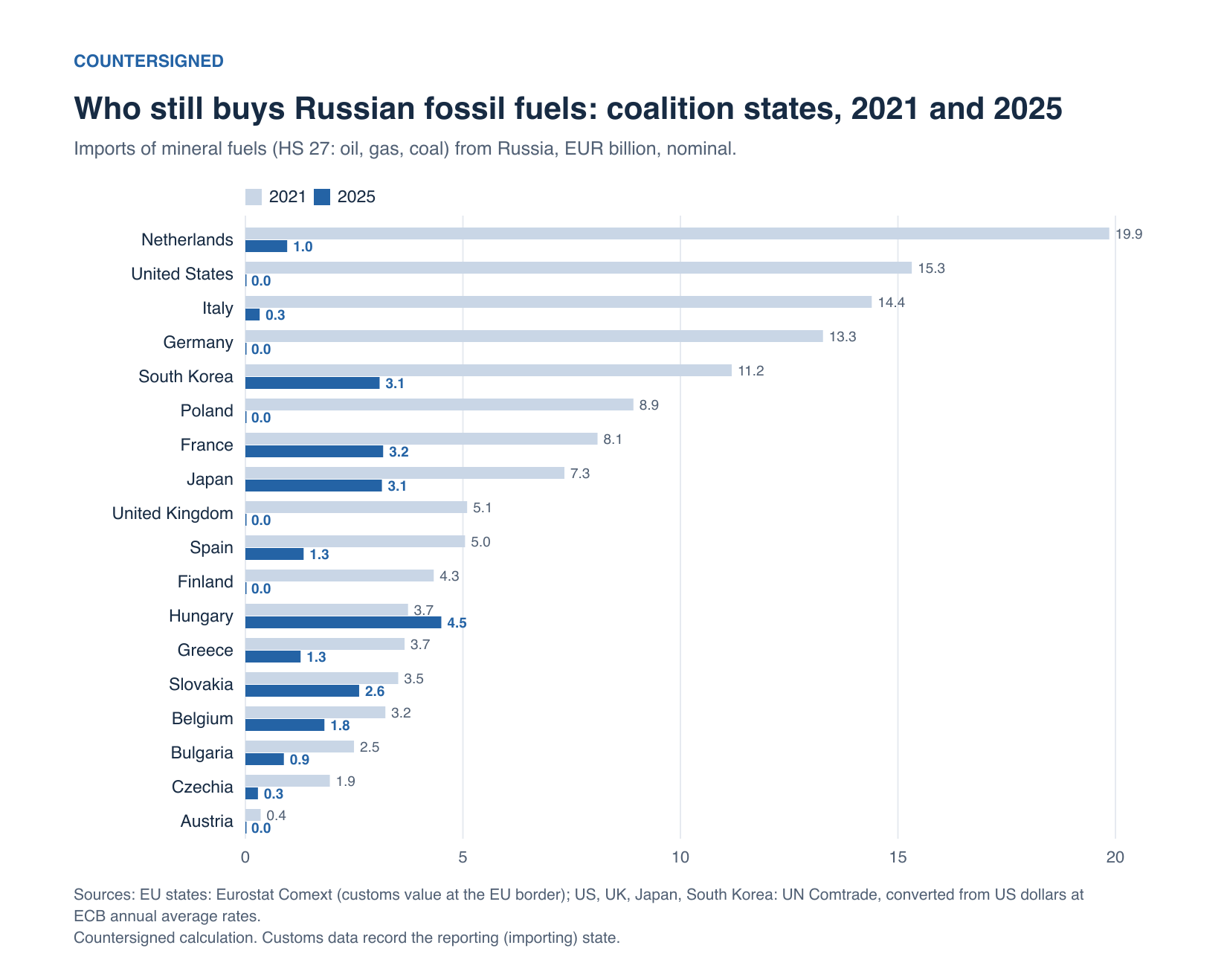
The five largest importers of Russian mineral fuels in 2022–August 2026 were Hungary (EUR 27.6 billion), Italy (27.3), the Netherlands (26.4), France (24.2) and Germany (19.2) D01; Germany’s figure excludes most of its pipeline gas (see below). The largest in 2025 were Hungary (EUR 4.5 billion), France (3.2, all gas) and Slovakia (2.6, mostly oil); Germany and Poland recorded none (section 12) D01.
Customs data record the state of entry, not of use: according to Reuters, Russian LNG landed in countries such as France and Spain is often “sent onwards to buyers across the bloc” S562.
Other coalition states, and Russia’s revenue by destination
According to Countersigned’s calculation from Comtrade data, imports from Russia by the eight non-EU coalition states fell from USD 93.2 billion in 2021 to 18.3 billion in 2025 D12. US imports fell from USD 30.8 to 4.0 billion, British from 24.9 to 0.5, South Korean from 17.4 to 6.9 and Japanese from 14.1 to 5.5 billion (section 12) D12.
At the European Central Bank’s annual average exchange rates, Countersigned’s calculation puts the coalition’s imports of Russian mineral fuels at USD 170.0 billion in 2021, 185.6 in 2022 and 26.7 in 2025: USD 286.6 billion over 2022–2025 (D01; D12; S147).
Summing CREA’s country figures, Countersigned’s calculation puts Russia’s estimated fossil-fuel export revenue from 24 February 2022 to 14 October 2026 at EUR 1,165 billion D13. By CREA’s estimates, the largest destinations were China (EUR 357.8 billion), the EU (238.4), India (191.8) and Türkiye (138.0) D13.
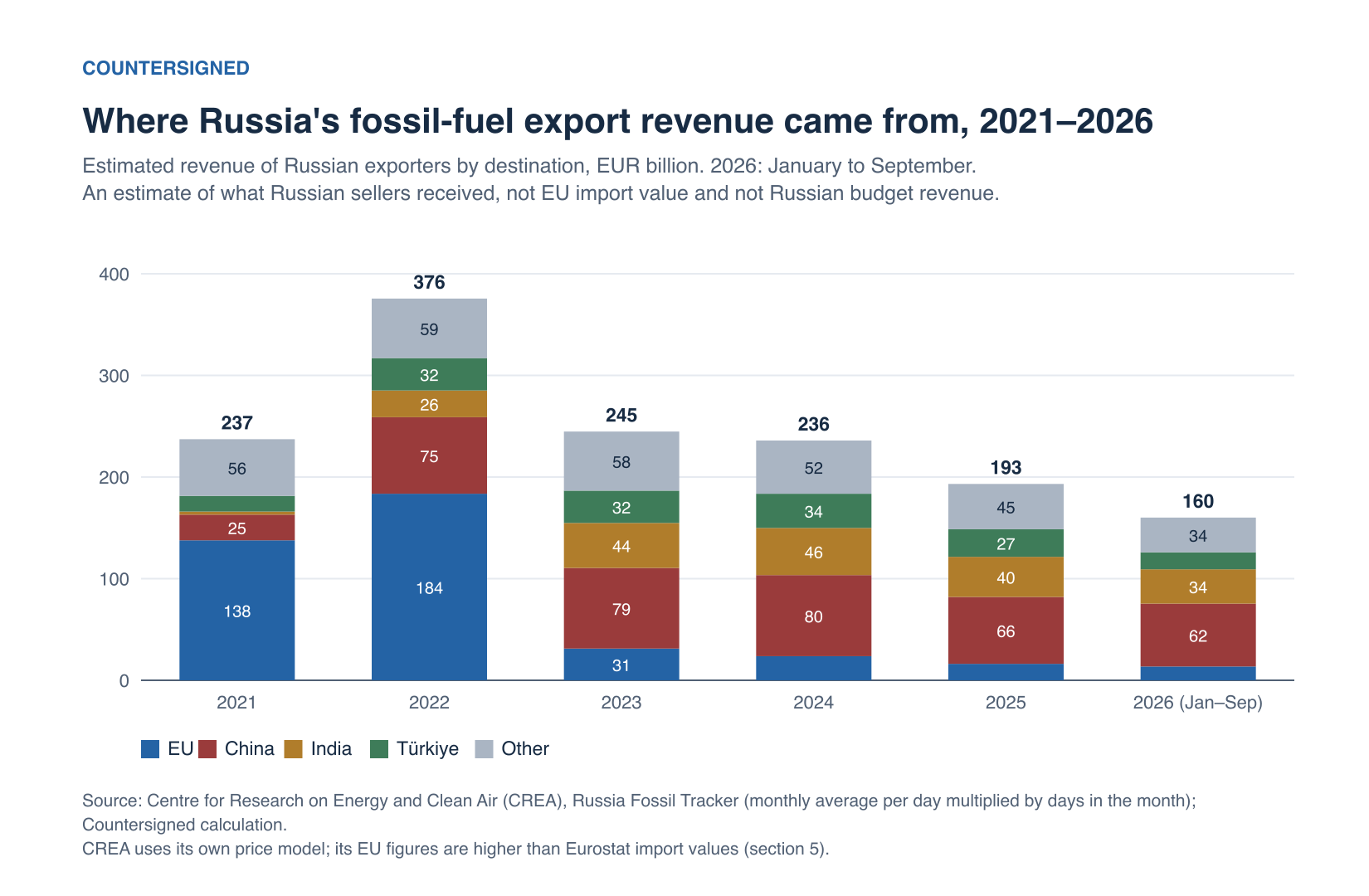
CREA’s EU estimates exceeded customs values for mineral fuels in 2021–2024 (EUR 183.6 billion against 147.2 billion in 2022) but not in 2025 (16.2 against 17.4 billion); the largest gap is for gas, EUR 75.3 billion against 48.3 billion in 2022 (D13; D01). Part of it appears to lie in the customs data. Comext records almost no Russian gas imports for Germany (EUR 0.06 billion in 2021, 0.01 billion in 2022) and none for Austria, while CREA attributes EUR 14.4 billion and 10.2 billion of Russian gas revenue since the invasion to them (D01; D13). No held source explains this. The series are also defined and priced differently S834. In this report’s assessment, customs values are the firmer measure of what EU buyers paid for oil and coal, but they understate payments for pipeline gas, for which CREA’s model-based estimates are the only held alternative (moderate confidence: neither source explains the German and Austrian figures).
Some Russian oil reached coalition states as fuel refined in third countries, which CREA called in 2023 “a legal way” of selling to sanctioning countries S858; such products are not recorded in EU trade statistics as imports from Russia S350. Assuming that refineries mix their crude perfectly S859, CREA estimates that EUR 9 billion of the EUR 18 billion of oil products bought by G7+ states (the G7 plus the EU, Australia, New Zealand, Norway and Switzerland S351) from six Indian and Turkish refineries in the invasion’s third year was made from Russian crude S325. The EU has banned such products since 21 January 2026 S176.
Nuclear fuel, fertilisers and metals
The Euratom Supply Agency (ESA), the EU body that monitors nuclear fuel supply, gives Russia’s share of supply to EU utilities as D16:
- natural uranium: 19.7 per cent in 2021, 23.5 in 2023 and 16.0 in 2025;
- conversion (turning uranium into a gas for enrichment): 25.0, 26.5 and 24.4 per cent;
- enrichment (raising the share of the fissile uranium isotope): 31.0, 37.9 and 22.6 per cent.
ESA called dependence on a single fuel design for Russian-designed VVER reactors “a significant vulnerability” S265. By the end of 2025 all EU VVER operators had secured contracts with non-Russian fuel suppliers S774. From 2022 to August 2026 EU imports of Russian enriched uranium came to EUR 1.6 billion and of fuel elements to EUR 2.1 billion, according to Countersigned’s calculation D01.
Russia supplied 20–28 per cent of the enrichment services bought by US reactor owners each year in 2021–2025, according to Countersigned’s calculation from US Energy Information Administration data; the 2025 figure for natural uranium bought from Russia is withheld D17. A US law of May 2024 bans imports of Russian low-enriched uranium from 11 August 2024, with waivers possible until 1 January 2028 (S724; S1241).
EU fertiliser imports from Russia fell from EUR 2.6 billion in 2022 to 1.4 billion in 2023 and rose to 1.7 billion in 2025 D01. From 2021 to 2025, imports of unwrought (raw) aluminium fell from EUR 1.7 to 0.8 billion and semi-finished steel from 2.6 to 1.6 billion D01.
Payments compared with aid and military spending
Published comparisons with aid to Ukraine use different measures:
- CREA, by its own estimate: EU imports of Russian fossil fuels in the invasion’s third year (to February 2025), EUR 21.9 billion, “surpassed the EUR 18.7 bn of financial aid” the EU sent in 2024 S325. That aid figure covers financial aid only, and its source is not named.
- Reuters, October 2025: more than EUR 213 billion of EU imports of Russian energy since 2022, from CREA data, which estimate Russian export revenue rather than customs value (see above), against EUR 167 billion of financial, military and humanitarian aid allocated by the EU, according to the Kiel Institute, a German economic think tank S562.
- Kyiv Post, data to December 2025: EUR 231 billion paid by Europe, not only the EU, for Russian fossil fuels, against EUR 200.7 billion of aid according to Kiel; but “since 2023, European aid to Ukraine has outpaced Russian fossil fuel imports on a yearly basis” S563.
Kiel counts aid pledged since 24 January 2022 S004. This report adds no comparison of its own: no held aid series matches the payment figures’ definitions. For scale, the Stockholm International Peace Research Institute estimates Russia’s military spending in 2025 at USD 190 billion S044. Import value is not Russian budget revenue (section 7).
6. Enforcement and evasion
Oil and the shadow fleet
The KSE Institute at the Kyiv School of Economics, a Ukrainian think tank, defines the shadow fleet as tankers “not owned, managed, or insured by an entity in the sanctions coalition”, so the price cap (section 3) does not apply (S359).
In May 2023 the US Treasury, which conceived the cap, said it “is achieving both goals” of restricting Russia’s oil revenue and maintaining supply (S816; S880). A Federal Reserve Bank of Dallas working paper by Kilian, Rapson and Schipper attributes the March 2023 discount on Russia’s Urals crude to the 2022 embargo and finds the cap’s effect on the export price “negligible” once it had facilitated the use of Western shipping services (S880). The World Bank wrote in October 2023 that “it seems” Russia, with a shadow fleet, “has been able to trade outside of the cap” (reported by the trade journal Riviera) (S370).
KSE’s tracker shows shadow tankers carrying 70 per cent of Russia’s seaborne crude exports in February and May 2026 and 75 per cent in April (S355; S354; S353). In August 2024–June 2026, 431 of 596 EU-designated tankers (72 per cent) loaded at Russian ports at least once after designation (S352). EU listings reached almost 600 vessels by 18 December 2025 (S365). After the 21st package of 23 July 2026, the insurer West of England P&I Club counts “over 670” and the Kyiv Independent newspaper 692 (S362; S363).
Western shipowners earned over USD 6.3 billion selling ageing tankers that joined the shadow fleet, according to the journalists’ networks Organized Crime and Corruption Reporting Project and Follow the Money; indirect sales to companies in non-sanctioning countries were “not illegal” (S058).
Goods and components
Economists of the European Bank for Reconstruction and Development found that EU exports of sanctioned goods to Armenia, Kazakhstan and Kyrgyzstan rose by an extra 30 per cent relative to other goods, evidence they call “suggestive” of circumvention (S375), and estimate that such strategies “offset less than 10 percent of the sanctions’ impact” (S376). In April 2026 the EU first used its anti-circumvention tool, banning exports of certain machine tools and network equipment to Kyrgyzstan, according to the law firm Norton Rose Fulbright (S039).
China supplied about 90 per cent of Russia’s 2023 imports of high priority items, dual-use and advanced-technology goods found in Russian weapons, according to the think tank Carnegie Endowment (S881; S015). Conflict Armament Research, a UK investigative group that has documented well over 12,000 components, found marks of US-owned companies on one-third of those in Russian land-attack missiles and drones (S894).
Estimates of the fall in Russia’s imports of priority goods conflict: 45 per cent (Carnegie, May 2024), “more than half in value terms” (KSE, 2026), or 10 per cent in January–October 2023 against pre-sanctions levels (KSE, January 2024) (S015; S017; S890). They cover different goods and periods.
Money and enforcement
On 17 June 2026 the UK Treasury announced a GBP 1.0 million penalty on Sabre Global Technologies, calling it its “largest ever penalty for a breach of Russian financial sanctions since the 2022 invasion” (S900). On 11 August 2026 its Office of Financial Sanctions Implementation fined Citibank’s London branch GBP 4.7 million, mostly for breaches in 2022 (S1246).
EU Directive 2024/1226 requires member states to make intentional violations of EU sanctions criminal offences (S667). A 2023 European Parliament study had found “unequal penalisation of sanctions violations across Member States” (S1145).
A7A5, a rouble-backed crypto token issued in Kyrgyzstan, carried over USD 1 billion a day by July 2025, according to the blockchain analytics company Elliptic (S068). In August 2025 the US Treasury sanctioned Grinex, successor to the Russian crypto exchange Garantex (S070).
Corporate exits
In KSE’s #LeaveRussia list (latest dated entry 10 May 2026), at least 569 foreign companies are classed as “Exited”, 1,355 as “Leave” and 2,401 as “Stay” (S901). The economists Evenett and Pisani estimated Western divestment rates of 5–13 per cent in the war’s first nine months (S902). Loss tallies differ (section 9).
Russia’s Decree No. 302 of 25 April 2023 places assets of persons from “unfriendly” states under “temporary management” (our translation) by a state agency, without the power to dispose of them (S904). It was applied to Fortum’s assets in April 2023, to Uniper’s by July 2023, and to Danone’s and Carlsberg’s in July 2023 (S065; S392).
In the EU and the UK, enforcement has tightened over time in law, listings and penalties, but evasion methods have changed: most EU-designated tankers kept loading, and China supplied most priority goods (S365; S362; S667; S1246; S352; S015). This report judges that tighter enforcement has not closed the main evasion channels (moderate confidence: import estimates conflict, and no held study separates enforcement effects from the 2026 oil-price shock).
7. Effects on Russia: economy, budget, technology, power
Russian statistics have become less complete since 2022 (S422; S920). A review by the research group Cedar and the Boris Nemtsov Foundation rated gross domestic product (GDP, total economic output) and consumer prices as indicators that “can be trusted with reservations” S421.
Growth, prices and interest rates
Over 2022–2025, Russian output grew about as much as the International Monetary Fund (IMF) expected before the invasion. The IMF’s October 2021 forecast implied a 2025 level of 108.7 (2021 = 100). After a fall of 1.4 per cent in 2022 and growth of 4.1, 4.9 and 1.0 per cent in 2023–2025, the IMF’s October 2026 data give the same 108.7, according to Countersigned’s calculation from IMF forecast vintages D09. In April 2022 the IMF had expected a fall of 8.5 per cent in 2022 and a 2025 level of 91.6 D09. By the same measure, 2025 output was 7.2 per cent below the pre-war forecast in Germany, 2.1 per cent in Poland and 0.1 per cent in the United States (section 9) D09.
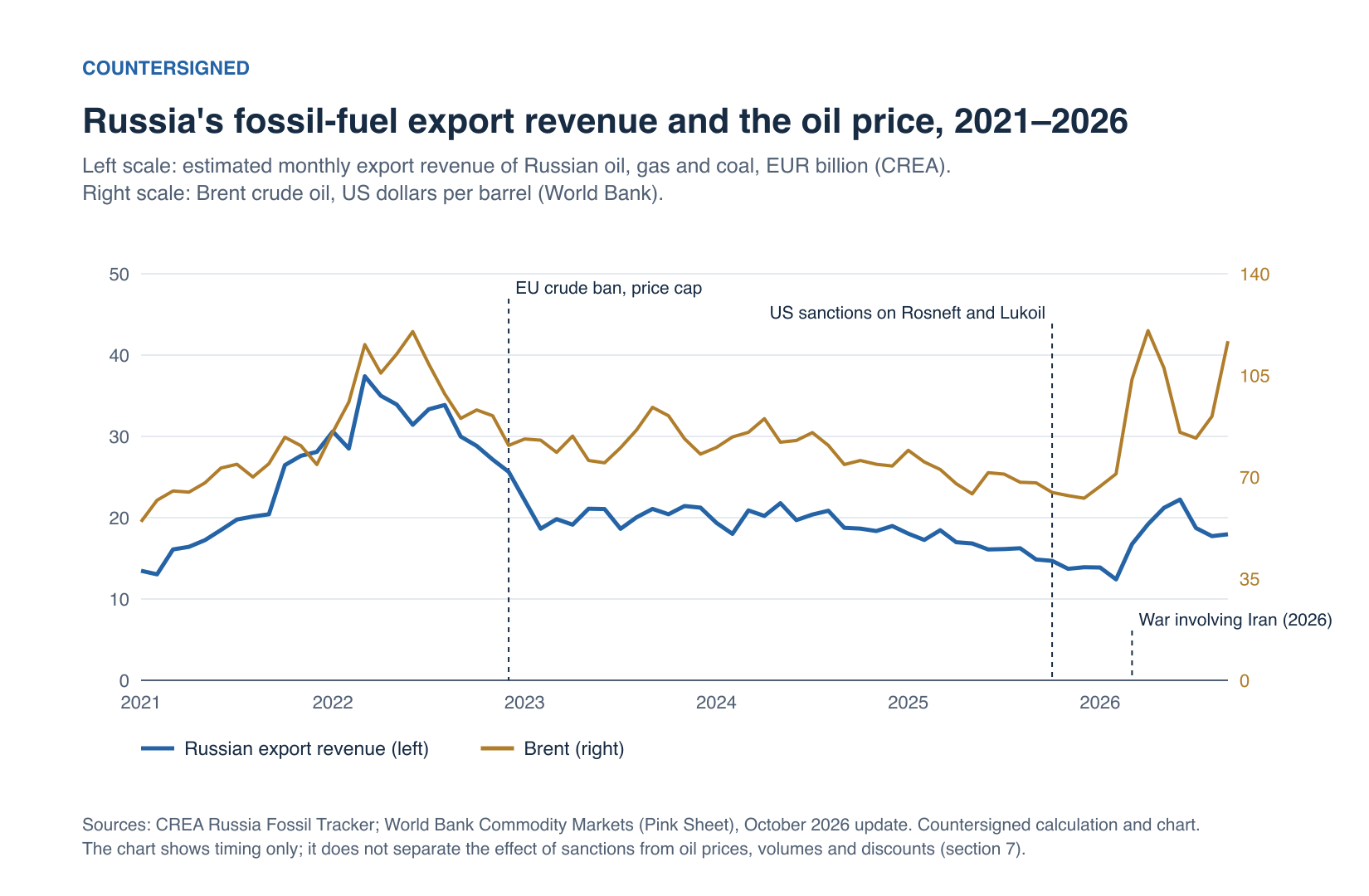
BOFIT, the Bank of Finland’s research institute on emerging economies, calls rising government spending “a major driver of the Russian economy”: spending rose by an average of 15 per cent a year in 2022–2026, mainly through war-related expenditure, now about 20 per cent of the total S925. Oleg Vyugin, writing for the research group Re:Russia, also names the use of accumulated resources and companies’ “schemes to circumvent sanctions restrictions” S931.
Growth slowed to 1 per cent in 2025. BOFIT cites weak consumption and investment after slower wage growth, higher taxes and high interest rates S404. The first official estimate put output in the first quarter of 2026 0.3 per cent below a year earlier, The Bell reported S933. The IMF raised its 2026 forecast to 1.1 per cent in April, citing higher oil prices during the war involving Iran S409, and cut it to 0.9 per cent in October S407.
Inflation, measured as the average of monthly year-on-year rates, was 13.8 per cent in 2022, 5.9 in 2023, 8.4 in 2024, 8.7 in 2025 and 5.9 per cent in January–September 2026, against 3.4 to 6.7 per cent in 2019–2021, according to Countersigned’s calculation from Bank of Russia data D15. The Bank of Russia raised its key rate, its main policy interest rate, from 9.5 to 20 per cent from 28 February 2022 (D15; S915). The rate reached 21 per cent from 28 October 2024 and was cut to 14 per cent by 27 July 2026 (D15; S073).
The budget
Oil and gas budget revenue comes mainly from the mineral extraction tax on crude oil S1404. The Ministry of Finance’s website could not be retrieved, so its figures come via a news report on the trade site Oil & Gas 360, BOFIT and the Chinese state agency Xinhua. Revenue fell by 24 per cent, from RUB 11.13 trillion in 2024 to RUB 8.48 trillion in 2025, the lowest level since 2020, “as oil prices fell while the rouble appreciated”, that report said (S081; S1514). This report does not examine why oil prices fell in 2025 and does not attribute that fall to sanctions. No source held for this report gives the totals for 2021–2023. Oil and gas provided “nearly a quarter” of federal revenue in 2025, according to BOFIT S1401.
The sources name four drivers:
- Oil price. Brent, the main international benchmark crude, averaged USD 80.7 per barrel in 2024 and USD 69.1 in 2025, according to Countersigned’s calculation from World Bank prices D08.
- Discount. Russian crude sold USD 13 per barrel below comparable grades on average in 2025 and USD 23 below in January–February 2026, according to International Energy Agency (IEA) estimates reported by BOFIT S1515.
- Rouble. This tax is based on the dollar export price, so a stronger rouble lowers revenue in roubles (S1400; S1518).
- Sanctions and strikes. BOFIT judged that new sanctions on the oil sector hit Russian exports hard in 2025 S404, the year the United States designated Rosneft and Lukoil, Russia’s two largest oil companies (section 3) S203. Much of the fall in export volumes in 2026 reflects Ukrainian strikes on refineries and oil terminals, according to BOFIT S925.
The war involving Iran, from 28 February 2026, disrupted shipping through the Strait of Hormuz S660, and Brent averaged USD 94.0 in January–September D08. The IEA estimated that Russia’s oil export revenue (sellers’ receipts, not budget revenue) “nearly doubled, from $9.7 billion to $19 billion” in March S1375. The US and the UK also temporarily relaxed sanctions on Russian oil, BOFIT notes S1516. Yet budget oil and gas revenue in January–September 2026 was RUB 5.471 trillion, 17.2 per cent less than a year earlier (S155; S1520). The ministry cited a lower average dollar exchange rate and higher compensation payments to domestic refineries S155.
The 2026 budget law planned a deficit of RUB 3.786 trillion and the updated plan of mid-July 4.828 trillion S1518; in January–September the deficit reached RUB 5.2 trillion, 2.2 per cent of GDP, by preliminary Finance Ministry estimates reported by Trading Economics S1520. Trading Economics calls RUB 7.3 trillion, 3.2 per cent of GDP, the full-year target without naming its source S1520; the same amount is the 2026 deficit forecast by Sberbank’s Center for Macroeconomic Research S042. The National Wealth Fund, which the government draws on to offset revenue shortfalls, held liquid assets of about RUB 4 trillion at the end of August 2026 (S155; S925). Value-added tax (VAT), a tax on most goods and services, rose from 20 to 22 per cent on 1 January 2026 (S1400; S912; S1519). The draft budget for 2027–2029 projects deficits of about 2 per cent of GDP a year S045. National defence together with security and law enforcement was planned at 38 per cent of federal spending in 2026 (S046; S024); the 20 per cent estimated by the Stockholm International Peace Research Institute (SIPRI), below, relates military spending alone to all government spending.
Reserves, technology and military production
Russia’s international reserves were USD 630.6 billion at the end of 2021 and USD 769.0 billion at the end of August 2026, including assets immobilised abroad (section 11), according to Bank of Russia data D15. The value of gold holdings rose from USD 133.1 billion, 21 per cent of the total, to USD 333.5 billion, 43 per cent D15; the data do not separate price effects from purchases. Trade has turned towards China and India (section 10).
Export controls more than halved the value of Russia’s imports of components and equipment important for weapons production, but China came to account for approximately 75 per cent of reported exports of these goods to Russia, at a premium reaching approximately 300 per cent in 2025, according to Kyiv School of Economics analyses cited by the Center for Strategic and International Studies (CSIS), a US think tank S938. Russia’s aviation chief, Dmitry Yadrov, warned in October 2025 that in the worst case 339 aircraft could be lost over five years S1536.
SIPRI estimates Russian military spending at USD 190 billion in 2025, 7.5 per cent of GDP (Germany: 2.3 per cent) and 20 per cent of government spending, the highest share it has recorded for Russia S044. Arms production and supplies from allies are discussed in section 8.4.
Society and power
At least 666,000 Russians emigrated after early 2022, according to an estimate by the news outlet The Bell, relayed by bne IntelliNews in July 2024 S418. Later reports suggest 45 per cent returned S418.
In one survey by the pollster Levada Center, 26 per cent of respondents admitted being afraid to answer political questions, according to the researcher Jeremy Morris S110. Levada’s latest held results on sanctions date from April 2018, when 78 per cent said they and their families had not encountered major problems because of them (S1528; S1529). Its releases of January and August 2026 contain no question on sanctions (S109; S108).
Alexandra Prokopenko of the Carnegie Endowment, a US think tank, argues that sanctions have changed “the behavior of the ruling stratum”, quoting a senior interlocutor who said they had “cemented the elites” S944.
Ukrainian drone attacks have damaged Russian refineries and forced “unprecedented export bans”, according to the IEA as reported by Oil & Gas Journal S414. Refinery runs fell to 3.8 million barrels a day in June 2026, 30 per cent less than a year earlier, and sanctions compound the damage by restricting access to replacement equipment S414.
What can be attributed to sanctions
The price cap (section 3) has “constraining Russian revenues” as one of two objectives S732. The US Treasury said its October 2025 designations would “degrade the Kremlin’s ability to raise revenue for its war machine” S203.
- Growth in 2023–2024 came largely from war spending; the contraction the IMF expected in April 2022 was far milder in 2022 and absent in 2023 (S405; S931; D09) (high confidence: BOFIT and Re:Russia agree; IMF data show the outcome). No held source measures the part of sanctions in the slowdown since 2025.
- Budget revenue, in this report’s judgment, follows mainly the oil price and the rouble (S081; S155), and in 2026 the oil price rise caused by the war involving Iran (S1516; S1400); sanctions act through discounts and volumes. Economists at the Federal Reserve Bank of Dallas attribute a USD 32 discount in March 2023 to the EU embargo and find the price cap’s effect on the export price “negligible” once it allowed Western services to carry Russian oil to Asia S880 (moderate confidence: no held source converts the discount into budget revenue).
- Costs and technology. Sanctions “continue to restrict access to foreign financing and technology”, BOFIT finds, though Russia has mitigated some effects through third countries S925. They raised import and procurement costs (S938; S1321). As CSIS notes, “A price increase is evidence of friction, but it is not, by itself, evidence of capability disruption” S938 (moderate confidence: effects on output are not measured).
- Strikes are the principal reported cause of the 2026 fall in refining, with sanctions an aggravating factor according to the IEA (S414; S925) (moderate confidence: BOFIT and a press report of IEA analysis).
8. Sanctions, the course of the war and talks to end it
The war’s diplomatic history is told in the Countersigned report “Russia and Ukraine: history, war, diplomacy and prospects” (28 September 2026).
8.1 What the sanctioning governments said sanctions were for
In April 2022 the G7 leaders pledged to “further raise the cost of this war” and announced sanctions “to undermine and erode the capabilities of the Russian military to wage war”; they called new investment in Russia incompatible with “our objective to end this war” S951.
On 22 October 2025 the US Treasury imposed sanctions because of “Russia’s lack of serious commitment to a peace process”, adding that “a permanent peace depends entirely on Russia’s willingness to negotiate in good faith” S026. On 23 April 2026 the Council of the EU said its 20th package “aims to further cripple Russia’s economy and war machine” and pressed Russia to “engage in meaningful negotiations” S1489.
None of the official texts held for this report promises that sanctions alone would end the war. The US executive orders (presidential decrees) behind the Treasury’s sanctions could not be read: the Federal Register blocked access.
8.2 Sanctions in the talks, 2022–2026
Russian proposals have asked for sanctions to be lifted; Western drafts treat relief as staged and decided case by case, and Ukraine’s 20-point plan leaves it outside the agreement.
- Istanbul, 2022. The communiqué of the talks of 28–30 March 2022 contains no provision on sanctions S956. Article 6 of the draft treaty of 15 April 2022 says Russia and Ukraine “shall cancel all mutual sanctions” imposed since 2014, “regardless of the position and actions of other states” S957. It covers only sanctions between the two countries and is set in the type that the draft’s key assigns to “Issues that the Ukrainian Side refuses to discuss, citing their absence from the ‘Istanbul Communiqué’” S957.
- Putin’s terms, 14 June 2024. Putin made a ceasefire and talks conditional on Ukraine withdrawing its troops from four regions (Donetsk, Luhansk, Zaporizhzhia and Kherson) and abandoning its plans to join NATO S1180. Sanctions came later, with future agreements: “Naturally, this entails the removal of all Western sanctions against Russia as well” S1180. Novaya Gazeta Europe reported a demand for “a written guarantee” S429; that wording is not in the Kremlin’s English or Russian transcript (S1180; S1259).
- Black Sea, March 2025. The Kremlin’s account of the Russia–US expert talks of 25 March 2025 says the United States “will help restore Russia’s access to the world market for agricultural and fertiliser exports”, but only after sanctions are lifted from Rosselkhozbank (the Russian Agricultural Bank) and from banks, insurers and ships serving food and fertiliser trade S1282. The White House statements “made no explicit mention of Moscow’s conditions”, CNN reported S118; the held record does not show US acceptance.
- Russia’s memorandum, June 2025. In RBC-Ukraine’s rendering of the text published by the Russian state agency TASS, the proposed peace agreement includes “Lifting all current economic sanctions and refusing to impose new ones” (S1268; S1267). No official text is held.
- The 28-point plan, November 2025. In the draft obtained by the news site Axios, sanctions relief is to be “discussed and agreed upon in stages and on a case-by-case basis”, and “all global sanctions will be reinstated” if Russia invades Ukraine S121. Unofficial versions conflict on immobilised Russian assets: in the Axios text, USD 100 billion goes to US-led reconstruction and the remainder to a US–Russian investment vehicle S121; the Telegraph’s summary says “All frozen assets will be handed back to Russia, apart from $100bn” S431. The British–French–German counter-proposal, as released by Reuters, would keep Russian sovereign assets immobilised “until Russia compensates damage to Ukraine” S963.
- Ukraine’s 20 points, December 2025. Zelensky said the US–Ukraine document did not provide for lifting sanctions, “but we understand that America will pursue a gradual lifting of sanctions after the end of the war” S1274. Statements by Foreign Minister Sergei Lavrov on his ministry’s website could not be retrieved for this report.
- 2026. The held reports on the Abu Dhabi and Geneva rounds do not mention sanctions (S434; S1279; S135). After President Trump signed a law expanding sanctions in September, the Kremlin’s spokesman, Dmitry Peskov, said it was “unlikely to contribute” to progress “toward a settlement in Ukraine” S1290, and later that Russian diesel must reach markets “without any sanctions, restrictions” S164. In October the United States licensed Russian diesel and waived the duties and sanctions provisions of the new law, leaving sanctions under earlier executive orders in place (section 3) (S149; S723). On 14 October the Financial Times, citing unnamed sources, reported a US proposal to unfreeze some Russian assets “in an effort to revive peace negotiations”, which European delegates rejected S1280 (section 11). On 17 October Zelensky said European partners agreed that “no sanctions can be lifted from Russia until Putin stops the killings” S1281.
8.3 What research says about sanctions and the end of wars
In 2017 the political scientist Navin Bapat wrote that the success rate in the dataset of Hufbauer, Schott, Elliott and Oegg “is estimated to be approximately 34%” S1414. Robert Pape challenged that study in 1997; according to the journal’s summary, its co-author Kimberly Ann Elliott replied that it asked whether sanctions contributed to outcomes, not whether they caused them S449. The 2015 Iran nuclear agreement is discussed in section 13.
Evaluations of the Russia sanctions measure different things:
- Oleg Itskhoki (Harvard) and Elina Ribakova (Peterson Institute), 2024: the impact “has been mixed”; sanctions “are not a guaranteed solution to end wars or alter a country’s behavior” S967.
- Jeffrey Schott (Peterson Institute), April 2023: sanctions “have not stopped the war”, but with support for Ukraine “are blocking” Putin’s territorial objectives S973.
- Stockholm Institute of Transition Economics (SITE), for Sweden’s National Institute of Economic Research, 2024: Russian growth in 2022 was “between 6 to 11 percent lower than expected” – “If this in turn was a result of sanctions” S971.
- KSE Institute with FIU Latvia, Latvia’s sanctions authority, December 2025: an estimated USD 159 billion of lost oil “potential earnings” from March 2022 to August 2025; sanctions “meaningfully weakened Russia’s economy and warfighting capacity” S441.
- Kiel Institute, “Endgame”, June 2026: the measures “cannot be aggregated into a single metric to determine whether sanctions ‘work’”; outcomes such as an end to the aggression “may take decades, if they occur at all” S970.
8.4 Sanctions and Russia’s capacity to fight
Analysts agree that sanctions raised Russia’s military costs, but not on whether they limited output. A commentary for the think tank RUSI (Royal United Services Institute) concluded in January 2025 that sanctions “hindered Russia’s military capabilities by raising procurement costs, increasing reliance on allies and straining its economy” S940. CSIS expects Russia, despite “sanctions-induced elevated costs”, “to sustain a high production tempo in selected categories of weapons systems” S1321. Allies filled gaps: according to a state in the Multilateral Sanctions Monitoring Team, North Korea sent over 20,000 containers of munitions from September 2023 S010.
8.5 Assessment
- Russia has treated sanctions as a bargaining item throughout the talks (8.2; high confidence for 2024 and March 2025, which rest on Kremlin texts; the June 2025 memorandum is known only from the press).
- The held record links no change in Russia’s stated war aims to sanctions: the terms of June 2024 and June 2025 both require Ukrainian forces to leave four regions and Ukraine to stay out of military alliances (S1180; S1268) (moderate confidence: Russian decision-making cannot be observed, and stated terms may differ from real aims).
- Evaluations agree that sanctions raised Russia’s costs but differ on their effect on the war, largely because they measure different things (unresolved: no held study separates sanctions from the battlefield, Western aid and, in 2026, higher oil prices caused by the war involving Iran S970).
9. Effects on the sanctioning economies
9.1 How to separate the causes
Prices, inflation and output changed for several reasons at once: the war, Russia’s own gas cuts, Western sanctions, trends from before 2022 (including the tight gas market of 2021) and policy responses such as interest-rate rises. A separate shock began with the war involving Iran on 28 February 2026 (S660; S1366). Comparisons with 2010–2019 averages and pre-war forecasts show change, not its cause.
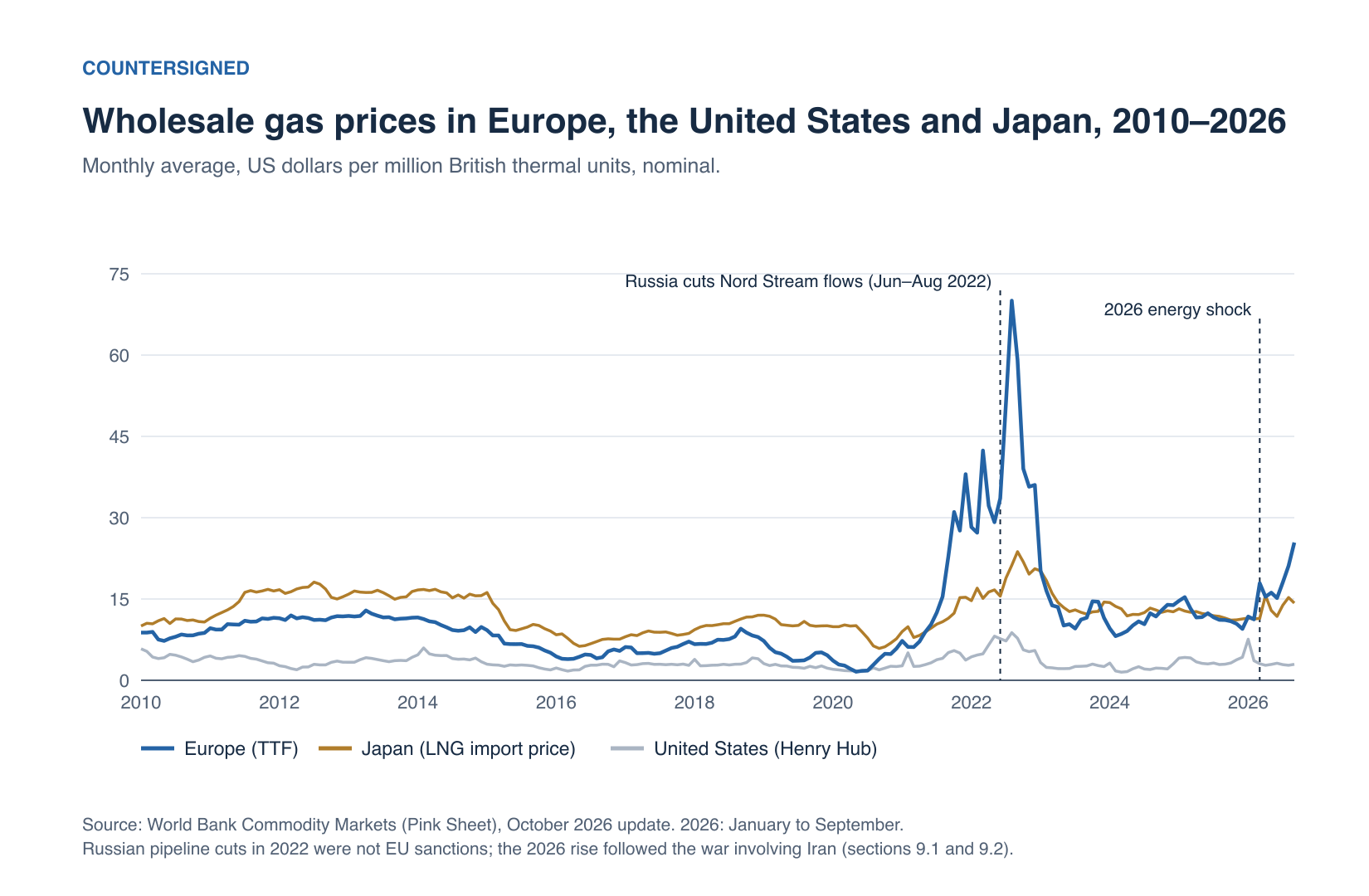
The EU did not prohibit imports of Russian pipeline gas in 2022 (S865; S1078; S622); its first such prohibition is in Regulation (EU) 2026/261 S615. Russia cut deliveries itself S1078. The dated record:
- 2021. In 2021 the European gas price averaged USD 16.1 per mmBtu (million British thermal units, an energy unit), double its 2010–2019 average of USD 8.2, according to Countersigned’s calculation from World Bank data D08. Oxford Institute for Energy Studies (OIES) analysts cite pandemic-related demand, weather and supply constraints (S1336; S475); the International Energy Agency (IEA) noted reduced short-term sales by Gazprom, Russia’s state-controlled exporter, in late 2021 (S991; S615).
- Yamal route and April 2022. Flows via Belarus and Poland fell by more than half between September and October 2021 and last ran on 10 May 2022, according to Countersigned’s calculation from data of the Brussels think tank Bruegel D18. No source held for this report explains the October fall. Gazprom halted supplies to Poland and Bulgaria on 27 April 2022 S1501. According to the IEA, after Russia sanctioned European companies in May, Gazprom announced it would stop using the Yamal pipeline S992.
- Nord Stream 1. Flows fell to 40 per cent of capacity on 15 June 2022, were zero from 11 to 21 July during announced maintenance and fell to about 20 per cent on 27 July, according to German regulators S1500. Gazprom said sanctions prevented the return of turbines serviced in Canada; the IEA reports that Canada granted a waiver but Russia “rejected receiving” them S992. On 31 August, a day after the last flow in Bruegel’s data D18, the Bundesnetzagentur (the energy regulator) reported that the Russian side had stopped deliveries citing “alleged maintenance”, which it found “technically not comprehensible” (our translation) S1495. The regulators’ 2023 report dates the indefinite suspension to 2 September 2022, “reportedly for technical reasons” S1500. The European Commission wrote that Nord Stream 1 ended its operations in September “as a result of sabotage” S1499; the German record shows no flow since early September, before the explosions of 26 September S1500.
- Afterwards. Russian pipeline gas fell from 39 per cent of the inflows tracked by Bruegel in the second half of 2021 to 18.6 per cent in 2022 and 5.8 per cent in 2025, according to Countersigned’s calculation D18. Transit through Ukraine ended on 1 January 2025 (S061; S1214).
None of the 13 studies held for this report apportions the 2022 price rise between these causes (S464; S1338). The IEA attributed the price pressure to reduced Russian flows and low storage, creating “artificial scarcity” S992. No source held for this report attributes the price rise to EU sanctions, and none states that they played no part (S992; S994). EU sanctions on Russian LNG followed from 2024 (S673; S167) (section 3).
In this report’s assessment, the 2022 loss of Russian pipeline gas via Nord Stream and Yamal resulted from Russia’s own decisions, not EU sanctions on gas, although Gazprom blamed sanctions for the turbines and the Yamal stop followed Russian counter-sanctions (high confidence: the official record dates the cuts, and no EU sanction covered pipeline gas that year).
9.2 Energy prices, 2010–2026
Wholesale gas became far dearer in Europe than in the United States or Japan. According to Countersigned’s calculation from World Bank monthly prices (nominal, not adjusted for inflation) D08:
- The European benchmark, the Dutch TTF hub, averaged 4.9 times its 2010–2019 level in 2022, with a monthly peak of USD 70.0 per mmBtu in August 2022, and 1.5 times in 2025.
- The US benchmark, Henry Hub, averaged 1.9 times its long-run level in 2022 and about 1.1 times in 2025; Japan’s LNG import price 1.5 and about 1.0 times.
- In January–September 2026, during the 2026 energy shock, TTF rose to 2.1 times its 2010–2019 level; Henry Hub and Japanese LNG stayed near 1.1 times.
Countersigned indexed Eurostat’s half-yearly prices (national currency) to each country’s 2010–2019 average (= 100) (D02; D03). In 2025, gas for medium-sized industrial users (excluding VAT) stood between 159 in Spain and 246 in Sweden among the countries compared (Germany 193, Poland 205, Hungary 207, EU 182). Household electricity stood at 196 in Czechia, 188 in Poland, 136 in Germany and 108 in Hungary (EU 143); household gas at 201 in France, 192 in Germany and 103 in Hungary (EU 176). Poland’s household gas series ends in 2023 and the UK series in 2020; Eurostat does not cover the United States or Japan (D02; D03).
Gas also drove electricity prices: in 2022 gas plants generated around 19 per cent of EU electricity but set the wholesale price in about 55 per cent of trading hours, according to an OIES paper S1211.
9.3 Inflation and interest rates
Consumer prices (the EU’s Harmonised Index of Consumer Prices, HICP) rose by 9.2 per cent on average in the EU in 2022; among the twelve countries compared, inflation ranged from 5.9 per cent in France to 14.8 in Czechia and 15.2 in Hungary, according to Countersigned’s calculation from Eurostat data D04. In October 2021 the IMF had forecast 2022 inflation of 1.5 per cent for Germany, 3.3 for Poland, 2.6 for the United Kingdom, 3.5 for the United States and 0.5 for Japan. Its October 2026 data show 8.7, 14.4, 9.1, 8.0 and 2.5 per cent (national measures) D09.
Energy items added 3.77 percentage points to euro-area inflation on average in 2022, with a peak of 4.44 points in October D04. Including indirect effects through other prices, Bank of Italy economists estimate the contribution of energy shocks to euro-area headline inflation at “roughly 60 per cent” on average in 2022 S460. An ECB study finds supply factors “playing a primary role”: energy rose first with post-pandemic demand, later with supply effects including distortions “sparked by the Russian invasion of Ukraine” S1010. The Bank of England named higher energy prices “one of the main reasons” for UK inflation S1013, while a Federal Reserve Board study traces the US surge to supply-demand imbalances from the pandemic and the policy response S1012. None estimates a separate effect of sanctions.
The Bank of England raised its rate from 0.1 per cent in December 2021 to 4.5 per cent in May 2023 S1013; the ECB raised rates repeatedly in 2022 S457, and after cuts from June 2024 its policy rate stood at 2 per cent in June 2025 S1366.
In 2026, euro-area inflation reached 3.8 per cent in September (flash estimate), with energy prices 18.8 per cent higher than a year earlier S158. The ECB raised its rates by 0.25 percentage points on 11 June and 10 September 2026, citing the war in the Middle East (S1408; S458); in September it said that this conflict and “recent developments in Russia’s unjustified war against Ukraine” had pushed the path of energy prices up further S458. Neither decision refers to sanctions.
9.4 Growth and industry
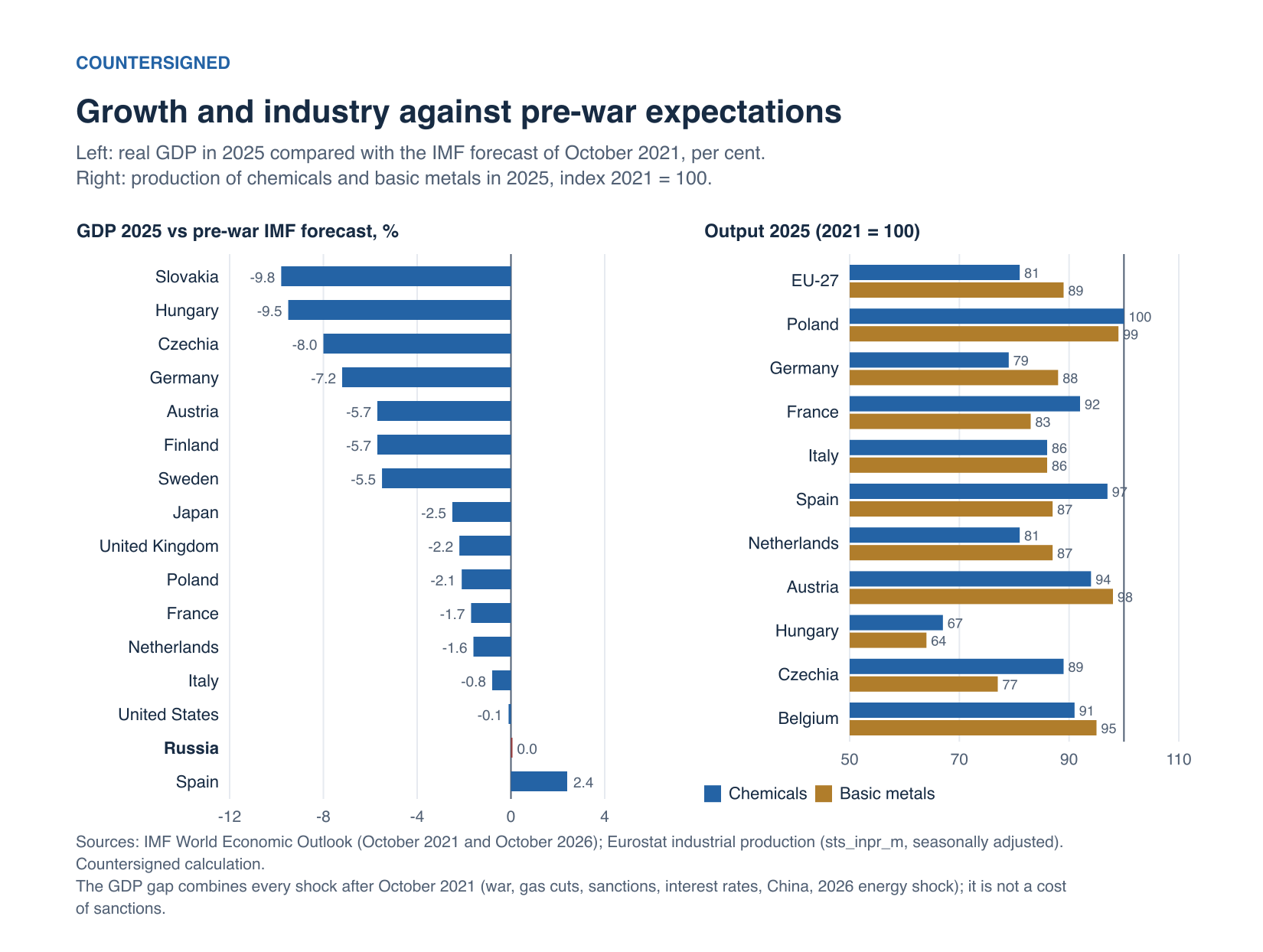
Most sanctioning economies ended 2025 below the IMF’s pre-war forecast. The gap between real GDP in 2025 and the level implied by the IMF’s October 2021 forecasts, according to Countersigned’s calculation from IMF data D09:
- Slovakia −9.8 per cent, Hungary −9.5, Czechia −8.0, Germany −7.2;
- Austria and Finland −5.7, Sweden −5.5;
- Japan −2.5, United Kingdom −2.2, Poland −2.1, France −1.7, Netherlands −1.6, Italy −0.8, United States −0.1;
- Spain +2.4; Russia 0.0 (section 7).
The gap combines every shock since October 2021 (the war, Russia’s gas cuts, sanctions, monetary tightening, the post-pandemic recovery, China, the 2026 energy shock) and forecast error. It is not a cost of sanctions D09.
Against the European Commission’s pre-war forecast of 10 February 2022, growth in 2022 was higher in Poland, Italy, Spain, the Netherlands and Austria, but far lower in Germany (1.9 per cent against 4.6). In 2023 all twelve countries compared grew less than forecast (D06; D10). In 2010–2019 Germany averaged 2.0 per cent a year, Poland 3.8 and Italy 0.3 D06.
On Eurostat’s production indices (2021 = 100), EU output of energy-intensive branches in 2025 stood at 81 in chemicals, 85 in non-metallic minerals such as glass and cement, 89 in basic metals and 91 in paper, against 101 for all manufacturing, according to Countersigned’s calculation D05. German chemicals stood at 79 and Hungarian at 67; Poland’s four energy-intensive branches were at 99 to 106. German manufacturing was already below its 2015–2019 average (105) in 2021. The indices start in 2015; Slovakia lacks branch data, and Finland and Sweden lack chemicals D05.
The German Council of Economic Experts, which advises the federal government, wrote that Russia’s curtailment of gas supplies in summer 2022 had aggravated the energy crisis, which would accelerate a structural change in industry “that was due anyway” S1356. Its later reports added lost competitiveness, “especially against China”, and war-related energy costs alongside decarbonisation, digitalisation and demographic change (S1357; S1358). Clemens Fuest, president of the ifo Institute, linked production cuts to the end of Russian gas via Nord Stream and rising energy prices, but noted that output had been falling “for some time” S1352. The German Economic Institute (IW) notes that Germany was “already” a high-energy-cost location in earlier years S1350. (Our translations.) No held source quantifies how much each cause contributed.
9.5 The cost to public budgets
The think tank Bruegel counted EUR 651 billion “allocated and earmarked” across Europe from September 2021 to January 2023: EUR 540 billion in the EU, EUR 158 billion of it in Germany, and EUR 103 billion in the UK (S481). Earmarked money is not money spent, some measures were still to be “rolled out” (S482), and the count starts before the invasion (9.2).
The European Commission put the net cost to EU budgets at 1.2 per cent of gross domestic product (GDP) in 2022 and 0.9 per cent in 2023, about EUR 190 billion and EUR 150 billion (S059). International Monetary Fund (IMF) staff found that about half the cost of announced support came from “untargeted, price suppressing policies” (S1363).
State aid to companies (support the Commission must approve) is counted separately. Of nearly EUR 796 billion approved between March 2022 and June 2024, EUR 218.86 billion was “actually granted to companies”, 0.52 per cent of EU GDP over the period, and this is aid granted, “not aid actually paid out” (S1037). It cannot be added to the totals above. An EU “solidarity contribution” on surplus profits of oil, gas, coal and refinery companies in 2022–2023, or equivalent national measures, raised EUR 26.15 billion by 30 June 2024 (S059).
On 20 December 2022 the Commission approved EUR 8 billion plus up to EUR 26.5 billion of new capital for Uniper (S1035) and EUR 6.3 billion for SEFE, formerly Gazprom Germania (S1036). In Germany’s account, Uniper’s losses of around EUR 40 billion came from costs “to replace curtailed Russian gas deliveries” (S1035), while SEFE’s costs “stem from the targeted Russian sanctions imposed on entities of the SEFE Group” (S1036); Russia declared them after Germany put SEFE under trusteeship (S1036).
Terminals for liquefied natural gas (LNG), gas shipped in liquid form, involve public funds and guarantees of EUR 2.7 to 2.9 billion for each of three German sites in operation, according to the campaign group Deutsche Umwelthilfe, which cites a non-public ministry report and wants LNG expansion stopped (S495). According to regulator data reported by Bloomberg, the terminals carried about 8 per cent of Germany’s gas imports in 2024; the economy ministry calls them a “safety buffer” and puts the total cost, on a different scope, at likely around EUR 5 billion (S496).
9.6 Lost trade and investment
EU exports to Russia fell from EUR 89.2 billion in 2021 to EUR 30.3 billion in 2025 and were EUR 19.4 billion in January to August 2026, according to Countersigned’s calculation from Eurostat trade data in nominal terms (D01). The data do not show how much of the fall export bans caused.
Western companies wrote off large sums: BP a post-tax charge of USD 24.4 billion in 2022 on exiting Rosneft (S1055) and TotalEnergies USD 14,756 million of war-related impairments and provisions (S1128). In 2025 BASF booked EUR 1,338 million of income, mainly from German federal guarantees for Wintershall Dea’s expropriated Russian assets, so part of that loss fell on the German state (S1056).
The overall tallies differ in definition and are not additive. The KSE Institute in Kyiv, whose #LeaveRussia list urges companies “to stop funding the war” (S901), counted in March 2025 confirmed losses above USD 170 billion, over USD 167 billion of them write-offs, including more than USD 57 billion by companies whose assets Russia seized (S903). Reuters counted more than USD 107 billion of “writedowns and lost revenue” by March 2024 (S080).
Near the eastern border, the Commission wrote in February 2026, “tighter border controls and sanctions have disrupted trade” and rail freight volumes fell by as much as 75–80 per cent (S1044). Commission economists estimated that in 2022–2023 bordering states lost around 1.4–1.8 percentage points of annual growth relative to the EU average through proximity to the war, an effect of the war as a whole that energy costs and inflation “can effectively account for” (S1045).
9.7 Who gained
The United States supplied 58 per cent of EU LNG imports in 2025, according to ACER, the EU agency of energy regulators (S084). Norway’s government petroleum revenue in 2022, estimated at NOK 1,457 billion, was “by far the highest ever recorded”, according to Statistics Norway (S1061).
In the EU–US framework of 21 August 2025 the EU “intends to procure” US energy “with an expected offtake valued at $750 billion through 2028” (S1070). Experts cited by Bloomberg doubted this, as EU energy imports from the US were below USD 80 billion in 2024 (S510).
Wind and solar overtook fossil fuels in EU electricity in 2025, with 30.1 per cent, up from 19.7 per cent in 2020, according to the think tank Ember (S1068), and EU gas demand in 2025 was 17 per cent below its 2019–2021 average, according to Bruegel (S998); neither source isolates an effect of sanctions. The switch created a new dependence: ACER notes an increased exposure “particularly to US supply” (S084).
9.8 Who bears the costs
In the euro area, European Central Bank economists found that between the third quarters of 2021 and 2022 the poorest fifth of households lost twice as much purchasing power, relative to income, as the richest (S1073). The Commission’s Joint Research Centre estimated that fiscal measures made up for about a third of households’ welfare loss in 2022, with large differences between countries, and were “not particularly well targeted at low-income households” (S1072).
Differences between countries in real GDP against the IMF’s pre-war forecast are set out in section 9.4. A study co-authored by the Institute for European Environmental Policy found some Western member states hit harder by electricity price shocks than Central and Eastern ones, though not by transport-fuel prices (S520). None of the sources held for this report compares the burden across countries in money terms.
9.9 The balance
None of the sources held for this report divides the 2022 rise in energy prices between Russia’s supply cuts, sanctions, the tight market of 2021 and other causes. The International Energy Agency blamed reduced Russian flows and low storage for “artificial scarcity” (S992) and the European Commission, a party to the sanctions, called Russia’s “weaponisation” of its gas exports “the dominant element” in July–September 2022 (S1499), but neither assigns shares. No defensible single figure for “the cost of sanctions” therefore exists. Four judgements follow:
- The largest cost of 2022 followed Russia’s own cuts. High energy prices, the support they triggered and the Uniper and SEFE rescues (9.5) followed the cuts in Russian pipeline deliveries (9.1), not EU measures: the EU prohibited imports of Russian pipeline gas only by a regulation of January 2026 (S615). Part of the rise began in 2021 (9.2). (Moderate confidence: no study apportions the price rise by cause.)
- After the oil measures took effect, oil prices fell. The EU ban on Russian crude applied from 5 December 2022 and on oil products from 5 February 2023 (S662; section 3), alongside the price cap on Russian oil carried with Western services. Brent crude averaged USD 82.6 a barrel in 2023, against USD 99.8 in 2022 and USD 79.6 in 2010–2019, according to Countersigned’s calculation from World Bank data (D08). The figures do not show why, and the 2022 average includes the months after the embargo was adopted in June. Brent rose again in 2026, averaging USD 94.0 in January–September and peaking at USD 120.4 in April, with the 2026 energy shock (9.2), not a sanctions measure (D08).
- Some costs follow at least partly from Western decisions: trade in the eastern border regions, which the Commission says tighter border controls and sanctions disrupted (S1044); write-offs, which mix sanctions, voluntary exits and Russian seizures (9.6); and replacement LNG and terminals, which answered both Russia’s cuts and the EU’s decision to end imports (section 3). (Low confidence for any split: no held source divides these costs by cause.)
- The benefits are not priced either: lower dependence on Russian energy (section 5) and revenue denied to Russia (section 7), against a new dependence on US LNG (9.7).
10. Effects beyond the West
Who gained from redirected trade
The think tank Bruegel found exports to Russia from sanctioning countries fell from an average of USD 10.5 billion a month before the invasion to USD 4.6 billion in 2023, while exports from Brazil, China, India, Kazakhstan and Türkiye rose from USD 6.0 billion to USD 11.5 billion, “close to” making up the shortfall S524.
By Countersigned’s calculation from estimates by the Finland-based research organisation CREA (Centre for Research on Energy and Clean Air), Russia earned an estimated EUR 1,165 billion from fossil-fuel exports between 24 February 2022 and 14 October 2026; China accounted for about 31 per cent, the EU for 20, India for 16 and Türkiye for 12 (S412; D13).
UN Comtrade customs data measure the value declared by importers instead. By Countersigned’s calculation, India’s imports from Russia rose from USD 8.7 billion in 2021 to USD 62.9 billion in 2025, including USD 45.4 billion of crude oil; China’s from USD 79.6 billion to USD 124.0 billion; and Türkiye’s from USD 29.0 billion to USD 42.4 billion, after USD 58.8 billion in 2022 D12.
The think tank Carnegie India estimates that Russian discounts benefited Indian refiners by approximately USD 12.2 per barrel S020. India’s Russian crude imports fell significantly in November 2025, after US sanctions on Rosneft and Lukoil and US tariffs on India S020 (section 3).
International Monetary Fund staff estimated unrecorded re-exports from Kyrgyzstan to Russia at about 30 per cent of Kyrgyz gross domestic product in 2022; this trade, predominantly re-exports from China, boosted growth S887 (section 6).
Food and fertilisers
In 2021 Russia, Ukraine or both ranked among the top three exporters of wheat, maize, rapeseed and sunflower seeds and oil, and Russia led in nitrogen fertiliser exports, according to the UN Food and Agriculture Organization (FAO) S1083. FAO’s index of world food prices peaked in March 2022 and in September 2026 was 15.1 per cent lower S1082.
A peer-reviewed study by researchers at the International Food Policy Research Institute described 2022 prices, in its introduction, as “driven in large part by the fallout from the war in Ukraine and sanctions imposed on Russia”, without separating the two S1089. It notes a pre-war rise in fertiliser prices, largely due to a Chinese export ban S1089. The European Commission, a party to the sanctions, stated in July 2022 that the food price rise “is not caused by EU sanctions” and that Russian agricultural products were not targeted; EU imports of certain potash fertilisers were restricted S1096. In July 2023 the UN Secretary-General acknowledged remaining obstacles to Russia’s food and fertiliser trade S115.
The UN-brokered Black Sea Grain Initiative moved over 32 million tonnes of grain and foodstuffs, according to the UN, until it expired on 17 July 2023 (S531; S1092). The Polish think tank OSW reported that Russia conditioned its return on concessions, including reconnecting its state agricultural bank to the SWIFT banking network, and judged the withdrawal an attempt to “drive up prices” S116. No held source measures the share of sanctions in food price rises (section 15).
Gas for poorer importers in 2022
The 2022 gas shock followed Russia’s own cuts to pipeline supplies S1504, not EU sanctions (section 9). According to the think tank IEEFA (Institute for Energy Economics and Financial Analysis), Europe’s demand for liquefied natural gas (LNG) “squeezed the volumes available to developing economies” S1504. The International Energy Agency named competition with Europe, and lower supply from Australia and the United States, as pushing up Asian spot prices (paid for single cargoes): Pakistan was “all but priced out” of the spot market, and Bangladesh shed nearly 20 per cent of its electricity load in mid-July 2022 S992.
Reserves, gold and currencies
In 2022 the Group of Seven and the EU froze Russian central-bank reserves held by other central banks S1107 (section 11). Economists Arslanalp, Eichengreen and Simpson-Bell report that 60 per cent of respondents to a 2023 Invesco survey of sovereign asset managers said the freeze made gold more attractive S1104. Central banks bought over 1,000 tonnes of gold a year in 2022–2024 and around 850 tonnes in 2025, according to the European Central Bank, which cites geopolitical tensions S1106. The same economists find no accelerating decline in the dollar’s share of reserves, “contrary to claims” that US financial sanctions accelerated it S1104.
In this report’s assessment, Russia’s trade has shifted since 2022 towards China, India, Türkiye and intermediaries, which gained discounted energy and transit business (high confidence: customs data and CREA estimates agree). The held sources link the 2022 food and gas strains on poorer importers to the war, Russia’s gas cuts, export restrictions and LNG competition; one study names sanctions, but none isolates them (moderate confidence: no held study separates the two).
11. Russia’s immobilised assets: what is new since 8 October 2026
This section updates the Countersigned report “Follow the money: who pays for the war in Ukraine and who earns from it” (8 October 2026).
State of play
Most of the immobilised assets (blocked but Russian-owned) sit at Euroclear, a Belgian firm that holds securities (S666; S079; S075). On 30 June 2026, EUR 202 billion of its balance sheet “relate to sanctioned Russian assets” S075. It pays “a large portion” of the profits on them to the EU: about EUR 6.6 billion by 17 July 2026 S075.
In December 2025 Belgium was still resisting a Commission proposal to lend Ukraine the cash accumulated on these assets, according to the European Parliament’s research service (S709; S1204); EU leaders then chose joint borrowing and, in Euroclear’s words, “decided not to proceed with a Reparations Loan backed by Russian immobilised assets at this stage” S076. Instead, Regulation (EU) 2026/467 of 24 February 2026 lends Ukraine up to EUR 90 billion for 2026–2027 from EU borrowing, repayable only once Russia pays reparations (S1203; S032).
Since December 2025 Council Regulation (EU) 2025/2600, adopted by qualified majority under the treaties’ emergency clause, Article 122(1), has also blocked the assets, so one veto at the six-monthly renewal can no longer free them (S666; S627; S1192; S623). The measures, called “temporary”, lapse when Russia ends the war, pays reparations and no longer threatens the EU economy S666. The Commission defended the legal basis S627; Valentin Kreilinger of the Swedish Institute for European Policy Studies calls it a “legal workaround” with possible repercussions S623; researchers Til Leichsenring and Julia Popp argue it “violates the Treaties” S1192.
On 15 May 2026 a Moscow court ordered Euroclear to pay Russia’s central bank RUB 18.17 trillion; Euroclear’s appeal was rejected on 16 July 2026 (S078; S075). Euroclear does not recognise the court’s jurisdiction and, UNN reported on 30 June 2026, has sued in Belgium to block enforcement (S075; S1209).
New since 8 October 2026
On 15 October 2026 the Anadolu news agency relayed a Financial Times report, citing unnamed sources, of a US proposal to unfreeze some Russian assets held in Europe and put them in a US-overseen financial vehicle to revive peace talks (section 8) S1280. The paper reported that European delegates rejected it; a US official said release mechanisms “remained under consideration” S1280. On 17 October 2026 President Volodymyr Zelensky said the issue was “fully under Europe’s control” S1281.
12. Consistency of declarations and practice
Each state is tested, as far as records are held, on four measures: its leaders’ dated statements of purpose; whether it kept buying Russian energy or nuclear fuel, and how much; the exemptions it sought or obtained; and its companies’ conduct. Declarations are held for six states; states without one are described but not ranked. Three counter-arguments are weighed: a declared gradual phase-out, physical constraints, and the steep fall in dependence.
Declarations
- France. Emmanuel Macron, 24 February 2022: sanctions “à la hauteur de l’agression” (“commensurate with the aggression”, our translation) S1466. Finance Minister Bruno Le Maire, 1 March 2022, as relayed by AFP: “We will bring about the collapse of the Russian economy” S571. He also spoke of “economic war”, later telling AFP his language had been “inappropriate” S572.
- Poland. Mateusz Morawiecki, 25 March 2022, according to his office: Poland was among the states proposing “najdalej idące sankcje” (“the furthest-reaching sanctions”, our translation) S1116.
- United States. Joe Biden, 8 March 2022: “We’re banning all imports of Russian oil and gas and energy” S1118.
- United Kingdom. Boris Johnson, 24 February 2022: sanctions “designed in time to hobble the Russian economy” S1477.
- Hungary. Viktor Orbán, October 2022, in his office’s English paraphrase: EU sanctions policy “is primitive in its implementation and disastrous in its impact” S1481.
- Slovakia. Robert Fico, 26 June 2025, according to his office: Slovakia would seek “finančné nástroje na odškodnenie” (“financial instruments for compensation”, our translation) if prices rose significantly S1482.
No held source records Japanese or South Korean leaders’ sanctions declarations.
Practice
Figures are Countersigned’s calculations of mineral-fuel imports (coal, oil, gas) from Russia at nominal border values: Eurostat D01 in euros, to August 2026; for non-EU states, UN Comtrade D12 in dollars, to 2025. They show where gas entered, not where it was used S862. Values for 2026 also reflect the 2026 energy shock (sections 7 and 9).
- United States. None recorded in 2025 D12. Russia supplied 25.8 per cent of US reactor owners’ enrichment purchases in 2025, according to Countersigned’s calculation from Energy Information Administration data (S853; D17).
- United Kingdom. None recorded in 2024 or 2025 D12.
- Japan. USD 3.5 billion in 2025, mostly gas D12. Japan obtained a Sakhalin-2 exemption from the G7 ceiling on Russian oil prices S549; the US licence described in section 3 let Mitsui and Mitsubishi keep buying the project’s liquefied natural gas (LNG), according to Jiji Press S552.
- South Korea. USD 3.5 billion in 2025, mainly coal and gas D12; no held source records an exemption.
- Hungary. EUR 4.5 billion in 2025 (EUR 2.8 billion gas, EUR 1.7 billion oil), above 2021’s EUR 3.7 billion, and EUR 2.3 billion in January–August 2026 D01. Only crude oil delivered by the Druzhba pipeline falls under the EU’s 2022 exemption, which Slovakia and Czechia share S302. Hungary also obtained a US exemption in November 2025: for one year, according to Secretary of State Marco Rubio, and for an unlimited period, according to the Hungarian government; no Treasury text is held (S542; S543). The energy group MVM holds Gazprom Export contracts for 4.5 billion cubic metres a year, with an obligation covering 2025–2036 S1133; Rosatom is building two units at the Paks nuclear plant S856.
- Slovakia. EUR 2.6 billion in 2025 (EUR 2.0 billion oil, EUR 0.6 billion gas) and EUR 1.5 billion in January–August 2026 D01; the oil came under the same pipeline exemption S1122.
- Czechia. EUR 0.3 billion of oil in 2025 D01.
- France. EUR 3.2 billion in 2025, all gas, EUR 2.3 billion in January–August 2026, and EUR 1.2 billion of nuclear materials and fuel in 2022–2026 D01.
- Belgium, Spain, Netherlands. EUR 1.8, 1.3 and 1.0 billion in 2025, all gas, and EUR 1.5, 1.4 and 1.0 billion in January–August 2026 D01.
- Greece, Bulgaria, Italy. EUR 1.3, 0.9 and 0.3 billion in 2025, all gas; EUR 0.9 and 1.0 billion for Greece and Bulgaria in January–August 2026 D01.
- Germany, Poland. None recorded in 2025 D01.
- Austria. Customs data record only EUR 0.4 billion of Russian mineral fuels even in 2021 D01, while the research centre CREA attributes EUR 10.2 billion of estimated Russian gas revenue since the invasion to Austria D13 and OMV took Russian gas until November 2024 S1125. Countersigned infers that the customs data miss these pipeline flows; no held source explains the gap.
- EU nuclear imports. EUR 0.8 billion of Russian enriched uranium and fuel elements in 2025 D01. The EU’s nuclear supply agency noted that the EU had taken no direct measures on Russian nuclear materials but that “the policy direction aims toward full phase-out” S336.
Comparisons with aid to Ukraine depend on definitions (section 5).
Public opinion
Eurobarometer results are held only as EU averages relayed by the EU-funded service EU NEIGHBOURS east: 72 per cent supported economic sanctions on Russia in spring 2025 S564 and 70 per cent backed “maintaining sanctions against Russia” in spring 2026 S565. Wording and country results are not held. Separate Pew Research Center surveys found 85 per cent of Americans for strict economic sanctions in March 2022 and 69 per cent in July 2024 (S1140; S1141).
Russia’s own declarations
No held source records a Russian leader saying that sanctions do not work. Russia sought their removal: on 14 June 2024 Vladimir Putin said that fixing his terms in agreements “предполагает и отмену всех западных санкций против России” (“implies the lifting of all Western sanctions against Russia”, our translation) S1259 (section 8).
Assessment
Among the six states whose leaders’ declarations are held, the widest gaps appear in France, which kept importing Russian gas (customs data record where gas entered, not where it was used) and nuclear materials after its finance minister spoke of bringing about the “collapse” of Russia’s economy, words he later called “inappropriate”, and in the United States, which banned Russian energy imports but still bought about a quarter of its enrichment work from Russia in 2025 and granted exemptions to Hungary and Japan. Hungary and Slovakia show the smallest gap: their leaders criticised sanctions or sought compensation, and their states used exemptions and voted against the EU’s gas phase-out S700.
Three counter-arguments narrow the gaps. The declared path was gradual: the EU’s gas regulation allows long-term contracts for Russian LNG until 31 December 2026 and for pipeline gas until 30 September 2027 S862, and US waivers from a 2024 ban on Russian enriched uranium end by 2028 S724. Physical constraints were real S265 but easing: all EU operators of Russian-designed reactors had non-Russian fuel contracts by the end of 2025 S774, and Hungary’s oil group MOL expects to rely fully on non-Russian crude by 2026 S1123. Dependence fell steeply: by Countersigned’s calculation, EU mineral-fuel imports from Russia went from EUR 104.0 billion in 2021 to EUR 17.4 billion in 2025 D01. In this report’s assessment, for most states the divergence lay more in pace than in direction; Hungary, whose recorded import value rose, is the exception (moderate confidence: import values move with prices, the declarations quoted are a selection, and no held source measures each state’s alternatives).
13. Alternatives: would diplomacy and a security arrangement with Russia have cost less?
This section tests the hypothesis that diplomacy and a security arrangement with Russia would have cost the West less than the policy it pursued. The war’s diplomatic history is told in the Countersigned report “Russia and Ukraine: history, war, diplomacy and prospects” (28 September 2026).
What Russia proposed and what it was offered, 2021–2025
On 17 December 2021 Russia’s Foreign Ministry published a draft treaty with the United States on “security guarantees” S095. Under Article 4, the United States would “prevent further eastward expansion” of NATO and deny membership to former Soviet states S095. The parallel draft for NATO is known to this report only second-hand: according to Steven Pifer of the Brookings Institution, a US think tank, it would rule out enlargement, “including in particular to Ukraine”, and bar NATO forces or weapons in “countries that joined the alliance after May 1997” S581.
According to excerpts published by the Spanish daily El País on 2 February 2022, the US and NATO replies rejected a bilateral security agreement and closing NATO’s door to Ukraine, but offered talks on disarmament and “trust-building measures”, conditional on de-escalation S1148. Chatham House, a London think tank, doubted that anyone in Russia expected agreement, but called it “a mistake” to turn down negotiations S096.
A communiqué from talks in Istanbul on 28–30 March 2022 envisaged Ukraine as “a permanently neutral state under international legal guarantees” S956. The draft treaty of 15 April 2022 marks many provisions as one side’s position “not agreed upon” by the other S957. According to the researchers Samuel Charap and Sergey Radchenko, Ukraine wanted a peacetime army of 250,000 and Russia “a maximum of 85,000” S1179. Japan’s National Institute for Defense Studies concluded that “consensus was not reached” on the draft S112, contrary to President Putin’s statement of 14 June 2024: “We reached consensus on all points” S1180. David Arakhamia, head of Ukraine’s delegation, said in 2023 that Boris Johnson, then UK prime minister, told Kyiv “let’s just fight”, though the same article reports that he denied that Johnson “forced Kyiv’s hand” S098; Johnson called such claims “total nonsense” S099. Charap and Radchenko found “no single smoking gun” S1179.
On 14 June 2024 Putin offered talks once Ukraine began a “full withdrawal of its troops” from four regions and gave official notice that “it abandons its plans to join NATO”; a settlement, he added, “entails the removal of all Western sanctions” S1180. Russia’s memorandum of June 2025, as relayed by the Belarusian agency BelTA from TASS, sought legal recognition of Crimea and the four regions as Russian and the lifting of all sanctions S1267.
The debate over NATO enlargement
The realist scholar John Mearsheimer wrote in 2014 that the United States and its European allies “share most of the responsibility”, with NATO enlargement as the “taproot” S1173; Stephen Walt wrote in 2022 that realists had “repeatedly warned” of “serious trouble” S1175. John M. Owen of the University of Virginia’s Miller Center replies that the invasion is “a reaction to NATO expansion” but not “the West’s fault” S604. Veronica Anghel and Dietlind Stolle of the European University Institute see a “flawed reading of Russia as devoid of imperialist goals” S605; Alexander Motyl, answering the 2014 article, noted that neither NATO nor any major member had said Ukraine “should be incorporated immediately” S607.
Four scenarios compared
No held source costs these scenarios in full, but two points apply to all. First, as section 9 assesses, Europe’s largest economic cost in 2022, through energy prices, followed Russia’s own cuts in pipeline gas supplies, not EU gas sanctions, which came only in 2026 (moderate confidence: no study apportions the price rise); the International Energy Agency (IEA) wrote in 2022 that Russia’s use of gas “as a political weapon” had become “increasingly obvious since September 2021” S992. In this report’s judgment, Moscow would have kept that lever in every scenario (low confidence: no held source models gas supply under a settlement). Second, NATO allies committed on 25 June 2025 to spend 5 per cent of GDP a year by 2035, at least 3.5 per cent on core defence and up to 1.5 per cent on related spending, against an estimated 2.3 per cent for European allies and Canada in 2025 (S1171; S1172; S089). Alexandr Burilkov and Guntram Wolff estimated for the think tank Bruegel that without US forces Europe could need at least EUR 250 billion more a year in the short term S1435.
- A. Current policy. Sanctions, aid to Ukraine and talks continue (costs in sections 9 and 10). In early 2026 ceding territory remained “a major sticking point”, according to the House of Commons Library S124. For Ukraine: continued war.
- B. Sanctions as a bargaining chip. Relief for specified Russian steps, reimposed automatically (“snapback”) on a breach. Erica Moret of the Graduate Institute in Geneva argues that relief “need not imply a loss of leverage” because it can be reversed S611. The 2015 nuclear agreement with Iran (JCPOA) had such a mechanism; a Carter Center study she co-wrote found only “temporary success” for its phased relief, until the US withdrew S1183. Both the US 28-point plan published by Axios in November 2025 and the European counter-proposal would restore “all global sanctions” if Russia invaded Ukraine (S121; S963). In this report’s reading, feasibility turns on territory and alignment.
- C. Settlement on Russia’s stated terms, in two versions with different dates. Russia’s draft treaty of 17 December 2021 would have committed the United States to “prevent further eastward expansion” of NATO and to limit deployments S095. Its terms of June 2024 and June 2025 require Ukrainian forces to leave four regions and Ukraine to stay out of military alliances (S1180; S1268); the 2025 memorandum, as relayed by BelTA from TASS, also foresees the lifting of all sanctions in force against Russia and no new ones (our translation) S1267. The European Council on Foreign Relations (ECFR) judges that even if fighting stops, the risk of a new war “will remain substantial for years, possibly decades” S133. In a poll by the Kyiv International Institute of Sociology of 12–24 February 2026, 57 per cent of respondents found withdrawal from Donbas in exchange for US and European guarantees “categorically unacceptable”; 36 per cent would approve it (our translation) S107. For Ukraine: withdrawal from four regions “within their administrative borders” S1180.
- D. Maximum pressure. A full energy embargo and secondary sanctions on third-country buyers (sections 3 and 6). No held source estimates its cost or its effect on Russia’s terms. In August 2025, according to the Polish think tank OSW, US Secretary of State Marco Rubio justified holding back new sanctions by concern that Russia could leave the talks S1265.
Two published estimates of the cost of a Russian victory could not be read for this report. Of one, only a press headline survives, contrasting USD 972 billion “for victory” with USD 1.8 trillion “when Russia comes for Baltics” S601. These figures are unverified.
Proposals for a negotiated arrangement
- RAND, a US research organisation: the war “will most likely end with some sort of negotiated outcome” (January 2023) S1162; more military pressure on Russia after the war “could pose more risks than benefits” (February 2024) S1163.
- Quincy Institute, a US think tank favouring restraint (February 2024): “Ukrainian neutrality and a multilateral arms control regime in return for Ukrainian independence”, with sanctions relief in an “economic basket” S1440.
- Chatham House: only “a convincing Ukrainian victory” safeguards Europe (June 2023) S1447; a ceasefire “that is rushed or poorly defined” could let Russia “regroup and rearm” (May 2026) S1448.
Assessment
These are this report’s judgments.
- The hypothesis cannot be settled with the evidence held (unresolved: no held source costs a negotiated alternative, and what Russia would have accepted and kept to cannot be observed). A costed comparison would change this.
- Russia’s demands from 2021 to 2025 concerned NATO’s posture, Ukraine’s alignment and armed forces, and territory; sanctions relief was one demand among these from 2022 (high confidence: Russia’s own texts state them) (S095; S112; S1180; S1267).
- Sanctions and diplomacy were not alternatives in the record. Relief appears in the Istanbul negotiating texts of 2022, in Russia’s terms of 2024 and 2025 and in the 2025 US and European plans (section 8) (high confidence: the texts name it) (S957; S112; S1180; S1267; S121; S963).
- A settlement on Russia’s terms would probably not have removed rearmament costs (low confidence: this rests on analysts’ forecasts of Russian behaviour) (S133; S1448). Verified costings, such as the two studies that could not be read, would change this.
14. What next: reversibility and indicators
How easily measures can be undone
According to the US Congressional Research Service (CRS), most EU sanctions run for “usually six months or a year” and need unanimity to be renewed, so one government can block them (S1193; S627). Russia’s central bank assets in the EU, immobilised under Article 122 of the EU treaties since December 2025, need no such renewal (section 11) (S666; S623).
The gas phase-out, Regulation (EU) 2026/261, is energy and trade legislation adopted with the European Parliament without national vetoes (S615; S618). Hungary (C-46/26) and Slovakia (C-398/26) ask the EU Court of Justice to annul it or declare it invalid, arguing first that it is in substance a sanction (S701; S702). No judgment, and no description of a repeal route, is held.
In the United States, Congress can vote to block a presidential waiver or termination of certain Russia sanctions written into law, within 30 days (CRS, 2022) S1194 or “either 30 or 60 days” (CRS, 2026) S1195. A bill of 30 June 2026 (H.R. 9552), not law, would extend this review to measures under Executive Order 14024 S643. Executive relief can be quick: General License 135 for Russian diesel on 9 October 2026 S149 and, on 16 October, an open-ended waiver of the Graham Act’s new duties and sanctions (section 3) S723.
Prospects for Russian gas
Studies from 2025, before Regulation 2026/261 and the 2026 energy shock, mostly expected no large return (S645; S648; S647; S646; S650).
Indicators to watch
- Council renewal decisions S1193, and the Commission’s review of the asset regulation, due by 31 December 2026 S666.
- Rulings in C-46/26 and C-398/26; Hungary’s foreign minister, Péter Szijjártó, expected Hungary’s case to last one to two years S618.
- The gas ban for long-term contracts: LNG from 1 January 2027, pipeline gas from 30 September 2027 (in some states 1 November 2027) S615.
- The expiry of General License 135 on 7 April 2027 S149, and any further US waivers.
- The Urals discount to Brent (section 6): about USD 20–25 a barrel through July 2026, according to BOFIT, the Bank of Finland’s research institute S1518.
- Russia’s oil and gas budget revenue (down 17.2 per cent in January–September 2026) and federal deficit (2.2 per cent of GDP in January–September 2026; section 7), from preliminary Finance Ministry data reported by Trading Economics S1520.
- EU imports from Russia in Eurostat’s Comext data (section 5), available to August 2026 D01.
- Brent D08 and TTF (Europe’s main wholesale gas benchmark) while the 2026 energy shock lasts; the Oxford Institute for Energy Studies ties TTF’s mid-September 2026 peak of EUR 83.53 per megawatt hour (ten-year average: EUR 39.63) to the war involving Iran S1213.
- Ceasefire markets, as market prices, not forecasts by this report: Polymarket betting pages archived in May and June 2026 showed 70 per cent for a ceasefire by end-2027 and 26 per cent by end-2026, but the same pages also contain contradictory automatic text (S128; S129). No later readings are held.
15. Contested claims: what the evidence shows
Each claim is given in a typical wording, not as a quotation; “not supported” means that the sources held contain no evidence for a claim, not that every element of it has been disproved.
- “Sanctions hurt Europe more than Russia.” — Cannot be tested with the evidence held. By Countersigned’s calculation from International Monetary Fund (IMF) data, Russia’s output in 2025 matched the IMF’s pre-war forecast, while Slovakia’s was 9.8 per cent below its own, Germany’s 7.2 and Poland’s 2.1 D09. These gaps combine every shock since the forecast on both sides (section 9.4). Europe’s largest cost, in 2022, followed Russia’s own gas cuts S1500 (moderate confidence: no study apportions the price rise). In Russia, sanctions acted through oil discounts and dearer imports (S880; S938) (section 7). No held study apportions either side’s losses to sanctions (section 9.9).
- “The EU paid Russia more for fuel than it gave Ukraine.” — Depends on definitions. Cumulative totals support it: Reuters reported more than EUR 213 billion of EU imports of Russian energy since 2022, against EUR 167 billion of EU aid allocated, citing CREA, a Finnish research organisation, and the Kiel Institute (S562; S563); CREA’s figure is an estimate of Russian export revenue, not a customs value. Annual comparisons vary: Kyiv Post, using Kiel data for Europe, found that European aid has “outpaced Russian fossil fuel imports on a yearly basis” since 2023 S563; CREA’s contrary finding for the invasion’s third year counts financial aid only S325 (section 5).
- “Sanctions caused Germany’s energy crisis.” — Not supported as stated. European gas prices had already doubled in 2021 against their 2010–2019 average, by Countersigned’s calculation from World Bank data D08. The EU did not sanction Russian pipeline gas in 2022 (S865; S1078; S622). Russia cut deliveries itself S992; some cuts followed its own sanctions on European companies, among them entities of SEFE, the former Gazprom subsidiary that Germany had placed under trusteeship (S992; S1036) (section 9.5). Gazprom blamed sanctions for turbines held in Canada, which granted a waiver; Russia “rejected receiving” them, according to the International Energy Agency S992. No held source attributes the 2022 price rise to EU sanctions, or rules out a part for them (S992; S994) (section 9.1; moderate confidence).
- “Russia’s economy is growing, so sanctions fail” / “Sanctions will collapse Russia’s economy.” — Both overstated. France’s finance minister, Bruno Le Maire, said on 1 March 2022, as reported by AFP: “We will bring about the collapse of the Russian economy” S571. Russian output fell by 1.4 per cent in 2022, not the 8.5 per cent the IMF expected in April 2022 D09. Growth in 2023–2024 came largely from war spending (S405; S931); it slowed to 1 per cent in 2025 S404. Output alone does not test declared aims such as raising the cost of the war S951 (sections 7 and 8).
- “Sanctions caused a food crisis in Africa.” — Overstated. The European Commission, a party to the sanctions, stated in July 2022 that Russian agricultural products were not targeted; some potash imports were restricted S1096. A peer-reviewed study by researchers at the International Food Policy Research Institute described 2022 prices as “driven in large part by the fallout from the war in Ukraine and sanctions imposed on Russia”, without separating the two S1089. No held source measures the share of sanctions in food price rises (section 10).
- “The United States profits from the sanctions through LNG.” — Partly true. The United States supplied 58 per cent of EU imports of liquefied natural gas (LNG) in 2025, according to ACER, the EU agency of energy regulators S084; this measures market share, not profit. EU buyers turned to LNG as Russia cut pipeline supplies in 2022, according to the think tank IEEFA S1504, and EU sanctions on Russian LNG followed only from 2024 (S673; S167) (section 9.7).
- “Without sanctions the war would have ended sooner.” — Cannot be tested with the evidence held. Russia has treated sanctions relief as a bargaining item, but the held record links no change in its stated war aims to sanctions (S1180; S1268) (section 8.5). What Russia would have accepted without sanctions cannot be observed (section 13). Nor does any official text held promise that sanctions alone would end the war (section 8.1).
Method and evidence limits
Question and scope. The report asks which sanctions the EU, the United States, the United Kingdom, Canada, Japan and other aligned states imposed on Russia from February 2022 to the evidence cutoff of 19 October 2026, why they came at the pace they did, and what they did and cost. The war’s history and diplomacy, and its money flows, are covered in Countersigned’s reports of 28 September and 8 October 2026.
Sources. Of 1,556 sources registered, 1,182 were downloaded and stored before writing. The report cites 344 of them and 15 datasets, all read from the stored copies. They include legal acts, official statistics, central banks, regulators, research institutes and think tanks on all sides of the debate, companies, and journalism, the last used mainly for statements and events. Russia’s Ministry of Finance could not be reached, so Russian budget figures come from BOFIT, the Bank of Finland’s research institute, and from news reports of the ministry’s data. Sources that refused automated access were recorded as not held and are not cited.
Figures. Trade values, prices, inflation, growth and output were computed by script from the original datasets and are marked as Countersigned’s calculations. Amounts are nominal; US dollars were converted at the ECB’s annual average rates where one currency was needed. Import value, estimated Russian export revenue and Russian budget revenue are kept apart throughout.
Checking. Agents reading the stored sources recorded each fact with a verbatim phrase, which a script located in the stored file. A separate AI agent then checked each drafted section sentence by sentence against the cited sources. The text was corrected, and each claim was registered with its passage. These are AI checks, not independent human review.
Limits.
- No held study apportions the 2022 rise in European energy prices between Russia’s supply cuts, sanctions, the 2021 gas market and other causes. A gap against a pre-war forecast measures everything that happened after the forecast.
- EU customs data record almost no Russian gas imports for Germany or Austria.
- Data for 2026 are affected by the energy shock that followed the outbreak of the war involving Iran.
- Russian statistics have been restricted since 2022.
- Many sources belong to the sanctioning side. The European Commission is a party to the sanctions; BOFIT, the European Central Bank and the Federal Reserve are institutions of sanctioning states, which also make up most of the IEA’s members. Their findings are attributed and weighed like those of CREA, the Kyiv School of Economics and Russian sources.
- Section 13 is a structured judgment, not a costed model.
Review. The text was drafted with AI assistance (Claude). The publisher, Łukasz Ostrowski, is responsible for the publication. External specialist review is not part of Countersigned’s model; no independent human fact-check has taken place. Corrections: countersigned.org/en/corrections.
Glossary
- Anti-circumvention tool (EU): a power, added in 2023, to restrict exports of listed goods to a third country that persistently allows them to be re-exported to Russia.
- Customs (CIF) value: the value of imports at the EU border, including transport and insurance; the basis of Eurostat’s trade statistics.
- Counterfactual: what would have happened without a given measure; it cannot be observed and has to be estimated or argued.
- Immobilised assets: foreign holdings of Russia’s central bank that may not be used or transferred; they remain Russian property.
- Listing: placing a person or company on a sanctions list, which freezes its assets and bars others from making money available to it.
- Mineral extraction tax: Russia’s tax on the production of oil, gas and other natural resources.
- Price cap: a ceiling price above which Western firms may not ship, insure or finance Russian oil.
- Secondary sanctions: penalties on firms in third countries for dealing with a sanctioned country.
- Shadow fleet: tankers with opaque ownership and insurance outside Western control, used to carry Russian oil outside the price cap.
- TTF: the Dutch Title Transfer Facility, Europe’s main wholesale gas price.
- Urals: Russia’s main export crude oil, sold at a discount to the Brent benchmark.
Sources and exact reference points
Titles are given as published, sometimes shortened or with a short description added; they are not findings of this report. Exact passages relied on for each claim are recorded in the case register.
- D01 · ec.europa.eu — Eurostat Comext DS-045409 extract: EU and member-state trade with Russia (imports by product: all, HS 27, coal, crude, products, gas, LNG, pipeline gas, uranium, nuclear fuel, fertilisers, aluminium, nickel, palladium, steel semis; exports all products), monthly 2019-01 to 2026-08, value in euro and quantity — Eurostat (2026-10-16 (dataset update stamp))
- D02 · ec.europa.eu — Eurostat household gas (nrg_pc_202, bands D1-D3) and electricity (nrg_pc_204, band DC) prices, half-yearly 2010-S1 to 2026-S1 — Eurostat (retrieved 2026-10-19)
- D03 · ec.europa.eu — Eurostat non-household gas (nrg_pc_203, band I3) and electricity (nrg_pc_205, band IC) prices, half-yearly 2010-S1 to 2026-S1 — Eurostat (retrieved 2026-10-19)
- D04 · ec.europa.eu — Eurostat HICP annual rates and contributions (prc_hicp_manr/ctrb to 2025-12; ECOICOP v2 prc_hicp_minr/ctr to 2026-09) — Eurostat (retrieved 2026-10-19)
- D05 · ec.europa.eu — Eurostat industrial production index sts_inpr_m (C, C17, C20, C23, C24, B-D), SCA, 2021=100, monthly 2015-01 to 2026-08 — Eurostat (retrieved 2026-10-19)
- D06 · ec.europa.eu — Eurostat real GDP growth nama_10_gdp (annual 2010-2025) and namq_10_gdp (quarterly to 2026-Q2) — Eurostat (retrieved 2026-10-19)
- D08 · thedocs.worldbank.org — World Bank Commodity Markets Pink Sheet, monthly historical prices (updated 2 October 2026) — World Bank (retrieved 2026-10-19)
- D09 · api.imf.org — IMF World Economic Outlook vintages: October 2026, April 2026, October 2025 (data portal API) and October 2021 / April 2022 forecasts from the WEO Historical Forecasts Database (browser extract) — IMF (retrieved 2026-10-19)
- D10 · economy-finance.ec.europa.eu — European Commission European Economic Forecast, Winter 2022 (Interim), statistical annex — European Commission (DG ECFIN) (retrieved 2026-10-19)
- D12 · comtradeapi.un.org — UN Comtrade (public preview API): annual imports from Russia, 2019-2025, reporters JP, KR, GB, CH, NO, CA, AU, US, IN, CN, TR, selected HS codes — United Nations Statistics Division (UN Comtrade) (retrieved 2026-10-19)
- D13 · api.russiafossiltracker.com — CREA Russia Fossil Tracker data: Russian fossil-fuel export revenue by destination and commodity, monthly 2022-02 to 2026-10, cumulative since 24 February 2022 — Centre for Research on Energy and Clean Air (CREA) (retrieved 2026-10-19)
- D15 · www.cbr.ru — Bank of Russia key rate (daily 2019-2026), international reserves (monthly) and inflation (monthly) series — Bank of Russia (retrieved 2026-10-19)
- D16 · euratom-supply.ec.europa.eu — Euratom Supply Agency annual reports 2021-2025: origin of natural uranium, conversion and enrichment supplied to EU utilities — Euratom Supply Agency (retrieved 2026-10-19)
- D17 · www.eia.gov — US EIA Uranium Marketing Annual Report (2025 data, released July/August 2026) and 2021 edition: origin of uranium and enrichment purchased by US owners and operators — US Energy Information Administration (retrieved 2026-10-19)
- D18 · doi.org — Bruegel datasets: national energy-support policies tracker (to January 2023) and European natural gas imports (daily 2021-07 to 2026-06; discontinued July 2026) — Bruegel (retrieved 2026-10-19)
- S004 · www.kielinstitut.de — Ukraine Support Tracker: Europe leads on aid – US weapons remain key (press release, 13 August 2026) — Kiel Institute for the World Economy (2026-08-13)
- S010 · msmt.info — Unlawful Military Cooperation including Arms Transfers between North Korea and Russia (MSMT/2025/1) — Multilateral Sanctions Monitoring Team (2025-05-29)
- S015 · carnegieendowment.org — Behind the Scenes: China’s Increasing Role in Russia’s Defense Industry — Carnegie Endowment for International Peace (2024-05)
- S017 · kse.ua — Russia Pays China a Growing Premium for War-Critical Technology - Russian CHP Imports Tracker for Q2 2026 — KSE Institute (Kyiv School of Economics) (2026-07-03)
- S020 · carnegieendowment.org — The Impact of U.S. Sanctions and Tariffs on India’s Russian Oil Imports — Carnegie Endowment for International Peace (2025-11)
- S024 · www.osw.waw.pl — Russia’s 2026 budget: mounting financial challenges and economic stagnation — OSW Centre for Eastern Studies (Poland) (2025-12-09)
- S026 · home.treasury.gov — Treasury Sanctions Major Russian Oil Companies, Calls on Moscow to Immediately Agree to Ceasefire — U.S. Department of the Treasury (OFAC) (2025-10-22)
- S032 · www.consilium.europa.eu — Council finalises €90 billion support loan to Ukraine — Council of the EU (Consilium) (2026-04-23)
- S039 · www.nortonrosefulbright.com — Beyond the ‘no-Russia’ clause: Kyrgyzstan becomes the first test case for the EU’s anti-circumvention tool — Norton Rose Fulbright (law firm client briefing) (2026)
- S042 · ua.news — Russia will set its budget deficit for 2027 at 2% of GDP, or 4.8 trillion rubles — UA.News (2026-09)
- S044 · www.sipri.org — Trends in World Military Expenditure, 2025 (SIPRI Fact Sheet) — SIPRI (2026-04)
- S045 · meduza.io — Russia plans to run budget deficits for the next three years with a combined shortfall of nearly 16 trillion rubles — Meduza (2026-09-30)
- S046 · novayagazeta.eu — Nearly 40% of Russian budget earmarked for military and police from next year — Novaya Gazeta Europe (2025-09-30)
- S050 · energyandcleanair.org — Fourth year of full-scale invasion: Russian fossil fuel revenues tank to 27% below pre-invasion levels — CREA (2026-02-24)
- S058 · www.occrp.org — European ships keep Russia’s shadow fleet afloat — OCCRP (2025)
- S059 · data.consilium.europa.eu — Temporary solidarity contribution — Council document ST 9076 2025 INIT — Council of the EU (2025)
- S061 · www.intellinews.com — Russian gas transit through Ukraine ends, with Europe meeting the new year with 5% less gas — bne IntelliNews (2025-01-01)
- S065 · globaltradealert.org — Russia: Putin’s decree puts Fortum Russia B.V. under temporary fiduciary management — Global Trade Alert (2023)
- S067 · home.treasury.gov — Treasury sanctions Gazprombank and takes additional steps to curtail Russia’s use of the international financial system — U.S. Department of the Treasury (2024-11-21)
- S068 · www.elliptic.co — The rise of A7A5: the ruble stablecoin now transfers $1 billion per day — Elliptic (2025)
- S070 · thehackernews.com — US sanctions Garantex and Grinex — The Hacker News (2025-08)
- S073 · cbr.ru — Monetary Policy Guidelines for 2027–2029 — Bank of Russia (2026)
- S075 · cf.euroclear.com — Euroclear: results for the first half year ended 30 June 2026 — Euroclear (2026-07-17)
- S076 · cf.euroclear.com — Euroclear: results for the year ending 31 December 2025 (cf mirror) — Euroclear (2026-02-04)
- S078 · meduza.io — Euroclear rejects Moscow ruling seeking massive damages, keeps Russian assets frozen — Meduza (2026-05-19)
- S079 · meduza.io — Moscow appeals court upholds 18.17 trillion ruble order against Euroclear — Meduza (2026-07-16)
- S080 · www.malaymail.com — Foreign firms’ losses from exiting Russia top US$107 billion — Reuters (via Malay Mail) (2024-03-28)
- S081 · www.oilandgas360.com — Russia’s oil and gas budget revenue falls 24% to lowest since 2020 — Oil & Gas 360 (republished BOE Report item; bylines Korsunskaya and Soldatkin, agency not named in text) (2026-01)
- S084 · acer.europa.eu — Analysis of the European LNG market developments 2026 — ACER (EU Agency for the Cooperation of Energy Regulators) (2026)
- S089 · nato.int — Defence Expenditure of NATO Countries (2014-2025) — data tables PDF — NATO (2025)
- S095 · comw.org — Treaty between the United States of America and the Russian Federation on security guarantees (draft, 17 December 2021) — full text mirror — Project on Defense Alternatives (comw.org), mirroring the Russian MFA text (2021-12-17)
- S096 · www.chathamhouse.org — Russian treaty proposals hark back to post-Cold War era — Chatham House (2021-12)
- S098 · www.pravda.com.ua — Head of Ukraine’s leading party claims Russia proposed ‘peace’ in exchange for neutrality — Ukrainska Pravda (2023-11-24)
- S099 · www.kyivpost.com — ‘Total Nonsense’ - Boris Johnson Denies Accusations of Sabotaging Ukraine Peace Deal — Kyiv Post (2024-01-11)
- S107 · kiis.com.ua — Сприйняття можливого референдуму щодо мирної угоди (Perception of a possible referendum on a peace agreement), survey of 1–8 March 2026 — Kyiv International Institute of Sociology (KIIS) (2026-03)
- S108 · www.levada.ru — Конфликт с Украиной в августе 2026 года (Conflict with Ukraine in August 2026: attention, support, attitude to negotiations) — Levada Center (Левада-Центр) (2026-09-01)
- S109 · www.levada.ru — Ukraine conflict in January 2026: attention, support for Russian armed forces, ideas on negotiations (English) — Levada Center (Levada Center) (2026-02-04)
- S110 · postsocialism.substack.com — Total Recall? How Russian Polling Manufactures Consent and Fools the West — Postsocialism (independent analyst commentary) (2026-04-24)
- S112 · www.nids.mod.go.jp — Documents from the 2022 Russia-Ukraine Ceasefire Negotiations (Commentary No. 370) — National Institute for Defense Studies (Japan Ministry of Defense) (2025-04-15)
- S115 · news.un.org — UN chief regrets Russia’s decision to withdraw from grain deal — UN News (United Nations) (2023-07-17)
- S116 · www.osw.waw.pl — Russia’s game with the West: Moscow withdraws from the grain deal — OSW Centre for Eastern Studies (Poland) (2023-07-18)
- S118 · www.cnn.com — Moscow sets far-reaching conditions for implementing US-brokered Black Sea ceasefire — CNN (2025-03-25)
- S121 · www.axios.com — Trump’s full 28-point Ukraine-Russia peace plan — Axios (2025-11-20)
- S124 · commonslibrary.parliament.uk — Ukraine peace talks (November 2025 to March 2026) — House of Commons Library, UK Parliament (2026-02-24 (updated as the issue develops))
- S128 · polymarket.com — Russia x Ukraine ceasefire by end of 2027? (Polymarket prediction market page) — Polymarket (2026-05-07)
- S129 · polymarket.com — Russia x Ukraine ceasefire by end of 2026? (Polymarket prediction market page) — Polymarket (2026-06 (archived snapshot; market page undated))
- S133 · ecfr.eu — Preventing the next war: A European plan for Ukraine — European Council on Foreign Relations (ECFR) (2025-06-20)
- S135 · kyivindependent.com — Ukraine, Russia hold US-mediated Geneva talks focused on ‘practical issues,’ negotiations to resume Feb. 18 — The Kyiv Independent (2026-02)
- S146 · ec.europa.eu — Eurostat: Imports of energy products down in Q1 2023 (embargo dates) — Eurostat (2023-07-04)
- S147 · www.ecb.europa.eu — ECB euro reference exchange rates: daily history (CSV in zip) — European Central Bank (updated daily; version retrieved 2026-10-12)
- S149 · ofac.treasury.gov — OFAC general licence on Russian-origin diesel (PDF) — U.S. Department of the Treasury, OFAC (2026-10-09)
- S154 · data.consilium.europa.eu — Council of the EU document ST 5271/2023: price caps for Russian petroleum products — Council of the European Union (2023-02)
- S155 · www.thestar.com.my — The Star / Xinhua: Russia’s oil and gas revenues fall 17.2 pct in Jan-Sept — The Star (Xinhua) (2026-10-10)
- S158 · ec.europa.eu — Eurostat: Euro area annual inflation up to 3.8% (September 2026 flash) — Eurostat (2026-10-02)
- S164 · www.hellenicshippingnews.com — Hellenic Shipping News (Platts, TASS): Russia says sanctions should be lifted for it to satisfy international diesel demand — Hellenic Shipping News (2026-09-28)
- S166 · www.congress.gov — Congress.gov: Ending Importation of Russian Oil Act, Public Law 117-109 (text) — U.S. Congress (2022-04-08)
- S167 · www.consilium.europa.eu — Timeline - Packages of sanctions against Russia since February 2022 — Council of the EU (2026-10-12 (latest entry in the timeline))
- S172 · finance.ec.europa.eu — New dynamic mechanism to lower price cap for Russian crude oil to $44,10 per barrel — European Commission (DG FISMA) (2026-01-15)
- S174 · eur-lex.europa.eu — Regulation - 2026/1848 - EN - EUR-Lex (CELEX 32026R1848) — Council of the EU / EUR-Lex (2026-07-23)
- S176 · eur-lex.europa.eu — Regulation 2025/1494 full text HTML (L_202501494) — Council of the EU / EUR-Lex (2025-07-19)
- S179 · eur-lex.europa.eu — Council Regulation (EU) 2025/2033 (19th package) — Council of the EU / EUR-Lex (2025-10-23)
- S180 · eur-lex.europa.eu — Consolidated Regulation (EU) No 833/2014 as of 2026-07-24 (English text via CELLAR; scout found the German page) — EUR-Lex (Publications Office) (2026-07-24)
- S186 · www.mayerbrown.com — Mayer Brown: The EU and US impose a price cap on Russian petroleum products — Mayer Brown (2023-02-10)
- S200 · www.steptoe.com — Steptoe: EU Council adopts 21st sanctions package — Steptoe (2026-07)
- S203 · content.govdelivery.com — Treasury Sanctions Major Russian Oil Companies; Calls on Moscow to Immediately Agree to Ceasefire — US Department of the Treasury (2025-10-22)
- S206 · ofac.treasury.gov — OFAC FAQs updated (index) — US OFAC (2026-10-16 (latest update shown))
- S235 · interfax.com — Interfax: 17 Dec 2025 item on Sakhalin-2/US licence — Interfax (2025-12-17)
- S239 · www.thomsonreuters.com — Thomson Reuters: Switzerland expands sanctions lists — Thomson Reuters (2026-05-28)
- S246 · eur-lex.europa.eu — Council Decision 2014/386/CFSP restrictions on goods from Crimea and Sevastopol — EUR-Lex / Council of the EU (2014-06-23)
- S265 · euratom-supply.ec.europa.eu — Euratom Supply Agency - Annual report 2021 (corrected edition) — Euratom Supply Agency (2022-12 (corrected edition))
- S275 · bofit.fi — BOFIT Weekly Review 23/2021 - NWF shift out of dollars — Bank of Finland BOFIT (2021-06)
- S279 · naturalgasworld.com — Germany halts Nord Stream 2 approval (Natural Gas World) — Natural Gas World (2022-02-22)
- S280 · www.polandatsea.com — Federal Network Agency suspends certification of Nord Stream 2 — Poland at Sea (2022-02-23)
- S287 · www.brookings.edu — BPEA discussion comments (Hassan) on Moll et al. — Brookings Papers on Economic Activity (2023-08)
- S295 · www.t-online.de — Habeck distances himself from Leopoldina gas-stop calculation (t-online/dpa) — t-online / dpa (2022-03-08)
- S302 · emerging-europe.com — EU finally agrees Russian oil embargo with exemptions for Czechia, Hungary, Slovakia — Emerging Europe (2022-05)
- S308 · euobserver.com — The EU’s Russia veto problem has moved from Orban to Bulgaria’s Radev — EUobserver (2026-06-27)
- S314 · www.intellinews.com — Belgium’s diamonds win exemptions in Washington and Brussels — bne IntelliNews (2026-08-13)
- S315 · eunews.it — Lobby belga dei diamanti: gigante russo Alrosa fuori dall’ottavo pacchetto — Eunews (2022-10-05)
- S325 · energyandcleanair.org — EU imports of Russian fossil fuels in third year of invasion surpass financial aid sent to Ukraine — CREA (2025-02-24)
- S330 · sofiaglobe.com — Eurostat: 90% drop in EU imports from Russia between Q1 2022 and Q4 2025 (Sofia Globe relay of Eurostat release) — Sofia Globe (relaying Eurostat) (2026-02-24)
- S333 · policy.trade.ec.europa.eu — EU trade relations with Russia (DG Trade) — European Commission DG Trade (2026)
- S336 · umweltfairaendern.de — ESA Annual Report 2024 (draft for website, hosted by umweltfairaendern.de) — Euratom Supply Agency (third-party host) (2025-07)
- S340 · eur-lex.europa.eu — Regulation (EU) 2025/1227 on duties on Russian/Belarusian agricultural goods and fertilisers — EU (Official Journal) (2025-06-20)
- S350 · novayagazeta.eu — The billion-euro loophole (Novaya Gazeta Europe, citing CREA) — Novaya Gazeta Europe (2026-06-24)
- S351 · www.gtreview.com — G7 still importing Russian-origin fuel due to ‘refining loophole’ (GTR) — GTR (2026-02-25)
- S352 · sanctions.kse.ua — KSE Russian Shadow Fleet Tracker Jul26 (June data) — KSE Institute (2026-08)
- S353 · sanctions.kse.ua — KSE Russian Shadow Fleet Tracker JUN26 (May data) — KSE Institute (2026-07)
- S354 · institute.kse.ua — KSE shadow fleet tracker May 2026 — KSE Institute (2026-06)
- S355 · sanctions.kse.ua — KSE Shadow fleet tracker MAR26 — KSE Institute (2026-04)
- S359 · kse.ua — Assessing Russia’s shadow fleet: initial build-up and links to the global shadow fleet — KSE Institute (2024-06-10)
- S362 · www.westpandi.com — West P&I Notice 7 2026-27: EU 21st Sanctions Package — West of England P&I Club (2026-07-29)
- S363 · kyivindependent.com — How Russia’s shadow fleet forced Europe back to sea — Kyiv Independent (2026)
- S365 · complianceconcourse.willkie.com — Willkie compliance note on 19 December 2025 EU measures — Willkie Farr & Gallagher (2025-12-19)
- S370 · www.rivieramm.com — World Bank: Russian crude price cap appears increasingly unenforceable — Riviera Maritime Media (reporting World Bank Commodity Markets Outlook Oct 2023) (2023-10)
- S375 · users.ox.ac.uk — The Eurasian Roundabout (Oxford draft) — Javorcik et al. (2023-10)
- S376 · ideas.repec.org — Decision to Leave: Economic Sanctions and Intermediated Trade (AEA P&P 115) — Chupilkin, Javorcik, Peeva, Plekhanov (2025)
- S392 · intellinews.com — Russia grabs Danone and Carlsberg assets as exit window shuts — bne IntelliNews (2023-07)
- S404 · www.suomenpankki.fi — BOFIT forecast for Russia 2026-2028: economic growth at last year’s level in 2026 (press release) — Bank of Finland (2026-03-30)
- S405 · www.suomenpankki.fi — BOFIT forecast for Russia 2025-2027: GDP growth to slow sharply (press release) — Bank of Finland (2025-03-24)
- S407 · interfax.com — Interfax 13 Oct 2026 on IMF Russia forecast — Interfax (2026-10-13)
- S409 · www.intellinews.com — IMF the first to improve Russia’s growth outlook on Iran war windfall — bne IntelliNews (2026-04-15)
- S412 · indiaseatradenews.com — India accounts for 16% of Russia’s fossil fuel export earnings since 2022: CREA — India Sea Trade News (2026-01-08)
- S414 · www.ogj.com — IEA: Ukrainian drone campaign degrades Russian refining resilience — Oil & Gas Journal (reporting IEA) (2026-09-14)
- S418 · intellinews.com — 666,000 Russians have emigrated since early 2022 - The Bell — bne IntelliNews (citing The Bell) (2024-07-16)
- S421 · www.intellinews.com — Red, yellow, green data: which statistics can you trust in wartime Russia? — bne IntelliNews (2024-03-20)
- S422 · worldcrunch.com — Disappearing data: how Russia has buried key wartime statistics — Worldcrunch (2025-08-18)
- S429 · novayagazeta.eu — Putin lists preconditions for negotiations with Kyiv on eve of Swiss peace summit — Novaya Gazeta Europe (2024-06-14)
- S431 · www.yahoo.com — Read in full: Trump and Putin’s 28-point peace plan (Telegraph text via Yahoo) — Telegraph via Yahoo (2025-11)
- S434 · www.mofa.gov.ae — UAE Hosts Second Round of Trilateral Talks in Abu Dhabi — UAE Ministry of Foreign Affairs (2026-02-04)
- S441 · www.fid.gov.lv — The cost of war: how sanctions are reshaping Russia’s future (KSE Institute / Latvian FIU) — Latvian FIU / KSE Institute (2025-12)
- S449 · www.belfercenter.org — Why Economic Sanctions Still Do Not Work (Pape 1998) — Belfer Center / International Security (1998)
- S457 · www.ecb.europa.eu — ECB Economic Bulletin Issue 7 2022 — European Central Bank (2022)
- S458 · www.ecb.europa.eu — Economic Bulletin Issue 6 2026 — European Central Bank (2026)
- S460 · www.suerf.org — Energy price shocks and inflation in the euro area (SUERF Policy Brief 77325) — SUERF (Hegemann/IMFS per related result) (2023)
- S464 · www.elibrary.imf.org — Medium-term Macroeconomic Effects of Russia’s War in Ukraine and Energy Security (IMF WP/24/039) — IMF (2024)
- S475 · oxfordenergy.org — Oxford Institute for Energy Studies item on supply-side factors of the 2021 gas rally (Sharples) — Oxford Institute for Energy Studies (winter 2021/22 (no date on the page))
- S481 · www.bruegel.org — National policies to shield consumers from rising energy prices (dataset) — Bruegel (2023-06-26 (last update seen))
- S482 · www.bruegel.org — Methodology for Figure 1 (Bruegel energy support tracker) — Bruegel (2022-09)
- S495 · duh.de — DUH cost-benefit analysis of LNG terminals (Oct 2024) — Deutsche Umwelthilfe (2024-10-11)
- S496 · www.gulf-times.com — Germany’s costly LNG terminals aren’t paying off as imports dip — Gulf Times (wire) (2025-01-12)
- S510 · worldoil.com — EU’s $750 billion energy deal with U.S. will be hard to attain — World Oil (2025-07-28)
- S520 · rienergia.staffettaonline.com — Who took the burden of energy crisis (Antonelli) — Staffetta/RiEnergia (2023-09-05)
- S524 · bruegel.org — Emerging countries have replaced most of Russia’s lost trade with advanced economies — Bruegel (2024-03-21)
- S531 · www.un.org — Joint Coordination Centre for the Black Sea Grain Initiative — United Nations (2023)
- S542 · telex.hu — Rubio says Hungary given exemption from sanctions on Russian oil and gas for a year — Telex (2025-11-13)
- S543 · kyivindependent.com — Rubio confirms Hungary received only 1 year sanctions waiver on Russian oil, gas — Kyiv Independent (2025-11)
- S549 · macaubusiness.com — Sakhalin exception: the Russian energy Japan can’t quit — AFP via Macau Business (2025)
- S552 · english.adnkronos.com — Japan Hails U.S. Extension of Sakhalin-2 LNG Import Permit — Adnkronos (2025-12-18)
- S562 · www.bairdmaritime.com — FEATURE: Europe’s energy ties with Russia clash with Ukraine war stance — Baird Maritime (Reuters-type feature) (2025)
- S563 · www.kyivpost.com — European Aid to Ukraine Undercut by Russian Fossil Fuel Imports Through 2025 — Kyiv Post (2025)
- S564 · euneighbourseast.eu — Eurobarometer: vast majority of Europeans support Ukraine and sanctions against Russia — EU NEIGHBOURS east (EU-funded) (2025)
- S565 · euneighbourseast.eu — New Eurobarometer shows continued strong support for EU’s response to war in Ukraine — EU NEIGHBOURS east (2026)
- S571 · guardian.ng — France says sanctions will cause ‘collapse’ of Russian economy — Guardian Nigeria (AFP) (2022-03-01)
- S572 · www.thecitizen.co.tz — France, Russia clash after Paris evokes ‘economic war’ — The Citizen (AFP) (2022-03)
- S581 · www.brookings.edu — Russia’s draft agreements with NATO and the United States: Intended for rejection? — Brookings (Order from Chaos blog) (2021-12-21)
- S601 · euromaidanpress.com — Study reveals Europe’s real choice on Ukraine: $972 billion for victory or $1.8 trillion (press summary) — Euromaidan Press (2025-12)
- S604 · millercenter.org — Is the war in Ukraine the fault of the West? — Miller Center (University of Virginia) (2022-03-21)
- S605 · euideas.eui.eu — In praise of reality, not realism: An answer to Mearsheimer — European University Institute (EUIdeas) (2022-06-28)
- S607 · www.europeanleadershipnetwork.org — Mearsheimer-critique page (European Leadership Network) — European Leadership Network (2014-10-31)
- S611 · opiniojuris.org — Options for a Peace Settlement for Ukraine, Option Paper XVII: sanctions relief and security guarantees — Opinio Juris (Geneva Graduate Institute option series) (2022-11-05)
- S615 · eur-lex.europa.eu — Regulation (EU) 2026/261 (Russian gas phase-out; amends Reg 2017/1938) — European Parliament and Council (EUR-Lex) (2026-02-02 (OJ; adopted 2026-01-26))
- S618 · telex.hu — Hungary challenges EU ban on Russian gas at EU Court of Justice — Telex (2026-02-02)
- S622 · www.osw.waw.pl — End of Russian gas imports to the EU closer than ever — OSW (Centre for Eastern Studies) (2026-01-16)
- S623 · sieps.se — Article 122 TFEU - the legal workaround to freeze Russian assets and possible repercussions — SIEPS (2025)
- S627 · www.euronews.com — EU triggers emergency clause to indefinitely immobilise Russian assets — Euronews (2025-12-11)
- S643 · www.govinfo.gov — H.R. 9552 NOPE Act (119th Congress) — US Congress / GovInfo (2026)
- S645 · think.ing.com — What a potential restart of Russian gas flows could look like — ING Think (2025-03)
- S646 · www.realinstitutoelcano.org — The end of the war in Ukraine and the future of the EU-Russia energy relation — Real Instituto Elcano (2025-04-10)
- S647 · www.kcl.ac.uk — Return of Russian gas to Europe increasingly unlikely — King’s College London (2025-09-10)
- S648 · www.woodmac.com — What a future Ukraine peace deal means for energy (part 1) — Wood Mackenzie (2025)
- S650 · www.caixabankresearch.com — Ukraine’s reconstruction and its potential energy implications for Europe — CaixaBank Research (2025)
- S660 · www.imo.org — IMO: Statement on US-Iran agreement — International Maritime Organization (2026-06-15)
- S662 · eur-lex.europa.eu — Council Regulation (EU) 2022/879 of 3 June 2022 amending Regulation (EU) No 833/2014 (sixth package: crude oil and petroleum products embargo) — Council of the EU (2022-06-03)
- S663 · eur-lex.europa.eu — Council Regulation (EU) 2022/576 of 8 April 2022 amending Regulation (EU) No 833/2014 (fifth package: coal) — Council of the EU (2022-04-08)
- S664 · eur-lex.europa.eu — Council Regulation (EU) 2022/1904 of 6 October 2022 amending Regulation (EU) No 833/2014 (eighth package: price cap basis) — Council of the EU (2022-10-06)
- S665 · eur-lex.europa.eu — Council Regulation (EU) 2023/1214 of 23 June 2023 amending Regulation (EU) No 833/2014 (eleventh package: anti-circumvention) — Council of the EU (2023-06-23)
- S666 · eur-lex.europa.eu — Council Regulation (EU) 2025/2600 on immobilisation of Russian central bank assets (Article 122 TFEU) — Council of the EU (2025-12)
- S667 · eur-lex.europa.eu — Directive (EU) 2024/1226 on the definition of criminal offences and penalties for the violation of Union restrictive measures — European Parliament and Council (2024-04-24)
- S668 · eur-lex.europa.eu — Council Regulation (EU) No 269/2014 of 17 March 2014 (asset freezes and travel bans, territorial integrity of Ukraine) — Council of the EU (2014-03-17)
- S669 · eur-lex.europa.eu — Council Regulation (EU) No 833/2014 of 31 July 2014 (original sectoral measures) — Council of the EU (2014-07-31)
- S670 · eur-lex.europa.eu — Council Regulation (EU) 2022/328 of 25 February 2022 amending Regulation (EU) No 833/2014 — Council of the EU (2022-02-25)
- S673 · eur-lex.europa.eu — Council Regulation (EU) 2024/1745 of 24 June 2024 amending Regulation (EU) No 833/2014 (fourteenth package) — Council of the EU (2024-06-24)
- S675 · eur-lex.europa.eu — Council Regulation (EU) 2022/263 of 23 February 2022 (non-government-controlled areas of Donetsk and Luhansk) — Council of the EU (2022-02-23)
- S696 · eur-lex.europa.eu — Council Decision (CFSP) 2026/2279 of 12 October 2026 amending Decision 2014/145/CFSP concerning restrictive measures in respect of actions undermining or threatening the territorial integrity, sovereignty and independence of Ukraine — Council of the European Union (2026-10-12)
- S700 · data.consilium.europa.eu — Council document 5289/26 ADD 2 REV 1: Statements by Bulgaria, Hungary and Slovakia on the Regulation on phasing out Russian natural gas imports — Council of the European Union (2026-01-21)
- S701 · eur-lex.europa.eu — Case C-46/26: Action brought on 2 February 2026 – Hungary v European Parliament, Council of the European Union — Court of Justice of the European Union / EUR-Lex (2026-03-16)
- S702 · eur-lex.europa.eu — Case C-398/26: Action brought on 24 April 2026 – Slovak Republic v European Parliament and Council of the European Union — Court of Justice of the European Union / EUR-Lex (2026-06-15)
- S709 · www.europarl.europa.eu — Financing Ukraine in 2026 and 2027: Reparations loan, revision of long-term EU budget or alternative solution? — European Parliamentary Research Service (EPRS) (2025-12-17)
- S722 · ofac.treasury.gov — Russian Harmful Foreign Activities Sanctions Program Index (Executive Orders Determinations Directives and General Licenses up to October 2026) — US Department of the Treasury (OFAC) (2026-10-15)
- S723 · www.whitehouse.gov — Executive Order: Implementing the Lindsey O. Graham Sanctioning Russia and Iran Act of 2026 — The White House (2026-10-16)
- S724 · www.govinfo.gov — Public Law 118-62 (H.R. 1042): Prohibiting Russian Uranium Imports Act (138 Stat. 1022) — US Congress / Government Publishing Office (GovInfo) (2024-05-13)
- S729 · www.whitehouse.gov — Executive Order 14389 of February 20 2026: Ending Certain Tariff Actions — The White House (2026-02-20)
- S732 · ofac.treasury.gov — Price Cap Coalition Oil Price Cap (OPC) Compliance and Enforcement Alert — Price Cap Coalition (G7 EU and Australia) / US Treasury (2024-02-01)
- S735 · www.gov.uk — UK Maritime Services Ban and Oil Price Cap Industry Guidance — UK HM Treasury / Office of Financial Sanctions Implementation (OFSI) (2026-01-31)
- S736 · www.legislation.gov.uk — The Russia (Sanctions) (EU Exit) Regulations 2019 (S.I. 2019/855) — UK Government / Legislation.gov.uk (2019-04-10)
- S751 · obamawhitehouse.archives.gov — Executive Order 13660 — Blocking Property of Certain Persons Contributing to the Situation in Ukraine — The White House (2014-03-06)
- S754 · congress.gov — Countering America’s Adversaries Through Sanctions Act (CAATSA, Public Law 115-44) — United States Congress (2017-08-02)
- S768 · www.econstor.eu — What the literature says about the effects of sanctions on Russia (BOFIT Policy Brief 8/2023) — Bank of Finland BOFIT (Heli Simola) (2023-04-01)
- S774 · euratom-supply.ec.europa.eu — Euratom Supply Agency Annual Report 2025 — Euratom Supply Agency (European Commission) (2026-06-01)
- S786 · www.congress.gov — Protecting Europe’s Energy Security Act of 2019 (PEESA, Title LXXV of the National Defense Authorization Act for Fiscal Year 2020, Public Law 116-92) — United States Congress (2019-12-20)
- S789 · www.bundesnetzagentur.de — Temporary suspension of the procedure to certify Nord Stream 2 — Bundesnetzagentur (German Federal Network Agency) (2021-11-16)
- S800 · energyandcleanair.org — The Last Mile: Phasing Out Russian Oil and Gas in Central Europe — Center for the Study of Democracy (CSD) and Centre for Research on Energy and Clean Air (CREA) (2025-05-15)
- S801 · www.osw.waw.pl — A compromise over the sixth sanctions package — OSW Centre for Eastern Studies (2022-05-31)
- S802 · europeannewsroom.com — Hungary lifts veto on renewal of EU sanctions on Russia — dpa / European Newsroom (2025-01-28)
- S803 · econtribute.de — What if? The Economic Effects for Germany of a Stop of Energy Imports from Russia (ECONtribute Policy Brief No. 028) — Rüdiger Bachmann, David Baqaee, Christian Bayer, Moritz Kuhn, Andreas Löschel, Benjamin Moll, Andreas Peichl, Karen Pittel, and Moritz Schularick / ECONtribute (2022-03-07)
- S804 · www.sipotra.it — What if? The macroeconomic and distributional effects for Germany of a stop of energy imports from Russia — Rüdiger Bachmann, David Baqaee, Christian Bayer, Moritz Kuhn, Andreas Löschel, Benjamin Moll, Andreas Peichl, Karen Pittel, and Moritz Schularick / Economica (2024-10-18)
- S806 · www.kielinstitut.de — Joint Economic Forecast 1/2022: From Pandemic to Energy Crisis: Economy and Politics under Permanent Stress (Gemeinschaftsdiagnose Spring 2022) — Joint Economic Forecast Project Group (DIW Berlin, ifo Institute, IfW Kiel, IWH, RWI) (2022-04-13)
- S807 · www.leopoldina.org — Energy alternatives to Russian natural gas in Germany and the rest of Europe (Ad hoc statement, 8 March 2022) — German National Academy of Sciences Leopoldina (2022-03-08)
- S809 · www.zew.de — Economic Consequences of a Sudden Stop of Energy Imports: The Case of Natural Gas in Germany (ZEW Discussion Paper No. 22-021) — Tom Krebs / ZEW – Leibniz Centre for European Economic Research (2022-07-06)
- S811 · www.elibrary.imf.org — The Economic Impacts on Germany of a Potential Russian Gas Shutoff (IMF Working Paper WP/22/144) — Ting Lan, Galen Sher, and Jing Zhou / International Monetary Fund (2022-07-19)
- S812 · www.econtribute.de — Not Even a Recession: The Great German Gas Debate in Retrospect (ECONtribute Policy Brief No. 048) — Benjamin Moll, Moritz Schularick, and Georg Zachmann / ECONtribute (2023-05-08)
- S813 · www.brookings.edu — The Power of Substitution: The Great German Gas Debate in Retrospect — Benjamin Moll, Moritz Schularick, and Georg Zachmann / Brookings Papers on Economic Activity (Fall 2023, pp. 395-455) (2023-09-26)
- S814 · www.gov.uk — G7 Finance Ministers’ Statement on the united response to Russia’s war of aggression against Ukraine — G7 Finance Ministers / GOV.UK (2022-09-02)
- S816 · home.treasury.gov — The Price Cap on Russian Oil: A Progress Report — U.S. Department of the Treasury (2023-05-18)
- S827 · www.bruegel.org — How have sanctions impacted Russia? (Bruegel Policy Contribution Issue No. 18/22) — Maria Demertzis, Benjamin Hilgenstock, Ben McWilliams, Elina Ribakova, and Simone Tagliapietra / Bruegel (2022-10-12)
- S829 · www.iss.europa.eu — Slow-acting tools: Evaluating EU sanctions against Russia after the invasion of Ukraine (EUISS Brief No. 11) — Clara Portela and Janis Kluge (SWP) / European Union Institute for Security Studies (EUISS) (2022-10-19)
- S834 · energyandcleanair.org — Methodology - Centre for Research on Energy and Clean Air (CREA) — Centre for Research on Energy and Clean Air (CREA) (2022-04)
- S853 · www.eia.gov — Uranium Marketing Annual Report - U.S. Energy Information Administration (EIA) — U.S. Energy Information Administration (EIA) (2026-07-29)
- S856 · www.rusi.org — Rosatom is a Military Supplier – Europe Must Treat It as Such — Royal United Services Institute (RUSI) (2026-07-29)
- S858 · energyandcleanair.org — The Laundromat: How the price cap coalition whitewashes Russian oil in third countries — Centre for Research on Energy and Clean Air (CREA) (2023-04-19)
- S859 · energyandcleanair.org — Fact sheet: Australia’s imports of oil products refined from Russian crude twice their aid to Ukraine — Centre for Research on Energy and Clean Air (CREA) (2025-07-24)
- S862 · www.acer.europa.eu — ACER report on Russian gas import contracts and diversification — European Union Agency for the Cooperation of Energy Regulators (ACER) (2026-07-01)
- S865 · www.europarl.europa.eu — EU sanctions against Russia 2025: State of play, perspectives and challenges — European Parliamentary Research Service (EPRS) (2025-02)
- S880 · www.dallasfed.org — The Impact of the 2022 Oil Embargo and Price Cap on Russian Oil Prices (Working Paper No. 2401) — Lutz Kilian, David Rapson, Burkhard Schipper (Federal Reserve Bank of Dallas) (2025-01-20)
- S881 · finance.ec.europa.eu — List of Common High Priority Items (Version of February 2024) — European Commission (DG FISMA) in coordination with US, UK and Japan (2024-02-22)
- S887 · www.elibrary.imf.org — Kyrgyz Republic: 2023 Article IV Consultation—Staff Report — International Monetary Fund (IMF) (2024-03-04)
- S890 · kse.ua — Challenges of Export Controls Enforcement — KSE Institute (2024-01-25)
- S894 · www.iiss.org — Tracking the Components of Missiles and UAVs Used by Russia in Ukraine: What Lessons for Control Regimes? — International Institute for Strategic Studies (IISS) & Conflict Armament Research (CAR) (2025-07-15)
- S900 · www.gov.uk — UK issues largest penalty for financial sanctions breaches since Russia’s 2022 illegal invasion of Ukraine — UK HM Treasury & Office of Financial Sanctions Implementation (OFSI) (2026-06-17)
- S901 · leave-russia.org — #LeaveRussia: The List Of International Companies That Are Leaving Russia (and 80th Digest) — KSE Institute (Leave-Russia.org) (2026-10-07)
- S902 · ideas.repec.org — Geopolitics, conflict, and decoupling: evidence of Western divestment from Russia during 2022 — Simon J. Evenett, Niccolò Pisani (Journal of International Business Policy, Vol. 6, pp. 511–540) (2023-12-01)
- S903 · kse.ua — Foreign businesses’ direct losses in Russia exceed $170 billion due to write-offs, seizures, unfair court rulings, and exit taxes – KSE Institute study — KSE Institute (2025-03-05)
- S904 · www.kremlin.ru — Указ Президента Российской Федерации от 25.04.2023 г. № 302 «О временном управлении некоторым имуществом» (Presidential Decree No. 302 on Temporary Management of Certain Property, as amended through Sept 2026) — President of the Russian Federation (Kremlin.ru) (2023-04-25)
- S912 · interfax.com — Russia’s MinFin proposes to hike VAT to 22% as of Jan 1, 2026 — Interfax (2025-09-24)
- S915 · www.cbr.ru — Bank of Russia increases the key rate to 20% p.a. — Central Bank of the Russian Federation (Bank of Russia) (2022-02-28)
- S920 · www.themoscowtimes.com — Russia Limits Access to Key Economic and Demographic Data Amid Downturn Concerns — The Moscow Times (citing Promsvyazbank analytics and Rosstat) (2025-08-01)
- S925 · www.bofit.fi — BOFIT Forecast for Russia 2026–2028 (2/2026) — Bank of Finland Institute for Emerging Economies (BOFIT) (2026-10-05)
- S931 · re-russia.net — A Cancelled Manoeuvre: The Challenges Facing Economic and Fiscal Policy in 2026 — Oleg Vyugin (Re:Russia) (2026-04-17)
- S933 · en.thebell.io — Russia’s economy contracts for first time since 2023 — The Bell (2026-05-06)
- S938 · www.csis.org — Russia’s Turn to China Under Sanctions: Sanctions Decay, Substitution Elasticity, and the Challenge of Sustaining Pressure — Center for Strategic and International Studies (CSIS) (2026-10-09)
- S940 · www.rusi.org — The Impact of Sanctions and Alliances on Russian Military Capabilities — Royal United Services Institute (RUSI) (2025-01-10)
- S944 · carnegieendowment.org — Loyal but Powerless: The Downgrading of Russia’s Elite — Carnegie Endowment for International Peace (2026-06-17)
- S951 · www.g7.utoronto.ca — G7 Leaders’ Statement (Berlin, 7 April 2022) — Group of Seven (G7) (2022-04-07)
- S956 · static01.nyt.com — Istanbul Communiqué: Key Provisions of the Treaty on Ukraine’s Security Guarantees (March 2022, English translation published by The New York Times) — Ukrainian and Russian Negotiating Delegations / The New York Times (2024-06-15)
- S957 · static01.nyt.com — Draft Treaty on Permanent Neutrality and Security Guarantees for Ukraine (15 April 2022 draft, published by The New York Times) — Ukrainian and Russian Negotiating Delegations / The New York Times (2024-06-15)
- S963 · www.pravda.com.ua — Full text of Europe’s counter-proposal to US ‘peace plan’ released — Oleh Pavliuk and Kateryna Tyshchenko (Ukrainska Pravda / Reuters) (2025-11-23)
- S967 · www.brookings.edu — The Economics of Sanctions: From Theory into Practice — Oleg Itskhoki and Elina Ribakova (Brookings Papers on Economic Activity) (2024-09-25)
- S970 · www.kielinstitut.de — Endgame: The State of the Russian Economy (Kiel Report 06/2026) — Kiel Institute for the World Economy and Stockholm Institute of Transition Economics (SITE) (2026-06-09)
- S971 · www.hhs.se — The Russian Economy in the Fog of War — Stockholm Institute of Transition Economics (SITE) (2024-09-03)
- S973 · www.piie.com — Economic sanctions against Russia: How effective? How durable? (PIIE Policy Brief 23-3) — Jeffrey J. Schott (Peterson Institute for International Economics) (2023-04-01)
- S991 · iea.blob.core.windows.net — Gas Market Report, Q1-2022 — International Energy Agency (IEA) (2022-01-31)
- S992 · iea.blob.core.windows.net — Gas Market Report, Q4-2022 — International Energy Agency (IEA) (2022-10-03)
- S994 · www.acer.europa.eu — European gas market trends and price drivers (2023 Market Monitoring Report) — ACER and CEER (2023-10-24)
- S998 · www.bruegel.org — European natural gas demand tracker (Bruegel Dataset) — Bruegel (Marie Jugé; Ben McWilliams; Georg Zachmann) (2026-07-30)
- S1010 · www.ecb.europa.eu — What caused the euro area post-pandemic inflation? (ECB Occasional Paper Series) — European Central Bank (2024)
- S1012 · www.federalreserve.gov — Inflation since the Pandemic: Lessons and Challenges (FEDS Working Paper) — Board of Governors of the Federal Reserve System (2025)
- S1013 · www.bankofengland.co.uk — Monetary Policy Report - May 2023 — Bank of England (2023-05-11)
- S1035 · ec.europa.eu — State Aid SA.103791 (2022/N) – Germany – Recapitalisation of Uniper (C(2022) 9985 final) — European Commission (2022-12-20)
- S1036 · ec.europa.eu — State Aid SA.105001 (2022/N) – Germany – Recapitalisation of SEFE GmbH (C(2022) 9982 final) — European Commission (2022-12-20)
- S1037 · competition-policy.ec.europa.eu — Competition State Aid Brief No 1/2025: The use of crisis State aid measures in response to the Russian invasion of Ukraine (March 2022–June 2024) — European Commission (DG Competition) (2025-01-01)
- S1044 · ec.europa.eu — Communication on the EU’s eastern regions bordering Russia, Belarus and Ukraine: Strong regions for a safe Europe — European Commission (2026-02-18)
- S1045 · economy-finance.ec.europa.eu — The cost of EU Member States’ proximity to the war — European Commission (DG Economy and Finance) (2025-11-17)
- S1055 · www.bp.com — BP p.l.c. Group results: Second quarter and half year 2022 (Performing while transforming) — BP p.l.c. (2022-08-01)
- S1056 · www.basf.com — BASF Report 2025: Integrated Annual Report — BASF SE (2026-02-27)
- S1061 · www.ssb.no — Soaring revenues caused by high gas prices — Statistics Norway (SSB) (2023-03-06)
- S1068 · ember-energy.org — European Electricity Review 2026 — Ember (2026-01-22)
- S1070 · policy.trade.ec.europa.eu — Joint Statement on a United States-European Union framework on an agreement on reciprocal, fair and balanced trade — European Commission / United States Government (2025-08-21)
- S1072 · publications.jrc.ec.europa.eu — Inflation, Fiscal Policy and Inequality (JRC Working Papers on Taxation and Structural Reforms No 10/2023, JRC135517) — European Commission Joint Research Centre (Antonio F. Amores, Henrique Basso, Simeon Bischl et al.) (2023-12-04)
- S1073 · www.ecb.europa.eu — Who foots the bill? The uneven impact of the recent energy price shock (ECB Economic Bulletin, Issue 2/2023) — European Central Bank (Niccolò Battistini, Alina Bobasu, Johannes Gareis) (2023-03-27)
- S1078 · www.bruegel.org — The European Union-Russia energy divorce: state of play — Bruegel (2024-02-22)
- S1082 · www.fao.org — FAO Food Price Index — Food and Agriculture Organization of the United Nations (FAO) (2026-10-02)
- S1083 · www.fao.org — Information Note: The importance of Ukraine and the Russian Federation for global agricultural markets and the risks associated with the current conflict — Food and Agriculture Organization of the United Nations (FAO) (2022-03-08)
- S1089 · pmc.ncbi.nlm.nih.gov — The Ukraine war and rising commodity prices: Implications for developing countries — Channing Arndt et al. (Global Food Security, vol. 36, 2023; via PMC) (2023-03-01)
- S1092 · www.un.org — Black Sea Grain Initiative | Joint Coordination Centre — United Nations (2023-11-17)
- S1096 · finance.ec.europa.eu — Agrifood trade and EU sanctions — European Commission (DG FISMA) (2022-09-19)
- S1104 · www.nber.org — Our Underappreciated International Reserve System (NBER Working Paper) — Serkan Arslanalp, Barry Eichengreen, and Chima Simpson-Bell (NBER) (2025-11-01)
- S1106 · www.ecb.europa.eu — The international role of the euro, June 2026 — European Central Bank (ECB) (2026-06-02)
- S1107 · scholarlypublications.universiteitleiden.nl — Weaponisation of finance: the role of European central banks and financial sanctions against Russia — Lucia Quaglia and Amy Verdun (West European Politics / Leiden University) (2023-01-27)
- S1116 · www.gov.pl — Premier po szczycie RE: Polska była wśród państw proponujących najdalej idące sankcje, które będą w stanie odciąć dopływ pieniędzy do budżetu Rosji — Kancelaria Prezesa Rady Ministrów (Gov.pl) / Mateusz Morawiecki (2022-03-25)
- S1118 · www.energy.gov — Remarks by President Biden Announcing U.S. Ban on Imports of Russian Oil, Liquefied Natural Gas, and Coal — The White House / U.S. Department of Energy (2022-03-08)
- S1122 · molgroup.info — MOL Group Integrated Annual Report 2024 — MOL Hungarian Oil and Gas Public Limited Company (2025-01-17)
- S1123 · molgroup.info — MOL Group 2025 Half-Year Report — MOL Hungarian Oil and Gas Public Limited Company (2025-08-08)
- S1125 · www.omv.com — OMV announces termination of Austrian supply contract with Gazprom Export with immediate effect — OMV Aktiengesellschaft (2024-12-11)
- S1128 · totalenergies.com — Universal Registration Document 2025 including the Annual Financial Report — TotalEnergies SE (2025-10-09)
- S1133 · mvm.hu — MVM Energetika Zártkörűen Működő Részvénytársaság Base Prospectus (April 27, 2026) — MVM Energetika Zrt. (MVM Group) (2026-04-27)
- S1134 · curia.europa.eu — Judgment of the Court in Case C-59/23 P | Austria v Commission (Paks II nuclear power station) - Press Release No 116/25 — Court of Justice of the European Union (CJEU) (2025-09-11)
- S1140 · www.pewresearch.org — Public Expresses Mixed Views of U.S. Response to Russia’s Invasion of Ukraine — Pew Research Center (2022-03-15)
- S1141 · www.pewresearch.org — War in Ukraine: Wide Partisan Differences on U.S. Responsibility and Support — Pew Research Center (2024-07-29)
- S1145 · www.europarl.europa.eu — Implementation and monitoring of the EU sanctions’ regimes, including recommendations to reinforce the EU’s capacities to implement and monitor sanctions (PE 702.603) — European Parliament Directorate-General for External Policies / Kim B. Olsen, Clara Portela (2023-06-20)
- S1148 · english.elpais.com — US offered disarmament measures to Russia in exchange for deescalation of military threat in Ukraine — El País (Hibai Arbide Aza, Miguel González) (2022-02-02)
- S1162 · www.rand.org — Avoiding a Long War: U.S. Policy and the Trajectory of the Russia-Ukraine Conflict — RAND Corporation (Samuel Charap, Miranda Priebe) (2023-01-25)
- S1163 · doi.org — Planning for the Aftermath: Assessing Options for U.S. Strategy Toward Russia After the Ukraine War — RAND Corporation (Miranda Priebe, Samuel Charap et al.) (2024-02-09)
- S1171 · www.nato.int — The Hague Summit Declaration — North Atlantic Treaty Organization (NATO) (2025-06-25)
- S1172 · www.nato.int — Defence expenditures and NATO’s 5% commitment — North Atlantic Treaty Organization (NATO) (2026-04-16)
- S1173 · www.foreignaffairs.com — Why the Ukraine Crisis Is the West’s Fault: The Liberal Delusions That Provoked Putin — Foreign Affairs (John J. Mearsheimer) (2014-08-18)
- S1175 · foreignpolicy.com — Why Do People Hate Realism So Much? — Foreign Policy (Stephen M. Walt) (2022-06-13)
- S1179 · www.foreignaffairs.com — The Talks That Could Have Ended the War in Ukraine: A Hidden History of Diplomacy That Came Up Short—but Holds Lessons for Future Negotiations — Foreign Affairs (Samuel Charap, Sergey Radchenko) (2024-04-16)
- S1180 · en.kremlin.ru — Meeting with Foreign Ministry senior officials (14 June 2024 Speech by President Vladimir Putin) — President of Russia (Kremlin.ru) (2024-06-14)
- S1183 · www.cartercenter.org — Sanctions Relaxation and Conflict Resolution: Lessons from Past Sanctions Regimes — The Carter Center (Zuzana Hudáková, Thomas Biersteker, Erica Moret) (2021-10-01)
- S1192 · verfassungsblog.de — From Security to Economics: Freezing Russian Assets under Article 122(1) TFEU Violates the Treaties — Til Leichsenring and Julia Popp / Verfassungsblog (2025-12-23)
- S1193 · www.everycrsreport.com — U.S. Sanctions on Russia: Legal Authorities and Related Actions (CRS Report R48052) — Cory Welt and Dianne E. Rennack / Congressional Research Service (2024-04-26)
- S1194 · www.everycrsreport.com — U.S. Sanctions on Russia (CRS Report R45415) — Congressional Research Service (2022-01-18 (version held; first issued 2018-11-28))
- S1195 · www.everycrsreport.com — Turkey (Türkiye): Possible F-35 Sale and Sanctions Relief — Congressional Research Service (2026-07-14)
- S1203 · eur-lex.europa.eu — Regulation (EU) 2026/467 of the European Parliament and of the Council of 24 February 2026 implementing enhanced cooperation on the establishment of the Ukraine Support Loan — European Parliament and Council of the European Union (EUR-Lex) (2026-02-24)
- S1204 · www.europarl.europa.eu — Financing Ukraine in 2026 and 2027 — European Parliamentary Research Service (EPRS) (2025-12-18)
- S1209 · unn.ua — Euroclear filed a lawsuit against Russia demanding to block the compensation of 220 billion euros — UNN / Reuters (2026-06-30)
- S1211 · www.oxfordenergy.org — Unpacking the Hormuz Crisis: Implications for energy markets and the energy transition (Oxford Energy Forum, Issue 149) — Oxford Institute for Energy Studies (OIES) (2026-05-01)
- S1213 · www.oxfordenergy.org — Quarterly Gas Market Review (October 2026) — Oxford Institute for Energy Studies (OIES) (2026-10-01)
- S1214 · www.oxfordenergy.org — Transit of Russian gas across Ukraine: conditions for post-2024 continuation — Katja Yafimava / Oxford Institute for Energy Studies (OIES) (2024-12-01)
- S1241 · www.energy.gov — Russian Uranium Ban Waiver Guidance — U.S. Department of Energy (2024-05-24)
- S1246 · assets.publishing.service.gov.uk — Imposition of Monetary Penalty – Citibank, N.A., London Branch (CBNA London) — Office of Financial Sanctions Implementation (OFSI) / HM Treasury (2026-08-11)
- S1253 · www.international.gc.ca — Canadian Sanctions Related to Russia — Global Affairs Canada (2026-09-28)
- S1259 · kremlin.ru — Встреча с руководством МИД России — Президент России (kremlin.ru) (2024-06-14)
- S1265 · www.osw.waw.pl — Alaska summit: a victory for Putin, concessions from Trump — OSW Centre for Eastern Studies (2025-08-18)
- S1267 · belta.by — Стал известен полный текст меморандума РФ по урегулированию конфликта в Украине — BelTA (citing TASS) (2025-06-02)
- S1268 · newsukraine.rbc.ua — Renunciation of territories and neutrality: Media reveals full text of Russia’s memorandum — RBC-Ukraine (citing TASS) (2025-06-02)
- S1274 · united24media.com — 20 Points of Ukraine’s Peace Plan: Security Guarantees, Reconstruction, EU Membership — United24 Media (2025-12-24)
- S1279 · www.aa.com.tr — US-mediated Russia-Ukraine talks set for Geneva round — Anadolu Agency (2026-02-16)
- S1280 · www.aa.com.tr — US floats unfreezing some Russian assets to restart Ukraine peace talks: Report — Anadolu Agency (citing Financial Times) (2026-10-15)
- S1281 · en.interfax.com.ua — Zelenskyy on possible unfreezing of Russian assets for negotiations: Issue under Europe’s control — Interfax-Ukraine (2026-10-17)
- S1282 · en.kremlin.ru — Main outcomes of the Russia and United States expert groups meeting — President of Russia (en.kremlin.ru) (2025-03-25)
- S1290 · www.themoscowtimes.com — New U.S. Sanctions Will Harm Ukraine Peace Talks and Bilateral Ties, Kremlin Says — The Moscow Times (2026-09-21)
- S1321 · www.csis.org — Rebuilding to Reconquer: Can Russia’s Defense Firms Deliver? — Center for Strategic and International Studies (CSIS) (2026-07-14)
- S1336 · www.oxfordenergy.org — A Series of Unfortunate Events - Explaining European Gas Prices in 2021: The role of the traded gas hubs (OIES Energy Insight 111) — Oxford Institute for Energy Studies (Patrick Heather) (2022-03-01)
- S1338 · www.oxfordenergy.org — What Drives International Gas Prices in Competitive Markets? Four Fallacies and a Hypothesis — Oxford Institute for Energy Studies (Mike Fulwood) (2024-10-05)
- S1350 · www.iwkoeln.de — Anhaltende Schwächung energieintensiver Branchen — Institut der deutschen Wirtschaft (IW Köln) (2023-10-16)
- S1352 · www.ifo.de — ifo Standpunkt 254: Industriestandort Deutschland — ifo Institut (Clemens Fuest) (2023-10-20)
- S1356 · www.sachverstaendigenrat-wirtschaft.de — Jahresgutachten 2022/23: Energiekrise solidarisch bewältigen, neue Realität gestalten — Sachverständigenrat zur Begutachtung der gesamtwirtschaftlichen Entwicklung (2022-11-01)
- S1357 · www.sachverstaendigenrat-wirtschaft.de — Jahresgutachten 2024/25: Versäumnisse angehen, entschlossen modernisieren — Sachverständigenrat zur Begutachtung der gesamtwirtschaftlichen Entwicklung (2024-11-13)
- S1358 · www.sachverstaendigenrat-wirtschaft.de — Jahresgutachten 2025/26: Perspektiven für morgen schaffen – Chancen nicht verspielen — Sachverständigenrat zur Begutachtung der gesamtwirtschaftlichen Entwicklung (2025-11)
- S1363 · www.elibrary.imf.org — Targeted, Implementable, and Practical Energy Relief Measures for Households in Europe (IMF Working Paper WP/22/262) — International Monetary Fund (2022-12-16)
- S1366 · economy-finance.ec.europa.eu — Balancing inflation, output and fiscal sustainability: policy responses to energy shocks — European Commission (DG ECFIN) (2026-05-21)
- S1375 · iea.blob.core.windows.net — Oil Market Report - April 2026 — International Energy Agency (IEA) (2026-04-14)
- S1400 · www.bofit.fi — BOFIT Weekly Review 33/2026: Higher oil prices boost Russia’s export earnings, but fiscal deficit widens — Bank of Finland Institute for Emerging Economies (BOFIT) (2026-08-14)
- S1401 · www.bofbulletin.fi — High oil prices help, but won’t solve, Russia’s economic troubles — Bank of Finland Bulletin (BOFIT) (2026-04-15)
- S1404 · institute.kse.ua — Assessment of the Impact of the Iran War on Russia — KSE Institute (Kyiv School of Economics) (2026-03-20)
- S1408 · www.ecb.europa.eu — Economic Bulletin Issue 4, 2026 — European Central Bank (ECB) (2026-06-25)
- S1414 · issforum.org — ISSF Roundtable 9-17 on Busted Sanctions: Explaining Why Economic Sanctions Fail — Bryan R. Early, Susan Hannah Allen, Navin Bapat, Eric B. Lorber, and Mark Souva (H-Diplo / ISSF) (2017-06-19)
- S1435 · www.bruegel.org — Defending Europe without the US: first estimates of what is needed — Alexandr Burilkov and Guntram B. Wolff (Bruegel and Kiel Institute for the World Economy) (2025-02-21)
- S1440 · quincyinst.org — The Diplomatic Path to a Secure Ukraine — George Beebe and Anatol Lieven (Quincy Institute for Responsible Statecraft) (2024-02-16)
- S1447 · doi.org — How to end Russia’s war on Ukraine: Safeguarding Europe’s future, and the dangers of a false peace — Timothy Ash, Janet Gunn, John Lough, Orysia Lutsevych, James Nixey, James Sherr, and Kataryna Wolczuk (Chatham House) (2023-06)
- S1448 · doi.org — How a Russia–Ukraine ceasefire could imperil Ukrainian and European security: Assessing risks, consequences and options for mitigation — Simon Smith, Orysia Lutsevych, Keir Giles, and John Lough (Chatham House) (2026-05-28)
- S1466 · www.elysee.fr — Adresse aux Français du 24 février 2022 — Présidence de la République - Élysée (Emmanuel Macron) (2022-02-24)
- S1475 · www.whitehouse.gov — Fact Sheet: President Donald J. Trump Addresses Threats to the United States by the Government of the Russian Federation — The White House (Donald J. Trump) (2025-08-06)
- S1477 · www.gov.uk — Prime Minister’s address to the nation on the Russian invasion of Ukraine: 24 February 2022 — UK Prime Minister’s Office / GOV.UK (Boris Johnson) (2022-02-24)
- S1481 · 2015-2022.miniszterelnok.hu — Policy of sanctions is primitive and disastrous — Cabinet Office of the Prime Minister of Hungary (Viktor Orbán) (2022-10-13)
- S1482 · www.vlada.gov.sk — Robert Fico po rokovaní s predsedníčkou EK: Slovensko bude žiadať kompenzácie a výnimky — Úrad vlády Slovenskej republiky (Robert Fico) (2025-06-26)
- S1488 · www.consilium.europa.eu — Council press release, 12 October 2026: EU agrees largest-ever package of listings (1,569 individuals and entities in Russia’s military-industrial complex) — Council of the EU (2026-10-12)
- S1489 · www.consilium.europa.eu — Council press release, 23 April 2026: 20th package of sanctions against Russia — Council of the EU (2026-04-23)
- S1495 · www.bundesnetzagentur.de — Lagebericht Gasversorgung 31.08.2022 — Bundesnetzagentur (2022-08-31)
- S1499 · energy.ec.europa.eu — New reports highlight 3rd quarter impact of gas supply cuts — European Commission DG ENER (2023-01-13)
- S1500 · www.bundesnetzagentur.de — Market Monitoring key report 2023 (Developments in the electricity and gas markets) — Bundesnetzagentur / Bundeskartellamt (2023)
- S1501 · www.entsog.eu — Summer Supply Review 2022 (SO0047-23) — ENTSOG (2023-04)
- S1504 · ieefa.org — Global LNG Outlook 2023-27 — IEEFA (2023-02)
- S1514 · www.bofit.fi — Russian economy lost steam in 2025 (BOFIT Weekly 7/2026) — BOFIT (Bank of Finland) (2026-02)
- S1515 · www.bofit.fi — Higher oil prices bring at least temporary relief for the Russian economy (BOFIT Weekly 13/2026) — BOFIT (2026-03)
- S1516 · www.bofit.fi — Russian economy stabilising after weak start of the year (BOFIT Weekly 23/2026) — BOFIT (2026-06)
- S1518 · www.bofit.fi — Weak first half for Russian economy; EU expands sanctions (BOFIT Weekly 31/2026) — BOFIT (2026-07-31)
- S1519 · www.bofit.fi — Russia’s new budget framework does not promise support for fading economic growth (BOFIT Weekly 41/2025) — BOFIT (2025-10)
- S1520 · tradingeconomics.com — Russia Government Budget Gap Widens in January-September — Trading Economics (2026-10)
- S1528 · themoscowtimes.com — Most Russians say unaffected and unworried by Western sanctions - poll (Moscow Times) — Moscow Times (2018)
- S1529 · themoscowtimes.com — Russians less weary of sanctions, more negative towards West - poll — Moscow Times (2024-07-03)
- S1536 · www.themoscowtimes.com — Incidents involving Russian airliners quadruple in 2025 — Moscow Times (Novaya Gazeta Europe data) (2026-08-04)