Key findings
Twenty-fifth anniversary edition · Evidence cutoff: 11 September 2026
Institutional failure, concealment after the event and complicity in the attacks are different propositions. The documented failures do not by themselves establish complicity. This report separates the structural evidence from the intelligence and political record.
NIST’s structural explanation links damage and fire to observed deformation. For the towers, NIST concluded that the impacts damaged columns and removed fire protection; fire-weakened floors sagged and pulled perimeter columns inward, initiating collapse. It cites photographic and video evidence of that inward bowing. For WTC 7, NIST describes fire-driven internal failures preceding the descent of the exterior; the observed early collapse of the east penthouse is part of its evidence. S02 S03
The models examined different stages of failure. NIST modelled how the towers’ collapses began, rather than their entire subsequent descent. It considered the later progression explainable without equally complex modelling. Its WTC 7 investigation included a global collapse simulation, with increasing uncertainty after collapse was under way. The University of Alaska Fairbanks study, funded by Architects & Engineers for 9/11 Truth, disputes NIST’s WTC 7 explanation; it is a university report rather than a peer-reviewed journal article. These distinctions matter when comparing what each model demonstrates. S02 S03 S09
The descent measurements refer to different objects and intervals. NIST estimated about 11 and 9 seconds for the first exterior panels of the towers to reach the ground; these are not measurements of the acceleration of the entire buildings. For WTC 7’s north face, its final report records a 2.25-second interval of gravitational acceleration over approximately 32 metres. Section 5 sets out NIST’s explanation and the engineers’ published objections. S02 S03
The dust findings and testing decisions remain distinct issues. Harrit and colleagues interpreted red-grey chips as active thermitic material. Millette’s later examination found an epoxy-and-pigment coating, detected no particles of elemental aluminium in the examined chips and did not identify the product. His findings were reported in a laboratory progress report. NIST did not test the steel for thermite or thermate residues; it explains why it considered its other findings sufficient and why constituent-element tests would not necessarily be conclusive. S12 S45 S02
The surviving steel is a limited, documented collection. NIST examined 236 recovered pieces, estimated at one-quarter to one-half of one per cent of the towers’ structural steel. Investigators and the Structural Engineers Association of New York collected and catalogued material at recovery yards; it included identified pieces from impact and fire floors. Critics question the loss of the rest. The surviving inventory supports specific analyses, while the missing material limits what can now be tested. S28 S02
Official records document failures to share information and an inaccurate military timeline. A notification that Khalid al-Mihdhar held a US visa was put on hold inside the CIA and never sent to the FBI. The DOJ Inspector General could not establish why. Commission members later described debating a criminal referral over the inaccurate military response timeline; the record cited here does not establish deliberate deception. S07 S20 S94
The Saudi litigation must be distinguished from a finding of responsibility. Declassified records have expanded the evidence available for examination. The FBI’s May 2021 closing communication found insufficient evidence for prosecution, while its July 2021 synthesis assessed a wider Saudi-linked support network. In August 2025 a federal judge allowed the victims’ case to proceed on the jurisdictional record, reserving disputed facts for trial; the ruling is on appeal. Section 14 distinguishes these findings and presents the Saudi response. S125 S124 S123 S54
Method and status. This article presents official findings, documented objections and the status of the evidence without issuing its own verdict on contested claims. Sources include government and court records, scientific publications, the parties’ own material and labelled secondary accounts. Research and writing were AI-assisted. The publisher approved this edition on 12 September 2026. No independent human fact-check or specialist structural-engineering review has taken place.
1. What is not in dispute
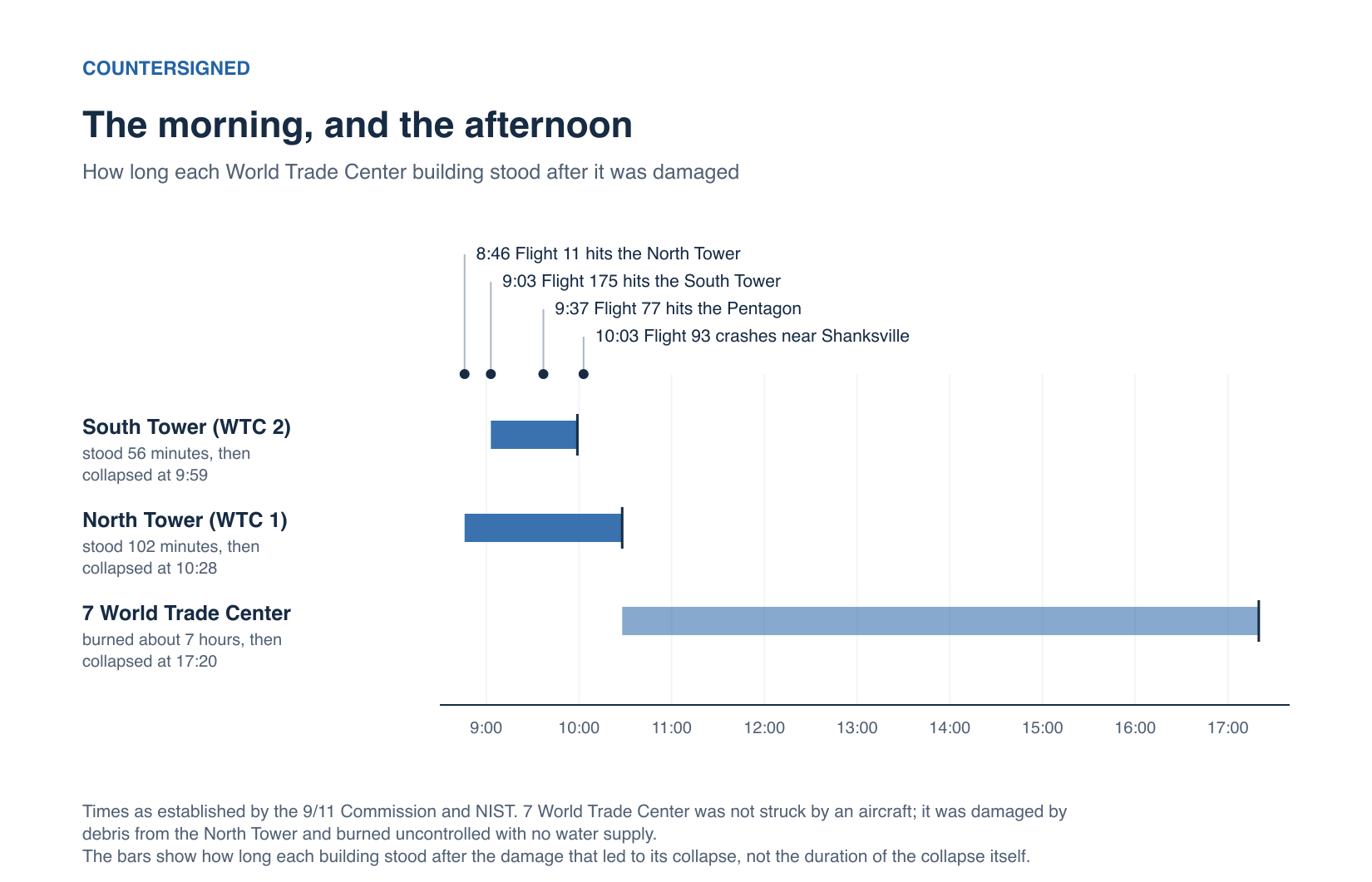
Four aircraft were hijacked on the morning of 11 September 2001. American Airlines Flight 11 struck the North Tower of the World Trade Center at 8:46, United Airlines Flight 175 struck the South Tower at 9:03, American Airlines Flight 77 struck the Pentagon at 9:37, and United Airlines Flight 93 crashed in a field near Shanksville, Pennsylvania at 10:03. The South Tower collapsed at 9:59, 56 minutes after being hit. The North Tower collapsed at 10:28, 102 minutes after being hit. A third World Trade Center building, the 47-storey 7 World Trade Center, collapsed at 5:20 that afternoon after burning uncontrolled for about seven hours. It had not been struck by an aircraft.
2,977 people were killed, not counting the 19 hijackers: 2,753 at the World Trade Center, 184 at the Pentagon, and 40 on Flight 93.
Nobody seriously disputes that the aircraft were hijacked, that they struck the buildings, or that al-Qaeda declared the attack its own. Osama bin Laden acknowledged responsibility. Khalid Sheikh Mohammed described himself as the organiser, including in a statement presented to a Guantánamo tribunal on 10 March 2007. S93 The argument concerns what else was true at the same time.
It is worth stating what the disagreement is not about. Serious critics of the official account do not generally argue that no aircraft hit the towers. Among people who have published technical objections, the dispute concentrates on three questions: why the buildings came down, what the United States government knew beforehand, and why parts of the investigation were conducted as they were.
2. The investigations, and what each one actually examined
Five official bodies and one professional-society study examined the attacks, and the boundaries between them matter, because each is routinely cited for conclusions it never reached.
The FBI’s PENTTBOM investigation was a criminal inquiry into who carried out the attacks. It identified the 19 hijackers and traced the plot’s financing and travel. It did not examine why the buildings collapsed.
The FEMA Building Performance Assessment Team produced the first structural study in May 2002. It was a volunteer effort with limited site access and no subpoena power. Its report described its best hypothesis for Building 7’s collapse as having “only a low probability of occurrence” and recommended further research. S67
The Joint Inquiry of the House and Senate intelligence committees reported in December 2002 on intelligence failures. Twenty-eight pages concerning foreign government support were classified until July 2016.
The 9/11 Commission reported in July 2004 on the attacks’ origins and the government’s response. It did not investigate the collapses, which it left to NIST. S06
The ASCE Pentagon Building Performance Report, published January 2003, examined the structural damage at the Pentagon. S17
The National Institute of Standards and Technology conducted the technical investigation of the World Trade Center. Its report on the towers, NCSTAR 1, appeared in 2005; its report on Building 7, NCSTAR 1A, in November 2008. S04 S03
The single most consequential fact about the NIST investigation is the limit it set on itself. Its objective was to determine why the collapses began. Once initiation was established, the agency states, “the propagation of the collapse was readily explained without the same complexity of modeling”. NIST therefore produced no model of either tower actually coming down. S02
This is not a hidden fact; NIST publishes it. But it means that when a member of the public asks “does the official explanation account for how the buildings fell?”, the accurate answer is that the official investigation deliberately stopped short of that question. Everything said about the towers’ collapse sequence — by NIST’s defenders and its critics alike — comes from work done outside the official investigation. Building 7 is different: there NIST did simulate the collapse itself, as section 5 describes.
The NCSTAR reports themselves did not undergo journal peer review: they were reviewed by an advisory committee and released for public comment. NIST states that its fire and thermal-analysis methods had undergone technical peer review and had been published in professional journals. Its researchers also published their WTC 7 structural analysis in the Journal of Structural Engineering in 2012. The publication records of other researchers are discussed in section 9. S02 S72
3. What the towers were designed to survive
The claim that the towers were built to take an airliner strike is true, and less reassuring than it sounds.
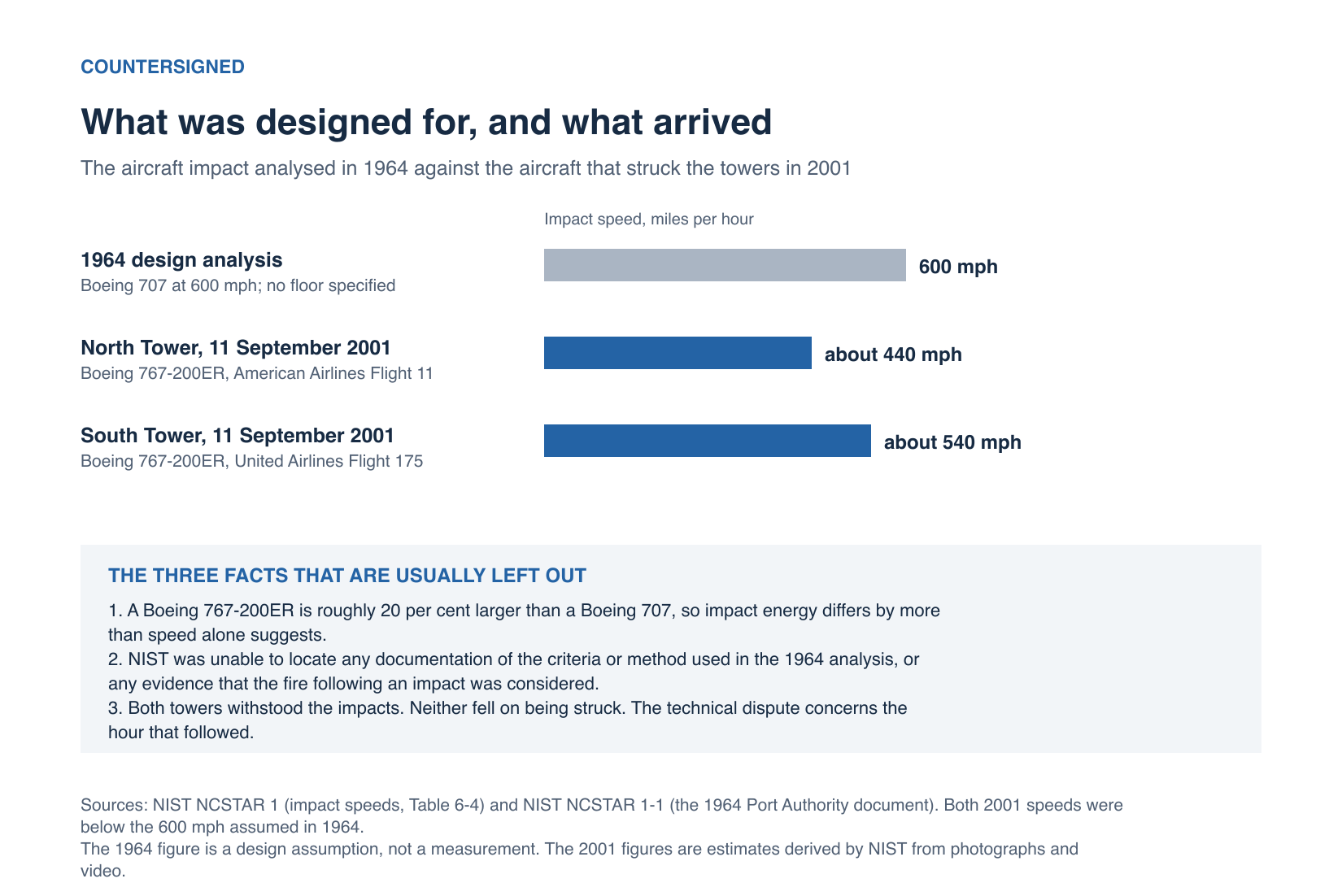
A three-page Port Authority document records that during design, in February and March 1964, engineers analysed the impact of a Boeing 707 travelling at 600 miles per hour, and asserted that such a collision “would result in only local damage which could not cause collapse or substantial damage to the building”. A separate Port Authority calculation from March 1964 worked out the tower’s period of vibration after an aircraft impact at the 80th floor; no conclusion was recorded on the sheet. NIST, searching the surviving records, reported that its investigators were “unable to locate any documentation of the criteria and method used in the impact analysis”. The working papers are gone. S48 S04 S02
Two things follow. First, the surviving records do not establish that the resulting fire was analysed. NIST “was unable to locate any evidence to indicate consideration of the extent of impact-induced structural damage or the size of a fire that could be created by thousands of gallons of jet fuel”. S04
Second, the aircraft were not the same. A Boeing 767-200ER is, in NIST’s words, “about 20 percent bigger” than a 707. NIST estimated the impact speeds at about 440 miles per hour for the North Tower and about 540 for the South Tower — both below the 600 miles per hour assumed in 1964. What differed was the aircraft, not the speed; and because NIST could find no record of the criteria or method the 1964 analysis used, no closer comparison is possible from the record. S02 S04
Against this stands a statement by the towers’ chief structural engineer. John Skilling told the Seattle Times in 1993, after the World Trade Center bombing, that his team had analysed a Boeing 707 impact and that the biggest problem would be the aircraft’s fuel dumping into the building: although there would be “a horrendous fire” and many deaths, “the building structure would still be there”. S63 Skilling died on 5 March 1998. S66 His statement is a recollection of an analysis whose documentation NIST could not find, and it goes further than the surviving white paper does.
Frank DeMartini, the Port Authority construction manager, said in an interview recorded in early 2001 that the structure was designed for the impact of a fully loaded 707 and that he believed multiple aircraft strikes could be absorbed. Leslie Robertson, the other lead structural engineer, wrote in The Bridge in 2002 that the design contemplated a slow-flying Boeing 707 lost in fog and seeking to land at JFK or Newark. He stated that little was known about the effects of the resulting fire and that no designs were prepared for that circumstance. This account differs from the 600-mile-per-hour impact described in the surviving Port Authority document. His article was inspected in a text republication because the original NAE page was inaccessible. S68
The one point on which everyone agrees is often lost: both towers withstood the impacts. Neither fell on being struck. The entire technical argument concerns what happened over the following hour.
What NIST concluded. The aircraft impacts severed columns, dislodged fireproofing from steel columns and floor trusses, and spread fuel over several floors. The resulting fires weakened the exposed floors and columns. Sagging floors pulled the perimeter columns inward; the inward bowing and subsequent failure of the south face of the North Tower and the east face of the South Tower initiated collapse. NIST cites photographs, video and police aviation observations in support of that sequence. This is its explanation of collapse initiation; the later descent is discussed below. S02
4. How fast the towers fell
The phrase “free fall” does the heaviest work in public argument about 9/11, and it is worth being exact.
Free fall from the roof of the North Tower, 417 metres, would take about 9.2 seconds. But neither collapse began at the roof. Both began at the impact zone — around the 95th floor of the North Tower and the 80th floor of the South Tower — and free fall from those heights would take roughly 8.5 and 8 seconds. NIST estimated that the first exterior wall panels reached the ground about 11 seconds after collapse initiation at WTC 1, and about 9 seconds at WTC 2, timed from video and from seismic records at Palisades, New York: in both cases longer than free fall from the level where the collapse began. S02 S04
Those figures track the first exterior panels to strike the ground, not the collapse of the structure itself. The collapse front — the boundary between standing and collapsing structure — moved more slowly, and the dust cloud makes it hard to track after the first seconds. NIST’s own report nonetheless says that the section above the impact zone “came down essentially in free fall, as seen in videos”, because the storeys below “provided little resistance”. Those elapsed times do not establish the acceleration of either tower’s whole structure. Chandler’s measurement discussed below concerns the visible upper section of the North Tower during the first seconds of its descent. S02
What critics do argue, on the basis of video measurement, is that the upper section of the North Tower accelerated downward smoothly, without the sudden deceleration that a collision between the falling block and the intact structure below should produce. Graeme MacQueen and Tony Szamboti tracked the roofline in a January 2009 paper and called the absent deceleration “the missing jolt”; the physics teacher David Chandler published a parallel measurement in February 2010, putting the upper section’s downward acceleration at 6.31 metres per second squared, about 64 per cent of gravitational acceleration. Both papers appeared in the Journal of 9/11 Studies, which is published by the movement itself. The claim is not that the building fell at free fall, but that it fell without the resistance a column-by-column failure would impose. S57 S58
The counter-argument is set out in papers by Zdeněk Bažant and colleagues. Bažant and Yong Zhou’s January 2002 paper in the Journal of Engineering Mechanics presented a simplified analysis in which structural resistance was roughly an order of magnitude below that needed to arrest the collapse once the upper section began falling. Bažant and Mathieu Verdure’s March 2007 paper developed the two-phase model: a “crush-down” front descending through the lower structure, followed by a “crush-up” of the upper block. Bažant, Jia-Liang Le, Frank Greening and David Benson published a further paper on the towers’ collapse in October 2008. These are analyses supporting a gravity-driven collapse, distinct from NIST’s investigation. S69 S70 S71
That model has been contested in the engineering literature. Gregory Szuladziński, Anthony Szamboti and Richard Johns published “Some Misunderstandings Related to WTC Collapse Analysis” in the International Journal of Protective Structures in 2013, arguing that the treatment of inertia and column capacity was wrong. S15 Earlier, in 2010, the Journal of Engineering Mechanics published a discussion by the critic Anders Björkman and a closure from Jia-Liang Le and Bažant. S16 S47
The publication sequence therefore includes Bažant and colleagues’ papers in 2002, 2007 and 2008, the discussion and closure in 2010, and the critics’ paper in 2013. Publication in a peer-reviewed journal records the venue and review process; it does not by itself settle the substantive objections.
5. Building 7, and the 2.25 seconds in NIST’s final report
Building 7 raises a distinct set of questions about fire-induced failure, measured acceleration and the modelling of a building that was not struck by an aircraft.
The building was 47 storeys, 186 metres, and stood across Vesey Street from the North Tower. It was not hit by an aircraft. Debris from the North Tower’s collapse struck its south face and started fires that burned on multiple floors for about seven hours. There was no water to fight them; the mains had been broken. The building collapsed at 5:20 p.m. Nobody was killed in it.
What NIST concluded. Debris from the North Tower severed seven exterior columns and started fires on at least ten floors; on six of them, floors 7 to 9 and 11 to 13, the fires burned out of control. On the 13th floor, the steel floor beams on the east side expanded in the heat and pushed a girder off its seat at Column 79, an interior column. Floor 13 collapsed, beginning a cascade of floor failures down to floor 5. Column 79, now unbraced over nine storeys, buckled. The failure propagated east to west through the interior, then the exterior columns buckled and the building came down. NIST calls it “the first known instance of a tall building brought down primarily by uncontrolled fires”. It also concluded that diesel fuel stored in the building for emergency generators played no role, and that “blast events inside the building did not occur”. S03 S01 S05
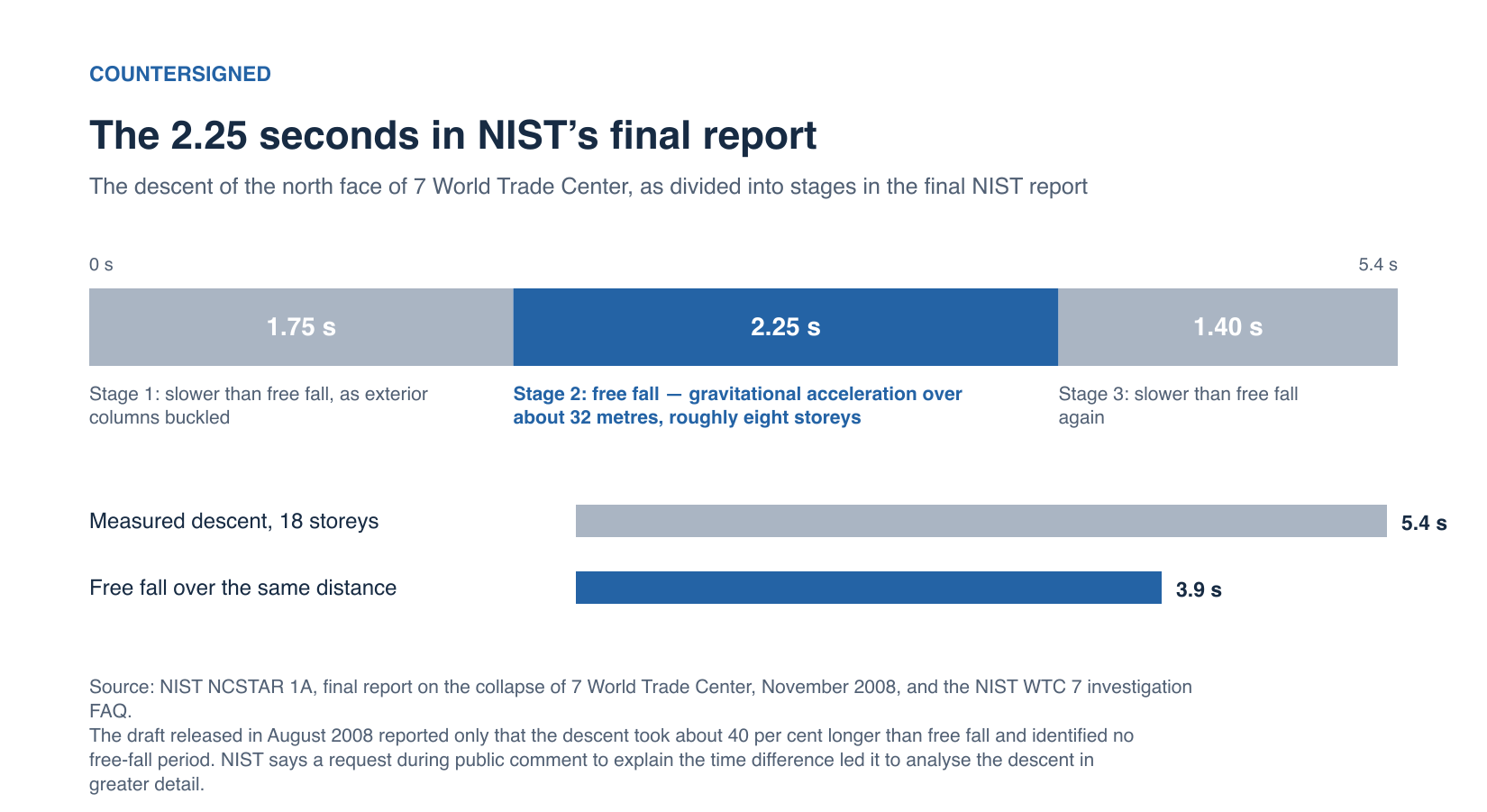
The free-fall interval. NIST’s draft report, released for public comment on 21 August 2008, stated that the collapse took about 40 per cent longer than free fall and did not identify any free-fall period. The physics teacher David Chandler measured the north face from video and stated publicly that a portion of the descent was at exactly gravitational acceleration. NIST says that public comments asked it to confirm the time difference and explain it in greater detail, prompting a more detailed analysis of roofline displacement, velocity and acceleration. In the November 2008 final report, NIST divided the descent into three stages:
- Stage 1, 0 to 1.75 seconds: acceleration slower than gravity, as exterior columns buckled.
- Stage 2, 1.75 to 4.0 seconds: gravitational acceleration — free fall — for 2.25 seconds, over about 32 metres, roughly eight storeys.
- Stage 3, 4.0 to 5.4 seconds: acceleration again below gravity.
The north face descended about 18 storeys in 5.4 seconds; free fall over that distance would have taken 3.9 seconds. S01 S03
Critics interpret the free-fall interval as evidence that the supporting structure across eight storeys had ceased to resist the descent, and argue that fire cannot cause that loss simultaneously across a floor plate. NIST’s explanation connects the observed motion to a sequence of structural failures: loads from buckled interior columns transferred to exterior columns, which buckled between floors 7 and 14 over about two seconds. Once this roughly eight-storey region had buckled, the structure above it descended at gravitational acceleration during Stage 2; acceleration decreased in Stage 3 as it encountered the collapsed structure below. NIST also points to the east rooftop penthouse falling into the building, and windows breaking on the east side of the north face, before the exterior began its global descent as evidence that interior failure preceded exterior collapse. S03 S01
The University of Alaska Fairbanks study. Between 2015 and 2020 a team led by Professor J. Leroy Hulsey at the University of Alaska Fairbanks built an independent finite-element model of the building. The project was funded by Architects & Engineers for 9/11 Truth with a budget of $316,153 — an advocacy organisation funding research into its own contention, which the university disclosed. A draft was released in September 2019 with a public comment period; the final report followed in March 2020.
Its conclusions: “the principal conclusion of our study is that fire did not cause the collapse of WTC 7 on 9/11”, and that the collapse “was a global failure involving the near-simultaneous failure of every column in the building”. S09 S10
The study has not been published in a peer-reviewed structural engineering journal. The university published the final report and made its model data available for download. S09
The data NIST has withheld. On 9 July 2009 the Director of NIST made a formal finding under the National Construction Safety Team Act that releasing certain investigation data “might jeopardize public safety”. NIST released 25,644 data files in response to the request and withheld 68,500 — in the court’s summary, the detailed connection models, connection material properties and break elements that had been validated against the actual events. NIST’s stated reasoning was that validated models of how a building fails “could be used to predict the collapse of a building” and might help someone “learn how to simulate building collapses and how to most effectively destroy large buildings”. A federal court upheld the withholding in Quick v. United States Department of Commerce in 2011. S11
The consequence is that NIST’s collapse analysis cannot be independently reproduced from the inputs that drive it. That is a statement about the record, not about whether the conclusion is right.
The correction request and the lawsuit. In April 2020 AE911Truth, ten family members of victims and 88 architects and structural engineers filed a request for correction under the Data Quality Act, arguing among other things that NIST had omitted web stiffeners from its model of the critical girder. NIST denied the request in August 2020 and denied the appeal in June 2021. A lawsuit followed in September 2021, brought by the organisation, ten architects and structural engineers and eight family members. The US District Court for the District of Columbia dismissed it on standing grounds in August 2022, finding that the plaintiffs had not alleged a legally cognisable informational or organisational injury. The appellate judgment explains that neither the Information Quality Act nor the National Construction Safety Team Act required the disclosure the plaintiffs claimed they had been denied. The plaintiffs characterised the result as recognising a right to a report but not to its accuracy. The Court of Appeals for the District of Columbia Circuit affirmed on the same ground in October 2023 and refused rehearing, and the Supreme Court declined to hear the case in April 2024. S51 S42 S49 S50
No court has ruled on whether NIST’s Building 7 analysis is correct. The case was decided on who may sue, not on what happened.
6. How often fire has brought down a tall building
The most-repeated argument against the official account is a base rate: no steel-framed high-rise had ever collapsed from fire before 11 September 2001, and three did that day. The premise is close to correct. The inference is where the difficulty lies.
Tall buildings have burned severely without global collapse, before 2001 and since. One Meridian Plaza in Philadelphia, 38 storeys, burned for about 18 hours in February 1991 with local structural failures and no collapse. The First Interstate Bank building in Los Angeles burned across four floors in 1988 and did not collapse. The Windsor Tower in Madrid burned for about 19 hours in February 2005: its unprotected steel perimeter columns above the 17th-floor transfer level failed and brought down the outer sections of the concrete floors above it, while the reinforced concrete core and the floors below survived. Grenfell Tower in London burned through in 2017 without collapsing — a concrete structure. S56
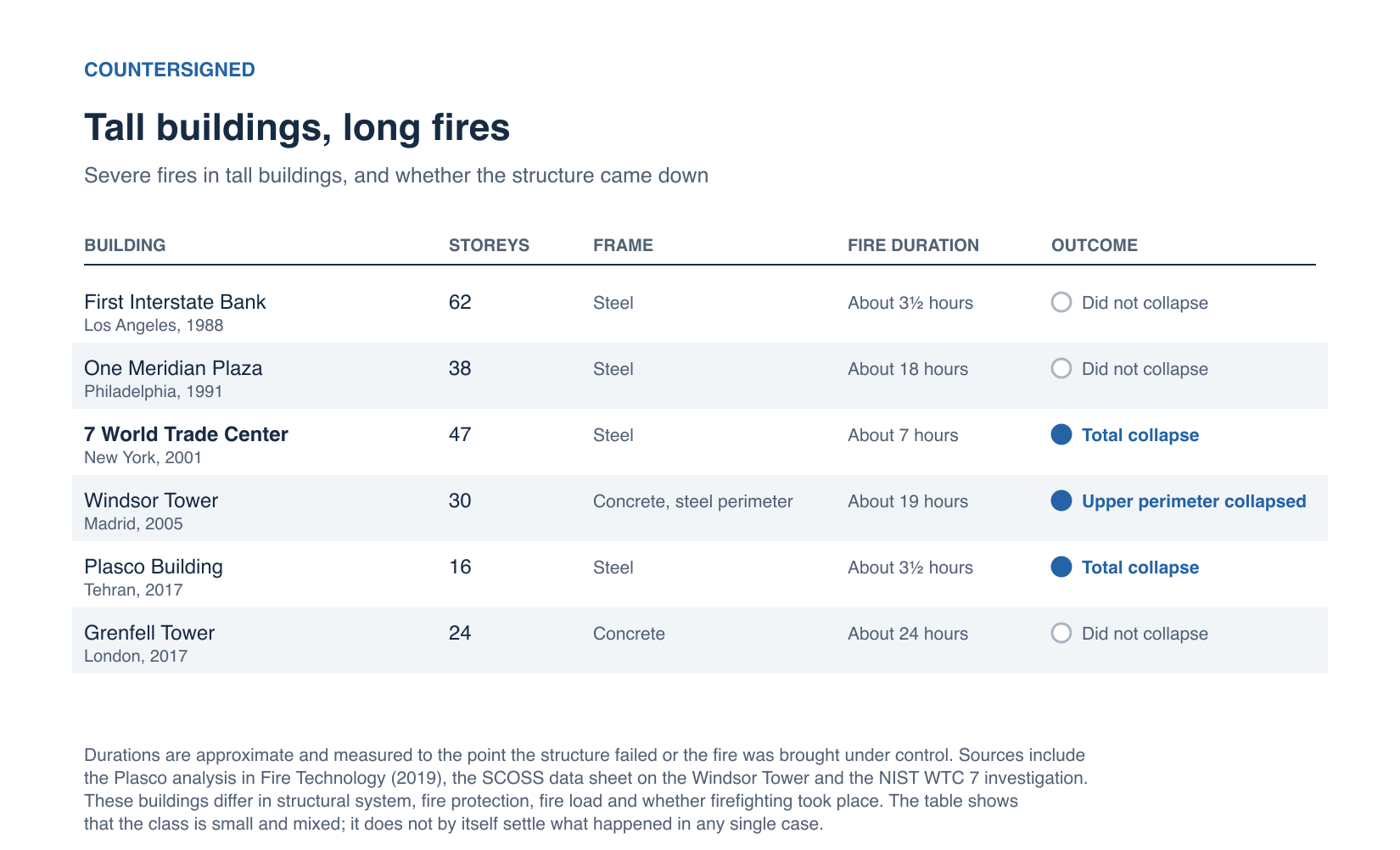
After 2001 the record of total collapse changed. On 19 January 2017 the 16-storey steel-framed Plasco Building in Tehran collapsed completely after a fire that began with an electrical fault. Twenty-two people were killed, including 16 firefighters. A study in the journal Fire Technology reconstructs the sequence from the fire to the complete collapse using structural records, interviews and video analysis. S13
AE911Truth also disputes a fire-only explanation of Plasco: its preliminary assessment of 20 February 2017 urged investigators to consider controlled demolition involving explosives and incendiaries as the most likely hypothesis. This is the organisation’s attributed position, not the finding of the later Fire Technology study. S103
So the class “steel-framed tall buildings that collapsed because of fire” is not empty and does not consist only of 9/11.
The methodological difficulty runs in both directions. Buildings differ in structural system, fire protection, fire load, duration and whether firefighting occurred. None of the pre-2001 comparison fires involved an aircraft impact that stripped sprayed fireproofing from structural members, disabled sprinklers and severed water mains, and started fires on several floors at once. Building 7 had none of that either — it had debris damage, ordinary office fires and no water — which is precisely why it is the case critics press hardest.
A base rate is only as good as the reference class. The honest statement is that this event class is small, heterogeneous, and too sparse to settle the argument by counting.
7. The search for explosives
Four lines of physical evidence are offered for explosives or incendiaries, and each has a documented history.
Red-grey chips in the dust. In April 2009 Niels Harrit and eight co-authors published “Active Thermitic Material Discovered in Dust from the 9/11 World Trade Center Catastrophe” in The Open Chemical Physics Journal. They reported red-grey chips in dust samples that ignited at about 430 °C and contained iron oxide and aluminium in nanometre-scale structures, which they identified as an engineered thermitic material. S12
A replication attempt by James Millette of MVA Scientific Consultants in 2012 reported chips in WTC dust with the same appearance and elemental composition. It was a private laboratory progress report, not a peer-reviewed journal article. His infrared spectroscopy matched the red layer to an epoxy resin and kaolin clay; electron and optical microscopy identified the epoxy as the matrix and the particles within it as iron oxide pigment and kaolin clay plates. He detected no particles of elemental aluminium in the examined chips and concluded that the red layer “is not thermite or nano-thermite”. He did not identify what product the chips came from, and noted that their composition does not match the primer paint used on the towers’ columns. S45
The cited reports reach different conclusions about the chips they examined. Harrit and co-authors identified thermitic material; Millette identified an epoxy-and-pigment coating but left its source product unidentified. The latter finding does not establish that the chips were the towers’ column primer. S12 S45
Iron microspheres. In a May 2004 expert report prepared for Deutsche Bank, RJ Lee Group identified spherical iron and heat-affected silicate particles among the markers used to distinguish WTC dust. It attributed the heat-affected particles to fires following the WTC event. The US Geological Survey’s 2005 Particle Atlas of World Trade Center Dust also records iron-rich particles; Table 1 labels Iron-03 and Iron-04 as spheres. These are analyses of dust constituents and contamination, not determinations of the collapse mechanism. S101 S102
AE911Truth interprets the iron-rich spheres as evidence supporting a thermitic reaction and disputes ordinary-fire explanations. The particles’ presence is documented in the laboratory records; their attribution to thermite is the critics’ interpretation. S112
Molten metal. Multiple first-hand accounts describe molten metal in the debris piles in the weeks after the attack. NIST states that it found no evidence supporting the melting of steel in the jet-fuel fires before the towers fell — steel melts at about 1,500 °C, and NIST puts the maximum upper-layer air temperatures at about 1,000 °C — and that the condition of the steel in the wreckage, molten or not, was “irrelevant” to its investigation of why the collapses began. Where molten material was seen pouring from the South Tower before it fell, NIST attributed it to aluminium alloys from the aircraft, which melt between about 475 and 640 °C. The reported molten flows in the debris piles have not been identified through sampling: no sample of those flows is known to have been taken and analysed. S02
A separate physical finding concerns recovered steel, not samples of those reported flows. FEMA’s Appendix C documented “a severe high temperature corrosion attack on the steel, including oxidation and sulfidation with subsequent intergranular melting” in a WTC 7 sample and also examined a sample attributed to one of the towers. Its authors recommended further study and left unresolved whether the unusual corrosion began before collapse or during prolonged heating in the debris. NIST, discussing the limits of tests for thermite or thermate residues, noted that sulfur was already present in gypsum wallboard and that the relevant metal compounds also occurred in construction materials. That identifies an alternative source of the elements; it is not a completed explanation of the Appendix C samples. S73 S02
Sound and seismic record. The Lamont-Doherty Earth Observatory at Columbia University recorded the collapses as seismic events of magnitude 2.1 and 2.3, and published the analysis in Eos on 20 November 2001. They attributed the signals to the impacts and the collapses themselves, and concluded that damage to nearby buildings came from falling debris and air pressure rather than ground shaking. The paper does not address whether explosives were used; it notes that the 1993 truck bomb of roughly half a ton of explosive was not detected seismically even at a station 16 kilometres away. S31 S59
NIST’s own argument from sound is specific: the smallest charge capable of failing Building 7’s critical column would have produced 130 to 140 decibels at half a mile, and no sound of that magnitude appears in any witness account or on the audio track of any video. S01
NIST separately estimated that severing a large WTC 7 steel column with conventional thermite would require at least 100 pounds (about 45 kilograms) placed around it and kept in contact during the reaction, which it considered unlikely to escape detection. AE911Truth replies that the blast calculation used RDX, a high explosive, while its hypothesis involves nano-thermite, possibly with other explosives or incendiaries; it also argues that calculations for conventional thermite do not test that hypothesis. These are competing arguments about the proposed material and delivery method. S01 S77
Witness accounts of explosions. The New York Fire Department recorded oral histories from 503 members. Graeme MacQueen, in an analysis published by Architects & Engineers for 9/11 Truth, identified 118 who described explosions. The City withheld the records until their release on 12 August 2005 after The New York Times sued. The witness descriptions and MacQueen’s classification are documented; the physical causes of the reported sounds remain disputed. S32
Residue testing. NIST stated that it did not test the steel for residues in response to a question about explosives or thermite. It also argued that testing for the constituent elements of thermite or thermate would not necessarily have been conclusive, because those elements occurred in ordinary construction materials. The cited investigation therefore contains no residue-test result resolving that question. S02
8. What a demolition would have required
NIST’s objections concerning preparation at Building 7 concern access and detectability. Its FAQ states that installing explosive charges would require work around columns, including removing and replacing walls or coverings and fireproofing without detection. It also questions whether the quantity of conventional thermite it calculated could have been installed without detection. These objections refer to Building 7, which was not hit by an aircraft; surviving an aircraft impact is a separate issue for hypotheses about the towers. S01
AE911Truth’s published reply challenges the assumption that installation would have to occur without the knowledge of those responsible for building security. It cites Jim Hoffman’s suggestion that devices could be concealed in legitimate equipment and argues that a covert operation need not follow ordinary commercial-demolition practice. Those are proposed ways of meeting the access problem, not a documented account of an installation at WTC 7. S77
The record here consists of NIST’s assessment of preparation requirements and the critics’ published replies about concealment and complicity. The cited sources do not identify a verified installation operation.
9. Who disputes the official account
The number most often quoted is that thousands of architects and engineers reject the official findings. The figure is real; so is its denominator.
Architects & Engineers for 9/11 Truth reported passing 3,000 architect and engineer signatories in May 2018 and 3,500 verified signatories in September 2021. The petition calls for a new investigation into the destruction of the three buildings. S75 S76
For scale: there were just over 123,000 licensed architects in the United States in 2025, according to the National Council of Architectural Registration Boards. AE911Truth’s signatories are drawn worldwide, include architects and engineers of all disciplines, and are not restricted to structural engineers or fire protection engineers — the two specialisms directly relevant. S33
AE911Truth’s own answer to this point is that a petition measures willingness to sign, not the distribution of expert opinion; that signing carries professional risk in a field dependent on public and institutional clients; and that scientific questions are not settled by headcount. The organisation has never claimed to represent a majority.
On publication record, the picture is uneven. The Szuladziński, Szamboti and Johns paper appeared in a peer-reviewed journal. The Journal of 9/11 Studies, which carries much of the movement’s technical output, is published by the movement itself and is not indexed in mainstream engineering databases. The widely circulated 2016 article “15 years later: on the physics of high-rise building collapses” by Steven Jones, Robert Korol, Anthony Szamboti and Ted Walter appeared in Europhysics News — the magazine of the European Physical Society. Its appearance there should not be taken, by itself, as evidence of journal peer review. S14
Analyses supporting fire- and gravity-driven collapse also have a publication record: the Bažant papers appeared in the Journal of Engineering Mechanics, and NIST researchers published their WTC 7 structural analysis in the Journal of Structural Engineering in 2012. Outside journals, Popular Mechanics published an investigation drawing on interviews with engineers and other specialists, including explanations of why steel need not melt to lose load-bearing capacity and why expelled air and debris can resemble demolition features. These publications differ in purpose and review process and should be read on those terms. S69 S70 S71 S72 S74
Public opinion is a separate matter from expert opinion. A Chapman University survey in 2016 found 54.3 per cent of Americans agreeing that the government is concealing information about the attacks — the most widely held such belief the survey measured. S38 A YouGov survey of 1,098 US adults in August 2026 found that only 15 per cent of adults under 30 remember where they were that day, against 90 per cent of those over 30 — the generational shift within which these arguments are now conducted. S37
10. The Pentagon
The Pentagon dispute includes different claims about the aircraft’s approach, the interpretation of flight-recorder data and whether the aircraft struck the building. Citizen Investigation Team and Pilots for 9/11 Truth publish distinct arguments; they should not be treated as a single alternative account. S104 S105
The physical record. The ASCE Pentagon Building Performance Report, published January 2003, found that a Boeing 757-200 weighing about 82,000 kilograms, carrying roughly 20,000 litres of fuel, struck the building at approximately 850 kilometres per hour. The right wing hit an emergency generator outside the building; the left engine struck a ground-level external vent structure before the fuselage entered the building. Approximately 50 structural columns were destroyed or significantly impaired. The report’s authors examined the columns and modelled the impact and the subsequent fire. S17
Aircraft debris was recovered and photographed, including fuselage sections, landing gear, engine components and interior material. The flight data recorder and cockpit voice recorder were recovered on 14 September. The Armed Forces Institute of Pathology identified the remains of 184 of the 189 people who died, including the five hijackers; the remains of five victims could not be identified. S65 Five light poles along the approach path were knocked down, one of which pierced a taxi.
The flight-recorder objection. In a press release dated 26 March 2007, Pilots for 9/11 Truth argued that the altitude data released by the National Transportation Safety Board (NTSB) placed the aircraft at least 300 feet too high to strike the light poles. It stated that the released data ended at least one second before the official impact time and that extending the trends would leave the aircraft at least 100 feet too high to hit the Pentagon. This is the group’s interpretation of released data and animation, rather than an inference from the size of the hole or the appearance of the lawn. S104
The NTSB’s 2002 flight-path study combines radar data with the recovered flight data recorder and reconstructs an impact at the Pentagon at 9:37:45, at about 460 knots. That study predates the group’s 2007 objection. A later reply came from Frank Legge, himself a critic of parts of the official account: his revised 2015 paper says that Warren Stutt’s fuller decoding recovered previously undecoded final data and showed a descent, pull-up and impact near ground level. Legge consequently rejected the claim that the recorder file ruled out an impact. The present review cites those interpretations; it has not independently decoded the raw recorder file. S106 S107
The approach-path objection. Citizen Investigation Team (CIT) bases its argument on witnesses it interviewed who placed the aircraft north of the Citgo petrol station. Its own explanation says such a route could not produce the documented light-pole and Pentagon damage, and treats that testimony as grounds for rejecting the official impact path and alleging staged damage. The claim therefore concerns a conflict between witness recollections and the physical damage pattern, not simply the absence of clear security-camera images. S105
The ASCE report instead reconstructs an oblique impact from the distribution of damaged columns, the generator and the external vent structure. It describes severe facade damage across approximately 37 metres. Legge’s paper discusses CIT’s witnesses but argues that their recollections should not take precedence over conflicting accounts and physical evidence. This documents a disagreement within the critical literature as well as a disagreement with the official account. S17 S107
The sources establish the competing claims and their evidentiary bases: recorded flight data and physical damage on one side, and disputed readings of released data and selected witness accounts on the other. They do not establish a unified alternative reconstruction.
11. Flight 93
United Flight 93 crashed near Shanksville at 10:03. The cockpit voice recorder — the only one of the four aircraft’s voice recorders to yield usable audio; those from Flights 11 and 175 were never found, and Flight 77’s was too badly burned to read — captured passengers attempting to storm the cockpit and the hijackers deciding to crash the aircraft rather than lose control of it. S06
The question that remains is the shootdown order. The 9/11 Commission concluded that Cheney gave the order, but found “no documentary evidence” for the earlier call in which, he said, the President had authorised it, noted that the note-takers beside him recorded no such call, and described the sources as incomplete. President Bush and Vice President Cheney both initially believed Flight 93 had been shot down. The Commission concluded that Cheney’s authorisation came at about 10:10 or later — after the crash — and that it was never transmitted to the pilots in a form they could have acted on. S06 S40 S41
A leaflet distributed by 9/11Research, Was Flight 93 Shot Down?, cites reported debris at Indian Lake and New Baltimore, giving distances of three and eight miles, and reports of another aircraft as reasons to question the crash account. Those are the leaflet’s reported distances and its interpretation, not measurements established by this review. S108
The National Park Service’s account of the FBI recovery operation records debris at Indian Lake, which it places 1.5 miles from the crash site, as well as in nearby yards and fields. The NTSB’s flight-path study, using radar and the recovered recorder, describes the aircraft responding to flight-control inputs before striking the ground inverted and about 40 degrees nose-down at 10:03:11. Neither source presents the outlying debris as a finding that an interceptor attacked the aircraft. S109 S111
On the second aircraft, Popular Mechanics reported that a VF Corporation Falcon business jet inspected the crash site at air traffic control’s request, citing the company’s aviation director and confirmation from its copilot. This is attributed reporting rather than an aircraft identification independently established here. S110
The recovery of debris beyond the main crater is documented. The leaflet’s distance claims and shootdown interpretation differ from the findings and distances in the cited official records; the sources cited here do not provide a complete reconstruction of how each outlying fragment travelled.
12. The warnings
The clearest documented material about 9/11 is about what was known in advance and not acted on. Most of it is uncontested by the agencies involved and set out in their own inspectors general’s reports and in the congressional inquiries; the Able Danger claims, below, are the exception.
The Phoenix memo. On 10 July 2001 FBI Special Agent Kenneth Williams sent headquarters a communication reporting that individuals connected to Osama bin Laden appeared to be enrolling in United States flight schools, and recommending a national programme to track them. It was not acted on before the attacks and was not connected to the Moussaoui case. S23
Zacarias Moussaoui. On 15 August 2001 a Minnesota flight school reported a student with no aviation background and no pilot’s licence, who had paid some $8,000 in cash and said he wanted only to learn to take off and land a Boeing 747. He was arrested on an immigration violation. FBI headquarters declined to seek a warrant for his laptop; agent Coleen Rowley’s memo to the director in May 2002 set out how the field office’s requests were refused, and became one of the defining whistleblower documents of the period. S60 S24
The 6 August 2001 President’s Daily Brief. Titled “Bin Ladin Determined To Strike in US”, it was declassified in April 2004 under pressure from the Commission. It did not identify the specific plot or discuss aircraft used as missiles. The White House described it as largely historical. S22 Its final passages also reported current FBI information about suspicious activity consistent with preparations for hijackings or other attacks, including surveillance of federal buildings in New York. The document ended with the report of a May call to the US embassy in the United Arab Emirates saying that bin Laden supporters in the United States were planning attacks with explosives. S121
Able Danger. Lieutenant Colonel Anthony Shaffer and others stated publicly in 2005 that a military data-mining programme had identified Mohamed Atta as an al-Qaeda associate more than a year before the attacks, and that lawyers prevented the information being passed to the FBI. A Pentagon review begun in August 2005 had, by a briefing on 1 September, interviewed some 80 people; the Department of Defense Inspector General then investigated and reported in September 2006 that “the evidence did not support assertions that Able Danger identified the September 11, 2001, terrorists nearly a year before the attack”, finding inaccurate the recollections of the four witnesses who described a chart naming Atta. Several of those witnesses stated afterwards that their accounts had been misrepresented in the report. S61 S62
At the Senate Judiciary Committee hearing on 21 September 2005, chairman Arlen Specter said that the Defense Department had ordered five key witnesses not to testify and had supplied documents only the previous evening. The department cited concern about classified information; Specter said the committee would protect it and could consider a closed session. These restrictions limited what that hearing could establish; they do not themselves establish the disputed claim that the programme identified Atta. S122
Taken together, the documented failures are extensive and, Able Danger apart, their existence is not disputed by the institutions involved. The disagreement is about whether they amount to an unusual concentration of error.
13. Two hijackers the CIA did not report
Inspector general reports document failures to pass information about two men who lived openly in California to the FBI.
In January 2000 the CIA learned that Khalid al-Mihdhar, who had attended an al-Qaeda meeting in Malaysia, held a multiple-entry United States visa. An FBI agent seconded to Alec Station — the CIA unit tracking bin Laden — drafted a report to notify FBI headquarters that a known al-Qaeda associate could travel to the United States, the FBI’s jurisdiction. The report was not sent. A CIA officer noted in the system that it should be held.
In March 2000 the CIA learned that Nawaf al-Hazmi had flown from Bangkok to Los Angeles on 15 January. The FBI was not told until August 2001. S07
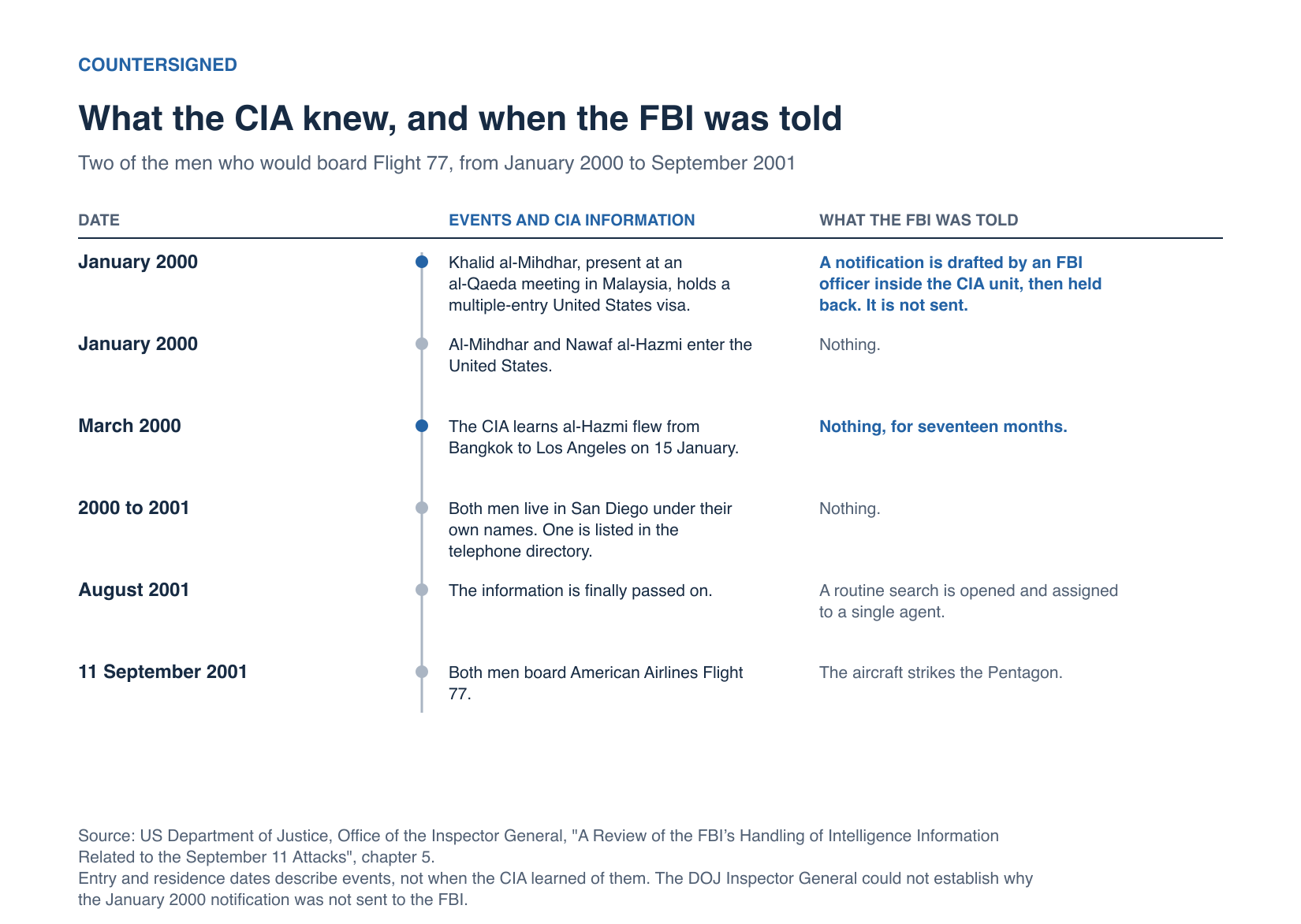
Both men then lived in San Diego under their own names, took flight lessons, and one of them had a telephone listing. Both were aboard Flight 77 when it struck the Pentagon. When the FBI finally opened a search for al-Mihdhar in late August 2001, it was assigned to a single agent and treated as a routine intelligence matter.
The Department of Justice Inspector General’s review identified five points at which the FBI could have learned of or developed information about the two men, and found no evidence that anyone in the intelligence community had specific knowledge of the plot. The CIA Inspector General’s report on accountability, completed in 2005 with an executive summary declassified in August 2007, found no “silver bullet” and, in the words of its summary, “no single point of failure” but did identify failures to share and act on data, and recommended an Accountability Board to consider disciplinary action against a handful of officials, including former Director George Tenet. Director Porter Goss declined to convene it in October 2005; his successor Michael Hayden, releasing the executive summary in August 2007, said he had found no reason to revisit that decision. S08 S95
The recommended Accountability Board was not convened. Neither inspector general could establish why the notification had been put on hold inside the CIA and never sent. S07 Two explanations circulate: a bureaucratic turf dispute over an FBI presence in a CIA operation, or a deliberate hold because the CIA was attempting to recruit the two men or monitor them through a foreign service, an operation the FBI’s involvement would have compromised.
Former White House counterterrorism coordinator Richard Clarke publicly advanced the recruitment explanation in 2011 as a hypothesis he could not substantiate. Former CIA Director George Tenet and former CIA officials Cofer Black and Richard Blee responded in a joint statement that his allegation was “reckless and profoundly wrong”. S92
A declaration by Don Canestraro, an investigator on the defence team of Guantánamo defendant Ammar al-Baluchi within the Military Commissions Defense Organization, is dated 20 July 2021 and was public by April 2023. According to Florida Bulldog’s reporting, it summarises interviews with former FBI and CIA officials supporting the recruitment explanation. Most interviewees are unnamed. This is a defence investigator’s account of interviews, not an adjudicated finding or direct testimony by those interviewees. S80
The failure to transmit information is documented; the proposed explanations for the hold remain disputed.
14. The Saudi question
The public record of possible Saudi assistance includes changing investigative assessments, a decision not to prosecute, and a civil case that has passed a jurisdictional threshold. These are different findings, made under different standards.
Twenty-eight pages of the 2002 Joint Inquiry report, dealing with foreign government support for the hijackers, were withheld when the Joint Inquiry reported in December 2002 and remained classified until July 2016. They set out contacts between the two San Diego hijackers and Saudi nationals, including Omar al-Bayoumi, who met them and helped them find and finance an apartment, and Fahad al-Thumairy, a Saudi consular official and imam at the King Fahd mosque in Los Angeles.
The 9/11 Commission recorded al-Bayoumi’s own account that the encounter was accidental, wrote that it did “not know whether the lunch encounter occurred by chance or design”, and reported that its investigators found him an “unlikely candidate for clandestine involvement” with extremists. FBI Director Robert Mueller told the congressional Joint Inquiry in September 2002 that as far as the Bureau knew, the hijackers “contacted no known terrorist sympathizers in the United States”. S06 S46
FBI memoranda written in 2017 and declassified in 2021 and 2022 under an executive order describe al-Bayoumi as a “co-optee”, or part-time asset, of Saudi intelligence in the period up to September 2001. British police seized material from his Birmingham home and office in 2001, including a video of him touring the United States Capitol and a handwritten diagram that appeared to calculate an aircraft’s trajectory. Lawyers for Saudi Arabia describe the recording as a tourist video. Telephone records show numerous calls between al-Bayoumi and al-Thumairy, who denied knowing al-Bayoumi when interviewed by the FBI and by 9/11 Commission staff. S06 S18
The 9/11 Commission stated that it had not found evidence that al-Thumairy provided assistance to the two hijackers. S06
Operation Encore began as a New York FBI investigation in 2007 into possible assistance to the two hijackers in Southern California. S125 ProPublica reported that its investigative team was disbanded by senior FBI officials in 2016, and that agents first saw some relevant memoranda after their declassification in 2022. S18 The formal closing communication is dated 27 May 2021. It states that the FBI and federal prosecutors jointly found insufficient evidence to prosecute al-Thumairy, al-Bayoumi and Musaed al-Jarrah for knowingly conspiring to assist the hijackers in the attacks. It records a re-examination of the case in 2019–2020 and says the investigation could reopen if new information emerged. S125
A separate FBI synthesis dated 23 July 2021 described a Saudi-supported militant network in the United States and stated that Saudi officials and intelligence officers directly operated and supported entities within it. The author inferred that this implied Saudi government knowledge or concurrence in the network’s activities. The document links that network to the hijackers’ support contacts; this is an investigative assessment, not a judicial finding that Saudi leaders knew the specific attack plan. S124
The litigation. The Justice Against Sponsors of Terrorism Act, passed over a presidential veto in 2016, created an exception to foreign sovereign immunity for specified terrorism claims. Depositions of Saudi officials in the consolidated New York case were ordered in 2020 and completed by mid-2021; argument on the renewed motion to dismiss took place in July 2024. S52 In his opinion filed on 28 August 2025, Judge George Daniels found sufficient evidence to support jurisdiction, including a reasonable inference that al-Bayoumi and al-Thumairy acted within their Saudi employment when assisting the hijackers. The opinion states that, for this jurisdictional purpose, the plaintiffs had shown knowing support or at least deliberate indifference. It leaves final assessment of disputed facts and liability for trial. S123
The same opinion records Saudi Arabia’s position: no Saudi official directed assistance to the hijackers; al-Bayoumi did not knowingly assist them; al-Thumairy neither assisted them nor directed others to do so. Saudi Arabia argued that calls concerned education, religious or administrative matters. Daniels found that explanation insufficient to defeat jurisdiction given the calls’ timing and frequency, while also rejecting the plaintiffs’ interpretation of the Capitol video as proof of reconnaissance and their description of an apartment gathering as an incriminating welcome party. S123
Saudi Arabia denies any involvement, and a denial of a motion to dismiss is a ruling that a case may proceed, not a finding of liability. Saudi Arabia appealed to the Second Circuit in September 2025, the plaintiffs cross-appealed, and oral argument is scheduled for 7 October 2026; the August 2025 ruling is under appellate review, not final. S53 S54
15. The day itself: exercises and timelines
Exercises. Several military exercises were in progress on the morning of 11 September. NORAD was running Vigilant Guardian, a command post exercise conducted on computers without aircraft, which the Commission described as postulating a bomber attack from the former Soviet Union. On 9 September, NORAD announced that Operation Northern Vigilance would deploy fighters as necessary to Alaska and northern Canada to monitor a Russian exercise. S82
The 9/11 Commission examined whether the exercises degraded the response and concluded that Vigilant Guardian, because the scheduled exercise increased staffing at the sectors and at NORAD, probably expedited it. The recorded exchange in which a NEADS officer asks “Is this real world or exercise?” is genuine, and is the source of much of the later argument. Critics read the coincidence of scenarios as cover; the Commission read it as coincidence with a marginally helpful effect. S06
The false timeline. In September 2001 NORAD issued a public timeline of its response. The Commission’s staff, having subpoenaed the FAA and NORAD tapes, found that it did not match the recordings. The recordings established a different sequence of notifications and responses from the one initially presented. S21 Commission staff proposed referring the matter to the Justice Department for criminal investigation into why false information had been provided. The commissioners debated it in closed session in the summer of 2004 and, short of time, referred it instead to the inspectors general of the Departments of Defense and Transportation in 2004. Commissioner John Lehman said he believed the panel may have been lied to but that the evidence did not support a criminal referral. S20 S94 S21
This is a documented instance of a federal agency giving a materially false public account of its own conduct on the day.
Mineta’s testimony. Transportation Secretary Norman Mineta testified in May 2003 that on arriving at the Presidential Emergency Operations Center he heard a young man repeatedly report an aircraft’s distance to Vice President Cheney — fifty miles, thirty miles, ten miles — and ask, “Do the orders still stand?”, to which Cheney replied that they did. Mineta placed this before the Pentagon was struck at 9:37. The Commission’s final report places Cheney’s arrival in the centre at about 9:58 and does not include Mineta’s account. Whether Mineta misremembered the time, whether the exchange concerned Flight 93, and what the standing orders were, are unresolved. S06
The BBC broadcast. At about 4:54 p.m. New York time, roughly 25 minutes before Building 7 fell, BBC World reported that it had collapsed, with the building visible standing behind the reporter. The BBC’s explanation, published by editor Richard Porter in February 2007, is that it relayed an erroneous wire report amid chaotic coverage; Reuters later issued a correction. The BBC also stated that it no longer held the original tapes of its 9/11 coverage, “for reasons of cock-up, not conspiracy” — a statement that did more to fuel the controversy than to end it. CNN had also reported the building’s imminent or actual collapse. That Building 7 was expected to fall was widely known on the ground by mid-afternoon; the fire department had established a collapse zone around it. S43
“Pull it”. In the PBS documentary America Rebuilds, scheduled for broadcast on 10 September 2002, S84 the World Trade Center leaseholder Larry Silverstein described a call from a fire department commander who was unsure the fire could be contained: “I said, we’ve had such terrible loss of life, maybe the smartest thing to do is pull it. And they made that decision to pull and we watched the building collapse.” His spokesperson later stated that “pull it” referred to withdrawing the firefighters, not to demolishing the building. Critics point to the withdrawal timeline: NIST records a final order to cease efforts to save Building 7 at about 2:30 p.m. S03 Silverstein’s later statement says the commander told him firefighters were still inside and were later ordered out. No demolition preparation has been documented. S29
16. Money, documents and evidence
The put options. In the days before the attacks, unusually heavy trading in put options — contracts that profit when a share price falls — occurred in the parent companies of United Airlines on 6 September and American Airlines on 10 September. The 9/11 Commission investigated with the SEC and FBI and concluded the trades had innocent explanations. Ninety-five per cent of the United put volume on 6 September was bought by a single US-registered investment adviser with no conceivable al-Qaeda connection, acting on a bearish view of the airline industry formed from recently released on-time departure figures and American’s own disclosure of poor business fundamentals; the same adviser bought 115,000 American shares on 10 September and lost money on them. Much of the American put surge on 10 September was traced to a California investment newsletter faxed and e-mailed to subscribers on Sunday 9 September: of 28 purchasers the SEC interviewed, 26 cited it. S25 S26
Academic analyses reached different statistical assessments. Poteshman (2006) found unusual long-put activity consistent with advance knowledge of the attacks. Chesney, Crameri and Mancini (2015, with a separate appendix) also classified some pre-attack trades as abnormal under their method. These statistical results do not by themselves identify the traders or establish what they knew; the latter paper explicitly states that trader identities were unavailable. S151 S152
A publicly circulated copy of a letter dated 23 December 2009 records the Securities and Exchange Commission (SEC) telling a requester: “We have been advised that the potentially responsive records have been destroyed.” The request concerned chapter 5, note 130 of The 9/11 Commission Report. The available page gives no inventory, destruction date or reason; its signature and closing are not visible, and the complete signed response has not been verified. S143
In April 2010, the SEC authorised disclosure, with redactions, of its 15 May 2002 trading-review memorandum to the National Security Archive, in a separate information-access case. That memorandum, expressly cited in the same Commission footnote, remains publicly available. S146 S147 The 2009 response therefore does not establish that the Commission’s entire evidentiary basis was destroyed. Which potentially responsive records were destroyed, and whether the complete underlying transaction data survive, remain unresolved here.
The passport. The claim that a hijacker’s passport was found in the rubble while nothing else survived is inaccurate in its premise, and the accurate version is more interesting.
Satam al-Suqami’s passport was picked up in the street near the World Trade Center by a passer-by, who handed it to a police detective while debris was still falling from the South Tower — before either tower collapsed; the passer-by left before he could be identified. It was not found in the rubble. Vast quantities of paper survived; photographs of lower Manhattan that morning show streets covered in office documents, and tens of thousands of personal items were eventually recovered from the debris. Paper ejected by the impact disperses rather than burning. S39
What remains genuinely unexplained is the tradecraft. Mohamed Atta flew from Portland, Maine to Boston on the morning of the attack to connect with Flight 11 — an unnecessary risk that nearly failed, and did fail for his checked luggage, which did not make the connection. The bags contained flight simulator information, a will, and material identifying his associates. The 9/11 Commission noted the Portland detour and did not explain it. Why a man about to destroy himself would check baggage containing his own documentation is not a question the official account answers.
Related: within days the FBI named the 19 hijackers, and several men with similar names came forward alive in Saudi Arabia and Morocco, producing press reports including by the BBC that hijackers had survived. These turned out to be cases of name confusion — Arabic naming conventions produce many near-identical names — and the FBI has maintained its identifications. The episode is frequently cited as though the identifications were retracted, which they were not.
Evidence handling. Of the roughly 200,000 tons of structural steel used to build the two towers, NIST kept 236 pieces for the investigation — by its own estimate between a quarter and a half of one per cent. Much of the remainder was sold for scrap and shipped abroad within months. S28
The sharpest criticism of this came not from any conspiracy organisation but from the fire service’s own trade press. In January 2002 Fire Engineering editor Bill Manning wrote that structural steel “has been and continues to be cut up and sold for scrap”, described the FEMA and ASCE investigation as a “half-baked farce”, and pointed out that the national standard for fire investigation, NFPA 921, contains no exemption permitting the destruction of evidence in buildings over ten storeys. The FEMA report itself records that, with the site treated as a crime scene and no identification system in place in the first days, it took its volunteer engineers up to three hours to get from the outer perimeter to the command centre, a distance of less than six blocks. S55 S27
What was inside Building 7. The building housed the Securities and Exchange Commission’s New York office, which lost depositions, trading records and other files for several hundred active cases, including an inquiry into how investment banks allocated initial public offerings during the technology boom. It also housed a Secret Service field office, a covert CIA station used for operations against foreign diplomats at the United Nations, and the city’s Office of Emergency Management command centre on the 23rd floor. S35 S36
The loss of office files does not by itself establish that the associated investigations ended. On 15 October 2001, when its New York office reopened in Manhattan, the SEC said staff had continued their responsibilities while reconstructing records to ensure that no case or investigation would be lost because of the disruption. That is a contemporaneous agency assurance, not a case-by-case account of the eventual results. It concerns the destruction of the office on 11 September, separately from the later records-disposal issue raised by the FOIA response above. S127
The insurance and the lease. Larry Silverstein’s group took a 99-year lease on the World Trade Center in July 2001, six weeks before the attacks, with insurance bound at about $3.55 billion per occurrence. S89 He subsequently argued that two aircraft striking two buildings constituted two insured occurrences, seeking about $7.1 billion; insurers maintained the $3.55 billion single-occurrence ceiling. Litigation ran for years; the eventual payout was roughly $4.55 billion. S98 S34
The context usually omitted is that the privatisation had been under way since 2000, that a rival bidder initially won and withdrew, and that the site carried substantial asbestos liabilities. The timing is a fact; what follows from it is not established by anything in the record.
The Saudi departures. Nine chartered flights carried 160 people, mostly Saudi nationals including relatives of Osama bin Laden, out of the United States between 14 and 24 September, and a Saudi government flight left Newark on 14 September. They departed after airspace reopened, not during the closure, which is the form the claim usually takes. Of the 26 people on the bin Laden family flight, 22 were interviewed by the FBI; the Commission records that “most of the passengers were not interviewed”. The 9/11 Commission found the evacuation properly handled. Critics note that the Commission’s own account shows most passengers were never questioned. S06 S30
The five men in New Jersey. Five Israeli nationals employed by a moving company, Urban Moving Systems, were detained on 11 September after a witness reported them apparently celebrating with a view of the burning towers. They were held for about ten weeks and deported in November on visa violations. FBI records released under freedom of information law record the investigation and record no established foreknowledge of the attacks. Some former officials have described the operation as Israeli intelligence surveillance with the company as a front; that characterisation appears in press reporting, not in an official finding. The episode is cited in both directions and has repeatedly been used to support claims the documents themselves do not contain. S44
17. What the official account’s own authors said about it
The Commission’s ten members, five Republicans and five Democrats, adopted its report without dissent. Its preface said the investigation had sought to be independent, impartial, thorough and nonpartisan. That is the Commission’s account of its work; criticisms of its access and procedures also came from within it. S06
Its executive director, Philip Zelikow, had served on the Bush administration’s National Security Council transition team and had co-authored a book with Condoleezza Rice, who was National Security Adviser and a subject of the inquiry. The Family Steering Committee, formed by victims’ relatives, called for his resignation. He did not resign and directed the drafting of the report, but was recused from the part of the investigation concerning the National Security Council transition and barred from interviews of senior Bush aides. S85
In their 2006 account Without Precedent, Thomas Kean and Lee Hamilton described the constraints on the Commission. A review in Kirkus Reviews quotes them as saying, “We were set up to fail”, and summarises their concerns about the breadth of the mandate, the short deadline and the limited budget. S100
On evidence, the constraint was severe. Much of the Commission’s account of the plot’s planning, in Chapters 5 and 7, rests on CIA summaries of interrogations of detainees including Khalid Sheikh Mohammed, Ramzi bin al-Shibh and Abu Zubaydah. The Commission was not permitted to interview the detainees or the interrogators, and could not assess demeanour or press a follow-up question. It said so in the report. S06 Videotapes of the interrogations of Abu Zubaydah and Abd al-Rahim al-Nashiri were destroyed in 2005. S96 Kean and Hamilton wrote in January 2008 that the CIA had not told the Commission about the tapes. S90
The Senate Intelligence Committee recorded at least 183 applications of waterboarding to Khalid Sheikh Mohammed in March 2003; this is a count of applications, not separate interrogation sessions. The Senate Intelligence Committee’s 2014 study of the CIA detention programme found that detainees subjected to the techniques supplied fabricated information in several documented instances. The CIA disputed the committee’s assessment of the programme’s effectiveness. S96 In a court filing reported by Truthout, the government stated that it had not contended in that proceeding that Abu Zubaydah had any direct role in, or advance knowledge of, the attacks. The report also describes the government as no longer alleging membership of al-Qaeda. Those statements concern the government’s litigation position, rather than a court finding about his role. S86
The Commission explained why it nevertheless used the detainee reports: it said it evaluated the statements carefully, attempted to corroborate them with documents and other statements, and indicated where they underpinned its narrative. It also disclosed its lack of direct access to detainees and interrogators. S06 Those procedures do not remove the reliability concerns created by coercion, and the access restrictions limit independent scrutiny. They also mean that the report’s account should not be treated as resting exclusively on uncorroborated detainee statements. This article has not reconstructed the narrative claim by claim after excluding such testimony.
18. Questions that remain open
The questions below distinguish unresolved matters from explanations that exist but remain contested. Neither investigative failures nor objections to particular findings by themselves establish an alternative account of the attacks. The Commission attributed the plot to al-Qaeda. The FBI’s 2021 closing communication likewise records that its investigation identified the 19 hijackers and linked them to al-Qaeda, and that bin Laden and Khalid Sheikh Mohammed played critical roles in the plot. S06 S125
For the collapses, NIST reported that it found no corroborating evidence for controlled demolition of the towers and no evidence supporting a blast event inside Building 7. These are the stated findings of its investigations, whose mechanisms, limits and critics’ objections are discussed above. They are not a claim that this article has independently tested every alternative explanation. S02 S01
Why was notification to the FBI that Khalid al-Mihdhar held a US visa put on hold inside the CIA and never sent, and why was the proposed Accountability Board not established? The failure to send it is documented; the inspectors general could not establish why. The two competing explanations — bureaucratic turf, or a recruitment operation — have different implications and neither has been established by the investigations cited here.
Why did NORAD give a false account of its response, and why was the referral dropped? The falsity is established by the tapes. The intent is not.
What would independent analysis of NIST’s Building 7 model show? 68,500 data files remain withheld under a public-safety finding upheld in 2011. In the litigation discussed in section 5, dismissal for lack of standing was upheld on appeal; that decision did not adjudicate the model’s technical correctness.
Why did Building 7’s north face fall at gravitational acceleration for 2.25 seconds? NIST’s explanation exists and is disputed by engineers who have published their objections. Section 5 presents the mechanism and the published technical objections.
What were the red-grey chips? One study says engineered thermitic material; one replication attempt found an epoxy-and-pigment coating, detected no particles of elemental aluminium in the examined chips, and did not identify the product. The exchange stopped without resolution.
Was there molten steel in the debris, and what produced it? No sample of the reported molten flows is known to have been taken and analysed. Without such a sample, their composition cannot be established by direct testing.
What did Saudi officials know? The reported disbanding of the Encore team in 2016 was followed by a formal FBI closing decision in May 2021 finding insufficient evidence for prosecution. A July 2021 synthesis assessed Saudi support for a wider network; agents reported first seeing some relevant memoranda in 2022. In August 2025 the civil court found sufficient evidence for jurisdiction, a decision now under appeal. Those records leave the extent of knowing assistance disputed; none is a final civil liability verdict. S125 S124 S123 S18 S54
Why did Mohamed Atta fly from Portland, and why did he check baggage? Asked by the Commission. Not answered.
Which records did the SEC mean in its 2009 response, and how does that statement relate to the memorandum disclosed in 2010? The memorandum survives; the scope of the reported destruction and the completeness of the underlying transaction data remain unresolved here. S143 S146 S147
How much of the plot’s official narrative would survive the removal of torture-derived testimony? This article has not established what the narrative would contain after excluding that testimony; access to the underlying interrogation record remains limited.
The destruction of material, limits on access and conflicting interpretations constrain further examination. Those limits should be identified alongside the positive evidence and the findings already reached. Uncertainty about a particular contact, record or mechanism does not by itself overturn the evidence linking the attacks to al-Qaeda or establish a different cause of the collapses. This article records the remaining disputes without treating every disputed point as unanswered or the entire account as unverified.
Sources and exact reference points
- S01 · www.nist.gov — WTC 7 investigation FAQ. WTC 7 investigation FAQ: three-stage descent with 1.75–4.0 s free fall; Column 79 thermal-expansion mechanism; “blast events inside the building did not occur”; 130–140 dB at half a mile; diesel ruled out; “first known instance of a tall building brought down primarily by uncontrolled fires”; draft-to-final revisions
- S02 · www.nist.gov — WTC towers investigation FAQ. WTC towers FAQ: ~11 s and ~9 s elapsed times for the first exterior panels and the measurement method, quoting NCSTAR 1’s “came down essentially in free fall”; rationale for stopping at collapse initiation; ~1,000 °C upper-layer air temperatures, steel melting point, the wreckage’s condition “irrelevant to the investigation”, molten material attributed to aluminium alloys; “unable to locate any documentation of the criteria and method” and 767 “about 20 percent bigger” than a 707; “NIST did not test for the residue of these compounds in the steel” and the reasons given
- S03 · nvlpubs.nist.gov — NCSTAR 1A final report on WTC 7 (Nov 2008). NIST NCSTAR 1A, final report on WTC 7, November 2008: descent stages, 32.0 m free-fall segment, 18-storey descent in 5.4 s against 3.9 s free fall
- S04 · nvlpubs.nist.gov — NCSTAR 1 final report on the towers (2005). NIST NCSTAR 1, final report on the towers, 2005: Boeing 707 at 600 mph in the Port Authority document and the “thousands of gallons of jet fuel” sentence (§5.3.2); Table 6-4 impact speeds 443 ± 30 and 542 ± 24 mph; impact floors 93–99 and 77–85; roof of WTC 1 at 1,368 ft; “essentially in free fall” (§6.14.4)
- S05 · www.nist.gov — News release, 21 August 2008. NIST news release, 21 August 2008: announcement of the WTC 7 findings
- S06 · www.govinfo.gov — The 9/11 Commission Report (July 2004). The 9/11 Commission Report, July 2004: al-Bayoumi “chance or design” and “unlikely candidate” passages (ch. 7); Cheney PEOC timeline and “no documentary evidence” for the authorisation call (ch. 1); Flight 93’s recorder the only one to survive (ch. 1, note 76); exercises assessment; nine chartered flights with 160 people, “most of the passengers were not interviewed” (ch. 10 notes); detainee-sourced chapters 5 and 7
- S07 · oig.justice.gov — Review of the FBI’s Handling of Intelligence Information Related to 9/11, ch. 5. DOJ Inspector General, “A Review of the FBI’s Handling of Intelligence Information Related to the September 11 Attacks”, chapter 5: the five junctures, the January 2000 blocked notification, March 2000 Bangkok–Los Angeles travel information withheld until August 2001
- S08 · irp.fas.org — Director’s statement on release of the 9/11 IG executive summary, Aug 2007. CIA Director Michael Hayden’s statement on the Inspector General summary, 21 August 2007: separate phrases “silver bullet” and “no single point of failure”; one proposed Accountability Board for a handful of individuals; Goss declined in October 2005, Hayden upheld that decision.
- S09 · ine.uaf.edu — WTC 7 structural reevaluation project page. University of Alaska Fairbanks WTC 7 study: principal investigator J. Leroy Hulsey, $316,153 budget funded by AE911Truth, September 2019 draft and March 2020 final, both stated conclusions
- S10 · www.ae911truth.org — WTC 7 study and campaign pages. Architects & Engineers for 9/11 Truth: study summary, signatory milestones, correction request and litigation history
- S11 · www.courtlistener.com — Quick v. US Dept of Commerce, NIST. Quick v. US Department of Commerce, NIST: 9 July 2009 public-safety finding under 15 U.S.C. § 7306(d); 25,644 data files released and 68,500 withheld; the court’s description of the withheld connection models
- S12 · benthamopenarchives.com — Active Thermitic Material Discovered in Dust from the 9/11 WTC Catastrophe (2009). Harrit et al., “Active Thermitic Material Discovered in Dust from the 9/11 World Trade Center Catastrophe”, The Open Chemical Physics Journal, 2009
- S13 · link.springer.com — Collapse of the 16-Story Plasco Building in Tehran due to Fire. 19 January 2017; electrical short; complete collapse of 16-storey Plasco; 22 fatalities including 16 firefighters; reconstruction methods.
- S14 · www.europhysicsnews.org — 15 years later: on the physics of high-rise building collapses. Jones, Korol, Szamboti and Walter, Europhysics News, 2016; article discussing the building collapses. Journal peer-review status not established in this correction pass.
- S15 · journals.sagepub.com — Szuladzinski, Szamboti and Johns, Some Misunderstandings Related to WTC Collapse Analysis (2013). Szuladziński, Szamboti and Johns, “Some Misunderstandings Related to WTC Collapse Analysis”, International Journal of Protective Structures, 2013
- S16 · ascelibrary.org — Anders Björkman, Discussion of Bažant, Le, Greening and Benson, ‘What Did and Did Not Cause Collapse of World Trade Center Twin Towers in New York?’ (2010), 136(7) 933-934. Anders Björkman, Discussion of Bažant, Le, Greening and Benson, “What Did and Did Not Cause Collapse of World Trade Center Twin Towers in New York?”, Journal of Engineering Mechanics 136(7), 933–934, 2010 — a critic’s discussion, not Bažant’s reply
- S17 · attivissimo.net — The Pentagon Building Performance Report (Jan 2003). ASCE, The Pentagon Building Performance Report, January 2003: aircraft mass, fuel load, impact speed, ~50 columns destroyed or impaired; right wing through the generator, left engine into a ground-level vent structure; nearly level approach a few feet above the ground; actual opening between column lines 8 and 18, severe facade damage ~120 ft with ~90 ft projected width
- S18 · www.propublica.org — 25 Years After 9/11, Questions About the FBI’s Pursuit of Saudi Suspects (2026). ProPublica reporting on Saudi-linked contacts, the reported disbanding of the Encore team in 2016, and later access to memoranda. The formal May 2021 closing decision is a separate record, S125.
- S20 · www.nbcnews.com — Book: Sept. 11 panel considered Pentagon probe (2006). NBC/AP, 2006: inaccurate military accounts and referrals to inspectors general; not a source for a Farmer book quotation, an exact 29 July referral date or a completed no-deception finding.
- S21 · www.rutgerslawreview.com — Staff monograph on the FAA and NORAD response (Farmer’s team). 9/11 Commission staff monograph on the FAA and NORAD response (Farmer’s team), draft as published by Rutgers Law Review
- S22 · www.presidency.ucsb.edu — Fact sheet and text of the 6 August 2001 PDB. White House fact sheet and text, “Bin Ladin Determined To Strike in US”, 6 August 2001, declassified April 2004
- S23 · irp.fas.org — Staff statement, 24 September 2002. Eleanor Hill, Joint Inquiry staff statement, 24 September 2002: the Phoenix communication of 10 July 2001 and the Moussaoui investigation
- S24 · cryptome.org — Memorandum to FBI Director Robert Mueller, May 2002. Coleen Rowley’s memorandum to FBI Director Robert Mueller, May 2002
- S25 · govinfo.library.unt.edu — Monograph on terrorist financing, appendix. 9/11 Commission staff monograph on terrorist financing, appendix: the pre-attack options trading review
- S26 · www.snopes.com — Airline put options before 9/11. Review of the airline put-option claims, the SEC and Commission findings, and the newsletter recommendation
- S27 · www.fireengineering.com — Bill Manning, Selling Out the Investigation (Jan 2002). Bill Manning, “Selling Out the Investigation”, Fire Engineering, January 2002: “half-baked farce”; steel sold for scrap; NFPA 921 has no height exemption
- S28 · www.nist.gov — NCSTAR 1-3B, steel inventory and identification. NIST NCSTAR 1-3B, steel inventory and identification: 236 samples, “roughly a half percent of the 200,000 tons of structural steel used in the construction of the two towers” (estimate 0.25 to 0.5 per cent)
- S29 · www.snopes.com — The ‘pull it’ quotation and Building 7. The “pull it” quotation in full, the September 2002 PBS broadcast, and the spokesperson’s explanation
- S30 · www.snopes.com — Saudi departures after 9/11. Quotes the Commission’s account of nine chartered flights with 160 people after airspace reopened, and 22 of 26 interviewed on the bin Laden flight
- S31 · www.eurekalert.org — Seismology of 11 September. Lamont-Doherty Earth Observatory seismology of 11 September: magnitude 2.1 and 2.3 signals; damage attributed to falling debris and air pressure, not ground shaking
- S32 · www.ae911truth.org — 118 Witnesses: The Firefighters’ Testimony to Explosions in the Twin Towers. Graeme MacQueen, “118 Witnesses: The Firefighters’ Testimony to Explosions in the Twin Towers”, from the 503 FDNY oral histories
- S33 · www.ncarb.org — The Number of U.S. Architects Rose by 6% in 2025. Just over 123,000 U.S. architects in 2025, according to NCARB survey.
- S34 · www.insurancejournal.com — WTC Claims Dispute, $7.1 Billion at Stake (2002). Insurance litigation reporting from 2002; not evidence for the July 2001 lease date, a 2007 settlement or the eventual $4.55 billion payout.
- S35 · abcnews.go.com — Law enforcement lost evidence in rubble. SEC files “for several hundred cases” and other law-enforcement records lost in 7 World Trade Center
- S36 · www.cbsnews.com — Report: CIA lost office in WTC. The covert CIA station in 7 World Trade Center
- S37 · yougov.com — What Americans think about the Sept. 11 attacks, 25 years later. YouGov, fieldwork 20–23 August 2026, n = 1,098: 15% of under-30s recall where they were, against 90% of over-30s
- S38 · blogs.chapman.edu — Survey of American Fears, 2016. Chapman University Survey of American Fears, 2016: 54.3% agree the government is concealing information about the attacks
- S39 · govinfo.library.unt.edu — Monograph on terrorist travel. 9/11 Commission staff monograph on terrorist travel: hijacker documents, the Portland connection, recovered travel papers
- S40 · www.history.com — The 9/11 White House shootdown order. The shootdown authorisation, its timing, and the belief that Flight 93 had been shot down
- S41 · nsarchive.gwu.edu — Conflicting evidence on the shootdown order. National Security Archive posting on the shootdown order: the Commission's account of the authorisation and its timing, with the Archive's commentary
- S42 · www.ae911truth.org — District court dismissal of the Data Quality Act suit. District court dismissal of the Data Quality Act suit on standing grounds, as reported by the plaintiffs
- S43 · www.poynter.org — A BBC reporting error is not proof the network was part of an ‘inside job’. The BBC’s premature report of the Building 7 collapse, Richard Porter’s explanation, and the Reuters correction
- S44 · forward.com — Spy Rumors Fly on Gusts of Truth. The Urban Moving Systems detentions, the FBI investigation and its documented conclusions
- S45 · aneta.org — Progress Report on the Analysis of Red/Gray Chips in WTC Dust (29 February 2012). Mirror of the 29 February 2012 progress report; conclusions identical to revised report of 1 March 2012 (911facts.dk PDF). No detected particles of elemental aluminium; unidentified epoxy/iron oxide/kaolin coating.
- S46 · irp.fas.org — Statement of Robert S. Mueller III to the Joint Inquiry, 26 September 2002. Statement of FBI Director Robert S. Mueller III to the Joint Inquiry, 26 September 2002: “As far as we know, they contacted no known terrorist sympathizers in the United States”
- S47 · ascelibrary.org — Le and Bažant, Closure to ‘What Did and Did Not Cause Collapse of World Trade Center Twin Towers in New York?’ (2010), 136(7) 934-935. Jia-Liang Le and Zdeněk P. Bažant, Closure to “What Did and Did Not Cause Collapse of World Trade Center Twin Towers in New York?”, Journal of Engineering Mechanics 136(7), 934–935, 2010 — the authors’ reply
- S48 · nvlpubs.nist.gov — NCSTAR 1-1, section 5.1.4. NIST NCSTAR 1-1, §5.1.4: the three-page Port Authority document on a Boeing 707 at 600 mph analysed in February/March 1964; the separate March 1964 period-of-vibration calculation for an impact at the 80th floor with no conclusion stated
- S49 · media.cadc.uscourts.gov — Judgment, No. 22-5267, AE911Truth v. Raimondo, 3 October 2023. US Court of Appeals for the D.C. Circuit, No. 22-5267, judgment of 3 October 2023 affirming the dismissal for lack of standing
- S50 · www.supremecourt.gov — Docket 23-981, AE911Truth v. Raimondo. Supreme Court docket 23-981, Architects & Engineers for 9/11 Truth v. Raimondo: rehearing denied 6 December 2023; petition denied 29 April 2024
- S51 · files.wtc7report.org — Request for Correction to NIST, 15 April 2020. Request for Correction to NIST, 15 April 2020, submitted by 10 family members, 88 architects and structural engineers and AE911Truth (hosted by the requesters)
- S52 · www.motleyrice.com — September 11 litigation timeline. Plaintiffs’ counsel’s litigation timeline: depositions of Saudi officials ordered 27 August 2020, deadline 30 June 2021; argument on the renewed motion to dismiss 31 July 2024 — a party account
- S53 · andersonkill.com — 9/11 litigation timeline. Plaintiffs’ counsel’s litigation timeline: Saudi notice of appeal 9 September 2025, plaintiffs’ cross-appeal 22 September 2025, Second Circuit argument set for 7 October 2026 — a party account
- S54 · www.floridabulldog.org — Troubling questions: U.S. response to 9/11, Saudi Arabia seeks escape from multi-billion-dollar lawsuit (8 Sep 2026). Florida Bulldog, 8 September 2026: Second Circuit oral argument set for 7 October
- S55 · www.fema.gov — FEMA 403, World Trade Center Building Performance Study, chapter 1. FEMA 403, World Trade Center Building Performance Study, chapter 1: checkpoints at a crime scene; “it took up to 3 hours for SEAoNY volunteers to get to the command center from the outer perimeter of the site, a distance of less than six blocks”
- S56 · www.cross-safety.org — Failure data sheet SC/08/024: The fire at the Torre Windsor office building, Madrid 2005. SCOSS failure data sheet SC/08/024, the Torre Windsor fire, Madrid 2005: 30-storey building, concrete core and waffle slabs, unprotected steel perimeter mullions above level 17, fire of some 19 hours, sections above the level-17 transfer floor collapsed
- S57 · www.journalof911studies.com — MacQueen and Szamboti, ‘The Missing Jolt’ (vol. 24, January 2009; revised 22 April 2009). Graeme MacQueen and Tony Szamboti, “The Missing Jolt: A Simple Refutation of the NIST-Bazant Collapse Hypothesis”, Journal of 9/11 Studies 24, January 2009 (revised 22 April 2009); credits Frank Legge’s 2006 measurement, does not cite Chandler
- S58 · www.journalof911studies.com — Chandler, ‘Destruction of the World Trade Center North Tower and Fundamental Physics’ (February 2010). David Chandler, “Destruction of the World Trade Center North Tower and Fundamental Physics”, Journal of 9/11 Studies, February 2010: downward acceleration of the upper section 6.31 m/s²; describes MacQueen and Szamboti’s work as “a parallel observation”
- S59 · agupubs.onlinelibrary.wiley.com — Kim, Sykes, Armitage et al., ‘Seismic Waves Generated by Aircraft Impacts and Building Collapses at World Trade Center’ (82(47), 20 Nov 2001). Kim, Sykes, Armitage et al., “Seismic Waves Generated by Aircraft Impacts and Building Collapses at World Trade Center, New York City”, Eos 82(47), 20 November 2001: damage attributed to falling debris and air pressure; the 1993 truck bomb “was not detected seismically, even at a station only 16 km away”
- S60 · oig.justice.gov — Review of the FBI’s Handling of Intelligence Information Related to 9/11, ch. 4. DOJ Inspector General review, chapter 4: the flight school’s stated concerns about Moussaoui on 15 August 2001 — take-off and landing only, no aviation background or licence, $8,000–$9,000 in cash
- S61 · irp.fas.org — Background briefing on Able Danger, 1 September 2005. Department of Defense background briefing on Able Danger, 1 September 2005: “To date we’ve conducted interviews with 80 people”
- S62 · irp.fas.org — Report of investigation: Able Danger and LTC Anthony Shaffer, 18 September 2006. DoD Inspector General, report of investigation on Able Danger and LTC Shaffer, 18 September 2006 (scanned): “the evidence did not support assertions that Able Danger identified the September 11, 2001, terrorists”; four witnesses interviewed on the Atta chart
- S63 · archive.seattletimes.com — Eric Nalder, ‘Twin Towers Engineered To Withstand Jet Collision’, 27 February 1993. Eric Nalder, “Twin Towers Engineered To Withstand Jet Collision”, The Seattle Times, 27 February 1993: Skilling on the 707 analysis, the fuel and “a horrendous fire”
- S65 · www.washingtonpost.com — Steve Vogel, ‘Remains Unidentified For 5 Pentagon Victims’, 21 November 2001. Steve Vogel, “Remains Unidentified For 5 Pentagon Victims”, The Washington Post, 21 November 2001: remains of 184 people identified, including the five hijackers; five victims could not be identified
- S66 · archive.seattletimes.com — Structural Engineer Skilling Dies – His Work, Vision Shaped Much Of Seattle’s Skyline. Obituary dated 6 March 1998 reports that Skilling died the previous day.
- S67 · www.fema.gov — FEMA 403, Chapter 5: WTC 7. Preliminary 2002 hypothesis and recommendation for further research.
- S68 · 911-engineers.blogspot.com — Reflections on the World Trade Center (2002). Robertson’s account: slow-flying Boeing 707 lost in fog and seeking a landing; no design prepared for the resulting fire.
- S69 · doi.org — Why Did the World Trade Center Collapse?—Simple Analysis. Simplified resistance/energy argument; Journal of Engineering Mechanics 128(1), January 2002, pp. 2–6.
- S70 · doi.org — Mechanics of Progressive Collapse: Learning from World Trade Center and Building Demolitions. Two-phase crush-down/crush-up model; Journal of Engineering Mechanics 133(3), March 2007, pp. 308–319.
- S71 · doi.org — What Did and Did Not Cause Collapse of World Trade Center Twin Towers in New York?. Publication record only: Journal of Engineering Mechanics 134(10), October 2008, pp. 892–906.
- S72 · doi.org — Analysis of Structural Response of WTC 7 to Fire and Sequential Failures Leading to Collapse. NIST researchers’ WTC 7 structural analysis published in Journal of Structural Engineering 138(1), January 2012, pp. 109–117.
- S73 · www.fema.gov — FEMA 403, Appendix C: Limited Metallurgical Examination. Oxidation, sulfidation and intergranular melting in recovered samples; possible pre-/post-collapse timing and recommendation for further study.
- S74 · www.popularmechanics.com — Special Report: Debunking the 9/11 Conspiracy Theories of the World Trade Center. Popular Mechanics’ reporting and interviews with engineering specialists; steel weakening without melting and expelled air/debris explanation.
- S75 · www.ae911truth.org — The Architects and Engineers Who Propelled Us to the Milestone of 3,000 Signatories. Organisation’s own announcement of passing 3,000 architect/engineer signatories in May 2018.
- S76 · www.ae911truth.org — AE911Truth celebrates the milestone — and verification — of 3,500 architects and engineers. Organisation’s account of 3,500 verified signatories reached in September 2021 and its verification criteria.
- S77 · www.ae911truth.org — The Official Theory — WTC 7. Critics’ own reply: NIST’s RDX and conventional-thermite scenarios do not test their proposed nano-thermite/other energetic-material hypothesis.
- S80 · www.floridabulldog.org — Ex-FBI agents accuse top CIA, FBI officials of 9/11 coverup. Opening paragraphs and Fuel for the Recruitment Theory; declaration dated July 20 2021, defence role, anonymous interviews. Public by article date; precise initial release date not established.
- S82 · www.norad.mil — NORAD Maintains Northern Vigilance. Web extraction lines 15-19; deploy as necessary, not proof of actual deployment.
- S84 · variety.com — PBS skeds Rebuilds for Sept. 10 slot. Opening sentence schedules America Rebuilds for 10 September 2002; schedule cited as schedule.
- S85 · historynewsnetwork.org — Philip Zelikow: A critic assesses his role in steering the 9-11 Commission. Paragraph beginning The upshot was that Zelikow was recused; NSC transition and senior Bush aides interviews. Secondary book review.
- S86 · truthout.org — Government Recants Major Terror Claims Against High-Value Detainee Abu Zubaydah. Retreat’s Impact: quotation beginning the Government has not contended in this [habeas] proceeding; opening membership description. Article reporting a litigation position, not a judicial finding. Exact 2009 date not independently established. Publication metadata dates this migrated article 2012-08-13; do not infer a 2009 filing date from it.
- S89 · law.justia.com — One World Trade Center LLC v Cantor Fitzgerald Securities, 2004 NY Slip Op 24444. Opinion opening, 6 Misc 3d 383: agreement dated 16 July 2001; plaintiff says effective 24 July 2001. Web extraction line 60.
- S90 · billstclair.com — Stonewalled by the C.I.A.. Opening and paragraphs beginning Yet no one and The commission did not have a mandate; tapes not disclosed. Original NYT blocked; mirror read.
- S92 · www.salon.com — Insiders voice doubts about CIA’s 9/11 story. Paragraphs The only explanation Clarke could offer was admittedly speculative and Although they declined to be interviewed; three officials joint denial.
- S93 · i.a.cnn.net — Verbatim Transcript of Combatant Status Review Tribunal Hearing for ISN 10024. PDF p.1 hearing date; p.17 organising/planning claim; p.18 numbered item 2: I was responsible for the 9/11 Operation, from A to Z. Pages 1,17,18 OCR; p.18 visually inspected.
- S94 · www.washingtonpost.com — 9/11 Panel Suspected Deception by Pentagon. Paragraphs Suspicion of wrongdoing, After a debate and John F. Lehman; no July29 date present.
- S95 · www.nbcnews.com — No disciplinary review for 9/11 failures of Tenet. Opening and accountability recommendations; Tenet named.
- S96 · www.govinfo.gov — Committee Study of the Central Intelligence Agency’s Detention and Interrogation Program. PDF pp.8 (tapes destroyed 2005), 12 (fabricated information), 112 (applications until March 25), 147/printed118 note698 (at least183), 297/printed268 (March2003), 327 (CIA June2013 disagreement on effectiveness).
- S98 · www.snopes.com — Did a WTC Leaseholder Buy Terrorism Insurance Just Before 9/11?. Paragraph The court ultimately did grant Silverstein a payout of $4.55 billion. June lease date conflicts with court record; not used for date.
- S100 · www.kirkusreviews.com — Without Precedent: The Inside Story of the 9/11 Commission — review. Review paragraph beginning The opportunity of the 9/11 Commission: quoted We were set up to fail and broad mandate, tight deadline, small budget; book release metadata15Aug2006. Web lines130,141–144,147,155–157. Original HTML saved and local text inspected.
- S101 · www1.ae911truth.org — WTC Dust Signature — Expert Report, May 2004. Laboratory report identifying spherical iron and heat-affected silicate particles as WTC dust markers and attributing heat effects to fires following the WTC event.
- S102 · pubs.usgs.gov — Particle Atlas of World Trade Center Dust, USGS Open-File Report 2005–1165. Atlas of dust constituents; metals/metal oxides in trace to minor quantities; Table 1 labels Iron-03 and Iron-04 as spheres.
- S103 · www.ae911truth.org — The Plasco Building Collapse in Tehran: A Preliminary Assessment, 20 February 2017. Advocacy organisation’s preliminary assessment arguing investigators should consider controlled demolition involving explosives and incendiaries as the most likely hypothesis.
- S104 · ic911.org — Official Account of 9/11 Flight Contradicted by Government’s Own Data — press release, 26 March 2007. Group’s own claims about released Flight 77 data/animation: at least 300 feet too high for light poles, data terminating at least one second before impact, extrapolated height at least 100 feet too high for Pentagon.
- S105 · citizeninvestigationteam.com — Why does it matter which side of the gas station the plane flew on?. CIT’s own explanation of why it treats north-of-Citgo witness recollections as incompatible with light-pole/building damage and the official impact path.
- S106 · www.ntsb.gov — Flight Path Study — American Airlines Flight 77, 19 February 2002. Official flight-path reconstruction based on radar and recovered FDR; final described impact at 9:37:45 at approximately 460 knots.
- S107 · richardgage911.org — What Hit the Pentagon? Misinformation and its Effect on the Credibility of 9/11 Truth, January 2015, Version 10. Critical-literature reply: later complete decoding attributed to Warren Stutt no longer conflicts with impact near ground level; critique of prioritising CIT witness accounts.
- S108 · www.911research.wtc7.net — Was Flight 93 Shot Down?. Critics’ leaflet citing reports of outlying debris and another aircraft; heading gives Indian Lake and New Baltimore as 3 and 8 miles away.
- S109 · www.nps.gov — Response and Investigation. Official memorial account of FBI recovery, including debris at Indian Lake 1.5 miles away and in nearby yards and fields.
- S110 · www.popularmechanics.com — Flight 93 Myths Debunked: The Real Story Behind the Crash. Named-source reporting that VF Corporation’s Falcon inspected the site at ATC request; account attributed to aviation director David Newell and copilot confirmation.
- S111 · www.ntsb.gov — Flight Path Study — United Airlines Flight 93, 19 February 2002. Official radar/FDR reconstruction: final flight-control inputs, inverted 40-degree nose-down impact at 10:03:11.
- S112 · www.ae911truth.org — High-Temperature Thermitic Reactions. Critics’ own interpretation of iron-rich spheres and other heat-related observations as evidence supporting thermitic reactions.
- S121 · nsarchive2.gwu.edu — President’s Daily Brief, 6 August 2001: Bin Ladin Determined To Strike in US. The original two-page brief ends with current FBI concerns about surveillance and preparations for attacks, followed by the May embassy-call report; it does not identify the specific September 11 plot.
- S122 · www.govinfo.gov — Able Danger and Intelligence Information Sharing — Senate hearing, 21 September 2005 (S. Hrg. 109–311). Specter’s opening statement says five key witnesses were ordered not to testify, documents arrived the preceding evening, and the Defense Department raised classification concerns; he describes safeguards and a possible closed session.
- S123 · www.nysd.uscourts.gov — In re Terrorist Attacks on September 11, 2001 — Opinion denying Saudi Arabia’s renewed motion to dismiss (Document 11182, filed 28 August 2025). Primary opinion: Saudi arguments; jurisdictional reasonable inferences, not final liability; court rejects some plaintiffs’ characterizations of the Capitol video and gathering. Saudi legal position is reported through the court’s citations to its briefs; original briefs not independently acquired.
- S124 · www.govinfo.gov — FBI Electronic Communication, “Connections to the Attacks of September 11, 2001,” 23 July 2021; reproduced in S. Hrg. 118–172. FBI synthesis assesses Saudi support for a wider militant network and infers government knowledge/concurrence in the network’s activities; its connections to hijacker support are an investigative assessment, not a judgment proving advance knowledge of the specific plot.
- S125 · vault.fbi.gov — Operation Encore: “To administratively close case,” 27 May 2021, with addendum dated 8 September 2021. Formal May 2021 closure after insufficient evidence for prosecution; 2007 New York origin, 2019–2020 re-examination, and possible reopening. Distinct from reporting of the team’s disbanding in 2016. The release also contains an addendum correcting interview-count and investigative-predication statements.
- S127 · www.sec.gov — SEC Northeast Regional Office Reopens in Manhattan — Press Release 2001-112, 15 October 2001. The SEC says staff continued responsibilities while reconstructing records to ensure no case/investigation was lost. This is a contemporary assurance, not proof of every case’s eventual disposition or of duplicate copies elsewhere. Separate from later FOIA records disposal.
- S143 · www.scribd.com — Public one-page reproduction of SEC letter to David Callahan. Publicly circulated one-page reproduction of the SEC response to David Callahan, 23 December 2009, request 09-07659-FOIA. It says the agency had been advised that potentially responsive records had been destroyed and found no responsive information. No signature or closing is visible; completeness and authenticity are not independently established.
- S146 · unredacted.com — Pre-September 11, 2001 Trading Review; Information Memorandum ENF 02-13; File HO-9325. SEC Division of Enforcement memorandum of 15 May 2002, Pre-September 11, 2001 Trading Review, expressly cited in chapter 5, note 130 of The 9/11 Commission Report. This publicly available redacted 20-page copy establishes that the cited memorandum survives, not that all underlying data survive.
- S147 · unredacted.com — SEC appeal response to Meredith Fuchs, National Security Archive; FOIA 05-1269-FOIA. Signed SEC disclosure decision to Meredith Fuchs of the National Security Archive, 6 April 2010, in appeal 05-1269-FOIA. It authorises release of the 15 May 2002 trading-review memorandum with specified redactions. This is a different request and appeal from Callahan’s.
- S151 · 911panel.org — Unusual Option Market Activity and the Terrorist Attacks of September 11, 2001. Journal article, July 2006. Conclusion on p. 1725: unusual long-put activity was consistent with advance knowledge. A statistical inference, not identification of traders. The journal PDF is preserved on a third-party mirror.
- S152 · marcchesney.com — Detecting abnormal trading activities in option markets. Published article and separate appendix on the author’s website. The appendix examines abnormal trades before the attacks; p. 264 of the article states that trader identities are unavailable. Statistical classifications do not independently identify traders or establish their knowledge.