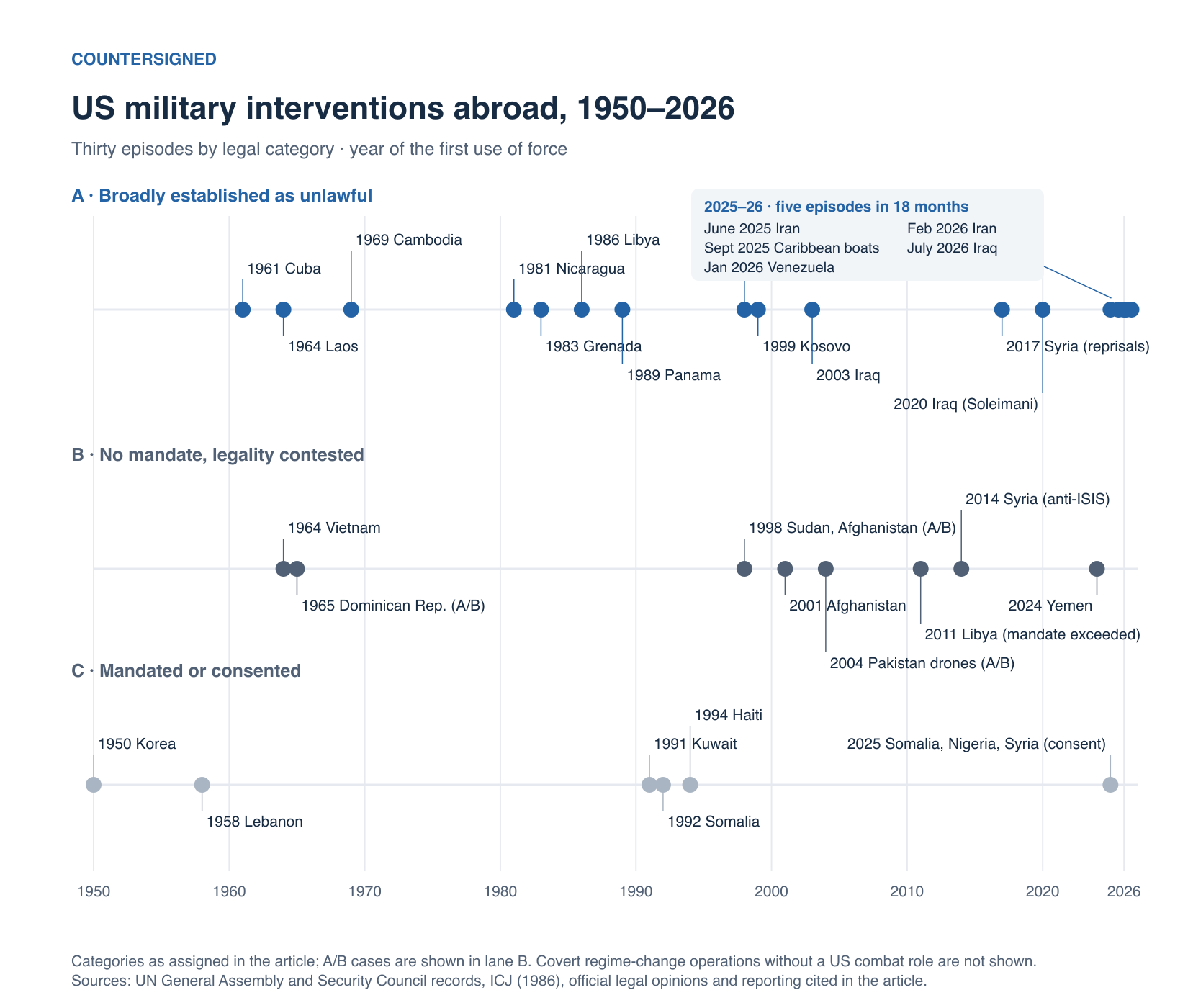
Since 1945 the United States has used armed force abroad without a UN Security Council mandate in at least 25 distinct episodes. For seventeen of them the illegality under the UN Charter is broadly established: by a judgment of the International Court of Justice, by General Assembly resolutions adopted with large majorities, by statements of the UN Secretary-General, or by a near-consensus of official legal services and legal scholarship. For a further eight, including Vietnam, Afghanistan in 2001 and the campaign against ISIS in Syria, a legal basis is seriously arguable and lawyers remain divided. This report separates the two groups, reconstructs how governments in the West, the East, Asia and the Global South reacted at the time, and shows how that pattern has inverted: in the 1980s Washington’s closest allies voted against it at the UN; in 2025–26 most of them fell silent while condemnation came from Latin America, Africa, Malaysia, Russia and China.
The yardstick: three lawful grounds, four contested doctrines
The rules are short. Article 2(4) of the UN Charter prohibits “the threat or use of force against the territorial integrity or political independence of any state.” The Charter allows only two exceptions: enforcement action authorized by the Security Council under Chapter VII, and the “inherent right of individual or collective self-defence if an armed attack occurs” under Article 51, which must be reported to the Council. Customary law adds a third lawful ground: the valid consent of the government of the territorial state. United Nations, Charter, Articles 2, 42 and 51
The International Court of Justice fixed the meaning of these words in the Nicaragua case of 27 June 1986. Arming, training and financing an insurgent force and mining a state’s harbours violate the prohibition on the use of force and the principle of non-intervention; collective self-defence requires an armed attack on the victim state and that state’s request for help; and only “the most grave forms” of force count as an armed attack. ICJ, Nicaragua v. United States, judgment of 27 June 1986
Successive administrations have invoked four doctrines to widen these exceptions. None commands majority support among states. Anticipatory self-defence against an imminent attack is arguable under the 1837 Caroline formula; preventive war against a non-imminent threat, the basis claimed for Iraq in 2003 and Iran in 2025 and 2026, is rejected by most states and scholars. Humanitarian intervention without a mandate is asserted as law only by the United Kingdom; the 2005 “responsibility to protect” requires Council action. Self-defence against non-state actors in a state “unwilling or unable” to stop them, the basis for the Syria campaign since 2014 and for drone strikes in Pakistan, is endorsed by a minority of Western states and rejected by Russia, China, Brazil, Mexico and most of the Non-Aligned Movement. And a “law-enforcement operation” against an indicted foreign official, the framing used for Panama in 1989 and Venezuela in 2026, is not an exception at all. Bundestag research service, “Der Fall ‘Maduro’ im Lichte des Völkerrechts”, 30 January 2026
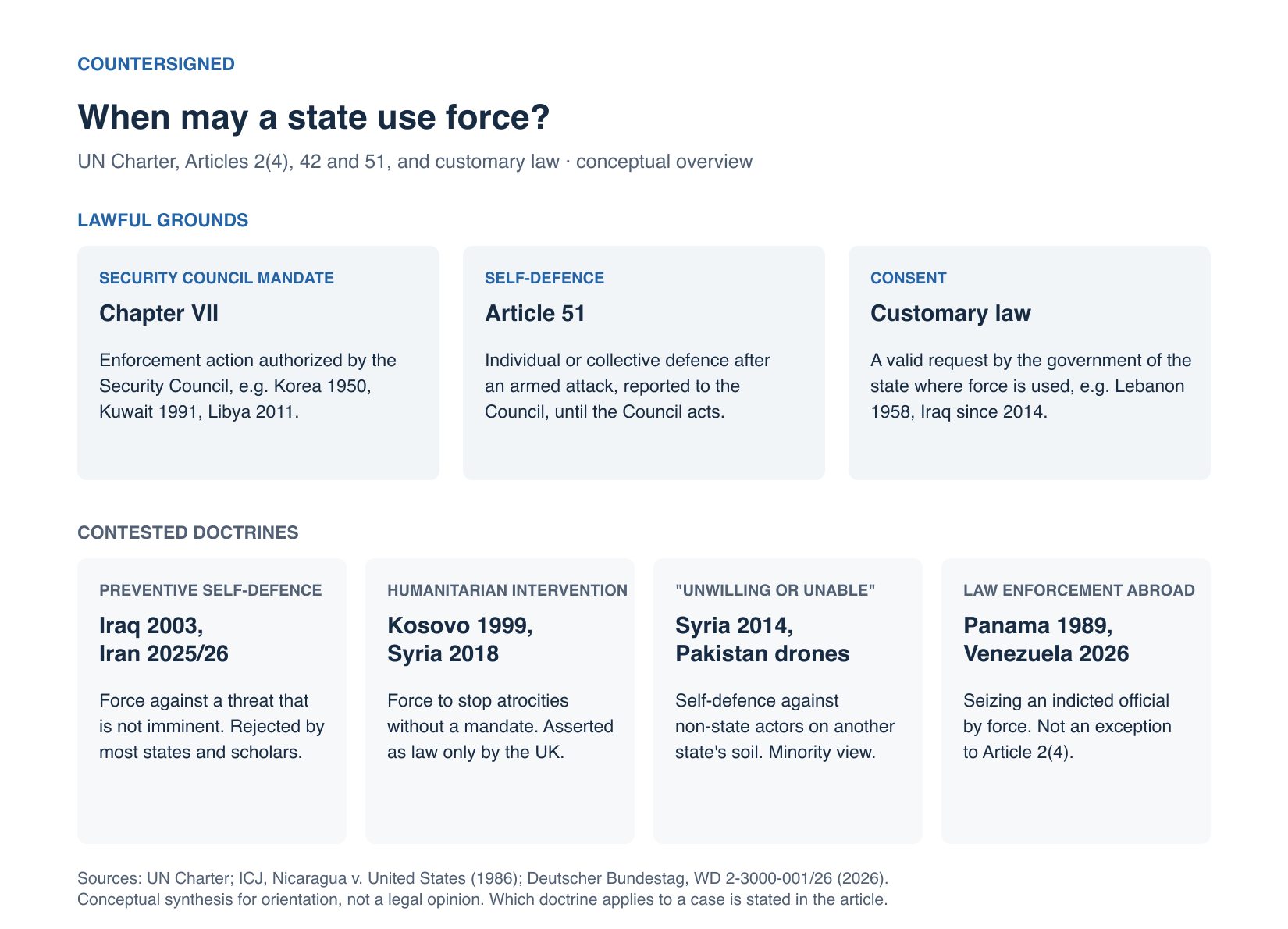
This report uses three categories. Category A, “broadly established as unlawful”: a court has so ruled, a UN organ has so found, or official legal services and an unmistakable majority of scholarship agree. Category B, “no mandate, legality contested”: self-defence or consent is seriously arguable and expert opinion is divided. Category C, “mandated or consented”: outside the question, listed only for contrast. The classification is this report’s judgment; the evidence for each case is given so that a reader can disagree.
Thirty episodes in one view
The timeline below covers every episode identified between the Charter’s entry into force and 9 September 2026. Operations with a mandate (Korea 1950, the Gulf War 1991, Somalia 1992, Haiti 1994) or with the host government’s consent (Lebanon 1958, the anti-ISIS operations in Iraq, Somalia and Nigeria) appear in grey. Covert regime-change operations without a US combat role, in Iran 1953, Guatemala 1954 and Chile 1973, are documented in declassified records but are not counted as wars. UN Security Council resolutions 84 (1950), 678 (1990), 794 (1992) and 940 (1994) National Security Archive, Iran 1953; FRUS, Guatemala 1952–54; Church Committee, Chile 1963–73
| Episode | Mandate or consent | US justification | Category | UN outcome |
|---|---|---|---|---|
| Cuba 1961 (Bay of Pigs) | None | Denied US role | A | Only a mild General Assembly appeal |
| Vietnam 1964–73 | None; SEATO cited | Collective self-defence of South Vietnam | B | Council never seized |
| Laos 1964–73, Cambodia 1969–73 | None; kept secret | Interdiction of North Vietnamese supply lines | A | None |
| Dominican Republic 1965 | OAS force created after the landing | Protect nationals | A/B | Ceasefire call only |
| Nicaragua 1981–90 | None | Collective self-defence of El Salvador | A | ICJ judgment; GA 41/31 (94–3–47); two US vetoes |
| Grenada 1983 | Contested regional request | Protect nationals | A | GA 38/7 (108–9–27); US veto |
| Libya 1986 | None | Self-defence against terrorism | A | GA 41/38 (79–28–33); veto |
| Panama 1989 | None | Arrest Noriega | A | GA 44/240 (75–20–40); OAS 20–1; veto |
| Sudan and Afghanistan 1998 (Infinite Reach) | None | Self-defence after embassy bombings | A/B | Sudan’s request for an inquiry not acted on |
| Iraq 1998 (Desert Fox) | None | Enforce inspections | A | Emergency session, no decision |
| Kosovo 1999 | None | Humanitarian necessity | A | Draft to halt bombing defeated 3–12; “illegal but legitimate” |
| Afghanistan 2001 | None for the invasion | Self-defence after 9/11 | B | Resolutions 1368/1373 recognized self-defence |
| Iraq 2003 | None | “Revival” of 1990 mandate; WMD | A | Annan: “illegal”; Chilcot |
| Pakistan 2004–18 (drones) | Publicly denied | Self-defence against al-Qaeda | A/B | UN rapporteur: violation of sovereignty |
| Libya 2011 | Resolution 1973 (10–0–5) | Protection of civilians | C, mandate exceeded (B) | Regime change criticized by Russia, China, AU, Brazil |
| Syria 2014– (anti-ISIS) | None; no Syrian consent | Collective self-defence of Iraq | B | Syria protested from 2015 |
| Syria 2017, 2018 (reprisals) | None | Deter chemical weapons | A | Russian draft defeated 3–8–4 |
| Iraq 2020 (Soleimani) | None; Iraq objected | Imminent attack | A | UN rapporteur: unlawful |
| Yemen 2024–25 | None; resolution 2722 did not authorize force | Defence of shipping | B | Resolution “took note” only |
| Iran, June 2025 | None | Collective self-defence of Israel | A | Ceasefire draft never voted |
| Caribbean and Pacific, Sept 2025– | None | “Armed conflict” with cartels | A | OHCHR and IACHR: extrajudicial killings |
| Venezuela, Jan 2026 | None | “Law-enforcement operation” | A | Guterres: “dangerous precedent”; no Council product |
| Iran, Feb 2026– | None | Collective self-defence of Israel | A | Resolution 2817 condemned Iran’s counter-strikes only |
| Iraq, July 2026 | None; Iraq objected | Response to drone attacks | A | None known |
1961–1973: Cuba and Indochina
Some 1,400 CIA-trained Cuban exiles landed at the Bay of Pigs on 17 April 1961 with US air and naval support and were defeated within three days, while Washington denied involvement at the UN. Nikita Khrushchev warned Kennedy the next day that the “little war” could “touch off a chain reaction in all parts of the globe.” Latin America split: Mexico, Venezuela and the Dominican Republic abstained on Cuba’s complaint, Brazil was instructed to abstain, and the General Assembly passed only a mild Latin American text urging peaceful settlement. Office of the Historian, The Bay of Pigs Invasion and its Aftermath FRUS 1961–63, vol. V, Khrushchev to Kennedy, 18 April 1961
Vietnam belongs in the contested category. The State Department’s legal adviser Leonard Meeker argued in March 1966 that North Vietnamese aggression amounted to an armed attack, so that US action was collective self-defence under Article 51 and the SEATO treaty. The Lawyers Committee on American Policy Towards Vietnam and Richard Falk replied that the 1954 Geneva Accords treated Vietnam as one state pending elections, that the conflict was a civil war, and that bombing the North exceeded any defensive necessity. The Security Council never took up the war. FRUS 1964–68, vol. XXVII, Meeker memorandum University of Miami Law Review, The Legality of the United States’ Involvement in Vietnam
Laos and Cambodia are not contested. The 1962 Geneva agreement guaranteed Laos’s neutrality; from December 1964 the United States bombed it for nine years under CIA cover, some 580,000 sorties, without acknowledgment, while North Vietnam violated the same agreement by using Laotian territory. In Cambodia, Operation Menu (from March 1969) was hidden from Congress by falsified logs until the New York Times exposed it in May 1969; the ground incursion followed in April 1970. Neither state had consented, no self-defence claim was reported to the Council, and Congress ended the bombing by statute in August 1973. Wikipedia, International Agreement on the Neutrality of Laos Wikipedia, Operation Menu
The reactions foreshadowed a pattern. Britain under Harold Wilson gave diplomatic support but refused to send “even a platoon of bagpipes.” Charles de Gaulle told a crowd of over 100,000 in Phnom Penh on 1 September 1966 that negotiations could begin only once Washington committed to withdraw. Sweden’s Olof Palme, after the Christmas 1972 bombing of Hanoi, listed “Guernica, Oradour, Babi Yar, Katyn, Lidice, Sharpeville, Treblinka”; Washington froze ambassadorial relations for more than a year. In Asia the picture was reversed: South Korea sent over 320,000 troops in total, Australia 61,000, Thailand about 12,000 and the Philippines about 10,000, while Japan hosted the logistics base and faced mass protest at home. The Soviet Union and China armed North Vietnam. London Review of Books, Sterling and Strings: Harold Wilson and Vietnam Fondation Charles de Gaulle, Discours de Phnom-Penh University of London Press, Olof Palme, Sweden and the Vietnam War Vietnam Veterans Memorial Fund, Allies in Action
1981–1990: the decade the allies voted no
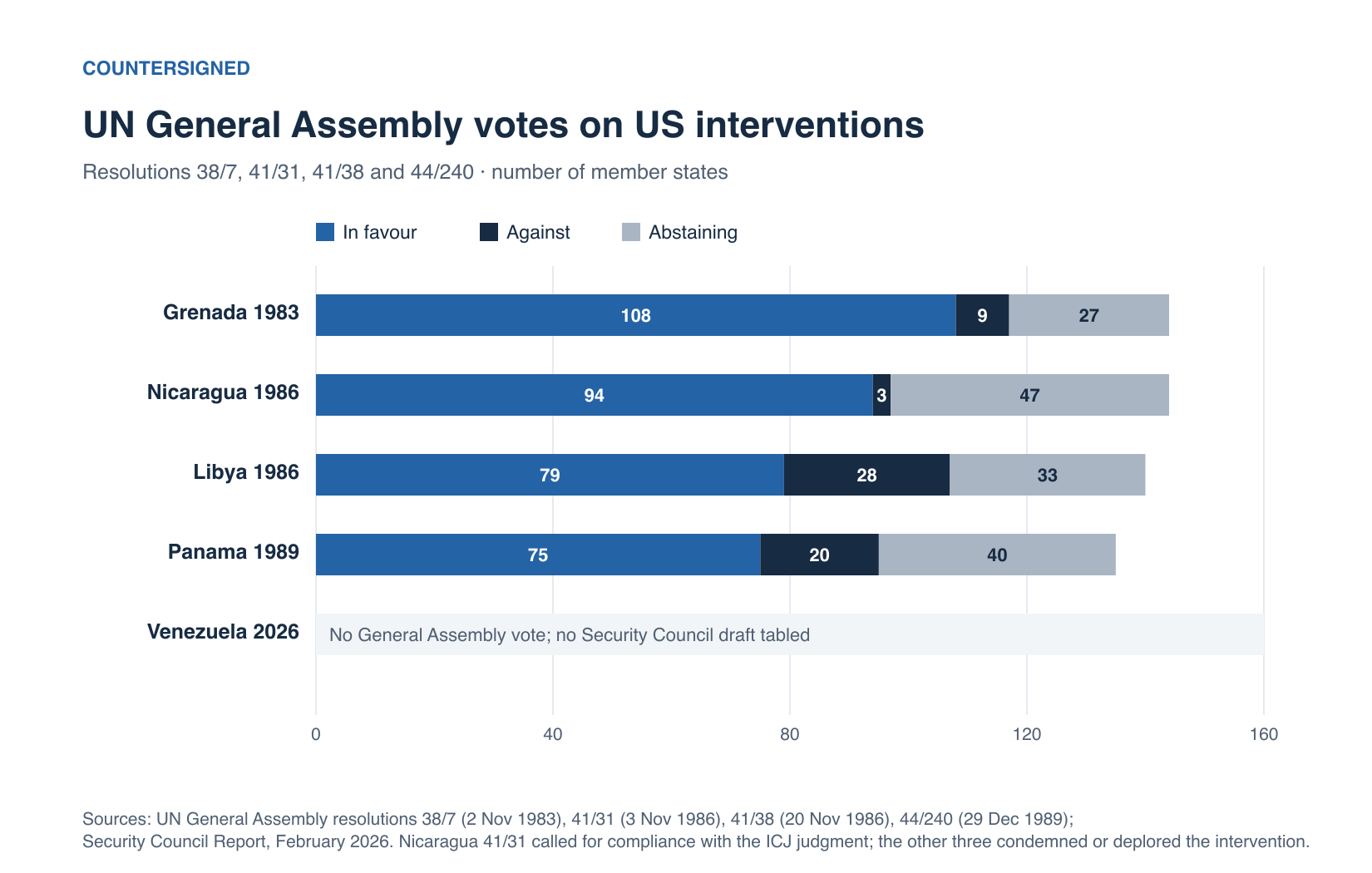
The Reagan administration armed the contra insurgency in Nicaragua from 1981 and mined its harbours in 1984. Nicaragua sued; the United States walked out of the case and, in October 1985, out of the Court’s compulsory jurisdiction. The Court’s 1986 judgment held that the United States had breached the prohibition on the use of force and the principle of non-intervention and ordered reparation. Washington vetoed a Council resolution demanding compliance on 31 July 1986 and again in October. The General Assembly then called for compliance on 3 November 1986 by 94 votes to 3 (the United States, Israel and El Salvador) with 47 abstentions, most of them Western allies unwilling to vote against Washington but unwilling to defend it. Washington Post, U.S. Vetoes Nicaraguan Resolution, 1 August 1986 UN General Assembly resolution 41/31
Grenada, invaded on 25 October 1983, produced the sharpest allied rebuke of the Cold War. The Council draft “deeply deploring” the invasion received 11 votes and a US veto; Britain, Togo and Zaire abstained. The General Assembly adopted resolution 38/7 by 108 to 9 with 27 abstentions, calling the intervention “a flagrant violation of international law.” France, Italy and the Netherlands were among the allies voting for it; Britain, West Germany, Canada and Japan abstained; only Caribbean co-belligerents, El Salvador and Israel voted with the United States. Margaret Thatcher, told only hours before the invasion of a Commonwealth realm, criticized it publicly. UN General Assembly resolution 38/7 Washington Post, U.S. Allies Join in Lopsided U.N. Vote, 3 November 1983 Declassified UK, The only US military intervention Britain (somewhat) opposed
The bombing of Tripoli and Benghazi on 15 April 1986, a reprisal for the Berlin discotheque attack, tested the alliance physically. Britain allowed the use of its bases; France, Spain and Italy refused overflight, forcing the F-111s on a thirteen-hour detour around Iberia, and West Germany denied basing. A Council draft was vetoed by the United States, Britain and France; the General Assembly “condemned” the raid on 20 November 1986 by 79 votes to 28 with 33 abstentions. Reprisals after the fact are not self-defence under the Nicaragua reading of Article 51. US Air Force Historical Support Division, Operation El Dorado Canyon UN General Assembly resolution 41/38
Panama closed the decade. Operation Just Cause removed and arrested General Manuel Noriega on 20 December 1989. Three days later the United States, Britain and France vetoed a non-aligned draft (10 in favour, 4 against, 1 abstention). The Organization of American States “deeply deplored” the intervention by 20 votes to 1, the first formal censure of the United States in its 42-year history. On 29 December the General Assembly adopted resolution 44/240 by 75 to 20 with 40 abstentions, calling the invasion “a flagrant violation of international law” and demanding withdrawal. The Bundestag’s research service observed in 2026 that even then the Federal Republic “was not able” to name the breach as such. UPI, Resolution condemning U.S. vetoed in Security Council, 23 December 1989 Washington Post, OAS Votes to Censure U.S., 23 December 1989 UN General Assembly resolution 44/240
1998–2003: Kosovo and Iraq
Four days of US and British bombing of Iraq in December 1998 were justified as enforcement of inspection resolutions that authorized no force. Russia recalled its ambassadors from Washington and London; Russia, China and France, three of the five permanent members, called the strikes unjustified. House of Commons Library, Iraq: “Desert Fox” and Policy Developments
NATO’s 78-day campaign against Yugoslavia began on 24 March 1999 without a resolution because Russia and China had announced vetoes. On 26 March a draft demanding an immediate halt was defeated by 3 votes (Russia, China, Namibia) to 12. The Independent International Commission on Kosovo, set up at Sweden’s initiative and chaired by Richard Goldstone, concluded in 2000 that the intervention was “illegal but legitimate”: illegal because it lacked Council approval, legitimate because diplomacy was exhausted and atrocities were under way. Prime Minister Yevgeny Primakov turned his plane around over the Atlantic on the day the bombing began; India’s Atal Bihari Vajpayee called the campaign a violation of the Charter; China, after the US bombing of its Belgrade embassy on 7 May killed three journalists, lodged its “strongest possible protest” while crowds besieged US missions. All nineteen NATO members took part or supported. Moscow cites the precedent to this day. UN press release SC/6659, 26 March 1999 Independent International Commission on Kosovo, The Kosovo Report UN press release SC/6674, 8 May 1999
Afghanistan in October 2001 is the clearest Category B case. The United States sent an Article 51 letter, resolutions 1368 and 1373 had reaffirmed the right of self-defence in the context of 9/11, and NATO invoked Article 5 for the first time. The majority view, shared by the House of Commons Library, is that the initial operation was lawful self-defence; a minority argue that a non-state attack cannot trigger Article 51 against a state. Russia, China, India, Pakistan and Iran acquiesced or assisted. House of Commons Library, The legal basis for the invasion of Afghanistan
Iraq in 2003 is not. The invasion proceeded after the United States and Britain abandoned a second resolution they could not pass. Asked by the BBC in September 2004 whether the war was illegal, Kofi Annan answered: “Yes, if you wish. I have indicated it was not in conformity with the UN Charter.” The British Iraq Inquiry found in 2016 that the circumstances of the legal decision were “far from satisfactory” and that, lacking a Council majority, “the UK was in fact undermining the Security Council’s authority.” UN News, Annan, 16 September 2004 Liberty, briefing on the Chilcot Report
The world split in a way not seen since. Jacques Chirac announced on 10 March 2003 that France would veto; Gerhard Schröder told the Bundestag on 13 February that under his leadership Germany would not take part; Vladimir Putin said on 20 March that “military action can in no way be justified” and was “a big political error.” Turkey’s parliament refused on 1 March to open a northern front. The Arab League summit denounced “any attack on Iraq”; the Non-Aligned summit in Kuala Lumpur opposed war without Council authority; on 15 February between six and ten million people demonstrated in some 600 cities. On the other side, a coalition of some 48 states joined or endorsed the invasion, with British, Australian and Polish combat forces and later Italian, Spanish, Danish, Dutch, Japanese and South Korean contingents. Deutscher Bundestag, Schröders Nein zur militärischen Option im Irak PBS NewsHour, World Reaction, 20 March 2003 CNN, Turkey rejects U.S. troop proposal, 1 March 2003 Wikipedia, 15 February 2003 Iraq War protests
2004–2020: drones, Syria and the Soleimani strike
CIA drone strikes in Pakistan’s tribal areas killed, by the Pakistani government’s count, “at least 400 civilians.” On 12 April 2012 a joint session of parliament unanimously demanded that “no overt or covert operations inside Pakistan shall be permitted.” The UN Special Rapporteur Ben Emmerson stated after meetings in Islamabad in March 2013: “The position of the Government of Pakistan is quite clear. It does not consent to the use of drones by the United States on its territory.” The Peshawar High Court declared the strikes illegal in May 2013. Evidence of earlier tacit consent under Musharraf, and of continued private cooperation, is why the case carries an A/B marker. OHCHR, Statement of the Special Rapporteur following meetings in Pakistan, 15 March 2013 Bureau of Investigative Journalism, Pakistani court rules CIA drone strikes are illegal Jamestown Foundation, Private Approval, Public Condemnation
Libya in 2011 had a mandate, resolution 1973, adopted with Brazil, China, Germany, India and Russia abstaining. When NATO’s campaign ended with Gaddafi’s death, Russia’s Sergei Lavrov, South Africa’s Jacob Zuma, the African Union and Brazil argued that regime change exceeded the mandate. The episode explains why Russia and China refused any authorization for Syria and why the “responsibility to protect” lost most of its Global South support. UN press release SC/10200, 17 March 2011 Council on Foreign Relations, Jacob Zuma’s Tightrope Walk on Libya
In Syria the anti-ISIS campaign from September 2014 rests on an Article 51 letter stating that Iraq had requested help and that Damascus was “unwilling or unable” to stop ISIS. Syria protested from 2015; Russia, which intervened at Syria’s request, called the US presence illegal. That campaign is contested. The chemical-weapons reprisals are not: the 59 missiles fired at Shayrat on 7 April 2017 and the US, British and French strikes of 14 April 2018 were justified as deterrence, not self-defence. The Bundestag’s research service concluded in 2018 that using force to punish a state’s violation of a convention breaches the prohibition on force; Chancellor Merkel nevertheless called the action “necessary and appropriate.” A Russian draft condemning the 2018 strikes received 3 votes (Russia, China, Bolivia) against 8 with 4 abstentions. In 2017 Germany, France, Britain, Japan, Australia, Saudi Arabia and Turkey backed the strike; Russia, Iran, Syria and Bolivia opposed it. US letter to the Security Council, S/2014/695 Bundestag research service, WD 2-3000-048/18 France 24, UN rejects Russia’s bid to condemn air strikes on Syria, 14 April 2018 CNN, Who’s with the US on Syria strike, 7 April 2017
The drone strike that killed General Qassem Soleimani at Baghdad airport on 3 January 2020 was carried out without Iraq’s consent; the Iraqi parliament voted two days later to end the foreign troop presence. The UN Special Rapporteur on extrajudicial executions, Agnès Callamard, reported in July 2020 that the strike was “unlawful”: no evidence of an imminent attack had been produced, and “by killing General Soleimani on Iraqi soil without first obtaining Iraq’s consent, the US violated the territorial integrity of Iraq.” France, Germany and Britain called for de-escalation without endorsing the strike; Russia and China condemned it; Israel and Saudi Arabia welcomed it. Al Jazeera, Iraqi parliament calls for expulsion of foreign troops, 5 January 2020 Airwars, New UN report insists Soleimani assassination by US was ‘unlawful’
2024–2025: Yemen and the first Iran strikes
Resolution 2722 of 10 January 2024 condemned Houthi attacks on shipping and “took note” of states’ right to defend their vessels; adopted 11–0–4, it did not authorize force. Two days later US and British strikes began. The Trump administration’s Operation Rough Rider (15 March to 5 May 2025) carried out over 1,100 strikes; a strike on the Ras Isa port and another on a migrant detention centre in Saada caused mass civilian casualties, and Amnesty International called for a war-crimes investigation. Western allies and the Gulf states supported the campaign; Russia, Iran and several UN special rapporteurs argued that its scale exceeded self-defence. The attacks on shipping were real and continuing, which keeps the case contested. UNSCR, Resolution 2722 (2024) Combating Terrorism Center, An Assessment of Operation Rough Rider
Israel attacked Iran on 13 June 2025. On 22 June seven B-2 bombers dropped fourteen 30,000-pound penetrators on Fordow and Natanz and submarines struck Isfahan, to prevent an Iranian bomb; no Iranian armed attack on the United States had occurred. Legal analysis published since finds that neither state met Article 51: “there was zero indication of Iranian forces preparing to launch an actual strike… in the hours or days before June 13,” and preventing a future capability “is a far cry from repelling an actual attack.” Congressional Research Service, U.S. Strikes on Nuclear Sites in Iran Opinio Juris, Jus ad Bellum Under Strain, 26 September 2025
The Secretary-General called the bombing “a perilous turn in a region that is already reeling.” Russia’s ambassador said the United States had “opened a Pandora’s box”; China demanded an immediate ceasefire; Pakistan condemned the strikes; a Russian, Chinese and Pakistani draft demanding an “immediate and unconditional ceasefire” was circulated but never voted because of the certain US veto. Keir Starmer said Iran “can never be allowed to develop a nuclear weapon”; France urged restraint; Friedrich Merz, who days earlier had praised Israel for doing “the dirty work for all of us,” demanded that Iran negotiate. Saudi Arabia, Qatar and Iraq warned of destabilization; Turkey, unusually, stopped short of condemning Washington. Brazil “vehemently” condemned “a violation of Iran’s sovereignty and international law,” and the BRICS summit in Rio condemned the attacks as violations of the Charter. India called for de-escalation without condemnation. Al Jazeera, Key players tangle at UNSC, 22 June 2025 OPB/NPR, World reacts to U.S. strikes on Iran, 22 June 2025 Internationale Politik Quarterly, Merz’ Improvised “Dirty Work” Foreign Policy Agência Brasil, Brazil condemns Israeli and US attacks, June 2025
September 2025 onwards: killings at sea
From 2 September 2025 the US military has destroyed small vessels it describes as drug boats in the Caribbean and the eastern Pacific. Human Rights Watch counted 69 strikes and at least 227 dead by 2 September 2026. The administration says it is in an “armed conflict” with cartels designated as terrorist organizations; it has identified none of the dead and produced no evidence of cargo. The UN human rights office and the Inter-American Commission concluded that the strikes violate the right to life; Human Rights Watch calls them extrajudicial killings because “the United States is not engaged in an armed conflict with another state or non-state actor in the Caribbean or Pacific.” On 24 December 2025 a CIA drone struck a first land target in Venezuela. Human Rights Watch, United States: Year of Extrajudicial Killings at Sea, 2 September 2026 Human Rights Watch, Q&A: US Military Operations in the Caribbean, Pacific, 16 December 2025
Colombia’s foreign ministry called on Washington “to cease these attacks and… respect the norms dictated by international law”; President Gustavo Petro suspended intelligence cooperation, and a Colombian family filed the first complaint at the Inter-American Commission. Britain stopped sharing intelligence on suspect vessels in October 2025 because it considered the strikes illegal and did not want to be complicit; the Netherlands curtailed sharing too. Two Trinidadian fishermen were among the dead, yet Trinidad and Tobago, Ecuador, the Dominican Republic and Guyana cooperated with the deployment. CBS News, Colombia calls for U.S. to stop lethal boat strikes CNN, UK suspends some intelligence sharing with US over boat strike concerns, 11 November 2025
3 January 2026: the seizure of a head of state
US special forces seized President Nicolás Maduro and his wife in Caracas in a raid of two and a half hours; between 23 and 47 Venezuelan soldiers, 32 Cuban security personnel and two civilians were killed. Washington called it “a surgical law enforcement operation facilitated by the U.S. military,” compared it expressly to Noriega’s arrest and did not invoke Article 51. Vice-President Delcy Rodríguez was sworn in as acting president on 5 January. Wikipedia, 2026 United States intervention in Venezuela
The Secretary-General said he was “deeply concerned that the rules of international law have not been respected” and that the events “constitute a dangerous precedent.” The Bundestag’s research service found on 30 January that the force used was “neither legitimized by a mandate of the Security Council nor an exercise of the right of self-defence under Article 51, which the United States moreover did not invoke,” and that drug trafficking “does not qualify as, and has never been considered, an ‘armed attack’.” The German Society of International Law, its Argentine, Brazilian and Peruvian counterparts, the American Society of International Law and Chatham House condemned the raid “unanimously” as a breach of Article 2(4) and of the OAS Charter. UN News, US actions in Venezuela ‘constitute a dangerous precedent’: Guterres, 3 January 2026 Bundestag research service, WD 2-3000-001/26
On 4 January Brazil, Chile, Colombia, Mexico, Spain and Uruguay jointly expressed “profound concern and firm rejection of the military actions carried out unilaterally in Venezuelan territory.” Russia called it “an act of armed aggression”; China was “deeply shocked” and “strongly condemns”; Cuba spoke of “state terrorism”; Malaysia’s Anwar Ibrahim called it “a clear violation of international law”; South Africa a “manifest violation” of the Charter; the African Union expressed “grave concerns”; Uganda, for the Non-Aligned Movement, called it “an act of war,” and fourteen further African governments condemned it. At the Council on 5 January, France’s deputy envoy said the operation “runs counter to the principle of non-use of force”; Denmark said “the inviolability of borders is not up for negotiation”; Colombia recalled “the worst interference in our area in the past.” Yet no draft resolution was tabled and the General Assembly took no action, in contrast to Panama in 1989. Wikipedia, International reactions to the 2026 United States intervention in Venezuela PBS NewsHour, U.S. allies and adversaries alike use UN meeting to critique Venezuela intervention Security Council Report, The Security Council’s Muted Response to the Venezuela Crisis, February 2026
Support came from Israel, Argentina’s Javier Milei (“liberty advances”), Paraguay, Peru, El Salvador, Albania and Italy’s Giorgia Meloni, who called the raid “legitimate.” Keir Starmer said “we shed no tears” while reaffirming international law; Canada, Japan, South Korea, Australia and India called for dialogue. Friedrich Merz said on 3 January that “the legal classification of the US operation is complex. We are taking our time.” Four days later the government spokesman said the United States had “not convincingly demonstrated in the Security Council that its action was in conformity with international law.” Two months on, the promised assessment had still not appeared. Bundesregierung, Bundeskanzler Friedrich Merz erklärt zur Situation in Venezuela, 3 January 2026 Correctiv, US-Angriff auf Venezuela: Bundesregierung drückt sich um völkerrechtliche Bewertung, 23 February 2026
28 February 2026 onwards: the Iran war
The United States and Israel struck Iran from 28 February 2026 after President Trump declared nuclear negotiations a failure. Supreme Leader Ali Khamenei was killed in the opening strikes; by 25 March Central Command reported over 10,000 targets hit, and a Tomahawk reportedly hit a school in Minab on the first day, killing 168 people, mostly children. Iran retaliated against Israel and against US bases in Bahrain, Kuwait, Qatar, Saudi Arabia, the United Arab Emirates and Jordan and closed the Strait of Hormuz to most shipping. A Pakistani-mediated ceasefire on 8 April, failed talks in Islamabad, a US naval blockade from 13 April, a memorandum signed in June and its collapse on 8 July followed; US strikes on Iranian tankers in early September 2026 show the conflict continuing at the time of writing. Compiled casualty figures, unverified, run to more than 10,000 Iranian dead. Congressional Research Service, U.S. Conflict with Iran, 26 March 2026 Wikipedia, 2026 Iran war ceasefire Al Jazeera, US conducts new wave of strikes on Iran as ceasefire falters, 8 July 2026
The US Article 51 letter of 10 March 2026 asserts collective self-defence of Israel within an “ongoing international armed conflict” and claims that “peaceful measures have once again been attempted and exhausted.” It “fails to specify what supposed armed attack by Iran on Israel provided the predicate,” and members of Congress briefed on the intelligence said there was no evidence of an imminent threat. German-language legal scholarship assesses the war “in the majority as a clear violation of the general prohibition on the use of force”; a minority, notably the former Canadian judge advocate general Kenneth Watkin, argues that decades of Iranian proxy attacks make the claim defensible. Just Security, An Unserious Justification for an Unnecessary War, 18 March 2026 Just Security, Operation Epic Fury: Reports of the Death of International Law are Greatly Exaggerated, 10 March 2026 Wikipedia (German), Irankrieg 2026
In the West, France, Germany and Britain stated on the first day: “We did not participate in these strikes… We condemn Iranian attacks on countries in the region in the strongest terms.” Emmanuel Macron called the strikes an “outbreak of war” with “serious consequences for international peace and security.” Britain allowed the use of its bases for “defensive” strikes and, from 20 March, for strikes on missile sites. Spain’s Pedro Sánchez refused the use of Rota and Morón, closed Spanish airspace to the aircraft involved and declared: “No to the breakdown of international law that protects us all. No to resolving conflicts with bombs. No to war.” Norway’s foreign minister said the attack was “not in line with international law.” The EU’s leaders called for “maximum restraint… and full respect for international law.” Canada, Australia, Ukraine and NATO’s secretary general supported the operation. Merz said on 1 March that “now is not the moment to lecture our partners and allies” and on 18 March that Germany “would have advised against going down this path.” Élysée, Joint Statement by the Leaders of France, Germany and the United Kingdom on Iran, 28 February 2026 Euronews, Europe reacts to US and Israeli attack on Iran, 28 February 2026 CNN, Most European leaders have tiptoed around Trump’s war with Iran. Not Spain’s PM, 8 March 2026 ZDF heute, Merz zu Iran, 1 March 2026 Euronews, Merz: Deutschland hätte vom Krieg im Iran abgeraten, 18 March 2026
In the East and the Global South, Russia called the strikes “a pre-planned and unprovoked act” of aggression; China demanded “an immediate halt to military actions” and respect for “Iran’s national sovereignty, security and territorial integrity.” Pakistan “strongly condemned” the attack and then became the principal mediator. Malaysia’s parliament passed an emergency motion on 2 March denouncing a “vile attempt” to sabotage negotiations. Japan and South Korea coordinated a “measured” response that neither endorsed nor condemned; India said nothing about the initial attack but condemned Iran’s strikes on the Gulf, which split BRICS: the bloc failed to agree a statement in May. Brazil condemned an attack launched “amid a negotiation process”; Mexico called for peace without condemnation; the African Union expressed “deep concern.” The Gulf states, Egypt and Jordan, themselves under Iranian fire, condemned Iran. At the Council on 11 March, a Bahraini draft condemning Iran’s attacks on its neighbours passed 13–0–2 without mentioning the US and Israeli strikes; a Russian draft calling on “all parties” to stop received 4 votes (Russia, China, Pakistan, Somalia) against 2 with 9 abstentions. Al Jazeera, World reacts to US, Israel attack on Iran, 28 February 2026 Malay Mail, Anwar slams Israeli-US attack on Iran, 28 February 2026 The Diplomat, Shockwaves Across Asia, March 2026 Al Jazeera, BRICS talks end without joint statement, 15 May 2026 Security Council Report, The Middle East Crisis: Votes on Two Draft Resolutions, March 2026
On 29 July 2026 US and Saudi forces struck Popular Mobilization Forces sites across Iraq after drone attacks on Saudi facilities; the PMF reported at least 20 dead. Iraq’s presidency “categorically rejected any attacks in Iraqi territory,” and Iran called the strikes a violation of Iraq’s “national sovereignty and territorial integrity.” Without Iraqi consent and without a mandate, the strikes belong in Category A. By contrast, US strikes in Somalia, Nigeria and post-Assad Syria in 2025–26 were coordinated with the respective governments, and the raid that killed the Jalisco cartel leader in Mexico in February 2026 was conducted by Mexican forces with US intelligence. Where consent was available the administration sought it; where it was refused it acted regardless. Al Jazeera, Iraqi armed groups condemn ‘dangerous escalation’ after US-Saudi strikes, 29 July 2026 Council on Foreign Relations, A Guide to Trump’s Second-Term Military Strikes and Actions
What the pattern of reactions shows
Three shifts stand out. First, allied dissent has moved from votes to silence. In 1983 and 1989 the General Assembly majorities included most of Western Europe; in 2026 no European government asked the Assembly to vote on Venezuela, and the only Council text that passed on Iran omitted the US strikes altogether. The Bundestag’s lawyers described the mechanism: governments fear that naming an ally’s violation would carry political costs, while scholars warn that silence itself erodes the norm. Bundestag research service, WD 2-3000-001/26, section 6
Second, the East–West axis has become an East–South axis. Russia and China opposed every case. What changed after 2003 is that the loudest condemnations of 2025–26 came from Brazil, Mexico, Colombia, Chile, South Africa, Malaysia and a broad list of African governments, while Asia’s US allies and India adopted a language of restraint that neither endorsed nor condemned.
Third, Germany’s stance has moved from open refusal to studied ambiguity. Schröder’s “no” to Iraq, Merkel’s “necessary and appropriate” for Syria, Merz’s “dirty work” for Israel, “complex” for Venezuela and “not the moment to lecture” for Iran trace a line that Germany’s own parliamentary lawyers have twice contradicted in writing.
Method, limits and what would change the findings
This is a document-based review of UN resolutions and voting records, ICJ judgments, official legal opinions of the Bundestag, the House of Commons Library and the Congressional Research Service, government statements and, for 2025–26, several independent news organizations. For every “clearly illegal” case we looked for the strongest legal argument on the US side and report it: the Meeker memorandum for Vietnam, the Goldsmith advice for Iraq, the Watkin analysis and the State Department’s letter for Iran. The premise that every no-mandate intervention is “unconditionally” illegal is too strong; Afghanistan 2001, Vietnam, the anti-ISIS campaign and Yemen are genuinely contested and are labelled as such. Quotations from German, French and Spanish sources are given in translation; original titles are kept in the references.
Consent is sometimes secret, as Pakistan showed, and the public record cannot resolve it. Reactions are not uniform within states: Germany’s chancellor and its parliamentary lawyers, Britain’s government and its intelligence services, and Pakistan’s parliament and its executive all diverged. Casualty figures for the Iran war are compiled from partisan sources and could not be checked. Several UN press releases on the 2026 meetings were blocked at retrieval and were replaced by Security Council Report, UN News, PBS and Al Jazeera coverage, so wording attributed to Council speakers is reported at second hand. All sources were checked on 9 September 2026. A Security Council or General Assembly resolution on Venezuela or Iran, publication of the German government’s promised assessment, an ICJ opinion, or credible evidence of a prior Iranian armed attack on Israel would each change parts of this picture.