Key findings
- The vaccines are authorised, and the first two mRNA vaccines were tested in large randomised trials. Seven hold EU authorisations, and the US regulator listed four as approved in May 2026, having revoked the emergency authorisations in August 2025. The two mRNA vaccines passed phase III trials with 43,548 and 30,420 participants, measuring illness with symptoms, not transmission, as the regulators stated at the time. The first EU authorisations were conditional, a legal route for less complete data in an emergency; those of Comirnaty and Spikevax became standard in October 2022. In the US the Pfizer-BioNTech vaccine was legally “investigational”, the usual term for a product still under clinical study, until its emergency authorisation; none of the legal categories used is called “experimental” (section 7).
- Since 2025 US policy has narrowed, on grounds the regulator states itself. Vaccination is approved only for people aged 65 and over and younger people at higher risk. The director of the regulator’s vaccine centre wrote that “at the present time, with best available information” there was no “substantial certainty” of a net benefit for healthy people, while his memos state that the trials of 2020 and 2021 “demonstrated acceptable efficacy against symptomatic COVID-19”. In March 2026 a court provisionally suspended the reconstituted advisory committee’s appointments and votes (section 7).
- The origin of the virus is unresolved. No infected animal has been found, and no evidence of the virus in a Wuhan laboratory has been produced. The WHO’s advisers said in 2025 that the weight of available evidence suggests spillover from animals, but that a laboratory origin “can therefore not be ruled out, nor can it be proven until more information is provided”, and that China has not shared the data requested; US agencies lean both ways with low or at most moderate confidence. Calling the laboratory hypothesis a conspiracy theory in 2020 went beyond the evidence then available, as does calling it established today (confidence: moderate; section 4).
- The pandemic exercises before 2020 fit routine preparedness, and no document held shows foreknowledge (confidence: high for the facts, moderate for the judgement). Four of the ten scenarios used a coronavirus and the others different pathogens; most exercises were public at the time, while three government reports were disclosed only from 2020; the organisers of the October 2019 exercise said afterwards that it was not a prediction. The lessons were not fully applied: the UK Covid-19 Inquiry found “a failure to fully learn from past civil emergency exercises” and preparation planned around influenza rather than the pandemic that occurred (sections 3 and 15).
- The toll is large but imprecise, and it differed widely between countries. The WHO’s model gives 14.83 million excess deaths for 2020–21 (13.23–16.58 million); a competing model gives 18.2 million, and published estimates for Germany differ several-fold depending on the method. Among eleven countries compared, excess deaths in 2020–21 ranged from 1.2 per cent above the expected number in Denmark to 19.5 per cent in Poland; in every one of them except Denmark, the fall in life expectancy from 2019 to its pandemic low was larger than any fall in the decade before, influenza years included (section 5).
- Measures reduced transmission in some countries, at a cost the sources do not measure. A Royal Society review found lockdowns and social distancing the most effective non-drug measures, on mostly low-certainty evidence; the economic and social costs are not quantified in the sources cited, apart from projected losses from school closures (section 6).
- In the rulings held for this report, courts found specific instruments unlawful, not whole pandemic responses. Polish administrative courts and the Supreme Court refused to apply restrictions imposed by regulation without adequate statutory authorisation. One civil judgment (Warsaw, February 2025, not final in June 2025, known from the audit office’s account) held that a state of natural disaster should have been declared, while a Supreme Court order of 2020, known from a 2023 law-journal article, held that it need not be. Spain’s Constitutional Court held the movement ban of the March 2020 state of alarm unconstitutional because that instrument did not allow it, while accepting that the measures were necessary; Germany’s Constitutional Court upheld the federal night-time curfews and the school closures of spring 2021. No Polish Constitutional Tribunal ruling on an epidemic restriction was found (section 9).
- Two companies describe government pressure on platforms; corruption by named politicians is not documented. Meta’s chief executive wrote that officials “repeatedly pressured” his teams, and Alphabet’s lawyers that officials “pressed the Company”; these are accounts by interested parties, and the US Supreme Court decided only that the plaintiffs lacked standing. Company revenues, state purchases and the Commission President’s role in one negotiation are documented; EU courts and the Ombudsman found failures in handling access requests, and the UK “VIP lane” was held unlawful. No official finding held for this report establishes corruption by a named politician (sections 10 and 12).
- The WHO depends on a few donors. In 2024 the United States and the Gates Foundation were its two largest voluntary contributors by gross cash received; after setting aside US$330 million as possibly uncollectable, the WHO ranks the Gates Foundation first and the United States seventh. Most voluntary money is earmarked by the donor. The documents show dependence, not that a donor determined a decision. The 2025 Pandemic Agreement, not yet in force, states that it gives the WHO Secretariat, including the Director-General, no authority to require lockdowns, vaccination mandates or travel bans (section 11).
- Compensation has been paid in few cases. Of 14,250 US claims over COVID-19 countermeasures, 66 had been compensated by 1 October 2026, totalling about US$8.0 million by our sum; 8,249 had been denied and 5,881 were pending. Poland’s compensation fund made 268 awards for COVID-19 vaccines by the end of 2025 and refused 948 applications in all (section 8).
Review status: approved for publication by the responsible editor on 16 October 2026; no independent medical or legal review (method note).
1. How to read this report
The pandemic reaches most readers as competing slogans. Governments, the World Health Organization (WHO), manufacturers, their critics and parliamentary majorities and minorities have all made claims that later proved wrong. This report therefore applies one evidential standard to every claim, whoever makes it, and states how far each conclusion goes.
Status of a factual claim. Each disputed claim receives one of five labels: supported (the evidence held confirms it), partially supported (true in part or only with a qualification), disputed (credible evidence points both ways), unverified (no adequate evidence could be found) and contradicted (the evidence held shows it to be false).
Confidence of an assessment. Where the report draws its own conclusion, it states how sure that conclusion is: high, moderate, low or unresolved, and what would change it. Confidence describes the evidence, not a probability.
Names. Persons are named only where a fact about them is officially confirmed: by a court; by an auditor, ombudsman or prosecutor; by an official register or filing; or by an official proceeding still under way, whose status is then stated. Press reports alone are not a basis for naming anyone.
Law. A measure is called unconstitutional or unlawful only where a competent court has said so. Elsewhere the report describes an allegation and says who makes it.
Money and influence. Three levels are kept apart: a documented relationship (a payment, a contract, a post); a potential conflict of interest (such a relationship plus a role in a decision on the same matter); and an established breach found by a court, auditor, ombudsman or prosecutor. A contact is not evidence of control, and a relationship is not evidence of corruption.
Limits. The report gives no medical advice. It summarises published research and official assessments rather than conducting its own review or mortality model. Its cutoff is 14 October 2026; method, sources and review status are at the end.
2. Prehistory: epidemics, gain-of-function research, preparedness
SARS and MERS
Severe acute respiratory syndrome (SARS), a coronavirus disease, spread from southern China, where the first cases appeared in November 2002 (S511). A World Health Organization (WHO) table, with data as of 31 December 2003, lists 8,096 probable cases and 774 deaths for illness beginning between 1 November 2002 and 31 July 2003 (S503); WHO declared the outbreak over on 5 July 2003 (S511). Middle East respiratory syndrome (MERS) followed in 2012: as of 9 May 2014 WHO had received reports of 536 laboratory-confirmed human cases since April 2012, including 145 deaths (S005).
The 2009 influenza pandemic and what the reviews found
A committee of the Parliamentary Assembly of the Council of Europe alleged in June 2010 that the handling of the 2009 influenza A(H1N1) pandemic caused a “waste of large sums of public money”, and an investigation in the BMJ alleged that scientists advising WHO on pandemic planning had done paid work for pharmaceutical firms “that stood to gain from the guidance they were preparing” (S006; S508); neither is an official finding. A review committee of independent experts appointed on behalf of WHO’s member states reported in 2011 that WHO “performed well in many ways during the pandemic” and that it found “no evidence of malfeasance” and no evidence of commercial influence on WHO’s advice or decisions, but criticised it for altering online documents “without notice or explanation” and for weak conflict-of-interest procedures (S511).
Gain-of-function research and US policy, 2014–2026
US official documents define “gain-of-function” differently, and which definition applies decides whether an experiment needs special review (S515; S516; S027). Announcing a funding pause in 2014, the White House Office of Science and Technology Policy (OSTP) and the Department of Health and Human Services (HHS) described such studies as aiming “to increase the ability of infectious agents to cause disease by enhancing its pathogenicity or by increasing its transmissibility” (S515).
The pause of 17 October 2014 withheld new federal funding from projects “reasonably anticipated” to give influenza, MERS or SARS viruses enhanced pathogenicity or transmissibility in mammals by the respiratory route (S515). Guidance issued by OSTP on 9 January 2017, which is “not binding”, recommended that agencies develop review mechanisms, known as P3CO (Potential Pandemic Pathogen Care and Oversight), reaching only an “enhanced” potential pandemic pathogen; pathogens recovered from nature are not enhanced ones, “regardless of their pandemic potential” (S516). HHS published its framework on 19 December 2017, which, it states, ended the pause (S993).
Executive order 14292 of 5 May 2025 defines dangerous gain-of-function research without the 2017 guidance’s limitation to pathogens already “enhanced” by laboratory work, which on our reading of the two texts is a broader definition (S027; S516).
The NIH grant to EcoHealth Alliance
The US National Institutes of Health (NIH) awarded grant R01AI110964, “Understanding the Risk of Bat Coronavirus Emergence”, in May 2014 to EcoHealth Alliance, with the Wuhan Institute of Virology (WIV) as a consortium participant; NIH’s record shows six project-years totalling $3,378,896 (S530; S993; S033).
NIH’s principal deputy director wrote on 20 October 2021 to the senior minority member of a House committee that the experiment in the grant’s final progress report tested whether spike proteins from bat coronaviruses in China could bind to the human cell receptor ACE2 in mice; that mice infected with “the SHC014 WIV1 bat coronavirus became sicker than those infected with the WIV1 bat coronavirus”, which NIH called “an unexpected result of the research”; that the work fell outside the framework for enhanced potential pandemic pathogens “because these bat coronaviruses had not been shown to infect humans”; that the grantee “failed to report this finding right away, as was required by the terms of the grant”; and that the viruses studied under the grant and the WIV subaward, the part of the grant passed on to the Wuhan institute, “are not and could not have become SARS-CoV-2” (see section 4) (S527).
In a notice dated 15 May 2024, effective 14 May, HHS suspended EcoHealth Alliance and proposed it for debarment from federal programmes because the record indicated it “lacks the present responsibility” to take part (S530). In January 2025 the department’s suspension and debarment official debarred EcoHealth Alliance and its former president and chief executive, Peter Daszak, for five years, until 14 and 20 May 2029 respectively, judging this “necessary to protect the Federal Government’s business interests” (S1331; S1333). The decision memorandum, which states that the responses submitted on Daszak’s behalf were taken into consideration, cites among other things the failure to report immediately, as the grant required, a more than tenfold (“1-log”) increase in viral growth, a progress report not submitted on time and a lack of full cooperation. It is an administrative decision, not a court ruling; no challenge to it was found in the sources held (S1332). The House committee that published the redacted documents announced the decision on 17 January 2025; the date is not legible in the copies (S039).
DEFUSE, and preparedness on the eve of the pandemic
In March 2018 a consortium led by EcoHealth Alliance submitted a proposal on bat-borne coronaviruses, DEFUSE, to the US Defense Advanced Research Projects Agency (DARPA), requesting $14,209,245; DARPA did not fund it (S533; S600). A DARPA programme manager told congressional investigators in May 2024 that a leaked rejection letter “looks like the letter I wrote” and that the absence of a plan for gain-of-function and dual-use risks affected the decision; the organisation’s then president said the rejection concerned cost and that “never once did biosafety come up” (S600).
The 2019 Global Health Security Index ranked the United States first with 83.5 points of 100, Germany 14th with 66.0 and Poland 32nd with 55.4, and concluded that “no country is fully prepared for epidemics or pandemics” (S539). It scores publicly documented capacity, “relies entirely on open-source information”, and may therefore under-score preparations a country has not published (S539).
3. Pandemic exercises 2001–2019: what they contained and what follows from them
In a tabletop exercise, teams work through an unknown fictional scenario and decide together how they would respond (S1329). This section describes the exercises and scenario studies of 2001 to 2019 named in the public debate and tests whether they show routine preparedness or foreknowledge. Some documents are held only as copies uploaded by third parties, Lock Step and the Clade X executive summary, and one of the accounts of Event 201 used here is a preprint by an outside author.
The exercises at a glance
- Dark Winter, 22–23 June 2001; a Johns Hopkins centre and three partners (S055). Scenario: smallpox released deliberately in three US cities. The analysts, two of whom had helped design the exercise, found the country “ill-prepared in several ways” (S057).
- Atlantic Storm, 14 January 2005; two research centres and a transatlantic network. Scenario: smallpox attacks on six European and North American cities, with “projections indicating the possibility of 660,000” cases within 30 days; participating leaders were found “not prepared to respond effectively at the pace and on the scale demanded by the crisis” (S549).
- Lock Step, May 2010; the Rockefeller Foundation with Global Business Network. Not an exercise but a scenario in which an influenza virus “originating from wild geese” kills 8 million people; the authors called their scenarios “stories, not forecasts” (S062). The copy held is a third-party archive upload.
- SPARS, 2017; Johns Hopkins Center for Health Security (S081). A training scenario for health communicators about an “entirely fictional” coronavirus first identified in St. Paul, Minnesota, in 2025 (S081; S568).
- Clade X, May 2018; the same Center, streamed live. A fictional parainfluenza virus appears in Frankfurt and Caracas; scenario modelling suggests over 50 million deaths worldwide are possible (S570; S1326).
- “A World at Risk”, September 2019; Global Preparedness Monitoring Board, convened by the WHO and the World Bank (S095). A report, not an exercise: it warned of “a very real threat” of a respiratory pandemic “killing 50 to 80 million people” and urged governments to “routinely conduct multisectoral simulation exercises” (S095).
Four exercises in detail
Modi-SARS (Germany). This federal risk analysis, led technically by the Robert Koch Institute (RKI), was sent to the Bundestag on 21 December 2012 and printed as Drucksache 17/12051 on 3 January 2013. Its hypothetical virus was “very closely” modelled on SARS and had passed to humans from wild animals via markets in Southeast Asia (our translation) (S063). The scenario assumed three waves, no vaccine for three years and at least 7.5 million deaths in Germany; 10 per cent of the sick would die, the scenario putting the rate at about 1 per cent in children and young people and 50 per cent in those over 65. For modelling case numbers, however, the analysis assumed all age groups equally affected and did not adopt the age-dependent course of illness described for SARS (S063). The analysis rated such an event “bedingt wahrscheinlich” (conditionally likely: once in 100 to 1,000 years) and states that a scenario “must not be understood as a forecast” (our translation) (S063).
Alice and Cygnus (United Kingdom). Exercise Alice (15 February 2016) dealt with Middle East respiratory syndrome (MERS), a coronavirus disease, in a scenario with 50 laboratory-confirmed cases and 650 possible contacts; the group “did not resolve the quarantine/self-isolation issues” (S561). Exercise Cygnus (18–20 October 2016) assumed an influenza pandemic that could cause 200,000–400,000 excess deaths, and found UK plans and capability “not sufficient to cope with the extreme demands of a severe pandemic” (S069). A redacted Cygnus report appeared only in late 2020, after a freedom-of-information request and a legal challenge; parts of the Alice report were still withheld in 2023 (S560; S072; S075).
Crimson Contagion (United States). This US health department series ended in an exercise on 13–16 August 2019 with 12 states and 87 hospitals. Its scenario was a novel avian influenza A(H7N9) virus originating in China, with 586,000 forecast US deaths. The report found the country lacked sufficient domestic manufacturing capacity or raw materials “for almost all pandemic influenza medical countermeasures”. Restricted to a “need-to-know basis”, it was released under the Freedom of Information Act on 16 September 2020 (S573).
Event 201 (New York, 18 October 2019). Organised by the Johns Hopkins Center for Health Security with the World Economic Forum and the Bill & Melinda Gates Foundation, it simulated a fictional coronavirus “transmitted from bats to pigs to people”, “modeled largely on SARS” and starting in South America; participants estimated 65 million deaths; its recommendations included planning how essential corporate capabilities would be used in a pandemic and countering disinformation (S093; S092; S575; S1329). On 29 January 2020 FactCheck.org quoted the organisers’ statement that they “did not make a prediction” and that their inputs “are not similar to nCoV-2019”; a disclaimer on the model description says the same (S1329; S1328; S575).
What follows
Pathogens and origins. Four of the ten scenarios used coronaviruses, placed in Saudi Arabia, Southeast Asian animal markets, Minnesota and South America (S561; S063; S568; S575). The others used smallpox, influenza (once originating in China) or parainfluenza (S057; S549; S062; S069; S573; S1326). A text search of the scenario documents held for this report found no mention of Wuhan; three of them could not be searched because they are image-only or inaccessible copies. The origin of SARS-CoV-2 is unresolved (see section 4).
Statements and publication. Texts written in 2010, 2012/13 and 2017 call their scenarios fictional or not forecasts; the Event 201 organisers said so afterwards, as an interested party (S062; S063; S081; S1328). Modi-SARS, SPARS, Clade X and Event 201 were public at the time (S063; S081; S1326; S1329); the government reports on Alice, Cygnus and Crimson Contagion were disclosed, wholly or in part, only from 2020, after requests, a legal challenge or press reports (S072; S075; S088; S573).
What was done with the lessons. The UK government said in 2020 that actions on all 22 Cygnus recommendations had been “taken forward” (S560). The UK Covid-19 Inquiry found in July 2024 that preparedness, planned around influenza, “was not adequate for the global pandemic that occurred”, and that “there was a failure to fully learn from past civil emergency exercises” (S078; S454). At least one lesson was used: a draft pandemic influenza bill “had its genesis as one of the lessons of Exercise Cygnus”, and a witness said that work on it helped with what later became the Coronavirus Bill (S867). In Germany, the Federal Administrative Court noted in 2022 that, after the Bundestag considered the Modi-SARS analysis, the relevant sections of the Infection Protection Act “remained unchanged” (our translation) (S1152). A panel convened by the WHO Director-General found in 2021 that simulation exercises were “at best patchy and not systematically followed up” (S627).
This report’s assessment. The evidence fits routine preparedness: most exercises were public, used varied pathogens and origins, and were described by their authors as not forecasts. The gaps they found, such as shortages of vaccine, hospital capacity or domestic manufacturing (S057; S069; S573), are in this report’s reading ones that any severe epidemic would expose. No held document shows that any organiser or participant knew of SARS-CoV-2 before it emerged, although documents cannot prove a negative (confidence: high for the facts, moderate for the judgement).
4. Where the virus came from: evidence, positions, open questions
Two explanations for the origin of SARS-CoV-2, the virus that causes COVID-19, are discussed: a natural spillover from bats to humans, directly or through another animal (an intermediate host), and a research-related incident in Wuhan (S100; S585).
The first weeks
On 31 December 2019 the World Health Organization (WHO) was informed of cases of pneumonia of unknown cause in Wuhan (S618). A day earlier Li Wenliang, a Wuhan doctor, warned colleagues about seven patients with a SARS-like illness; on 3 January 2020 the police made him sign a reprimand, and he died on 7 February after becoming infected (S626; S137).
A complete genome sequence was submitted to the public database GenBank on 5 January 2020 and made public on 11 January (S627; S585). On 14 January the WHO posted that preliminary investigations by the Chinese authorities had found “no clear evidence of human-to-human transmission”; Chinese experts confirmed such transmission on 20 January (S622; S627). On 30 January the WHO declared a public health emergency of international concern (PHEIC), the highest level of alert under the legally binding International Health Regulations (S625; S627).
Two hypotheses
Natural spillover. Live wild animals such as raccoon dogs were sold illegally at Wuhan’s Huanan market in late 2019 (S1171). Worobey and colleagues (2022) found the earliest known cases “geographically centered” on the market (S1169). The WHO’s Scientific Advisory Group for the Origins of Novel Pathogens (SAGO) states that genome analysis “provides evidence of two separate introductions”, citing among others Pekar and colleagues (2022) (S585). Crits-Christoph and colleagues (2024) found “increased SARS-CoV-2 positivity near and within a wildlife stall” in swabs from the closed market, but could not “conclusively identify which species may have shed SARS-CoV-2” (S1171). No infected animal or intermediate host has been identified; Chinese surveillance found the virus in none of 457 animal samples, including unsold frozen stock and stray animals (S607; S1171; S597).
A peer-reviewed critique found the Worobey study’s statistical inference “invalid on two grounds” (S128); a preprint, a study not yet peer-reviewed, argued that, without models accounting for two methodological problems, the Pekar study’s data do not support the conclusion of several separate spillovers (S129). In the joint WHO–China study, the earliest-onset case reported to China’s national disease reporting system (8 December 2019) had no history of exposure to the market (S1087).
Research-related incident. RaTG13, one of the closest known relatives of the virus at 96.1 per cent genetic identity, was sequenced at the Wuhan Institute of Virology (WIV); the WHO’s advisers list a bat virus found in Laos, BANAL-52, as closer still at 96.8 per cent; the joint WHO–China study describes the closest known relatives as nonetheless “evolutionarily distant” from the virus (S1087; S585). A June 2023 US intelligence report, quoted by a US House report, judged that “some WIV researchers probably did not use adequate biosafety precautions at least some of the time” before the pandemic (S600). In a fact sheet of 15 January 2021, five days before the change of administration, the US State Department stated that the US government had “reason to believe” that several WIV researchers fell ill in autumn 2019; according to a transparency website’s account of a declassified annex to the 2023 report, their symptoms were “consistent with, but not diagnostic of, COVID-19” (S537; S104). According to SAGO, China refused WHO requests for audits, documentation and staff interviews at Wuhan laboratories (S585).
Official positions
WHO and China. The joint WHO–China study of 30 March 2021 rated a laboratory incident “extremely unlikely” and introduction through an intermediate host “likely to very likely”, on what it called “an arbitrary Likert opinion scale”, a graded scale of expert opinion rather than a calculated probability (S584; S1087). Its arguments against a laboratory incident included staff health monitoring at three Wuhan laboratories with “no reporting of COVID-19 compatible respiratory illness” in the weeks or months before December 2019 (S1087); SAGO notes that the WIV gave “verbal assurances” on procedures, but the joint team made no physical inspections in 2021 (S585).
SAGO. On 27 June 2025 SAGO’s 27 independent experts wrote that “the weight of available evidence” suggests spillover from animals, but “SAGO cannot conclude with certainty where and when this occurred”; a laboratory origin “can therefore not be ruled out, nor can it be proven until more information is provided” (S585; S100). It had no access to “original raw data from any source” (S585). The Director-General added: “As things stand, all hypotheses must remain on the table” (S100).
US intelligence. According to SAGO’s summaries of reports of the Office of the Director of National Intelligence (ODNI), in 2021 four agencies and the National Intelligence Council assessed “with low confidence” a natural origin, one agency “with moderate confidence” a laboratory incident, and three could not decide; in June 2023 the Department of Energy and the FBI favoured a laboratory incident “for different reasons”, while the Council and four agencies favoured natural exposure (S585). Press and congressional accounts give the Department’s confidence as “low” and the FBI’s as “moderate” (S109; S600). On 25 January 2025 the CIA said it “assesses with low confidence that a research-related origin … is more likely than a natural origin”, while both “remain plausible” (S111).
Germany. On 12 March 2025 Die Zeit and Süddeutsche Zeitung reported that the Federal Intelligence Service (BND) had in 2020 judged a laboratory accident the most likely cause and rated it at 80 to 95 per cent probability; no BND or government document could be obtained (S115). A scientist asked by the Chancellery to review the material said the source data were not made available (S115).
France. On 1 April 2025 the National Academy of Medicine described the laboratory hypothesis as “supported by a body of facts and arguments, without being backed by proof” (our translation) and noted that no reservoir had been identified in the Wuhan markets and no animal outbreak elsewhere (S597). On 12 June 2025 the Academy of Sciences said the lack of information “does not allow a decision” (our translation) (S118).
US Congress and White House. The Republican majority of the House Select Subcommittee on the Coronavirus Pandemic concluded in its final report (4 December 2024) that the virus “Likely Emerged Because of a Laboratory or Research Related Accident” (S600); SAGO found that it offered no new evidence (S585). The Democratic minority, as quoted by SAGO, holds that “the origins of COVID-19 are unknown” (S585). In April 2025 a White House web page stated that “A lab-related incident involving gain-of-function research is the most likely origin of COVID-19” (S602; S120).
The Lancet statement and “Proximal Origin”
A statement by scientists in The Lancet, dated 19 February 2020 in the journal’s record, condemned “conspiracy theories suggesting that COVID-19 does not have a natural origin”; its authors declared “no competing interests”; a later addendum on competing interests could not be obtained (S612; S985; S600).
“The proximal origin of SARS-CoV-2” (Nature Medicine, 17 March 2020) stated: “we do not believe that any type of laboratory-based scenario is plausible” (S613).
The House majority alleges that the paper was “prompted” by the then director of the National Institute of Allergy and Infectious Diseases (NIAID) to “disprove” a laboratory origin, citing the lead author’s own wording. The lead author testified that the director had suggested considering a peer-reviewed paper if the lead author believed it was a laboratory leak; a co-author testified that the director “never directed that to me”, and another that the paper’s conclusion that the virus is not a “laboratory construct” does not rule out “a laboratory or research-related accident” (S600; S616). This report infers no motives.
This report’s assessment
This report rates the origin of SARS-CoV-2 as unresolved. Neither hypothesis has direct proof: no infected animal or intermediate host has been found, and no evidence of the virus or a close precursor in a Wuhan laboratory has been made available for review (S1171; S585). The US intelligence agencies that lean one way or the other do so with low or at most moderate confidence, and the WHO’s advisers state that the data needed to settle the question have not been shared by China (S107; S111; S100). The question could be advanced by the early virus sequences and market-animal data the WHO has requested from China, staff health and biosafety records of the Wuhan laboratories, and release of the material behind the US and German intelligence assessments (S585; S115). On this record, calling the laboratory hypothesis a conspiracy theory in 2020 went beyond the evidence then available, as does calling it established today (confidence: moderate).
5. Course and toll of the pandemic
The World Health Organization declared the coronavirus outbreak a public health emergency of international concern on 30 January 2020 and described COVID-19 as a pandemic on 11 March 2020 (S625; S1090). On 4 May 2023 the WHO’s Emergency Committee advised ending the emergency, and on 5 May the Director-General declared that COVID-19 “no longer constitutes” one; the Committee noted that the virus would continue to circulate widely and evolve (S668; S172).
How many died
Counts of COVID-19 deaths reported by countries are incomplete, and much more so in some countries than in others (S628). Researchers therefore also use excess mortality: the deaths that occurred minus those that would have been expected without the pandemic, based on earlier years. It includes indirect deaths, for example among patients left untreated by overburdened health systems, and nets out deaths that the pandemic prevented, such as fewer traffic accidents (S139). It is an estimate, not a count, and the result depends on the baseline and the method chosen (S635).
The WHO’s estimate, published in Nature by statisticians working with the WHO, is 14.83 million excess deaths worldwide in 2020 and 2021, with an uncertainty range of 13.23 to 16.58 million: 2.74 times the 5.42 million COVID-19 deaths reported to the WHO for that period (S628). It replaced a first version of May 2022 (14.9 million), corrected after errors for Germany and Sweden that, the WHO team states, did not substantively change the global figure (S139; S630; S628; S634). The WHO’s latest data set, of May 2023, gives 14.86 million (13.28 to 16.63 million) (S630; S1668). For almost half of all countries the figures rest on statistical modelling (S628). A competing model by the Institute for Health Metrics and Evaluation (IHME) arrived at 18.2 million (17.1 to 19.6 million) for the same two years; the two ranges do not overlap (S632).
On 5 May 2023 the WHO Director-General said that almost seven million deaths had been reported to the WHO but that “the toll is several times higher, at least 20 million” (S172). No WHO document held for this report shows how that figure was derived. Asked about it, the WHO’s technical lead said that these were estimates, offered to share the report on how they were made, and added that “we don’t know how many people have died”, but that the toll was “far higher than the seven million deaths that have been reported” (S172).
Eleven countries compared
Death counts cannot be compared directly between countries of different size and age structure (S628). Two measures are better suited to comparison. The first is excess deaths as a percentage of the deaths that would have been expected (S628). The second is life expectancy at birth: the average number of years a newborn would live if the death rates of that year stayed the same (S1670). It is calculated from the death rates at each age and is available for many years before the pandemic, so it shows how unusual the pandemic years were compared with ordinary years, including years with heavy influenza seasons.
Excess deaths, 2020–2021. In the WHO’s latest country estimates, excess deaths over the two years were 19.5 per cent above the expected number in Poland, 16.4 per cent in the United States, 14.5 per cent in Italy, 12.9 per cent in Spain and 12.2 per cent in the United Kingdom; 7.3 per cent in France, 7.1 per cent in Sweden and 5.3 per cent in Germany; and 3.4, 1.9 and 1.2 per cent in Finland, Norway and Denmark (our calculation from the WHO’s monthly figures for expected and excess deaths) (S1668). The WHO’s data set gives no figure for the EU as a whole, and the percentages depend on its model of expected deaths (S1668; S628).
Life expectancy, 2010–2024. Between 2010 and 2019 life expectancy in none of these countries fell more than 0.5 years below an earlier level. In Germany, France, Italy, the United Kingdom, the United States and the EU as a whole the largest one-year fall of 2010–2019 came in 2015, after the winter of 2014/15, which had the highest influenza-attributable mortality of the six seasons from 2012/13 to 2017/18 in pooled European estimates, 28.6 per 100,000 (S1669; S1670; S1671; S1634). From 2019 to its lowest point in 2020–2022, life expectancy fell by 2.5 years in Poland and 2.4 years in the United States (both in 2021); by 1.2 years in Italy and Spain (2020); by 1.2 years for men and 0.9 years for women in the United Kingdom (2020); by 1.1 years in the EU as a whole (2021); and by 0.5 to 0.7 years in France, Sweden, Germany and Finland, the last two reaching their lowest point only in 2022. In Denmark and Norway it was not lower in 2020 or 2021 than in 2019 and dipped in 2022, by 0.1 and 0.4 years (S1669; S1670; S1672; S1674). By 2024 it was back at or above the 2019 level in every European country of the set except for men in the United Kingdom; in the United States, whose latest final figure held for this report is for 2023, it was still below (78.4 against 78.8 years) (S1669; S1670; S1672; S1675). Eurostat’s figures can differ from national ones: for Poland it gives a fall of 2.5 years from 2019 to 2021 for the whole population, larger than the falls of 2.3 years for men and 2.1 years for women reported by Statistics Poland (below) (S1669; S1114); the British figures come from single-year life tables, which the statistics office publishes by sex only and does not class as accredited official statistics (S1669; S1670).
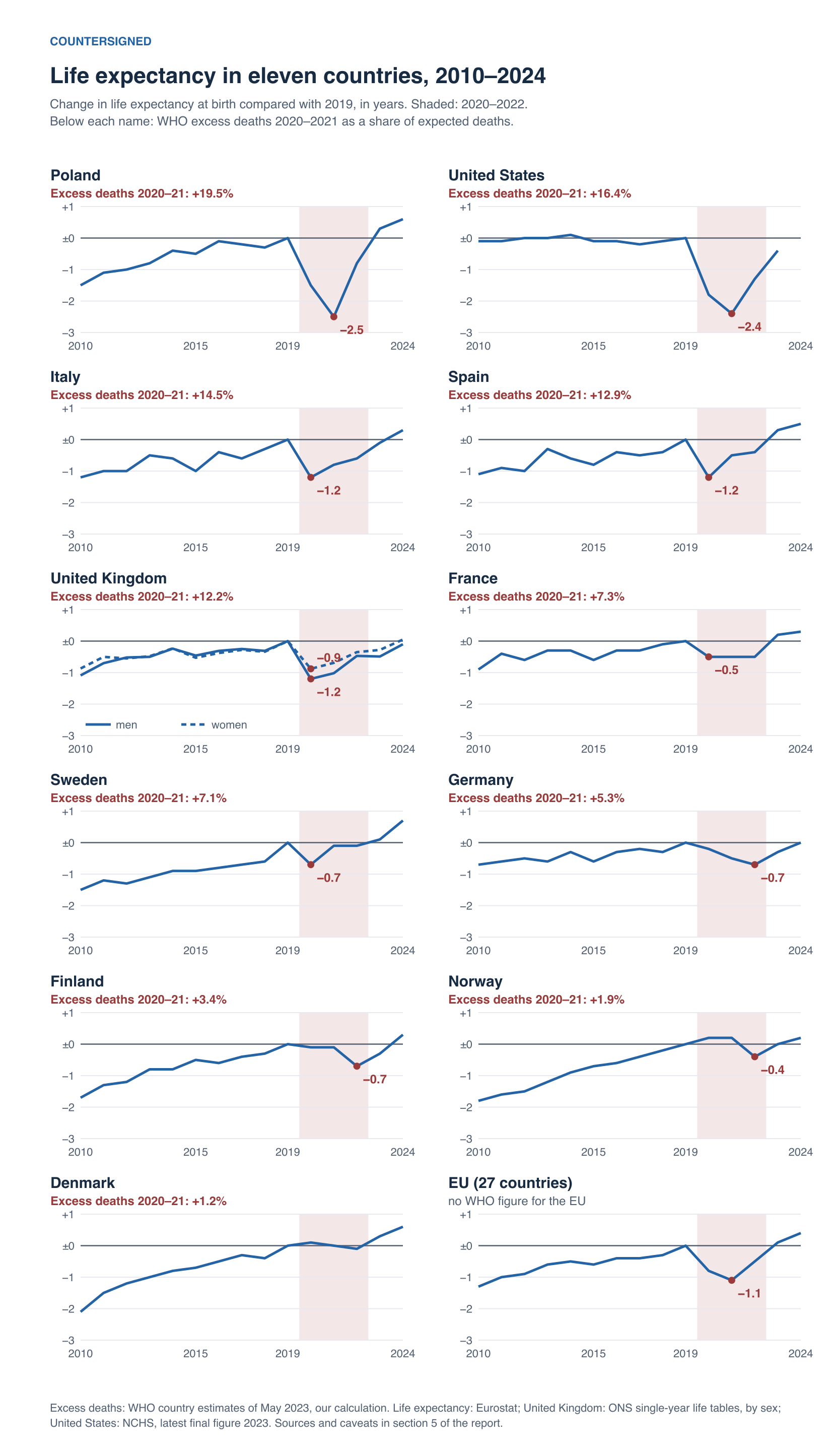
What the comparison shows. In every country of the set except Denmark, the fall from the 2019 level to the lowest point in 2020–2022 was larger than any fall below an earlier level in 2010–2019, influenza years included; in Denmark both were 0.1 years (our calculation from the figures above). The comparison shows how large the toll was, not why it differed: the WHO’s statisticians list, among other factors, age structure, population density and cultural practices, government measures (see section 6) and how people responded to them, and the variants circulating at different times, and this report does not attribute the differences to any single factor (S628).
Poland and Germany in detail
Poland recorded 477,400 deaths in 2020 and 519,500 in 2021, according to Statistics Poland (GUS); deaths in 2021 exceeded the average of the previous 50 years by almost 154,000 (S1114; S655). GUS classified about 41,500 deaths in 2020 and nearly 93,000 in 2021 as caused by COVID-19 (S656; S1114). A study in the GUS journal estimated that only about 41 per cent of the almost 71,000 excess deaths of 2020 were registered as COVID-19 deaths (S659). Shares like this differ between the sources cited here and below, which use different baselines; this report does not reconcile them (S635). In December 2021 deaths in Poland were 68.9 per cent above the 2016–2019 average for that month, the highest in the EU, according to Eurostat figures as reported by OKO.press; the EU average was 24 per cent (S162; S144). Life expectancy in 2021 was 2.3 years shorter for men and 2.1 years shorter for women than in 2019 (S1114).
The Supreme Audit Office (NIK) counted 239,506 more deaths in 2020–2022 than the 2015–2019 average, and found that most audited hospitals had not fully delivered their contracted services, contributing to a growing “health debt” (dług zdrowotny, our translation), which NIK defines as health services not provided whose absence can lead to illnesses developing or worsening (S1096). According to a Ministry of Health analysis summarised by NIK, deaths classified as COVID-19 accounted for 66 per cent of the excess in 2020 and 90 per cent in 2021 (S1096).
Germany shows how much the method matters. According to the Federal Statistical Office (Destatis), as reported in the trade press, about 985,600 people died in 2020, 5 per cent more than in 2019, where ageing alone would have implied about 2 per cent (S155). Destatis’ monthly comparisons, as the office itself states, cannot take the growing share of older people into account (S648). An age-adjusted calculation by German statisticians put excess mortality at about 1 per cent in 2020 and, on preliminary data, about 2.3 per cent in 2021 (S651; S652). For 2020–2021 combined, six calculations compared in one study range, for Germany, from 54,740 excess deaths in an age-adjusted calculation to 203,000 in the IHME model; the study also cites age-adjusted estimates by other authors of about 30,000, by a more refined method than its own, and 22,000. The WHO’s figure is 122,000 in its 2022 paper and 101,505 in its May 2023 data set. For Poland the same calculations range from 149,722 to 214,000, against 97,054 reported COVID-19 deaths in the international data series that study used; the cause-of-death figures of GUS cited above are higher (S635; S628; S632; S1668).
Who was at risk
The infection fatality rate (IFR) is the share of all infected people, including those never tested, who die. Before vaccines it rose steeply with age: a meta-analysis of 27 studies from 34 locations estimated it at 0.002 per cent at age 10, 0.01 per cent at 25, 0.4 per cent at 55, 1.4 per cent at 65, 4.6 per cent at 75 and 15 per cent at 85 (S661). A study in the WHO’s Bulletin found lower figures: a median of 0.27 per cent (corrected 0.23 per cent) across 51 locations and 0.05 per cent among people under 70 (S1277). A later analysis notes that early pooled estimates, both this one and a higher one of 0.68 per cent, did not account for the age structure of the populations studied (S665).
Long COVID
The WHO defines “post COVID-19 condition” as symptoms present usually three months after onset, lasting at least two months and not explained by another diagnosis (S167). Estimates diverge widely, partly because studies define it differently: reviews of studies among infected people report pooled shares of 36 per cent (a 2025 preprint, a study not yet peer-reviewed) and 41.79 per cent (a 2024 review), while surveys of whole adult populations give 4.7 per cent in Australia, 11.7 per cent in Canada and 14.3 per cent in the United States (S170; S169; S168). The figures have different denominators and cannot be averaged.
6. Lockdowns, masks, schools and treatment: what worked and what it cost
Measures other than vaccines and drugs, such as stay-at-home orders, masks and school closures, are non-pharmaceutical interventions (NPIs) (S671). Few were tested in randomised controlled trials, which assign participants by chance, and most were applied together, so the effect of any single measure was “extremely hard” to separate (S671).
What the Royal Society review found
A Royal Society review of August 2023, by scientists it convened “independently from the UK Government”, focused on transmission and, for some measures, COVID-19 deaths, made “no assessment of the economic or other societal impacts”, and rated much of the evidence low certainty (S671; S1287):
- Social distancing and lockdowns were the “most effective of all the NPIs”; the key limitation is a “dearth of experimental studies” (S671; S1287).
- Masks, especially respirators, supported by mandates, “generally reduced” transmission; the mostly observational studies commonly carried a “critical risk of bias” (S671; S1287).
- School closures were associated with fewer infections, with varied effects often depending on adherence and the children’s age (S671).
It found “clear evidence” that stringent packages of measures reduced transmission “in some countries”, and that NPIs became less effective as the virus became more transmissible (S671). A 2020 modelling study of European countries found “a large effect” of lockdowns on transmission, while a 2024 meta-analysis found that lockdowns in the spring of 2020 had “a relatively small effect” on COVID-19 mortality (S673; S680).
Masks
Cochrane’s review of randomised trials of physical measures against respiratory viruses was updated on 30 January 2023; only that edition’s abstract could be obtained (S181). Wearing masks in the community “probably makes little or no difference” to influenza-like or COVID-19-like illness (risk ratio 0.95, where 1 means no difference; 95 per cent confidence interval, or plausible range, 0.84 to 1.09) and to laboratory-confirmed infection, with moderate certainty; bias, varied outcome measures and low adherence, the authors wrote, “hampers drawing firm conclusions” (S181). On 10 March 2023 Cochrane’s Editor-in-Chief called claims that the review shows “masks don’t work” “inaccurate and misleading”: it examined interventions promoting mask wearing, found the results inconclusive, and could not say whether wearing a mask itself reduces risk (S182).
In rural Bangladesh, 600 villages with 342,183 adults were randomly assigned to a mask-promotion campaign or none. In campaign villages 42.3 per cent wore masks properly, against 13.3 per cent in the others; the measured share of adults with symptoms and antibodies to the virus was 0.68 per cent against 0.76 per cent: an adjusted prevalence ratio of 0.91 (0.82 to 1.00), at the edge of statistical significance. The authors note that it is “likely that the true rates of symptomatic seroprevalence are substantially higher”, because about 60 per cent of people with symptoms gave no blood sample (S684; S185).
Schools and other costs
Between February 2020 and February 2022, schools were fully closed for in-person teaching for about 141 days on average, according to the World Bank, UNESCO, UNICEF and partners (S1308). Their simulations put the share of children in low- and middle-income countries unable to read a simple text by age 10 at an estimated 70 per cent; “this is a simulation”, the report stresses (S1308). A review of 36 studies linked short closures in 2020 with emotional and behavioural problems, unable to separate them from wider lockdown (S691). No pooled international estimate of measured learning loss could be obtained, and the sources cited in this section do not quantify lost economic output during the pandemic, unemployment or delayed treatment of other illnesses.
Disputes over strategy
Sweden’s government-appointed Corona Commission, in its final report (SOU 2022:10) of 25 February 2022, judged the country’s path of voluntary advice “fundamentally correct” but the measures “too few” and late, and considered keeping preschools and compulsory schools open “the right balance” (S192; S695; S696). Sweden was, it found, “among the countries with the lowest excess mortality” in 2020–2021, but at times in spring 2020 had death rates among the highest in Europe, and guidelines meant older people sometimes did not receive hospital treatment that could have helped (S696).
On 4 October 2020 Martin Kulldorff, Sunetra Gupta and Jay Bhattacharya signed the Great Barrington Declaration, proposing “Focused Protection”: letting those at minimal risk of death live normally and build immunity “through natural infection, while better protecting those who are at highest risk” (S1304). The John Snow Memorandum, a letter by 31 authors in The Lancet dated 15 October 2020, called a “so-called herd immunity approach” of this kind “a dangerous fallacy unsupported by scientific evidence”: “it is not feasible to restrict uncontrolled outbreaks to particular sections of society”, there was “no evidence for lasting protective immunity to SARS-CoV-2 following natural infection”, and “Prolonged isolation of large swathes of the population is practically impossible and highly unethical”. It called instead for measures that “suppress and control transmission” (S1330; S700).
On 8 October 2020 the then director of the National Institutes of Health (NIH) emailed Anthony Fauci and another NIH official, calling the Declaration a “proposal from the three fringe epidemiologists” and writing: “There needs to be a quick and devastating published take down of its premises” (S701). This report holds the email only as quoted in sworn declarations filed in 2022 by two of the Declaration’s authors in a US lawsuit, not from the original freedom-of-information release (S701).
Treatment
In the British RECOVERY trial’s preliminary report of 17 July 2020, 22.9 per cent of hospitalised patients given the steroid dexamethasone died within 28 days, against 25.7 per cent with usual care; the benefit was confined to patients receiving oxygen or ventilation (S201). In the planned interim analysis of the Pfizer-supported EPIC-HR trial of unvaccinated high-risk outpatients, 0.77 per cent of those given nirmatrelvir with ritonavir within three days of symptoms were admitted to hospital with COVID-19 or died by day 28, against 7.01 per cent on placebo (S705).
Hydroxychloroquine did not reduce deaths of hospitalised patients in RECOVERY (27.0 against 25.0 per cent) and was discontinued for futility (lack of benefit) in the WHO’s Solidarity trial (S1176; S704). Trials of ivermectin in Brazil (TOGETHER), the United States (ACTIV-6, according to its coordinating centre) and the United Kingdom (PRINCIPLE) did not show a clinically meaningful benefit, and the PRINCIPLE authors judged one “unlikely”; in PRINCIPLE, self-reported recovery came about two days sooner, an estimated effect below the size set in advance as meaningful (S707; S494; S1290). On 4 June 2020 The Lancet and the New England Journal of Medicine retracted two papers based on data from the company Surgisphere, because a number of the authors were not granted access to the underlying data; the Lancet paper had prompted the WHO to halt a hydroxychloroquine study, which it resumed (S208).
7. Vaccines I: trials and authorisation, status in October 2026
Three questions are often asked: whether the COVID-19 vaccines are authorised, whether they went through the trials medicines normally require, and whether they are still “experimental”.
Are they authorised?
In the European Union, the European Medicines Agency (EMA) lists seven COVID-19 vaccines as authorised in September 2026: Comirnaty (BioNTech/Pfizer), Spikevax (Moderna), Nuvaxovid (Novavax), Bimervax (HIPRA), Kostaive (Seqirus), mNexspike and mCombriax (both Moderna). Versions of the first four adapted to the XFG variant, a later form of the virus, were authorised on 28 July 2026 (S744). At least three earlier vaccines are no longer authorised. COVID-19 Vaccine Valneva was withdrawn at the company’s request on 1 December 2023 (S1096); the European Commission withdrew Vaxzevria (AstraZeneca) on 27 March 2024 and Jcovden (Janssen) on 26 July 2024. In each case the companies had decided to stop marketing them “for commercial reasons” (S771; S238; S1086).
In the United States, the Food and Drug Administration (FDA) first allowed the Pfizer-BioNTech vaccine on 11 December 2020 and the Moderna vaccine on 18 December 2020 under an emergency use authorisation, a temporary permission for an unapproved product during a declared emergency (S1048; S1047; S718). Full licences followed: Comirnaty on 23 August 2021, Spikevax on 31 January 2022 and Nuvaxovid on 16 May 2025 (S720; S722; S724). On 27 August 2025 the FDA revoked the remaining emergency authorisations and approved the 2025–26 vaccines only for people aged 65 and over and younger people with at least one condition putting them at high risk of severe COVID-19 (S1036; S730; S220). The FDA stated that safety concerns were not the basis for revoking the Pfizer authorisation (S1036). A briefing document for the FDA’s advisory committee in May 2026 listed four approved vaccines: Comirnaty, mNEXSPIKE (Moderna), Nuvaxovid and Spikevax (S732). The 2026–27 versions of Comirnaty, Spikevax and Nuvaxovid were approved on 27 August 2026; the FDA product pages for Comirnaty and Spikevax show the same restricted indications (S733; S735; S217; S1037).
Did they go through the required trials?
The two mRNA vaccines, which deliver genetic instructions (messenger RNA) that cells use to make the virus’s spike protein, were tested in large phase III trials, the final and largest stage of testing before approval, in which volunteers are assigned at random to the vaccine or a placebo (an inactive injection) without knowing which they received. The Pfizer-BioNTech trial randomised 43,548 people aged 16 and over; there were 8 cases of COVID-19 with onset at least 7 days after the second dose among the vaccinated and 162 in the placebo group, an efficacy of 95 per cent (S711). The Moderna trial enrolled 30,420 adults at 99 US sites and reported an efficacy of 94.1 per cent; all 30 severe cases occurred in the placebo group (S713). The FDA expected at least one such trial with “clear and compelling” results even for an emergency authorisation, so a phase III trial was not skipped (S718).
The trials measured something specific: COVID-19 with symptoms, confirmed by a laboratory test (S711; S718). At authorisation the FDA listed what the data could not yet show: whether protection lasted longer than about two months, whether the vaccine prevented infections without symptoms or onward transmission, and its effect on deaths (S718; S209). The EMA likewise wrote that the pivotal Comirnaty study “was not designed to assess the effect of the vaccine against transmission of SARS-CoV-2 from subjects who would be infected after vaccination” (S740). When a Pfizer executive told a European Parliament committee on 10 October 2022 that the vaccine had not been tested for stopping transmission before it reached the market, this was consistent with what the regulators had published in 2020 and 2021; the parliament’s own record of the hearing could not be obtained, and media reports differ on the exact wording (S716; S213; S214).
Once the vaccines were authorised, trial participants who had received the placebo were offered the vaccine (S721; S723), which ended the comparison with an unvaccinated control group early. In its 2022 assessment of Comirnaty, the EMA’s committee accepted that continued follow-up “would no longer be informative” because a large part of the placebo group of the Pfizer-BioNTech trial had been vaccinated (S243).
Are they “experimental”?
The legal categories are more precise than the word “experimental”. In the US, the FDA called the Pfizer-BioNTech vaccine “investigational”, the usual term for a product still under clinical study, until the emergency authorisation; under that authorisation it was an “unapproved product”; after licensing, Comirnaty was “approved”, while the Pfizer-BioNTech vaccine remained available under the emergency authorisation for some uses until 2025 (S718; S216; S1036).
In the EU, the first vaccines received a conditional marketing authorisation. This route, laid down in EU law, is open to medicines for “seriously debilitating or life-threatening diseases” and to public health emergencies. It allows authorisation “on less comprehensive clinical data than normally required” when the benefit of immediate availability outweighs the risk of missing data. It is valid for one year at a time and carries specific obligations, such as completing studies, that the company must fulfil (S239; S241). For Comirnaty and Spikevax the EMA’s committee recommended conversion to standard authorisations in September 2022, saying the specific obligations attached to the conditional authorisations were “no longer considered key” to the balance of benefits and risks; the Commission followed for Spikevax on 3 October and Comirnaty on 10 October 2022 (S742; S747). The European Court of Auditors nevertheless describes conditional authorisation in its glossary as an “emergency authorisation” granted before comprehensive clinical data are available (S749).
In short: the first vaccines were authorised early, on less complete clinical data than usual, under legal routes designed for that purpose; the main vaccines now hold standard authorisations in the EU and licences in the US (S239; S742; S720; S722).
The United States since 2025
Vinayak Prasad, director of the FDA’s Center for Biologics Evaluation and Research, which regulates vaccines, wrote in an official decision memo of 25 August 2025, on Pfizer’s application, that “at the present time, with best available information”, there was no “substantial certainty” of a net benefit from vaccinating healthy people; that the manufacturer had not shown with high-quality data that vaccination reduces transmission or long COVID; and that approving the vaccines for healthy people would require randomised trials measuring clinical outcomes. His decision memos also state that the randomised trials of 2020 and 2021 “demonstrated acceptable efficacy against symptomatic COVID-19” (S729; S725). The FDA’s own review team had recommended the broader indication the company requested, and the agency’s record documents the director’s dissent “from certain aspects” of the team’s conclusions (S1035). In August 2026 the FDA released the companies from some follow-up studies agreed a year earlier, including placebo-controlled studies of safety or of the vaccine’s spike protein in adults aged 50–64, citing “operational and feasibility challenges” and replacing them with other studies (S733; S734; S735).
Recommendations on who should be vaccinated are a separate matter from authorisation. In June 2025 the Secretary of Health and Human Services removed all 17 members of the Advisory Committee on Immunization Practices (ACIP), the panel advising the Centers for Disease Control and Prevention (CDC) (S1054). On 19 September 2025 the reconstituted committee, chaired by Martin Kulldorff, a signatory of the Great Barrington Declaration (section 6), voted 12 to 0 to replace the general recommendation with “individual-based decision-making”, “also known as shared clinical decision making”, for everyone aged six months and over, adding that the balance of benefit and risk is most favourable for people at increased risk of severe disease (S1209; S1054; S1055). On 16 March 2026 a federal court in Massachusetts, in a case brought by the American Academy of Pediatrics, provisionally suspended the appointments of 13 committee members and “all votes taken by the now-stayed ACIP”, finding the challengers likely to succeed in showing that the committee’s reconstitution violated federal law; this was preliminary relief, not a final judgment (S1211).
Who paid
By November 2021 the European Commission had signed 11 contracts worth about 71 billion euros for up to 4.6 billion doses from eight manufacturers, most of them before the vaccines were authorised, sharing the development risk with the companies (S749). The Moderna trial was funded by US public agencies, the Biomedical Advanced Research and Development Authority and the National Institute of Allergy and Infectious Diseases; the Pfizer-BioNTech trial by the companies (S713; S711).
8. Vaccines II: effectiveness, safety, mandates, compensation
Protection and lives saved
A review of 18 studies found vaccine effectiveness, the reduction in risk among vaccinated people, waning: against any infection from 83 per cent in the first month after the initial doses to 22 per cent after five months, and against COVID-19 with symptoms from 94 to 64 per cent by the fourth month (S754). Against severe COVID-19 it was still 90 per cent after five months, though lower in people aged 65 and over (S754).
Deaths prevented can only be estimated by models comparing events with a scenario without vaccines (S255; S258). One study estimated 14.4 million deaths prevented in 185 countries and territories in the first year of vaccination (range 13.7 to 15.9 million), or 19.8 million based on excess deaths; its authors note that key inputs rested on “working assumptions” (S255). A WHO surveillance network estimated that vaccines directly saved about 1.6 million lives (1.5 to 1.7 million) in 34 countries of the WHO European Region from December 2020 to March 2023, 96 per cent of them people aged 60 or over (S258). A 2025 study estimated 2.5 million deaths averted worldwide in 2020–2024 (1.4 to 4.0 million), mostly among a minority of older people (S260). The three differ in period, area and method. Published critiques of these models could not be obtained.
Side effects
Myocarditis and pericarditis, inflammations of the heart muscle and its lining, have been in the FDA’s warnings for the mRNA vaccines since 25 June 2021 (S728; S998). In Nordic registers, males aged 16–24 had about 5.7 additional myocarditis cases per 100,000 second doses of the Pfizer-BioNTech vaccine and 18.8 per 100,000 of the Moderna vaccine within 28 days (S767). The current US label gives about 8 cases per million doses at ages 6 months to 64 years and about 27 per million in males aged 12–24, unadjusted, within a week of a 2023–2024 vaccine dose (S728; S1042). Among patients hospitalised with myocarditis after vaccination, abnormal heart scans were common about five months later, of unknown significance (S728). These figures, from different doses, ages and methods, are not directly comparable.
For Vaxzevria (AstraZeneca) and Jcovden (Janssen), thrombosis with thrombocytopenia syndrome (TTS), a rare combination of blood clots and low blood platelets, was added to the product information (S769; S770). For Vaxzevria, the EMA’s safety committee (PRAC) recommended on 7 April 2021 listing it as a very rare side effect, while the EMA judged the benefit still greater than the risks (S782). In September 2021 PRAC also recommended listing Guillain-Barré syndrome, an immune disorder of the nerves, as a “very rare” side effect of Vaxzevria, affecting fewer than 1 in 10,000 people; 833 cases had been reported worldwide (S769; S770). In October 2022 PRAC recommended adding heavy menstrual bleeding as a side effect of the mRNA vaccines, of unknown frequency, after almost 9,000 worldwide reports of mostly non-serious, temporary cases; the EMA found no evidence of an effect on fertility (S1297; S771).
What reporting systems can and cannot show
Several of these signals rested partly on passive reporting, in which anyone can report a suspected side effect (S772; S771). The US Vaccine Adverse Event Reporting System (VAERS) states that “for any reported event, no cause-and-effect relationship has been established” and that underreporting is a main limitation (S772). The European database EudraVigilance received about 12,000 reports of death from January 2021 to December 2023, with around 1 billion doses given; the EMA says this “does not mean” the vaccines caused them, though “in very exceptional cases” a vaccine was confirmed as the cause (S773). Such reports detect signals but do not measure risk: the FDA judged that they “will not be sufficient” for myocarditis and required studies (S722; S771). Two published critiques of how the pivotal trials measured serious harms and deaths, an analysis of serious adverse events (Vaccine, 2022) and an article in The BMJ (2020) whose title says the trials were not designed to show whether the vaccines save lives, could not be obtained for this report.
The FDA memo on child deaths
On 28 November 2025 the director of the FDA’s vaccine centre (see section 7) wrote to its staff that “at least 10 children have died after and because of receiving COVID-19 vaccination” (S776; S272). He cited an initial staff analysis of 96 deaths reported to VAERS in 2021–2024, with attribution graded as likely, probable or possible (S776). This is the author’s claim in an official document; according to NBC News, the memo gave no ages, medical histories or documentation (S272). An opinion article on the CIDRAP website describes a 73-page staff review of the same 96 deaths, dated 5 December 2025, presented as the analysis underlying the memo, which classified two as probable, five as possible and none as certain (S1050). The review itself could not be obtained, so these figures are not established.
Mandates before the courts
Germany required staff in health and care settings to prove vaccination, recovery or a medical contraindication (S786). The Federal Constitutional Court refused interim relief on 10 February 2022 and rejected the constitutional complaint on 27 April 2022 (1 BvR 2649/21) (S786). It set “the very low probability of grave consequences of a vaccination” against the “clearly higher probability” of harm to the life and limb of vulnerable people, and found it constitutionally unobjectionable that the legislature gave priority to protecting them (our translations); lacking secure scientific knowledge, it reviewed only whether the legislature’s forecast that the obligation would protect vulnerable people was defensible (S786).
France’s Constitutional Council upheld the “health pass”, proof of vaccination, a negative test or recovery, on 5 August 2021, noting that it imposed no obligation to vaccinate, but struck down three provisions, including automatic isolation of everyone testing positive (S787). On the vaccination obligation for certain professions it examined only a transitional rule (S787).
On 23 June 2022 members of Austria’s parliament moved to repeal its general COVID-19 vaccination law, whose application had already been suspended by regulation (S285; S287). On 13 January 2022 the US Supreme Court, in two interim orders on the agencies’ legal powers, blocked a vaccinate-or-test rule for about 84 million workers but let a vaccination requirement for staff of facilities funded by Medicare and Medicaid (public health insurance) take effect; neither was a final judgment (S789; S790).
Compensation
Under the US Public Readiness and Emergency Preparedness Act, manufacturers and others covered generally cannot be sued for damages except for death or serious injury caused by “willful misconduct”, until 31 December 2029 for some COVID-19 products; injured people can instead apply to the Countermeasures Injury Compensation Program (CICP) (S1066; S1064). The CICP compensates serious injuries or deaths that, “based on compelling, reliable, valid, medical and scientific evidence”, are found to be directly caused by a covered countermeasure, or that meet the requirements of a countermeasure injury table; a temporal association alone is not sufficient (S779). By 1 October 2026 it had received 14,250 COVID-19 claims, 11,198 alleging injury or death from vaccines, and made 8,369 decisions: 120 claims were found eligible and 8,249 denied, most for missing medical records or a missed deadline; 5,881 were pending. Of the 120 found eligible, 66 had been compensated, 50 awaited a decision on benefits and 4 had no eligible expenses (S779). All 66 claims compensated concern vaccines, 50 of them myocarditis or myopericarditis (S779; S1312). By our sum of the program’s table, they total USD 7,990,678.02, of which one TTS award accounts for USD 5,942,538.84 (S1312).
Poland’s Vaccination Compensation Fund, run by the Patient Rights Ombudsman, pays up to PLN 100,000 where a side effect listed in the product information required at least 14 days in hospital, or for anaphylactic shock (S1252; S1120). By 31 December 2025 it had granted benefits to 278 people, 268 of them for COVID-19 vaccines and 10 for other vaccines covered since 2023, and refused 948 cases; awards totalled PLN 6,224,494.80, and anaphylactic shock was the commonest ground (111 awards) (S1120).
In Germany, a newspaper survey of the federal states, reported in January 2024, counted 467 recognised vaccine injuries from 11,827 applications, with 5,597 still unprocessed; these are figures reported by a newspaper, not an official statistic (S781). The Federal Court of Justice has ruled that claims over vaccinations given under the federal ordinance until 7 April 2023 lie against the state, not the doctor (S783), and that an injured person may demand information from the manufacturer where causation is plausible, even if not probable; whether damages are owed remains open (S782; S280).
9. Law and constitutions: what the courts held
In the rulings reviewed for this report, challenges turned mainly on whether the right legal instrument was used and whether a measure was justified in substance. The instrument matters because constitutions such as Poland’s and Spain’s allow wider restrictions of rights under a formally declared extraordinary state, a temporary regime opened by a set procedure (S1314; S815).
Poland: emergency powers that were not used
The Polish Constitution provides for three extraordinary states (stany nadzwyczajne), to be used “if ordinary constitutional measures are inadequate” (our translation): martial law, a state of emergency and a state of natural disaster (stan klęski żywiołowej) (S1314). The government may declare a state of natural disaster for up to 30 days, extendable with the consent of the Sejm, the lower house (S1314). Under a 2002 Act, natural catastrophes justifying this state include mass outbreaks of infectious disease, as a court noted (S794). Otherwise, rights may be restricted only by statute and only where necessary; government regulations need detailed statutory authorisation with guidelines on content (S1314).
Instead, the health minister declared a state of epidemic threat on 13 March 2020 and a state of epidemic on 20 March; the government restricted rights by regulation under powers added by the COVID act of 2 March 2020 (S794; S1098; S796). According to a court, it considered ordinary constitutional measures sufficient (S794); the Supreme Administrative Court later confirmed that a state of epidemic is not an extraordinary state (S1110).
Poland: what the courts held
- Regional Administrative Court, Opole, 27 October 2020 (II SA/Op 219/20). It annulled a PLN 10,000 fine on a hairdresser and refused to apply the regulation: the statute gave no substantive guidelines, so the government could shape basic rights “in any way”. It also held that a ban on whole types of business went to the essence of economic freedom, which the Constitution allows to be restricted in that way only in an extraordinary state such as a state of natural disaster (our summary). It nevertheless called the restrictions “substantively justified” (our translations) (S794). According to a 2023 law-journal article, the Supreme Administrative Court (NSA) upheld it and, as a rule, similar annulments from July 2020 (S799).
- NSA, 24 September 2025 (II GSK 311/22), final. It confirmed the annulment of a PLN 10,000 fine on a pizzeria: virtually all essential elements of the punishable conduct were set by regulation, not by statute (S1110). Some first-instance courts upheld fines; the judgments cited were not final at the dates of the sources (S1109; S795).
- Supreme Court, 16 March and 15 April 2021. On 16 March (II KK 64/21, II KK 74/21, II KK 97/21), on cassations (extraordinary appeals against final judgments) by the Ombudsman (Commissioner for Human Rights), it acquitted people fined under the spring 2020 ban on movement (S1105; S799; S796). On 15 April it acquitted a man fined PLN 300 for being in a park, holding that the bans on movement and on using green areas exceeded the statutory authorisation and agreeing with the Ombudsman that they “były niekonstytucyjne” (“were unconstitutional”, our translation) (S796).
- Regional Court, Warsaw, 11 February 2025 (XXV C 1641/21). In a group action brought jointly by businesses it held, according to the Supreme Audit Office (NIK), that the government was “obliged, not entitled” to declare a state of natural disaster (our translation). The judgment was not final in June 2025; its text was not retrieved (S1096).
- Supreme Court, 28 July 2020 (I NSW 2849/20). According to a 2023 law-journal article, the Supreme Court held in an order that the government was not obliged to declare a state of natural disaster in response to COVID-19, as a state of epidemic could be declared instead; the order itself was not retrieved (S799).
Courts deciding fines refused to apply regulations in individual cases (S794; S1110); the Constitutional Tribunal rules, with universally binding force, on whether statutes and regulations conform to the Constitution (S1314), and no Tribunal ruling on an epidemic restriction was found. The President of NIK’s application of 16 June 2023 (K 9/23), mainly challenging how the COVID act and its amendment were passed, is pending; no hearing was listed as at 14 October 2026 (S800; S1097; S802).
Poland: criminal immunity
- Enacted, narrow, repealed. Article 15w of the COVID act, in force from 31 March 2020, excluded criminal (articles 231 and 296 of the Criminal Code), disciplinary and public-finance liability for people who broke duties or rules buying goods or services needed against the epidemic, if acting in the public interest and the purchase was otherwise impossible or seriously endangered (S1102; S800). It has since been repealed; the repealing act could not be obtained (S803; S1101). Narrower clauses remain in the consolidated text of 2025: articles 15t and 15zzzzzd state that a person does not commit the offence under article 296 of the Criminal Code by not determining or claiming amounts owed because a public procurement contract, or a contract with a non-governmental organisation, was not performed or was performed improperly as a result of circumstances related to COVID-19, or by amending such a contract as the act allows (S1101).
- Proposed, broader; not in force. A deputies’ bill received by the Sejm on 12 August 2020 (print 539) proposed an article 10d under which a person who, to counter COVID-19, breached official duties or rules would not commit an offence if acting in the public interest and if the action would otherwise have been impossible or significantly hindered (S805). The Public Finance Committee’s additional report of 16 September 2020 (print 569-A) proposed narrower wording: limited to offences under articles 231 and 296 of the Criminal Code, and requiring that the good sacrificed be of lower value than the good saved (S1104). The article 10d actually added by an act of 7 October 2020 lets the Prime Minister assign COVID-19 tasks to local governments (S804; S1103).
Other jurisdictions
- Germany. The Federal Constitutional Court held on 19 November 2021 that the federal night-time curfews and contact limits of spring 2021 were compatible with the Basic Law (the constitution), given the extreme danger, and proportionate; challenges to limits on shops, restaurants, sport and culture were inadmissible (S1154). The same day it held that school closures were permissible on the knowledge available in April 2021 (S1155). The Federal Administrative Court found the Bavarian restriction on leaving home of spring 2020 (permitted only for valid reasons) disproportionate and Saxon measures of the same period lawful (22 November 2022) (S811; S1152).
- Spain. On 14 July 2021 (STC 148/2021) the Constitutional Court held the movement ban of the March 2020 state of alarm unconstitutional: it amounted to suspending a right, which a state of exception, authorised in advance by parliament, would allow but a state of alarm does not (S815). The defect was one of instrument; the Court accepted the measures’ “necessity, suitability and proportionality” (our translation) (S815).
- Austria. The Constitutional Court found several ordinances gesetzwidrig (contrary to the statute), including a 2020 ban on entering public places that amounted to a general curfew; it raised no objection to the statute’s relevant provision (S301; S818; S302).
- United States. In interim orders, the Supreme Court blocked New York’s limits on worship attendance on religious-freedom grounds (25 November 2020) (S820), and on 13 January 2022 suspended a vaccine-or-test rule for large employers as likely beyond the agency’s authority (see section 8) (S290); the same day it let a vaccination rule for staff of facilities funded by Medicare and Medicaid take effect (S790).
- United Kingdom. The Court of Appeal held in Dolan (1 December 2020) that the health secretary had power to make the lockdown regulations (S822).
- Canada. The Federal Court and, on 16 January 2026, the Federal Court of Appeal held the government’s use of the Emergencies Act in February 2022, against border blockades and a protest convoy, unreasonable and in breach of the Charter of Rights and Freedoms; the case did not concern health rules (S825; S826). A separate application for leave to appeal, by applicants held to lack standing, is before the Supreme Court (see section 15) (S825; S315).
- European Court of Human Rights. No merits ruling on a COVID-19 lockdown was found: the Grand Chamber declared CGAS v. Switzerland inadmissible on 27 November 2023, partly for failure to use national remedies (S319). Vavřička v. the Czech Republic (8 April 2021) concerned Czech legislation on compulsory childhood vaccination against diseases well known to medical science, not COVID-19 (S321).
What can and cannot be said
No ruling held for this report found a country’s pandemic response as a whole unconstitutional. Courts did find specific instruments unlawful or unconstitutional. Most defects concerned legal form or power, not the health purpose; where courts weighed substance, as the Constitutional Courts of Germany and Spain did, they mostly upheld the measures, with exceptions such as the Bavarian restriction on leaving home and, in an interim order, the New York limits on worship. Of the Polish rulings found for this report, only one, not final and known only from the audit office’s account, held a state of natural disaster obligatory, and, according to a 2023 law-journal article, a Supreme Court order of 2020 held the opposite; no Constitutional Tribunal ruling on an epidemic restriction was found.
10. Information, censorship and disclosures years later
During the pandemic, platforms removed or downgraded posts they judged false, and officials contacted them about such content (S332).
Government contacts with platforms: what the courts decided
Two US states and five social-media users sued federal officials over pressure on platforms, citing free-speech rights (S332). On 4 July 2023 a district court in Louisiana granted in part a preliminary injunction, an order issued before a full trial. It wrote that “if the allegations made by Plaintiffs are true”, the case “arguably involves the most massive attack against free speech in United States’ history” (S1199; S831). The Fifth Circuit appeals court narrowed the injunction in September 2023 and modified it in October 2023 (S334; S1324; S831).
On 26 June 2024 the Supreme Court decided Murthy v. Missouri by six votes to three, on standing alone: the right to bring a case. The plaintiffs had to show a substantial risk of future injury “traceable to a Government defendant and redressable by the injunction they seek”, and none had done so (S332). The Court therefore did not decide whether officials had coerced the platforms; it reversed the Fifth Circuit and sent the case back (S332). It accepted that the government had “played a role in at least some of the platforms’ moderation choices”, but said the platforms had also used their own judgment (S332).
Justice Samuel Alito, joined by Justices Clarence Thomas and Neil Gorsuch, dissented: officials had “continuously harried and implicitly threatened Facebook”, which “repeatedly yielded”, and the conduct was “blatantly unconstitutional” (S332). The sources held do not show the case’s later course.
What the companies say
On 8 February 2021, saying it had consulted health organisations including the World Health Organization (WHO), Facebook began removing the claim that “COVID-19 is man-made or manufactured”. On 26 May 2021, citing “ongoing investigations into the origin of COVID-19”, it stopped (S341). Sources conflict on the sequence. The Supreme Court majority wrote that Facebook announced this February expansion “before White House officials began communicating with the platform” (S332). A May 2024 interim staff report of the House Judiciary Committee and its subcommittee on the “weaponization” of the federal government quotes an internal Facebook email: “In February 2021, in response to public pressure and tense conversations with the new [Biden] Administration, we started removing” the laboratory-leak theory (S835). The emails could not be obtained.
On 26 August 2024 Meta’s chief executive, Mark Zuckerberg, wrote to the committee chairman that in 2021 senior Biden administration officials “repeatedly pressured our teams for months to censor certain COVID-19 content, including humor and satire”. He added that “we own our decisions” and “I believe the government pressure was wrong” (S834). In connection with the COVID-19 pressure, the letter names no official and no post. The sources held for this report show that the European Commission asked platforms that had signed its Code of Practice on Disinformation to report monthly on their actions against COVID-19 disinformation (S849); they do not show whether European or German authorities contacted platforms about individual posts, and that part of the question remains open.
A “statement of facts” dated 23 September 2025 was submitted to the committee for Alphabet, Google’s parent company, by its outside lawyers (S1184). It says senior Biden administration officials “pressed the Company regarding certain user-generated content related to the COVID-19 pandemic that did not violate its policies”, while the company “continued to develop and enforce its policies independently” (S1184). Both company statements are accounts by interested parties, not findings.
Disclosures: what they show and what they do not
Fauci’s emails. Many emails of Anthony Fauci, director of the National Institute of Allergy and Infectious Diseases (NIAID) until the end of 2022 (S1199), were obtained by the news site BuzzFeed under the US Freedom of Information Act (FOIA), on 1 June 2021 according to a journal article; the release itself could not be obtained (S859; S134). One example, as quoted from BuzzFeed’s report in a 2022 journal article: answering a query of 5 February 2020 about masks, Fauci wrote that they “are really for infected people to prevent them from spreading infection to people who are not infected rather than protecting uninfected people from acquiring infection”; the paper observes that his advice on masks appears to have changed later (S859). Emails show what was written, not what was decided.
The RKI minutes. The Robert Koch Institute (RKI), Germany’s federal public-health agency, gave a partly blacked-out copy of its COVID-19 crisis-team minutes to a freedom-of-information requester in April 2023 (S861). On 30 May 2024 it published the minutes for January 2020 to April 2021 “largely unredacted” (our translation); later minutes, to July 2023, followed (S863; S862). For example, the minutes of 16 March 2020 record that a new risk assessment had been prepared over the weekend, was to be “scaled up” that week and would be published as soon as a named official “gives a signal”; those of 17 March record that, owing to “the strong rise in case numbers”, the risk to the population was now rated “high” (our translations) (S861). The RKI says individual statements in the minutes “do not necessarily represent a coordinated position of the RKI” (our translation) (S860). The RKI is supervised by the federal health ministry (S1146). On our reading, the minutes alone do not show which views were adopted or whether the ministry instructed the RKI on the content of its risk assessments; they do record ministry wishes, for example an oral instruction not to publish a modelling study (minutes of 5 March 2020, “mündliche Weisung”) (S861).
The “Lockdown Files”. In March 2023 a British newspaper published reports based on a cache of 100,000 WhatsApp messages of a former health secretary (S353). The UK Covid-19 Inquiry, a statutory public inquiry, found evidence of government WhatsApp discussions and that “a significant number of such messages were not retained, when they should have been – some deliberately, some accidentally and some in accordance with what owners believed was government policy” (S867). The Inquiry’s report held does not refer to the newspaper’s reports (S867; S353).
David Morens. An indictment against Morens, a senior adviser in the NIAID director’s office from 2006 to 2022, was filed under seal on 16 April 2026 in Maryland’s federal court (case 8:26-cr-00138) and unsealed on 27 April (S1018; S1194). It charges conspiracy against the United States (Count 1) and destroying, falsifying or concealing records (Counts 2 to 5) (S1193). It alleges that from about April 2020 to at least June 2023 he and two unnamed co-conspirators used his personal Gmail account to keep communications from FOIA requests, and quotes his email saying he had “learned from our foia lady here how to make emails disappear” (S1193; S1018). On 18 August 2026 he pleaded guilty to Count 1 and not guilty to Counts 2 to 5 (S1194). According to the US Attorney’s Office, he also admitted conspiring to pay illegal gratuities (S1019). The plea agreement itself could not be obtained; the docket held, updated to 25 September 2026, shows no sentence (S1194). The charges concern records and gratuities, not the origin of the virus; the link to the origins debate is the Justice Department’s own description, in which the then Acting Attorney General said that, as alleged in the indictment, Morens and the co-conspirators acted “in an effort to suppress alternative theories regarding the origins of COVID-19” (S1018).
11. The WHO: who pays and what follows from it
Who pays
Assessed contributions to the World Health Organization (WHO) are annual dues from its 196 Members and Associate Members, on a United Nations scale based mainly on gross domestic product (S354). Voluntary contributions come from member states and other donors and can be earmarked: tied to activities the donor defines (S890). In 2024, 81 per cent of audited revenue of US$3,172 million was voluntary and 15 per cent assessed; in 2025, 83 and 13 per cent of US$3,138 million. Only 13 per cent (2024) and 8 per cent (2025) of voluntary money for the programme budget was “fully flexible or thematic”; the rest was earmarked (S882; S885).
The latest contributor annex held, for 2024 (A78/INF./3), records US$2,856 million in voluntary cash for the programme budget. The largest contributors were the United States (US$447.0 million, 15.7 per cent), the Gates Foundation (US$320.9 million, 11.2 per cent), Gavi, the Vaccine Alliance (US$257.8 million, 9.0 per cent), the United Kingdom (US$239.6 million, 8.4 per cent), Germany (US$161.1 million, 5.6 per cent) and the European Commission (US$151.1 million, 5.3 per cent); the shares are our calculation (S358). After US executive orders of January 2025, the WHO set aside US$330 million of its 2024 voluntary revenue as possibly uncollectable; net of this, it ranks the Gates Foundation first and the United States seventh (S882).
Pharmaceutical companies gave little cash directly: the six largest company contributions total US$32.7 million (1.1 per cent, our calculation), and none names Pfizer, Moderna, BioNTech, AstraZeneca or Novavax (S358).
The proposed budget for 2026–27 sets the base segment, the WHO’s “core programme of work”, at US$4,267.1 million, and the total, with polio eradication, special programmes and emergencies, at US$6,206.7 million (S887; S885).
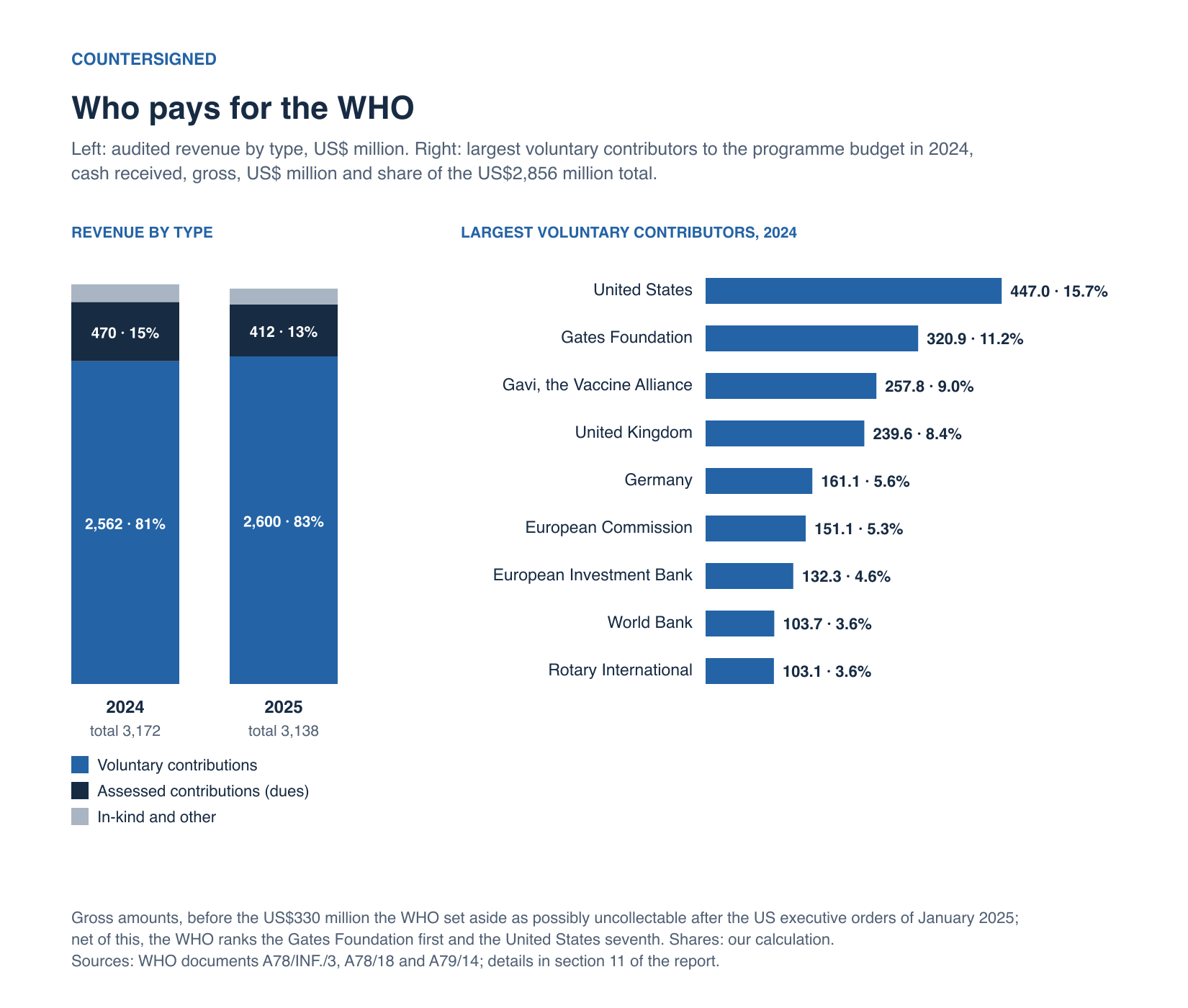
Rules on private money
Since 28 May 2016 a Framework of Engagement with Non-State Actors (FENSA) has governed the WHO’s dealings with companies, foundations and other non-state bodies. It excludes the tobacco and arms industries, bars money from companies with a direct commercial interest in the project funded, with exceptions for clinical trials, product development and pooled mechanisms, and states that private sector entities “do not take part in any decision making process” of the WHO (S896).
The WHO Foundation, a legally separate Swiss body announced on 27 May 2020, raises money for the WHO from the public, major donors and companies (S367). A study in BMJ Global Health found that 48.0 per cent of the US$82.8 million it disclosed receiving up to the end of 2023 came from anonymous gifts over US$100,000 (S899); the Foundation says anonymous contributions were “about 5% of total funds raised (2021–2024)” (S898). The bases differ; neither is backed by audited accounts held.
Another BMJ Global Health study, published on 28 October 2025, counted 640 Gates Foundation grants to the WHO worth US$5.5 billion in 2000–2024, all earmarked and 58.9 per cent of it for polio; these are grants awarded, not payments (S890; S362). The authors argue that earmarking lets the foundation “retain tight control over how the money is spent”, but see member states’ failure to raise assessed contributions as the root cause (S890).
Experts advising the WHO must declare their interests, which do not automatically disqualify them (S370).
The US and Argentina leave
On 20 January 2025 President Donald Trump signed Executive Order 14155, stating that the US “intends to withdraw” and ordering a funding pause and an end to US talks on the Pandemic Agreement and amended health regulations. It cites the WHO’s “mishandling of the COVID-19 pandemic” and “unfairly onerous payments” (S371). According to US officials the withdrawal was completed on 22 January 2026; the WHO’s arrears report of 7 May 2026 (data as at 23 April 2026) still lists the US as a member state in arrears (S373; S907; S906).
The WHO’s arrears table of 8 April 2026 lists US$280.9 million owed by the US for 2023–2025, including the full 2024 and 2025 dues, with Swiss francs converted at 0.789 per dollar (S906; S888). AP’s “more than $133 million” matches the dollar part alone, US$133.05 million in the WHO table (our comparison) (S373; S906).
Argentina’s letter of 25 February 2025, received by the UN Secretary-General on 17 March 2025, gave notice of withdrawal, effective one year after receipt; the UN’s legal counsel noted that the WHO Constitution has no withdrawal clause (S907). Argentina says it left on 17 March 2026; on 22 May 2026 the World Health Assembly “took note” and decided that “no further action at this stage is desirable” (S375; S909).
Health rules and the Pandemic Agreement
The International Health Regulations (IHR), rules for 196 States Parties on the response to “the international spread of disease”, were amended on 1 June 2024; these entered into force on 19 September 2025, except for states that rejected them (S378; S911; S380). The latest WHO table held (19 June 2026) lists twelve rejecting states: Argentina, Austria, Brazil, the Czech Republic, Iran, Israel, Italy, the Netherlands, New Zealand, the Philippines, Slovakia and the United States. WHO recommendations under the IHR remain “non-binding advice” (S911).
The Assembly adopted the WHO Pandemic Agreement on 20 May 2025 (S912). Article 3(1) names as a guiding principle “the sovereign right of States, in accordance with the Charter of the United Nations and the principles of international law to legislate and to implement legislation, within their jurisdiction”. Article 22(2) reads: “Nothing in the WHO Pandemic Agreement shall be interpreted as providing the Secretariat of the World Health Organization, including the Director-General of the World Health Organization, any authority to direct, order, alter or otherwise prescribe the national and/or domestic law, as appropriate, or policies of any Party, or to mandate or otherwise impose any requirements that Parties take specific actions, such as ban or accept travellers, impose vaccination mandates or therapeutic or diagnostic measures or implement lockdowns.” (S912)
The Agreement is not in force: it opens for signature only after the Assembly adopts an annex on Pathogen Access and Benefit-Sharing (PABS), rules for sharing pathogen samples and genetic data, and the benefits derived from them (S912). The seventh meeting of the negotiating Intergovernmental Working Group (6–17 July 2026) ended without a finished text; an eighth was set for 14–18 September (S1235). No outcome of the eighth meeting is held.
What follows
The held documents establish the WHO’s dependence on voluntary, mostly earmarked money from few donors: in 2025 the ten largest contributors, assessed and voluntary payments together, supplied 57 per cent of programme-budget revenue (S885). They do not establish that any donor determined a specific WHO decision: no audit, evaluation or ruling on that question was held, only rules against such influence and researchers’ interpretations.
12. Pharmaceutical industry, politicians and money (officially confirmed facts only)
This section reports what official records show about money paid to vaccine and medicine makers and about office-holders’ links with companies, applying the three levels and the naming rule of section 1.
Revenues and public money
The companies behind the two mRNA vaccines reported these revenues to the US Securities and Exchange Commission for 2021 and 2022 (financial years to 31 December):
- Pfizer (US dollars): Comirnaty 36,781 million and 37,806 million; Paxlovid, a COVID-19 treatment for certain high-risk patients, 76 million and 18,933 million (S1320; S396).
- Moderna (US dollars): product sales, all from its COVID-19 vaccine, 17,675 million and 18,435 million (S1321; S920).
- BioNTech (euros): COVID-19 vaccine revenues of 18,806.8 million and 17,145.2 million, out of total revenues of 18,976.7 million and 17,310.6 million (S1322; S1323).
These are company-reported revenues, not profits, and the Pfizer and BioNTech figures overlap: most of BioNTech’s vaccine revenue is its share of the gross profit on sales by partners, including Pfizer (S1320; S1322; S1323).
US government purchases made up 13 per cent of Pfizer’s revenues in 2021 and 23 per cent in 2022; EU purchases are in section 7 (S396).
Moderna, which developed its vaccine in collaboration with the US National Institute of Allergy and Infectious Diseases (NIAID) (S1321), took a licence for NIAID patents in December 2022, agreed to “low single-digit royalties” on future sales and made a “catch-up royalty payment” of 400 million dollars (S920). The National Institutes of Health lists Comirnaty and Spikevax among products based on its licences; its earned royalties on sales, one category of its royalty income, rose from 77.7 million dollars in fiscal 2021 to 627.8 million in 2022 (all categories together: about 127.7 million and 704.3 million dollars, our sum), without naming the payers (S1218; S942).
European Union
The May 2021 contract. The European Court of Auditors (ECA) reported in September 2022 (S250): “During March 2021, the President of the Commission conducted preliminary negotiations for a contract with Pfizer/BioNTech” (S402). It was the only contract negotiated at that stage without the joint team of Member State and Commission officials, “contrary to the Commission decision on procuring COVID-19 vaccines”; signed on 19 May 2021 for 900 million doses plus an option for 900 million more, it was the biggest of the EU’s contracts, and the ECA asked for records of the talks but “none was forthcoming” (S402). The ECA names only the office; an EU Court of Justice press release names its holder as Ursula von der Leyen (S1074).
Text messages. On 12 July 2022 the European Ombudsman found maladministration, a failure of good administration: asked by a journalist for text messages between its President and a pharmaceutical company’s chief executive, the Commission had searched only registered documents, although in practice it does not register them (S1221). The Ombudsman ruled on the handling of the request, not on the messages (S1221). On 14 May 2025 the General Court, the EU court that hears such cases at first instance, annulled (case T-36/23) the Commission’s refusal of a New York Times request for the messages: giving no “plausible explanation” why it could not find them, the Commission had breached the principle of good administration (S1223; S1074). No held source shows an appeal.
Contract terms. Under the contracts, Member States reimburse the companies, with some exceptions, for damages they may have to pay for a defective vaccine, without changing the companies’ legal liability (S931). On 17 July 2024, in a case brought by Members of the European Parliament (T-689/21), the General Court annulled the Commission’s refusal of wider access to these indemnification clauses and to the clauses on donations and resales (S931). On the Commission’s appeals to the Court of Justice, the EU’s highest court, an Advocate General, an independent legal adviser to the Court, proposed dismissal on 11 June 2026; the opinion is not binding, and no judgment was found by the cutoff (S406).
Prosecutors and courts. The European Public Prosecutor’s Office confirmed on 14 October 2022 “an ongoing investigation into the acquisition of COVID-19 vaccines in the European Union”; neither that statement nor one of 17 May 2024 names anyone, and no later one was found (S934; S1078). A Belgian press report states that on 20 January 2025 a court in Liège declared a criminal complaint against the Commission President inadmissible; the ruling itself was not obtained (S935). In a dispute that the Polish Ministry of Health says concerns Poland’s 2022 withdrawal from the Commission’s 2021 contract, a Brussels court of first instance on 1 April 2026 ordered Poland, in a non-final judgment, to pay the claimed sum with interest and take about 64 million doses; the Ministry stated no sum (S1121). By 3 August 2026, when it announced the step, Poland had appealed in the case brought by Pfizer Inc., Pfizer Export B.V. and BioNTech Manufacturing GmbH (S1122).
United States, Germany, Poland and the United Kingdom
United States. Records published by the Office of Government Ethics show that the Secretary of Health and Human Services, Robert F. Kennedy Jr., was entitled under a referral agreement to 10 per cent of fees in cases he referred to the law firm WisnerBaum; his December 2024 disclosure reported 856,559 dollars from the firm (S944; S1213). He undertook to divest his interest in pending cases against the United States, “including any claims filed under the National Vaccine Injury Compensation Program”, and not to acquire pharmaceutical holdings; on 1 February 2025, after reviewing a supplemental disclosure by the nominee, the department’s ethics official wrote that he continued to believe that Kennedy “is in compliance with applicable laws and regulations governing conflicts of interest” (S944). His 2026 disclosure, US lobbying totals and the EU Transparency Register entries could not be obtained, so this report cannot answer from official registers how much the companies spent on lobbying.
Germany. In the “mask affair”, prosecutors investigated a federal and a Bavarian member of parliament, identified by the Federal Court of Justice (BGH) only by initials, on suspicion of being paid for helping to sell masks worth 62.9 million euros net to authorities in March 2020. On 5 July 2022 (StB 7-9/22), ruling on investigative orders rather than after a trial, the BGH held that this was not punishable as bribery of members of parliament under section 108e of the Criminal Code, which covers acts in parliamentary work, not the use of one’s status outside parliament (S945).
The Federal Court of Audit reported on 28 March 2024 that the health ministry had bought 5.7 billion masks worth 5.9 billion euros “although the need was much lower” (our translation), only 1.7 billion having been distributed in Germany by the end of 2023 (S948). According to ZDF in July 2025, a later report counted follow-up costs of 517 million euros and about 100 supplier lawsuits worth 2.3 billion euros (S412). In June 2025 the finance ministry sent the Bundestag’s budget committee the paper of an expert adviser whom the health minister had asked in summer 2024 to advise on the pending supplier lawsuits. The health ministry had partly redacted it, rejected criticism of the procurement procedure and prices (“the criticism is misplaced”) and stated that it does not adopt the adviser’s statements (our translations). The paper is an opinion, not a finding by an auditor or a court (S1136).
Poland. The Supreme Audit Office (NIK) said on 9 September 2025 that of COVID-19 spending of more than 271 billion zloty (PLN) examined in 39 audits, it assessed more than PLN 20 billion as “uneconomical and not purposeful” (our translation) (S801; S802). It found that vaccine needs had been estimated unreliably, causing uneconomical spending of nearly PLN 8.4 billion; adding donated doses (about PLN 670 million) and expired doses together with the cost of destroying them (about PLN 800 million), it put the waste on vaccines at nearly PLN 10 billion and notified prosecutors in February 2025 (S802).
NIK also found that the ministry’s April 2020 ventilator purchases from two firms not specialised in medical equipment breached the Public Finance Act; one firm was prepaid PLN 161.3 million and failed to deliver 1,041 of 1,241 ventilators (S543). NIK sent prosecutors three notices on ventilators, one concerning a then deputy health minister, and others on protective equipment, where it saw “a risk of corruption-prone mechanisms” (our translation); no official record of their outcome was found (S1253; S950).
United Kingdom. On 12 January 2022 the High Court ruled that the “High Priority Lane”, or VIP lane, for protective-equipment offers referred by MPs, ministers and senior officials breached the duty of equal treatment and was unlawful, but refused relief because the contracts would “highly likely” have been awarded anyway (S823; S953). On 1 October 2025 the Commercial Court held that PPE Medpro, a company with access to the lane, had supplied 25 million gowns in breach of contract, and that the Department of Health and Social Care (DHSC) could recover almost £122 million (S953; S1161). The judgment records that a member of the House of Lords referred the company to the lane on the day it was incorporated, and that DHSC staff raised “the potential for conflict of interest”; the member was not a party and the judgment makes no finding that the member acted improperly (S953).
What the record shows
Documented relationships include governments’ purchases, Moderna’s royalty payment to NIAID, the Commission President’s preliminary negotiations, the HHS Secretary’s referral-fee interest and PPE Medpro’s referral to the VIP lane; potential conflicts of interest are those DHSC staff flagged and those the Secretary’s ethics agreement addresses. Established breaches concern institutions and companies: the Commission’s handling of access requests and a negotiation stage contrary to its own decision, the unlawful VIP lane, the Polish ministry’s breach of public-finance rules and PPE Medpro’s breach of contract. No official finding held for this report establishes corruption by a named politician; in the German mask cases the BGH held that the conduct alleged against two members of parliament was not punishable under section 108e (S945).
13. Conspiracy theory or truth? A claim register
This register rates, on the scale of section 1, claims labelled false or conspiratorial during the pandemic and some confident official statements, against the strongest evidence held in 2026; details are in the sections cited.
Labelled false or conspiratorial, later supported or still open
- A laboratory-related origin of the virus. A letter by scientists in The Lancet in February 2020 condemned “conspiracy theories suggesting that COVID-19 does not have a natural origin” (S985). Facebook removed such claims between February and May 2021 (S701; S474). The WHO’s advisory group concluded in June 2025 that a laboratory accident “can therefore not be ruled out, nor can it be proven until more information is provided” (S585). Disputed (section 4).
- US public money reached the Wuhan Institute of Virology. The US health department’s inspector general documented “$1.8 million” in subawards to eight institutions under NIH grants to EcoHealth Alliance, including the Wuhan institute (S992). Supported; Fauci confirmed the sub-award in his 2024 testimony (S446) (section 2).
- That work was gain-of-function research. NIH and Fauci denied this in 2021 (S957); in 2024 Fauci testified that “according to the regulatory and operative definition of P3CO”, the 2017 HHS review framework, NIH had not funded such research at the Wuhan institute (S446; S1354); a senior NIH official testified in 2024 that “if you’re speaking about the generic term, yes, we did” (S994). Disputed: the answer turns on the definition, and no court or prosecutor has ruled (sections 2 and 14).
- Vaccines do not durably stop transmission. No fact-check rating this claim false was found for this report, though platform rules covered transmission claims that contradicted health authorities (S1012; S841). The EMA’s assessment report for its opinion of December 2020 stated that the pivotal study “was not designed” to assess transmission, and the FDA listed it among “remaining uncertainties” (S740; S721). Fauci testified in 2024 that protection against infection “and hence, transmission was relatively limited” in duration (S446). Supported (section 7).
- mRNA vaccines can cause myocarditis. The FDA added a warning in June 2021 (S998). Its labelling update of June 2025 gives an unadjusted rate of about 27 cases of myocarditis or pericarditis per million doses in males aged 12 to 24 within a week of vaccination (S728). Supported; the risk is rare and concentrated in young men (section 8).
- The US government pressured platforms to remove COVID-19 content. Meta’s chief executive wrote in August 2024 that officials “repeatedly pressured our teams for months” and that the pressure “was wrong”; the White House said it “encouraged responsible actions” (S472; S339). The Supreme Court decided in 2024 only that the plaintiffs lacked standing, and said in a footnote that many of the lower court’s findings “appear to be clearly erroneous” (S332). Partially supported (section 10).
- Immunity after infection is real. A meta-analysis found protection against re-infection of 78.6 per cent after 40 weeks for earlier variants but 36.1 per cent for Omicron BA.1, and over 78 per cent against severe disease for all variants (S483). Supported; whether it matches vaccination is not settled in the sources held.
- “Focused protection” (the Great Barrington Declaration). Its authors were described by the NIH director in October 2020 as “fringe epidemiologists” (section 6) (S701). The merits of the strategy remain disputed (section 6).
- How many lives vaccines saved. A modelling study estimated 14.4 million to 19.8 million deaths prevented in the first year, depending on the death data used (S255). Partially supported: “millions” rests on models; no precise figure is established (section 8).
Refuted, unproven or disputed
- 5G causes or spreads COVID-19. The virus reached South Korea, the first country with 5G, as a case imported from China, and the radiation-protection commission ICNIRP states that 5G exposure “does not cause COVID-19” (S498; S1005). The industry group Mobile UK counted 133 arson attacks on UK telecommunications equipment in 2020 linked to such claims (S496). Contradicted.
- Vaccines contain microchips. PolitiFact found “no evidence” of tracking particles (S497). Contradicted.
- mRNA vaccines alter human DNA. Fact-checkers found “no reliable evidence” that DNA left over from manufacturing integrates into human DNA (S490; S492); a 2022 commentary noted that a laboratory result in a human cell line had not been shown in a living organism (S1008). Unverified: no evidence supports it, but the held sources do not contain a direct disproof.
- Residual DNA from manufacturing exceeds safety limits. A 2025 study of 15 batches found it “below approved limits”; another 2025 study on the question could not be obtained for this report (S1300). Unverified.
- Ivermectin treats COVID-19. Randomised trials found no benefit (S707; S494). Contradicted.
- Hydroxychloroquine treats COVID-19. The RECOVERY trial, in patients admitted to hospital, found no reduction in 28-day mortality (S1176). Contradicted for hospitalised patients (section 6).
- Vaccines cause infertility. A review of 29 studies of mixed quality found “no scientific proof of any association” (S1011). Contradicted.
- Vaccines or the pandemic are part of a “depopulation” plan. No source examined for this report supports the claim (S344; S841). Unverified. Claims that vaccines caused mass deaths are likewise without support in the sources held; rare deaths attributed to vaccines are discussed, and disputed, in section 8. Unverified.
- The Event 201 exercise was a plan or proof of foreknowledge. The organisers said they “did not make a prediction” (S093). Contradicted (section 3).
- “Masks don’t work”, read from a 2023 Cochrane review. Cochrane’s editor-in-chief called this “an inaccurate and misleading interpretation”; the evidence was inconclusive (S683). Disputed (section 6).
Official statements not borne out
- “Vaccinated people do not carry the virus.” On 29 March 2021 the CDC director said CDC data “suggests” this; the CDC later said the evidence “isn’t clear” (S476; S995). In July 2021 the CDC said high viral loads in vaccinated people infected with Delta “raised concern” that they can transmit the virus (S996). The Select Subcommittee’s majority report says that similar assurances by Fauci and President Biden met the same fate (S600). Contradicted.
- A laboratory origin was extremely unlikely. A WHO spokeswoman said in April 2020 that “all available evidence” suggested an animal origin, and the WHO–China joint study of March 2021 judged a laboratory origin “extremely unlikely” (S987; S1087). The WHO’s own advisers concluded in 2025 that the weight of evidence suggests a spillover from animals, but that a laboratory accident cannot be ruled out (S585). Disputed (section 4).
- No clear evidence of human-to-human transmission. On 14 January 2020 the WHO relayed that “preliminary investigations conducted by the Chinese authorities have found no clear evidence of human-to-human transmission” (S622); Chinese health experts confirmed publicly on 20 January 2020 that it was occurring (S627) (section 4). Contradicted.
- The six-foot distancing rule had a firm evidence base. Fauci told congressional investigators in January 2024 that it was “an empiric decision that wasn’t based on data”; in June 2024 he said there had been no controlled trial and that he believed the CDC had relied on older studies of droplets (S479; S446). Partially supported at most.
- Healthy people did not need masks. The US Surgeon General urged people on 29 February 2020 not to buy masks; on 3 April 2020 the CDC recommended non-medical face coverings in areas with high community transmission (S600). In 2023 Cochrane said that its review of interventions to promote mask wearing was inconclusive and could not address whether wearing masks itself reduces the spread (S683). Disputed (section 6).
14. The Fauci matter
Anthony Fauci directed the US National Institute of Allergy and Infectious Diseases (NIAID) from 1984 to 2022 and was chief medical adviser to the President (S871; S439). Whether Fauci has refused to testify before the Senate needs a precise answer: he did appear before the Senate Homeland Security and Governmental Affairs Committee (HSGAC) on 29 July 2026, under subpoena and under oath, but declined to answer its questions, citing his right under the Fifth Amendment to the US Constitution not to incriminate himself (S871; S968). His own stated reasons are quoted below; the report does not infer motives beyond them.
The earlier testimony
The dispute goes back to an exchange with Senator Rand Paul on 11 May 2021, when Fauci told Paul he was “entirely and completely incorrect” and that the National Institutes of Health (NIH) “has not ever and does not now fund gain-of-function research in the Wuhan Institute of Virology”; in the official transcript the two parts form one garbled sentence, followed by “We do not fund gain——” (S957). Asked on 20 July 2021 whether he wished to retract that, he said: “I have never lied before the Congress, and I do not retract that statement” (S1025). In 2024 he said he had used the “operative definition” of the US government’s 2017 review framework (section 2) (S447). The House Select Subcommittee’s Republican majority concluded that his 2021 testimony was “at a minimum, misleading”; its Democratic minority concluded that he “did not lie to Congress regarding gain-of-function research” at the Wuhan institute (S600; S961). No ruling by a court or prosecutor on the question was found in the sources held.
The pardon
On 19 January 2025 President Joe Biden granted Fauci “a full and unconditional pardon” for any federal offences he “may have committed or taken part in” from 1 January 2014 to the date of the pardon in connection with his posts (S439; S962). Biden said acceptance should not be read as an admission of guilt (S442). A presidential pardon applies to federal offences, not to state crimes, and does not cover conduct after the period it names (S436). Claims that the pardon is invalid because it was signed by autopen, a mechanical signing device, have been made by Senator Paul among others (S1015). A House Oversight Committee majority staff report of 28 October 2025 questions how the pardons of 19 January 2025 were approved and lists Fauci’s among them, but does not establish how Fauci’s own warrant was signed; no court has ruled on the pardon’s validity in the sources held (S964; S436).
Subpoena, hearing and contempt vote
On 9 September 2025 Paul, now chairman of HSGAC, asked Fauci for documents and testimony; his committee majority said that newly obtained emails “directly contradict” Fauci’s 2024 testimony that he had never deleted federal records (S1311). According to the committee’s ranking Democrat, Gary Peters, Fauci provided “thousands of personal emails and text messages” and agreed to a voluntary interview, but declined it through his lawyers on 16 June 2026 after the chairman refused to let minority staff take part (S1015). The committee subpoenaed him on 22 June 2026 (S968). Four days earlier the Office of the Director of National Intelligence had released declassified documents it said showed that Fauci “lied to Congress in 2024” about contacts with intelligence officials; this is an allegation by a government office, not a finding (S1313).
At the hearing Fauci read a statement. He said he had testified to or briefed congressional committees “well over 200 times” in 38 years; he cited Paul’s “obvious obsession with calling for my prosecution”, his “repeated slanderous comments” and the release of Fauci’s “unredacted personal diary, aimed at embarrassing and intimidating me”; he concluded that “the sole reason” for the summons was to make him “say something, anything” that could vindicate those calls; and he invoked the Fifth Amendment “under the advice of my attorneys” (S871). He then gave the same refusal to every question: 111 times in the printed transcript by our count, the number Paul himself gave (S871; S1192). Paul overruled the objection on two grounds: that the pardon made the privilege unavailable for the period it covers, and that Fauci had waived it by testifying in his opening statement (S871; S968). A letter from Fauci’s lawyers, which Senator Blumenthal described as an explanation of the refusal, was entered into the record but could not be obtained for this report (S871).
On 6 August 2026 the committee voted to report a resolution holding Fauci in contempt of Congress; under federal law, a witness under subpoena who refuses to answer questions pertinent to an inquiry can be prosecuted for this (S968; S1015). The official committee record gives the result as 8 votes to 5, with all Republicans in favour; two further Democratic votes against, cast by proxy, are “noted for the record only” (S1310; S1192). Contempt resolutions are typically considered by the full Senate; Paul argued that this step was not required and sent the referral directly to the Justice Department, which said it was “reviewing” it (S1192; S431). On 23 September Paul said the committee had “asked the Vice President to act”, as President of the Senate (S973). In the sources held, the latest of which is dated 23 September 2026, no full Senate vote and no certification of the committee’s report to the federal prosecutor is reported; the latest source on charges, of 14 August 2026, states that Fauci had not been charged (S1192; S972; S973; S436).
The legal dispute
Senator Hawley, a member of the committee majority, cited the Supreme Court’s Brown v. Walker (1896) at the hearing, and the committee’s ranking Democrat says the Chairman relies on it too; the Court held that a witness who “has already received a pardon” “cannot longer set up his privilege, since he stands, with respect to such offense, as if it had never been committed” (S871; S1015; S975). The ranking Democrat, Peters, argues that the privilege survives where a “real and appreciable” risk of prosecution remains, pointing to a letter in which 17 state attorneys general said a federal pardon does not preclude state proceedings (S1015). Burdick v. United States (1915) held that a pardon can be refused, in which case the privilege remains; according to the Congressional Research Service, an accepted pardon removes the objection. No held document records whether Fauci accepted or refused his (S437; S975). A law-firm analysis describes these questions as “far from settled”, and no court had decided them by the cutoff in the sources held (S971; S436).
15. Inquiries and open questions
How new details still emerge
New details continue to appear through formal procedures: inquiries report in stages; courts rule on access to the EU’s vaccine contracts and on disputes over them (S406; S1121); committees compel testimony (section 14); and governments declassify records, as the US Office of the Director of National Intelligence did in June 2026 after what it called a “yearlong declassification review” (S1313).
Official inquiries
United Kingdom. The UK Covid-19 Inquiry, a statutory inquiry, examines preparations and the response up to 28 June 2022 (S867). Between July 2024 and July 2026 it reported on preparedness, core decision-making, healthcare systems, vaccines and therapeutics, and procurement (S454). It found the government’s “outdated pandemic strategy, developed in 2011, was not flexible enough” and that, preparation having been for influenza and for smaller-scale outbreaks, the response “was significantly hampered before it began” (S078; S867). The reports on healthcare, vaccines and procurement could not be obtained for this report; five more are due “by mid-2027”, according to the government (S977).
Germany. In July 2025 the Bundestag set up a study commission (Enquete-Kommission) of members of parliament and experts, not a committee of inquiry (Untersuchungsausschuss); it was constituted on 8 September 2025, covers crisis management, the legal framework, vaccinations and the procurement of masks and tests, and is to report by 30 June 2027 (S460; S413).
Sweden. The Corona Commission’s final report (SOU 2022:10) was published on 25 February 2022. It judged the reliance on voluntary advice “fundamentally correct” but found the measures “were too few and should have come sooner”; “various issues relating to vaccinations” were outside its terms of reference (S461; S695; S696).
New Zealand. The Royal Commission of Inquiry into COVID-19 Lessons Learned was given a second phase in 2024 (S981). Its Phase Two report, dated February 2026, found that the country “did well” but that “some vaccination requirements were introduced too slowly, some lasted too long and some went too far” (S981).
Australia. The independent COVID-19 Response Inquiry reported on 29 October 2024; according to the government’s release, it found the country “was not adequately prepared for a pandemic”. The report itself could not be obtained (S1327).
United States. The House of Representatives’ Select Subcommittee on the Coronavirus Pandemic adopted its final report by voice vote on 4 December 2024 (S960). Its Republican majority stated that COVID-19 “most likely emerged from a laboratory in Wuhan, China”; the Democratic minority, presenting its own report, said the investigation “failed to find the virus’s origins” (see section 4) (S119; S961).
Poland
Poland’s Supreme Audit Office (NIK), which says it carried out 40 audits related to the epidemic, presented a summary of the results of nine of them on 9 September 2025 (S801; S802). It found that the response, “though consistent with the response of most states”, was “disproportionate to the phenomenon we were actually dealing with” (our translation) (S801). Its application of June 2023 asking the Constitutional Tribunal, Poland’s constitutional court, to review the special COVID-19 law of 2 March 2020 was still pending in September 2025, according to NIK (S800; S802). No parliamentary committee of inquiry into the pandemic response was found in the sources examined for this report; this describes the search, not a finding that none exists.
Indicators to watch
- PABS annex to the Pandemic Agreement (see section 11): under a proposed timetable of July 2026, talks on 2–13 November 2026 and adoption by the World Health Assembly of 23–30 May 2027, or at a possible special session in December 2026 (S917).
- Fauci contempt referral (see section 14): the Justice Department said it was “reviewing” it (S431).
- David Morens (see section 10): no sentence recorded in the docket as updated on 25 September 2026 (S1194).
- European Public Prosecutor’s Office (see section 12): no statement on its vaccine investigation after 17 May 2024 found (S1225; S1078).
- Case C-631/24 P (access to vaccine contracts, see section 12): Advocate General’s opinion of 11 June 2026; no judgment in the sources held (S406).
- Pfizer v. Poland (see section 12): Poland’s appeal against the Brussels judgment of 1 April 2026 (S1121; S1122).
- Reports due: German commission by 30 June 2027; last five UK reports by mid-2027 (S460; S977).
- Supreme Court of Canada, file 42262: application for leave to appeal after the Federal Court dismissed, for lack of standing, a challenge to the 2022 use of the Emergencies Act and the Federal Court of Appeal dismissed the appeal; with the judges since 14 September 2026 (S315).
- American Academy of Pediatrics v. Kennedy (appointments to the federal vaccine advisory committee): listed for argument before a federal appeals court on 6 October 2026; no decision in the sources held (S1212; S1057).
Method and evidence limits
Period. The report covers 2001 to 2026, from the first pandemic exercises to the aftermath of COVID-19; the evidence cutoff is 14 October 2026. The statistics for the eleven-country comparison in section 5 were retrieved on 16 October 2026.
Sources. About 1,670 sources were registered after a structured search by AI search agents of two different systems, run on the same list of topics. Of these, 1,246 could be downloaded and read locally, and 381 are cited: court decisions and statutes, regulatory and audit reports, parliamentary and congressional records, WHO documents, peer-reviewed studies, official statistics, and news reports where no official record was available, named in each case. Some publishers refuse automated access; documents from those hosts were read in a browser and stored as text copies with a fingerprint of the original, and a few are held only as excerpts, which the source list marks.
Procedure. Each source was downloaded once and thereafter read only from the stored copy. Facts were extracted with exact quotations and locators; a factual claim was entered in the evidence register only after the quoted passage had been found by machine in the stored text. Each section was then checked sentence by sentence against the sources it cites, and an adversarial editorial read of the whole draft was carried out; the errors found were corrected. A second sentence-by-sentence check followed, by separate AI checking agents that did not see the records of the first: of the material of sections 2 to 4 on 15 October 2026, and of sections 5 to 15 and the key findings on 16 October 2026. It found no invented facts, but several sentences that were stronger or broader than their sources and a few factual errors, among them a withdrawal date, the description of a draft bill and the date of a report; all were corrected. The report’s own assessments are marked as such, with a confidence label.
Limits. Several documents that matter could not be obtained: the full text of some court judgments (summaries by courts or official bodies were used instead), the 2021 and 2023 assessments of the US intelligence community in their original form, documents released by the US Office of the Director of National Intelligence in June 2026, the letters from Anthony Fauci’s lawyers about his refusal to testify, some Bundestag papers, and several company filings. Where a gap affects a statement, the text says so. Many proceedings described here are pending. German and Polish quotations are translated by Countersigned; the German and Polish editions quote the originals. No one named in the report was contacted for comment; their positions are taken from their public statements, testimony and filings.
How the report was made and reviewed. Research, drafting and checking were carried out by the AI system Claude (Anthropic) on behalf of and under the responsibility of Łukasz Ostrowski, the responsible editor, whose reading and approval of the text are the only human review. External specialist review, medical or legal, is not part of the Countersigned model. The report gives no medical advice. Corrections can be reported to the editors at countersigned.org.
Sources and exact reference points
Titles are given as published, sometimes shortened or with a short description added; they are not findings of this report.
- S005 · www.who.int — WHO MERS risk assessment May 2014 — WHO (2014-05)
- S006 · rm.coe.int — PACE Health Committee denounces ‘unjustified scare’ of Swine Flu, waste of public money (press release, Ref. 455a10) — Council of Europe, Parliamentary Assembly (Communication Division) (2010-06-04)
- S027 · www.govinfo.gov — Executive Order 14292 Improving the Safety and Security of Biological Research — White House / GovInfo (2025-05-05)
- S033 · cdn.factcheck.org — NIAID EcoHealth 2014-2019 (via FactCheck.org) — NIAID via FactCheck.org (2014-2019)
- S039 · oversight.house.gov — HHS formally debars EcoHealth Alliance and Daszak (House Oversight release) — House Oversight Committee (2025-01-17)
- S055 · www.centerforhealthsecurity.org — Dark Winter Script (PDF) — Johns Hopkins Center for Health Security / ANSER / CSIS (2001)
- S057 · cidrap.umn.edu — In simulated smallpox attack vaccine shortage crippled national response — CIDRAP (2002-03-25)
- S062 · ia601909.us.archive.org — rockefeller-foundation-lock-step.pdf (Internet Archive) — Rockefeller Foundation / GBN (uploaded copy) (2010 (upload 2020))
- S063 · dserver.bundestag.de — Bericht zur Risikoanalyse im Bevölkerungsschutz 2012 (Drucksache 17/12051) — Deutscher Bundestag / BMI (3 Jan 2013 (sent 21 Dec 2012))
- S069 · www.gov.uk — Annex B: Exercise Cygnus Report (accessible) — UK Department of Health and Social Care (Published 20 Oct 2020; updated 5 Nov 2020)
- S072 · www.leighday.co.uk — Exercise Cygnus documents finally disclosed following ICO complaint — Leigh Day (2021 (ICO ruling June 2021))
- S075 · ico.org.uk — ICO decision notice IC-171998-S6M5 (Exercise Alice) — Information Commissioner’s Office (Jan 2023)
- S078 · covid19.public-inquiry.uk — Module 1 Report and Recommendations In Brief — UK COVID-19 Inquiry (18 Jul 2024)
- S081 · science.feedback.org — Johns Hopkins report 2025 SPARS pandemic isn’t evidence upcoming pandemic planned — Science Feedback (2024-01-15)
- S088 · gulfnews.com — Before virus outbreak a cascade of warnings went unheeded (NYT syndicated) — Gulf News (syndicating New York Times) (Mar 2020)
- S092 · archive.org — The Event 201 (preprint, ResearchGate; copy in an Internet Archive collection of exercise documents) — Domina Petric (preprint author); copy uploaded to the Internet Archive by a third party (2020-03-27 (upload to ResearchGate))
- S093 · fullfact.org — Event 201 didn’t predict the Covid-19 pandemic — Full Fact (2020-04-27)
- S095 · apps.who.int — A World at Risk: GPMB 2019 Annual Report (PDF) — Global Preparedness Monitoring Board (WHO-hosted) (Sept 2019)
- S100 · www.who.int — WHO Scientific advisory group issues report on origins of COVID-19 (news release) — WHO (2025-06-27)
- S104 · www.theblackvault.com — Wuhan (ODNI) partially declassified annex on Wuhan lab and COVID-19 origins — ODNI via The Black Vault (MDR release) (2023-06 release; posted later)
- S107 · www.kunc.org — Energy Dept says with low confidence that lab leak may be origin of COVID-19 — NPR via KUNC (2023-02-27)
- S109 · www.rollcall.com — Energy department briefs senators on COVID-19 origins — Roll Call (2023-03-16)
- S111 · www.nbcnews.com — CIA shifts assessment on Covid origins saying lab leak likely caused outbreak — NBC News (2025-01-25)
- S115 · www.aerzteblatt.de — BND-Bericht zu Corona-Ursprung: Merkel weist Vorwurf der Vertuschung zurück — Deutsches Ärzteblatt (2025-03)
- S118 · academie-sciences.fr — Communique - Academie des sciences on the ANM report — Academie des sciences (2025-06-12)
- S119 · oversight.house.gov — Final report: COVID Select concludes 2-year investigation, issues 500-page final report — House Oversight Committee / Select Subcommittee (2024-12-02)
- S120 · www.michiganpublic.org — Lab Leak a flashy page on the virus’ origins replaces government COVID sites — NPR via Michigan Public (2025-04-18)
- S128 · scholars.hkbu.edu.hk — Statistics did not prove that the Huanan Seafood Wholesale Market was the early epicentre (Stoyan and Chiu; JRSS A 2024) — Hong Kong Baptist University / J. Royal Statistical Society A (2024)
- S129 · www.biorxiv.org — Statistical challenges for inferring multiple SARS-CoV-2 spillovers with early outbreak phylodynamics (Washburne et al. preprint) — bioRxiv (2022-10)
- S134 · usrtk.org — Timeline: The proximal origin of SARS-CoV-2 — U.S. Right to Know (2020-2023)
- S137 · www.caixinglobal.com — Reprimand of whistleblower doctor inappropriate (Li Wenliang; investigators) — Caixin Global (2020-03-20)
- S139 · www.who.int — 14.9 million excess deaths associated with the COVID-19 pandemic in 2020 and 2021 — WHO (2022-05-05)
- S144 · ec.europa.eu — Excess mortality rose sharply to 19% in December 2022 — Eurostat (2023-02-17)
- S155 · www.pharmazeutische-zeitung.de — Corona-Pandemie führt zu Übersterblichkeit (reports Destatis figures for 2020) — Pharmazeutische Zeitung (2021)
- S162 · oko.press — Nadmiarowe zgony w grudniu 2021 r. - Polska na pierwszym miejscu w UE — OKO.press (2022)
- S167 · www.who.int — A clinical case definition of post COVID-19 condition by a Delphi consensus — WHO (2021-10-06)
- S168 · www.ncbi.nlm.nih.gov — Global prevalence of post-COVID-19 condition: systematic review and meta-analysis of prospective evidence — authors not shown in result (2025)
- S169 · bmcpublichealth.biomedcentral.com — Post-COVID syndrome prevalence: systematic review and meta-analysis (BMC Public Health) — BMC Public Health (2024-07)
- S170 · pmc.ncbi.nlm.nih.gov — Long COVID prevalence article PMC11741453 — title not shown in result (undated)
- S172 · www.who.int — WHO press conference on COVID-19 and other global health issues - 5 May 2023 — WHO (2023-05-05)
- S181 · research.bond.edu.au — Physical interventions to interrupt or reduce the spread of respiratory viruses (Jefferson et al., Cochrane update 2023; Bond University records) — Bond University research repository (Jefferson et al.) (2023)
- S182 · www.cochrane.org — Statement on Physical interventions to interrupt or reduce the spread of respiratory viruses review (Cochrane) — Cochrane (Soares-Weiser) (2023-03)
- S185 · www.ncbi.nlm.nih.gov — Impact of community masking on COVID-19: A cluster-randomized trial in Bangladesh (Abaluck et al.) — Science (Abaluck et al.) (2022-01-14)
- S192 · data.riksdagen.se — Sverige under pandemin (SOU 2022:10), Riksdagen record — Coronakommissionen / Riksdagen (2022-02-25)
- S201 · pmc.ncbi.nlm.nih.gov — Dexamethasone in hospitalized patients with Covid-19 (RECOVERY, NEJM 2021; PMC copy) — NEJM / RECOVERY Collaborative Group (2020-07)
- S208 · retractionwatch.com — Lancet, NEJM retract controversial COVID-19 studies based on Surgisphere data (Retraction Watch) — Retraction Watch (2020-06-04)
- S209 · www.publichealthontario.ca — Safety and Efficacy of the BNT162b2 mRNA Covid-19 Vaccine (Polack et al.), public-health-agency PDF copy — Public Health Ontario (copy of NEJM article) (2020-12-10)
- S213 · en.protothema.gr — Pfizer did not know if Covid vaccine prevented transmission of the virus - executive admits in EU hearing — Protothema (English edition) (2022-10-12)
- S214 · seecheck.org — The director of Pfizer did not reveal anything new about the vaccine against Covid-19 — SeeCheck (fact-check) (2022-10)
- S216 · www.fda.gov — FDA Approves First COVID-19 Vaccine (Comirnaty BLA) — US FDA (2021-08-23)
- S217 · www.fda.gov — Comirnaty (COVID-19 Vaccine mRNA) FDA product page — US FDA CBER (current (2025-26))
- S220 · www.dph.ncdhhs.gov — Update on COVID-19 vaccines and rescission of 2024-25 EUAs (NC DHHS) — North Carolina Division of Public Health (2025-08-29)
- S238 · www.ema.europa.eu — Public statement: Vaxzevria (previously COVID-19 Vaccine AstraZeneca) - withdrawal of the marketing authorisation — European Medicines Agency (2024-05)
- S239 · www.ema.europa.eu — Conditional marketing authorisation (EMA overview) — European Medicines Agency (current)
- S241 · www.ema.europa.eu — Guideline on the scientific application and practical arrangements to implement Regulation (EC) No 507/2006 — European Medicines Agency (2015 (rev.))
- S243 · www.ema.europa.eu — Comirnaty EPAR assessment report - renewal (R-0137) — European Medicines Agency (undated)
- S250 · www.eca.europa.eu — EU COVID-19 vaccine procurement (ECA Special report 19/2022) — European Court of Auditors (2022-09-12)
- S255 · doi.org — Global impact of the first year of COVID-19 vaccination: a mathematical modelling study (Watson et al.) - DOI string seen in result text; no direct journal URL seen — Watson OJ et al. / Lancet Infectious Diseases (2022-06-23)
- S258 · researchportal.ukhsa.gov.uk — Estimated number of lives directly saved by COVID-19 vaccination programmes in the WHO European Region (UKHSA research portal record) — UKHSA / Meslé et al. (2024-09 (?))
- S260 · media.jamanetwork.com — Ioannidis et al. 2025 - lives and life-years saved by COVID-19 vaccination (JAMA Health Forum; link seen is a JAMA media page) — JAMA Health Forum / Ioannidis et al. (2025-07 (?))
- S272 · www.nbcnews.com — FDA memo claims COVID vaccine tied to 10 child deaths (NBC News) — NBC News (2025-11/12 (?))
- S280 · www.aerzteblatt.de — Teilerfolg für Klage gegen AstraZeneca nach Corona-Impfung — Deutsches Ärzteblatt (2026-03 (?))
- S285 · www.parlament.gv.at — Parliamentary initiative to repeal the COVID-19-Impfpflichtgesetz (Austria) — Österreichisches Parlament (2022-06-23)
- S287 · www.lto.de — Österreich: Corona-Impfpflicht wird abgeschafft — Legal Tribune Online (2022-06-23)
- S290 · www.supremecourt.gov — NFIB v. OSHA - 595 U.S. 109 (slip opinion) — US Supreme Court (2022-01-13)
- S301 · www.jusline.at — VfGH Erkenntnis V 363/2020 of 14 July 2020 (Betretungsverbote) — Jusline (VfGH decision text) (2020-07-14)
- S302 · www.vfgh.gv.at — VfGH Erkenntnis V 428/2020 of 1 October 2020 (PDF) — Verfassungsgerichtshof (2020-10-01)
- S315 · www.scc-csc.ca — SCC case 42262 docket (Canadian Frontline Nurses leave application) — Supreme Court of Canada (2026-03/04)
- S319 · www.echr.coe.int — ECHR press release CGAS v. Switzerland (Grand Chamber) — European Court of Human Rights (2023-11-27)
- S321 · www.echr.coe.int — ECHR press release Vavricka v. Czech Republic — European Court of Human Rights (2021-04-08)
- S332 · www.supremecourt.gov — 23-411 Murthy v. Missouri (slip opinion) — US Supreme Court (2024-06-26)
- S334 · www.ca5.uscourts.gov — State of Missouri v. Biden No. 23-30445 (5th Cir.) opinion — US Court of Appeals 5th Circuit (2023-09-08)
- S339 · www.pbs.org — Zuckerberg says White House pressured Facebook over COVID-19 content (PBS/AP) — PBS NewsHour/AP (2024-08-27)
- S341 · about.fb.com — An Update on Our Work to Keep People Informed and Limit Misinformation About COVID-19 (Meta; dated updates incl. Feb 2021 and 26 May 2021) — Meta/Facebook (2020-04 (updated 2021-05-26))
- S344 · euvsdisinfo.eu — EEAS special report update 2-22 April (EUvsDisinfo) — EEAS / EUvsDisinfo (2020-04)
- S353 · www.theweek.co.uk — Matt Hancock and the Lockdown Files: what’s happening with the Covid inquiry? — The Week (2023)
- S354 · www.who.int — Assessed contributions — WHO (undated (current))
- S358 · apps.who.int — A78/INF./3 PDF — WHO governing bodies (2025-05-29)
- S362 · bmjgroup.com — WHO priorities shaped by reliance on grants from donors such as the Gates Foundation (BMJ Group release on BMJ Global Health 10(10) e015343) — BMJ Group (2025-10)
- S367 · www.who.int — WHO Foundation established to support critical global health needs — WHO (2020-05-27)
- S370 · www.nitag-resource.org — Declaration of interests for WHO experts (Feb 2020 form) — WHO (hosted by NITAG Resource Centre) (2020-02)
- S371 · www.govinfo.gov — Executive Order 14155, Federal Register 90 FR 8361 — Federal Register / GovInfo (2025-01-29)
- S373 · abc7ny.com — US completes withdrawal from WHO (AP via ABC7) — AP / ABC7 (2026-01-22)
- S375 · www.aljazeera.com — Argentina officially withdraws from WHO — Al Jazeera (2026-03-17)
- S378 · www.who.int — International Health Regulations: amendments (Q&A) — WHO (2024-2025)
- S380 · adr-docs.karlerss.com — C.L.33.2025 (IHR amendments) — WHO Depositary circular (mirror) (2025)
- S396 · www.sec.gov — Pfizer Inc Form 10-K FY2022 — Pfizer Inc / SEC EDGAR (2023)
- S402 · op.europa.eu — ECA Special report 19/2022 (online version) — European Court of Auditors (2022-09-12)
- S406 · curia.europa.eu — Court of Justice press release CP 26/86: Advocate General opinion on appeals C-631/24 P and C-632/24 P — Court of Justice of the EU (2026-06)
- S412 · www.zdfheute.de — Bundesrechnungshof on Spahn mask procurement: ‘Massive Ueberbeschaffung’ (ZDFheute) — ZDFheute (2025-12)
- S413 · www.beck-aktuell.de — Beck-aktuell: Spahn mask affair, opposition demands inquiry after Bundesrechnungshof criticism — beck-aktuell (2025-12-15)
- S431 · www.goodmorningamerica.com — Senate committee votes hold Fauci contempt of Congress — ABC News/GMA (2026-08-06)
- S436 · weartv.com — Fauci, the Fifth Amendment and Biden’s Pardon: The Contempt Fight Explained — The National News Desk (Sinclair), published on WEAR-TV (2026-08-14)
- S437 · www.govinfo.gov — Burdick v. United States 236 U.S. 79 (1915) (official US Reports PDF) — US Supreme Court via GPO govinfo (1915)
- S439 · www.presidency.ucsb.edu — Executive Grant of Clemency - Dr. Anthony S. Fauci — American Presidency Project (UCSB) (2025-01-19)
- S442 · www.gpb.org — Biden pardons Fauci and Milley and members of Jan. 6 panel — AP via GPB (2025-01-20)
- S446 · www.congress.gov — A Hearing with Dr. Anthony Fauci (hearing transcript CHRG-118hhrg55830) — US GPO via Congress.gov (2024-06-03)
- S447 · oversight.house.gov — Fauci Part 1 Transcript (transcribed interview 8 Jan 2024) — House Select Subcommittee on the Coronavirus Pandemic (2024-01-08 (released May 2024))
- S454 · covid19.public-inquiry.uk — Inquiry Module Reports (UK Covid-19 Inquiry) — UK Covid-19 Inquiry (2026)
- S460 · www.zdfheute.de — Corona-Aufarbeitung im Bundestag: Kommission startet Arbeit — ZDFheute (2025-09)
- S461 · data.riksdagen.se — Sverige under pandemin (SOU 2022:10) full final report PDF — Coronakommissionen via Riksdagen (2022-02-17)
- S472 · wlos.com — Zuckerberg admits Meta caved to Biden admin demands to censor COVID-related content — WLOS (wire copy) (2024-08-27)
- S474 · www.fortune.com — Facebook COVID-19 man-made ban lift — Fortune (2021-05-27)
- S476 · www.fortune.com — It’s official: Vaccinated people don’t transmit COVID-19 (with later scientist pushback note) — Fortune (2021-04-01)
- S479 · oversight.house.gov — FINAL Fauci Memo (House Select Subcommittee memo on transcribed interview) — House Oversight / Select Subcommittee (2024-05)
- S483 · www.healthdata.org — Past SARS-CoV-2 infection protection against re-infection: systematic review and meta-analysis (Lancet) — IHME / COVID-19 Forecasting Team (Lancet) (2023-02-16)
- S490 · science.feedback.org — Regulatory agencies knew about residual DNA in COVID mRNA vaccines (no evidence of health concern) — Science Feedback (2023-24)
- S492 · www.factcheck.org — SciCheck: COVID-19 vaccines have not been shown to alter DNA or cause cancer — FactCheck.org (2023-10)
- S494 · dcri.org — Study confirms no benefit to taking ivermectin for COVID-19 symptoms (ACTIV-6) — Duke Clinical Research Institute (2022-23)
- S496 · www.nbcnewyork.com — Why it’s not possible for COVID vaccines to contain a magnetic tracking chip that connects to 5G — CNBC via NBC New York (2021-22)
- S497 · www.politifact.com — No, COVID-19 vaccines do not contain nanoparticles (PolitiFact) — PolitiFact (2021-03-12)
- S498 · www.aap.com.au — False claims about COVID-19, 5G and a vaccine that doesn’t exist yet — AAP FactCheck (2020)
- S503 · www.who.int — Summary of probable SARS cases with onset of illness from 1 November 2002 to 31 July 2003 — World Health Organization (WHO) (2003-12-31)
- S508 · hisunim.org.il — WHO and the pandemic flu ‘conspiracies’ (BMJ 2010;340:c2912) — Deborah Cohen; Philip Carter (The BMJ / Bureau of Investigative Journalism) (2010-06-03)
- S511 · apps.who.int — Implementation of the International Health Regulations (2005): Report of the Review Committee on the Functioning of the International Health Regulations (2005) in relation to Pandemic (H1N1) 2009 (Fineberg Report, A64/10) — World Health Organization (WHO) (2011-05-05)
- S515 · obamawhitehouse.archives.gov — Doing Diligence to Assess the Risks and Benefits of Life Sciences Gain-of-Function Research — White House Office of Science and Technology Policy (OSTP) (2014-10-17)
- S516 · obamawhitehouse.archives.gov — Recommended Policy Guidance for Departmental Development of Review Mechanisms for Potential Pandemic Pathogen Care and Oversight (P3CO) — White House Office of Science and Technology Policy (OSTP) (2017-01-09)
- S527 · s.wsj.net — Letter from NIH Principal Deputy Director Lawrence A. Tabak to Rep. Cathy McMorris Rodgers and Rep. James Comer on EcoHealth Alliance Grant R01AI110964 — National Institutes of Health (NIH) / US House Committee on Energy and Commerce (2021-10-20)
- S530 · oversight.house.gov — Notice of Suspension and Proposed Debarment of EcoHealth Alliance, Inc. (with Action Referral Memorandum) — US Department of Health and Human Services (HHS) (2024-05-15)
- S533 · assets.ctfassets.net — DARPA Rejection of DEFUSE Project Proposal (HR001118S0017-PREEMPT-FP-019) — Defense Advanced Research Projects Agency (DARPA) / US House Select Subcommittee on the Coronavirus Pandemic (2018-07-24)
- S537 · 2017-2021.state.gov — Fact Sheet: Activity at the Wuhan Institute of Virology — US Department of State (Office of the Spokesperson) (2021-01-15)
- S539 · ghsindex.org — 2019 Global Health Security Index: Building Collective Action and Accountability — Nuclear Threat Initiative (NTI); Johns Hopkins Center for Health Security; Economist Intelligence Unit (2019-10-24)
- S543 · www.nik.gov.pl — Wystąpienie pokontrolne: Przygotowanie organów państwa na zagrożenie epidemiczne w latach 2019–2020 (Ministerstwo Zdrowia / GIS) — Najwyższa Izba Kontroli (NIK) (2023-03-06)
- S549 · doi.org — Navigating the Storm: Report and Recommendations from the Atlantic Storm Exercise — Bradley T. Smith, Thomas V. Inglesby, Esther Brimmer, Donald A. Henderson, Tara O’Toole, et al. (Biosecurity and Bioterrorism) (2005-09-01)
- S560 · www.gov.uk — Annex A: About Exercise Cygnus — Department of Health and Social Care (GOV.UK) (2020-11-05)
- S561 · covid19.public-inquiry.uk — Report: Exercise Alice Middle East Respiratory Syndrome Coronavirus (MERS-CoV), 15 February 2016 (UK Covid-19 Inquiry Evidence INQ000090431) — Public Health England / UK Covid-19 Inquiry (2016-02-15)
- S568 · doi.org — The SPARS Pandemic 2025–2028: A Futuristic Scenario to Facilitate Medical Countermeasure Communication — Emily K. Brunson, Hannah Chandler, Gigi Kwik Gronvall, Sanjana Ravi, Tara Kirk Sell, Matthew P. Shearer, Monica Schoch-Spana (Journal of International Crisis and Risk Communication Research) (2020-03-01)
- S570 · www.centerforhealthsecurity.org — Clade X Tabletop Exercise Presentation Slides — Johns Hopkins Center for Health Security (2018-05-15)
- S573 · www.governmentattic.org — Department of Health and Human Services (HHS) Crimson Contagion 2019 Functional Exercise After-Action Report (FOIA Release) — U.S. Department of Health and Human Services (HHS), ASPR (2020-01-01)
- S575 · www.centerforhealthsecurity.org — Event 201 Epidemiological Model Description — Johns Hopkins Center for Health Security (2019-10-18)
- S584 · www.who.int — WHO-convened Global Study of Origins of SARS-CoV-2: China Part (Joint WHO-China Study, 14 January–10 February 2021: Joint Report) — World Health Organization (WHO) and China Joint Team (2021-03-30)
- S585 · cdn.who.int — Independent assessment of the origins of SARS-CoV-2 — World Health Organization — Scientific Advisory Group for the Origins of Novel Pathogens (SAGO) (2025-06-27)
- S597 · www.academie-medecine.fr — Rapport: De l’Origine du SARS-CoV-2 aux risques de zoonoses et de manipulations dangereuses de virus (Official PDF) — Académie nationale de médecine (Christine Rouzioux et al.) (2025-04-01)
- S600 · oversight.house.gov — After Action Review of the COVID-19 Pandemic: The Lessons Learned and a Path Forward (Final Report) — U.S. House Select Subcommittee on the Coronavirus Pandemic (Majority Staff) (2024-12-04)
- S602 · www.whitehouse.gov — Lab Leak: The True Origins of Covid-19 — The White House (2025-04-18)
- S607 · doi.org — Surveillance of SARS-CoV-2 at the Huanan Seafood Market — Nature (William J. Liu, Peipei Liu, George F. Gao, Guizhen Wu et al. / China CDC) (2023-04-05)
- S612 · doi.org — Statement in support of the scientists, public health professionals, and medical professionals of China combatting COVID-19 — The Lancet (Charles Calisher, Peter Daszak, Jeremy Farrar et al.) (2020-02-19)
- S613 · doi.org — The proximal origin of SARS-CoV-2 — Nature Medicine (Kristian G. Andersen, Andrew Rambaut, W. Ian Lipkin, Edward C. Holmes, Robert F. Garry) (2020-03-17)
- S616 · oversight.house.gov — Transcribed Interview of Dr. W. Ian Lipkin — U.S. House Select Subcommittee on the Coronavirus Pandemic (2023-04-06)
- S618 · www.who.int — Pneumonia of unknown cause – China (Disease Outbreak News) — World Health Organization (WHO) (2020-01-05)
- S622 · twitter.com — WHO Post on X/Twitter regarding preliminary investigations by Chinese authorities — World Health Organization (WHO) (2020-01-14)
- S625 · www.who.int — Statement on the second meeting of the International Health Regulations (2005) Emergency Committee regarding the outbreak of novel coronavirus (2019-nCoV) — World Health Organization (WHO) (2020-01-30)
- S626 · doi.org — Li Wenliang — The Lancet (Andrew Green) (2020-02-18)
- S627 · theindependentpanel.org — COVID-19: Make it the Last Pandemic — The Independent Panel for Pandemic Preparedness and Response (IPPPR) (2021-05-12)
- S628 · doi.org — The WHO estimates of excess mortality associated with the COVID-19 pandemic — Msemburi, W.; Karlinsky, A.; Knutson, V.; Aleshin-Guendel, S.; Chatterji, S.; Wakefield, J. (Nature) (2022-12-14)
- S630 · www.who.int — Global excess deaths associated with COVID-19 (modelled estimates) — World Health Organization (WHO) (2023-05-19)
- S632 · doi.org — Estimating excess mortality due to the COVID-19 pandemic: a systematic analysis of COVID-19-related mortality, 2020-21 — COVID-19 Excess Mortality Collaborators (The Lancet) (2022-03-10)
- S634 · www.nature.com — COVID death tolls: scientists acknowledge errors in WHO estimates — Van Noorden, R. (Nature) (2022-06-01)
- S635 · doi.org — Comparison of pandemic excess mortality in 2020-2021 across different empirical calculations — Levitt, M.; Zonta, F.; Ioannidis, J.P.A. (Environmental Research) (2022-06-24)
- S648 · www.destatis.de — Auswertung der unterjährigen Sterbefallzahlen seit 2020 — Statistisches Bundesamt (Destatis) (2026-10-04)
- S651 · doi.org — On assessing excess mortality in Germany during the COVID-19 pandemic — De Nicola, G.; Kauermann, G.; Höhle, M. (AStA Wirtschafts- und Sozialstatistisches Archiv) (2022-03-01)
- S652 · doi.org — An update on excess mortality in the second year of the COVID-19 pandemic in Germany — De Nicola, G.; Kauermann, G. (AStA Wirtschafts- und Sozialstatistisches Archiv) (2022-03-15)
- S655 · stat.gov.pl — Umieralność w 2021 roku. Zgony według przyczyn – dane wstępne — Główny Urząd Statystyczny (GUS) (2022-05-16)
- S656 · publikacje.new.stat.gov.pl — Umieralność w 2021 roku. Zgony według przyczyn - dane wstępne (Informacja sygnalna PDF) — Główny Urząd Statystyczny (GUS) (2022-05-16)
- S659 · doi.org — Nadmierna umieralność w Polsce podczas pandemii COVID-19 w 2020 roku — Wiadomości Statystyczne. The Polish Statistician (GUS) (2021-07-30)
- S661 · doi.org — Assessing the age specificity of infection fatality rates for COVID-19: systematic review, meta-analysis, and public policy implications — Levin, A.T.; Hanage, W.P.; Owusu-Boaitey, N.; Cochran, K.B.; Walsh, S.P.; Meyerowitz-Katz, G. (European Journal of Epidemiology) (2020-12-08)
- S665 · doi.org — Variation in the COVID-19 infection-fatality ratio by age, time, and geography during the pre-vaccine era: a systematic analysis — COVID-19 Forecasting Team (The Lancet) (2022-02-24)
- S668 · www.who.int — Statement on the fifteenth meeting of the IHR (2005) Emergency Committee on the COVID-19 pandemic — World Health Organization (WHO) (2023-05-05)
- S671 · royalsociety.org — COVID-19: examining the effectiveness of non-pharmaceutical interventions — The Royal Society (Chaired by Sir Mark Walport) (2023-08-24)
- S673 · pubmed.ncbi.nlm.nih.gov — Estimating the effects of non-pharmaceutical interventions on COVID-19 in Europe — Seth Flaxman et al. / Imperial College COVID-19 Response Team (Nature, 584:257-261) (2020-06-08)
- S680 · portal.research.lu.se — Were COVID-19 lockdowns worth it? A meta-analysis — Jonas Herby, Lars Jonung, and Steve H. Hanke (Public Choice, 201, doi:10.1007/s11127-024-01216-7) (2024-11-28)
- S683 · www.cochrane.org — Statement on ‘Physical interventions to interrupt or reduce the spread of respiratory viruses’ review — Karla Soares-Weiser / Cochrane (2023-03-10)
- S684 · pubmed.ncbi.nlm.nih.gov — Impact of community masking on COVID-19: A cluster-randomized trial in Bangladesh — Jason Abaluck et al. (Science, 375:eabi9069) (2022-01-14)
- S691 · pubmed.ncbi.nlm.nih.gov — School Closures During Social Lockdown and Mental Health, Health Behaviors, and Well-being Among Children and Adolescents During the First COVID-19 Wave: A Systematic Review — Russell Viner et al. (JAMA Pediatrics, 176:400-409) (2022-01-18)
- S695 · www.regeringen.se — Sverige under pandemin, Slutbetänkande SOU 2022:10 — Coronakommissionen / Regeringskansliet (Government of Sweden) (2022-02-25)
- S696 · www.regeringen.se — Summary in English: Sweden during the pandemic (SOU 2022:10) — Coronakommissionen / Regeringskansliet (Government of Sweden) (2022-02-25)
- S700 · pubmed.ncbi.nlm.nih.gov — Scientific consensus on the COVID-19 pandemic: we need to act now (The John Snow Memorandum) — Nisreen A. Alwan et al. (The Lancet, 396:e71-e72) (2020-10-15)
- S701 · www.supremecourt.gov — Joint Appendix / Declaration of Jay Bhattacharya in Missouri v. Biden Reproducing October 8, 2020 FOIA Email of NIH Director Francis Collins to Anthony Fauci — Supreme Court of the United States / U.S. District Court for the Western District of Louisiana (Case 3:22-cv-01213) (2022-11-03)
- S704 · pubmed.ncbi.nlm.nih.gov — Remdesivir and three other drugs for hospitalised patients with COVID-19: final results of the WHO Solidarity randomised trial and updated meta-analyses — WHO Solidarity Trial Consortium (The Lancet, 399:1941-1953) (2022-05-02)
- S705 · pubmed.ncbi.nlm.nih.gov — Oral Nirmatrelvir for High-Risk, Nonhospitalized Adults with Covid-19 — Jennifer Hammond et al. / EPIC-HR Investigators (New England Journal of Medicine, 386:1397-1408) (2022-02-16)
- S707 · pubmed.ncbi.nlm.nih.gov — Effect of Early Treatment with Ivermectin among Patients with Covid-19 — Gilmar Reis et al. / TOGETHER Investigators (New England Journal of Medicine, 386:1721-1731) (2022-03-30)
- S711 · pubmed.ncbi.nlm.nih.gov — Safety and Efficacy of the BNT162b2 mRNA Covid-19 Vaccine — Polack FP et al. / New England Journal of Medicine (PubMed) (2020-12-31)
- S713 · samev-dz.com — Efficacy and Safety of the mRNA-1273 SARS-CoV-2 Vaccine — Baden LR et al. / New England Journal of Medicine (2020-12-30)
- S716 · www.europarl.europa.eu — COVID-19: debate with the pharmaceutical industry — European Parliament Special Committee on the COVID-19 Pandemic (COVI) (2022-10-07)
- S718 · www.fda.gov — Emergency Use Authorization for Pfizer-BioNTech COVID-19 Vaccine Review Memo — U.S. Food and Drug Administration (FDA CBER) (2020-12-11)
- S720 · www.fda.gov — August 23, 2021 Approval Letter - COMIRNATY — U.S. Food and Drug Administration (FDA CBER) (2021-08-23)
- S721 · www.fda.gov — Clinical Review Memo, August 23, 2021 - COMIRNATY — U.S. Food and Drug Administration (FDA CBER) (2021-08-23)
- S722 · www.fda.gov — January 31, 2022 Approval Letter - SPIKEVAX — U.S. Food and Drug Administration (FDA CBER) (2022-01-31)
- S723 · www.fda.gov — January 30, 2022 Summary Basis for Regulatory Action - SPIKEVAX — U.S. Food and Drug Administration (FDA CBER) (2022-01-30)
- S724 · www.fda.gov — May 16, 2025 Approval Letter - NUVAXOVID — U.S. Food and Drug Administration (FDA CBER) (2025-05-16)
- S725 · www.fda.gov — Center Director Decisional Memo - NUVAXOVID — Vinayak Prasad, M.D., M.P.H. / U.S. Food and Drug Administration (FDA CBER) (2025-05-16)
- S728 · www.fda.gov — FDA Approves Required Updated Warning in Labeling of mRNA COVID-19 Vaccines Regarding Myocarditis and Pericarditis Following Vaccination — U.S. Food and Drug Administration (FDA) (2025-06-25)
- S729 · www.fda.gov — August 26, 2025 Center Director Decisional Memo - COMIRNATY — Vinayak Prasad, M.D., M.P.H. / U.S. Food and Drug Administration (FDA CBER) (2025-08-26)
- S730 · www.fda.gov — August 27, 2025 Approval Letter - COMIRNATY — U.S. Food and Drug Administration (FDA CBER) (2025-08-27)
- S732 · www.fda.gov — Vaccines and Related Biological Products Advisory Committee May 28, 2026 Meeting Briefing Document — U.S. Food and Drug Administration (FDA CBER) (2026-05-28)
- S733 · www.fda.gov — August 27, 2026 Approval Letter - COMIRNATY — U.S. Food and Drug Administration (FDA CBER) (2026-08-27)
- S734 · www.fda.gov — August 27, 2026 Approval Letter - SPIKEVAX — U.S. Food and Drug Administration (FDA CBER) (2026-08-27)
- S735 · www.fda.gov — August 27, 2026 Approval Letter - NUVAXOVID — U.S. Food and Drug Administration (FDA CBER) (2026-08-27)
- S740 · www.ema.europa.eu — Comirnaty: European Public Assessment Report (EPAR) — European Medicines Agency (EMA) (2021-01-31)
- S742 · www.ema.europa.eu — EMA recommends standard marketing authorisations for Comirnaty and Spikevax COVID-19 vaccines — European Medicines Agency (EMA) (2022-09-16)
- S744 · www.ema.europa.eu — COVID-19 medicines — European Medicines Agency (EMA) (2026-07-28)
- S747 · www.pei.de — CHMP empfiehlt Standardzulassung für die COVID-19-Impfstoffe Comirnaty (BioNTech/Pfizer) und Spikevax (Moderna) — Paul-Ehrlich-Institut (PEI) (2022-09-16)
- S749 · www.eca.europa.eu — Special report 19/2022: EU COVID-19 vaccine procurement – Sufficient doses secured after initial challenges, but performance of the process not sufficiently assessed — European Court of Auditors (ECA) (2022-09-12)
- S754 · pure.psu.edu — SARS-CoV-2 vaccine effectiveness against infection, symptomatic and severe COVID-19: a systematic review and meta-analysis — Ssentongo P et al. / BMC Infectious Diseases (2022-12-15)
- S767 · www.ema.europa.eu — Signal assessment report on Myocarditis, pericarditis with Tozinameran (COVID-19 mRNA vaccine (nucleoside-modified) – COMIRNATY) — European Medicines Agency (EMA) PRAC (2021-12-02)
- S769 · www.ema.europa.eu — Meeting highlights from the Pharmacovigilance Risk Assessment Committee (PRAC) 3-6 May 2021 — European Medicines Agency (EMA) (2021-05-07)
- S770 · www.ema.europa.eu — COVID-19 vaccine safety update: VAXZEVRIA (AstraZeneca) — European Medicines Agency (EMA) (2021-09-08)
- S771 · www.ema.europa.eu — COVID-19 Vaccines Safety Update November 2022 — European Medicines Agency (EMA) (2022-11-10)
- S772 · vaers.hhs.gov — Guide to Interpreting VAERS Data — U.S. Department of Health and Human Services (HHS) / CDC & FDA (2025-05-08)
- S773 · www.ema.europa.eu — COVID-19 vaccines: key facts (EudraVigilance user manual and spontaneous reporting limits) — European Medicines Agency (EMA) (2026-09-03)
- S776 · www.fda.gov — Deaths in children due to COVID-19 vaccines and CBER’s path forward — Vinay Prasad, MD, MPH (Director, CBER, U.S. FDA) (2025-11-28)
- S779 · www.hrsa.gov — Countermeasures Injury Compensation Program (CICP) Data — U.S. Health Resources and Services Administration (HRSA) (2026-09-10)
- S781 · www.aerzteblatt.de — Coronaimpfung: Bundesweit 467 Fälle als Impfschäden anerkannt — Deutsches Ärzteblatt (2024-01-22)
- S782 · www.bundesgerichtshof.de — Urteil vom 9. März 2026 - VI ZR 335/24 — Bundesgerichtshof (BGH) (2026-03-09)
- S783 · www.bundesgerichtshof.de — Urteil vom 9. Oktober 2025 - III ZR 180/24 — Bundesgerichtshof (BGH) (2025-10-09)
- S786 · www.bundesverfassungsgericht.de — Beschluss des Ersten Senats vom 27. April 2022 - 1 BvR 2649/21 (Einrichtungs- und unternehmensbezogene Nachweispflicht) — Bundesverfassungsgericht (BVerfG) (2022-04-27)
- S787 · www.conseil-constitutionnel.fr — Decision no. 2021-824 DC of 5 August 2021 (Loi relative à la gestion de la crise sanitaire) — Conseil constitutionnel (France) (2021-08-05)
- S789 · www.supremecourt.gov — National Federation of Independent Business v. Department of Labor, Occupational Safety and Health Administration, 595 U.S. 109 (No. 21A244) — Supreme Court of the United States (2022-01-13)
- S790 · www.supremecourt.gov — Biden v. Missouri, 595 U.S. 87 (No. 21A240) — Supreme Court of the United States (2022-01-13)
- S794 · kancelariamw.pl — II SA/Op 219/20 - Wyrok Wojewódzkiego Sądu Administracyjnego w Opolu z dnia 27 października 2020 r. — Wojewódzki Sąd Administracyjny w Opolu (2020-10-27)
- S795 · bip.warszawa.wsa.gov.pl — Informacja w sprawach dotyczących kar nałożonych przez organy inspekcji sanitarnych — Wojewódzki Sąd Administracyjny w Warszawie (2021-01-13)
- S796 · bip.brpo.gov.pl — 300 zł grzywny dla pana Tomasza za pobyt w parku w kwietniu 2020 r. AKTUALIZACJA: SN uwzględnił kasację RPO — Rzecznik Praw Obywatelskich (RPO) / Sąd Najwyższy (2021-06-07)
- S799 · kwartalnikradcaprawny.kirp.pl — Próba refleksji nad reakcją państwa na pandemię COVID-19 – uwagi o porządku prawnym czasu epidemii i jego wpływie na prawa i wolności człowieka — Radca Prawny. Zeszyty Naukowe (2023-07-27)
- S800 · www.nik.gov.pl — Wnioski Prezesa NIK do Trybunału Konstytucyjnego — Najwyższa Izba Kontroli (NIK) (2023-06-16)
- S801 · www.nik.gov.pl — Informacja zbiorcza o wynikach kontroli pt. „Epidemia COVID-19 – czas chaosu i nietrafionych decyzji” (zapis konferencji prasowej) — Najwyższa Izba Kontroli (NIK) (2025-09-09)
- S802 · www.nik.gov.pl — Transkrypcja wideo: Konferencja prasowa prezentująca informację zbiorczą o wynikach kontroli pt. „Epidemia COVID-19 – czas chaosu i nietrafionych decyzji – wybrane zagadnienia w świetle ustaleń kontroli NIK” — Najwyższa Izba Kontroli (NIK) (2025-09-09)
- S803 · api.sejm.gov.pl — Tekst jednolity ustawy z dnia 2 marca 2020 r. o szczególnych rozwiązaniach związanych z zapobieganiem, przeciwdziałaniem i zwalczaniem COVID-19, innych chorób zakaźnych oraz wywołanych nimi sytuacji kryzysowych — Sejm Rzeczypospolitej Polskiej (2021-11-19)
- S804 · eli.gov.pl — Ustawa z dnia 7 października 2020 r. o zmianie niektórych ustaw w celu przeciwdziałania społeczno-gospodarczym skutkom COVID-19 — Dziennik Ustaw Rzeczypospolitej Polskiej (2020-10-08)
- S805 · ingremio.org — Sankcjonowanie bezprawia? Kilka uwag o ekstraordynaryjnym działaniu władz publicznych — In Gremio (2020-10-01)
- S811 · www.bverwg.de — Ausgangsbeschränkung nach der Bayerischen Infektionsschutzmaßnahmenverordnung in der Fassung vom 31. März 2020 war unverhältnismäßig — Bundesverwaltungsgericht (BVerwG) (2022-11-22)
- S815 · www.boe.es — Pleno. Sentencia 148/2021, de 14 de julio de 2021. Recurso de inconstitucionalidad 2054-2020 (BOE-A-2021-13032) — Tribunal Constitucional de España / Boletín Oficial del Estado (2021-07-14)
- S818 · www.vfgh.gv.at — VfGH Erkenntnis vom 14. Juli 2020, V 411/2020-17 — Verfassungsgerichtshof Österreich (VfGH) (2020-07-14)
- S820 · www.supremecourt.gov — Roman Catholic Diocese of Brooklyn v. Cuomo, 592 U.S. ___ (No. 20A87) — Supreme Court of the United States (2020-11-25)
- S822 · www.judiciary.uk — R (Dolan and Others) v Secretary of State for Health and Social Care and Secretary of State for Education [2020] EWCA Civ 1605 — Court of Appeal (Civil Division) / Courts and Tribunals Judiciary (2020-12-01)
- S823 · www.monckton.com — R (Good Law Project Limited and EveryDoctor) v Secretary of State for Health and Social Care [2022] EWHC 46 (TCC) — High Court of Justice (Technology and Construction Court) (2022-01-12)
- S825 · www.fct-cf.ca — Canadian Frontline Nurses et al. v. Canada (Attorney General), 2024 FC 42 — Federal Court of Canada (Cour fédérale) (2024-01-23)
- S826 · www.fca-caf.ca — Attorney General of Canada et al. v. Canadian Civil Liberties Association et al., 2026 FCA 6 — Federal Court of Appeal (Cour d’appel fédérale) (2026-01-16)
- S831 · www.supremecourt.gov — 23-411 Murthy v. Missouri - Order Granting Stay and Certiorari (10/20/2023) — Supreme Court of the United States (2023-10-20)
- S834 · static.poder360.com.br — Letter from Mark Zuckerberg, Founder, Chairman and CEO, Meta Platforms, Inc., to Chairman Jim Jordan, House Committee on the Judiciary — Meta Platforms, Inc. / Mark Zuckerberg (2024-08-26)
- S835 · judiciary.house.gov — The Censorship-Industrial Complex: How Top Biden White House Officials Coerced Big Tech to Censor Americans, True Information, and Critics of the Biden Administration — U.S. House Committee on the Judiciary and Select Subcommittee on the Weaponization of the Federal Government (2024-05-01)
- S841 · support.google.com — Medical misinformation policy - YouTube Help — YouTube / Google Support (2024-01-01)
- S849 · digital-strategy.ec.europa.eu — First baseline reports – Fighting COVID-19 disinformation Monitoring Programme — European Commission (DG CONNECT) (2020-09-10)
- S859 · pmc.ncbi.nlm.nih.gov — Trump’s COVID-19 tweets and Dr. Fauci’s emails — PubMed Central / David E. Allen and Michael McAleer (2022-01-16)
- S860 · www.rki.de — Interne COVID-19-Krisenstabsprotokolle des Robert Koch-Instituts — Robert Koch-Institut (RKI) (2024-12-18)
- S861 · www.rki.de — Protokolle des RKI-internen COVID-19-Krisenstabs (Januar 2020 bis April 2021) — Robert Koch-Institut (RKI) (2024-05-30)
- S862 · www.rki.de — Hinweise zu den COVID-19-Krisenstabsprotokollen des Robert Koch-Instituts (Mai 2021 bis Juli 2023) — Robert Koch-Institut (RKI) (2024-12-18)
- S863 · www.rki.de — Stellungnahme zu von extern veröffentlichten Datensätzen mit RKI-Krisenstabsprotokollen, 2020-2023 — Robert Koch-Institut (RKI) (2024-07-23)
- S867 · covid19.public-inquiry.uk — Modules 2, 2A, 2B, 2C - Core decision-making and political governance - Volume II — UK Covid-19 Inquiry (2025-11-01)
- S871 · www.govinfo.gov — Testimony of Anthony Fauci: Hearing Before the Committee on Homeland Security and Governmental Affairs, United States Senate, 119th Congress, Second Session (S. Hrg. 119-504) — U.S. Senate Committee on Homeland Security and Governmental Affairs (via GovInfo) (2026-07-29)
- S882 · apps.who.int — Audited financial statements for the year ended 31 December 2024 (A78/18) — World Health Organization (2025-05-08)
- S885 · apps.who.int — Audited Financial Statements for the year ended 31 December 2025 (A79/14) — World Health Organization (2026-04-30)
- S887 · apps.who.int — Proposed programme budget 2026–2027 (A78/6) — World Health Organization (2025-05-07)
- S888 · apps.who.int — Financing and implementation of the Programme budget 2024–2025 and outlook on the Programme budget 2026–2027 (EB158/32) — World Health Organization (2025-12-23)
- S890 · pmc.ncbi.nlm.nih.gov — Who’s leading WHO? A quantitative analysis of the Bill and Melinda Gates Foundation’s grants to WHO, 2000-2024 — PubMed Central (PMC) (2025-10-28)
- S896 · apps.who.int — Framework of engagement with non-State actors (Resolution WHA69.10) — World Health Organization (2016-05-28)
- S898 · www.who.foundation — Reports, policies and official documents (WHO and WHO Foundation Affiliation Agreement & Statutes) — WHO Foundation (2020-05-27)
- S899 · pmc.ncbi.nlm.nih.gov — Who funds the WHO Foundation? A transparency analysis of donation disclosures over the first 3 years of its operation — PubMed Central (PMC) (2025-07-23)
- S906 · apps.who.int — Status of collection of assessed contributions, including Member States in arrears (A79/17) — World Health Organization (2026-05-07)
- S907 · apps.who.int — Communications of the United Nations Secretary-General as depositary of the Constitution of the World Health Organization: Argentina (A78/33 Add.1) — World Health Organization (2025-05-21)
- S909 · www.who.int — Seventy-ninth World Health Assembly – Daily update: 22 May 2026 (Decision on Argentina’s withdrawal notification) — World Health Organization (2026-05-22)
- S911 · apps.who.int — International Health Regulations (2005) — Consolidated Text Incorporating 2014, 2022, and 2024 Amendments — World Health Organization (2025-09-19)
- S912 · apps.who.int — WHO Pandemic Agreement (Resolution WHA78.1) — World Health Organization (2025-05-20)
- S917 · apps.who.int — Working modalities and updated timeline and deliverables of the open-ended Intergovernmental Working Group (A/IGWG/7/3 Rev.1) — World Health Organization (IGWG) (2026-07-07)
- S920 · www.sec.gov — Moderna, Inc. Annual Report on Form 10-K for the Fiscal Year Ended December 31, 2022 — Moderna Inc. / U.S. Securities and Exchange Commission (2023-02-24)
- S931 · eur-lex.europa.eu — Judgment of the General Court (Fifth Chamber) of 17 July 2024, Margrete Auken and Others v European Commission, Case T-689/21, ECLI:EU:T:2024:476 — General Court of the European Union / EUR-Lex (2024-07-17)
- S934 · www.eppo.europa.eu — Ongoing EPPO investigation into the acquisition of COVID-19 vaccines in the EU — European Public Prosecutor’s Office (EPPO) (2022-10-14)
- S935 · lpost.be — Ursulagate : la plainte au pénal contre Ursula von der Leyen jugée irrecevable à Liège — L-Post (2025-01-21)
- S942 · www.techtransfer.nih.gov — Royalty Income by Type (FY 2006–2025) – NIH Office of Technology Transfer Metrics — National Institutes of Health (NIH) Office of Technology Transfer (2026-01-01)
- S944 · extapps2.oge.gov — Supplement to Ethics Agreement and Financial Disclosure Report of Robert F. Kennedy, Jr. — U.S. Office of Government Ethics (OGE) / U.S. Department of Health and Human Services (2025-02-01)
- S945 · www.bundesgerichtshof.de — Pressemitteilung Nr. 107/2022: BGH entscheidet zur Strafbarkeit wegen Bestechlichkeit und Bestechung von Mandatsträgern in der sog. Maskenaffäre (Beschlüsse vom 5. Juli 2022 – StB 7/22, StB 8/22, StB 9/22) — Bundesgerichtshof (BGH) (2022-07-12)
- S948 · bundesrechnungshof.de — Prüfung der Beschaffung und Verteilung von Schutzmasken durch das Bundesministerium für Gesundheit (Beratungsbericht nach § 88 Abs. 2 BHO) — Bundesrechnungshof (2024-03-28)
- S950 · www.nik.gov.pl — Rządowa maskarada z maseczkami (Wyniki kontroli realizacji i finansowania poleceń Prezesa Rady Ministrów w sprawie zakupu środków ochrony indywidualnej w związku z przeciwdziałaniem COVID-19) — Najwyższa Izba Kontroli (NIK) (2024-03-21)
- S953 · www.judiciary.uk — Secretary of State for Health and Social Care v PPE Medpro Limited [2025] EWHC 2486 (Comm) — High Court of Justice (Commercial Court) / Courts and Tribunals Judiciary (2025-10-01)
- S957 · www.govinfo.gov — An Update from Federal Officials on Efforts to Combat COVID-19 (Senate HELP Committee Hearing, S. Hrg. 117-105) — U.S. Senate Committee on Health, Education, Labor, and Pensions / U.S. Government Publishing Office (2021-05-11)
- S960 · www.govinfo.gov — Business Meeting of the Select Subcommittee on the Coronavirus Pandemic (Committee Print CP:118-15) — U.S. House Committee on Oversight and Accountability / U.S. Government Publishing Office (2024-12-04)
- S961 · oversightdemocrats.house.gov — Ranking Member Ruiz Leads Select Subcommittee Democrats in Releasing Final Report Debunking Extreme Republican Probes — U.S. House Committee on Oversight and Accountability Democrats (2024-12-03)
- S962 · www.justice.gov — Pardons Granted by President Joseph Biden (2021-2025) — Office of the Pardon Attorney, U.S. Department of Justice (2026-05-14)
- S964 · oversight.house.gov — The Biden Autopen Presidency: Decline, Delusion, and Deception in the White House (Staff Report) — U.S. House Committee on Oversight and Government Reform (2025-10-28)
- S968 · www.hsgac.senate.gov — Original Senate Resolution Authorizing Certification of the Report of the Committee on Homeland Security and Governmental Affairs Regarding the Refusal of Dr. Anthony S. Fauci to Answer Questions — U.S. Senate Committee on Homeland Security and Governmental Affairs (2026-08-06)
- S971 · www.globalpolicywatch.com — Fauci Contempt Vote Underscores Renewed Stakes of Congressional Testimony — Covington & Burling / Legal Commentary (2026-08-13)
- S972 · www.globalpolicywatch.com — The Procedural Puzzle Complicating the Fauci Contempt Referral — Global Policy Watch (Covington & Burling) (2026-09-04)
- S973 · www.hsgac.senate.gov — Opening Statement of Chairman Rand Paul: Business Meeting on Immunity Resolution (September 23, 2026) — U.S. Senate Committee on Homeland Security and Governmental Affairs (2026-09-23)
- S975 · www.law.cornell.edu — Rejection of a Pardon | U.S. Constitution Annotated — Congressional Research Service / Legal Information Institute (Cornell Law School) (2025-01-01)
- S977 · www.gov.uk — UK Covid-19 Inquiry (Collection of Reports and Government Responses) — Cabinet Office, UK Government (GOV.UK) (2026-09-14)
- S981 · www.covid19lessons.royalcommission.nz — Whītiki Aotearoa: further lessons from COVID-19 to prepare Aotearoa New Zealand for a future pandemic (Phase Two Main Report) — Royal Commission of Inquiry into COVID-19 Lessons Learned (New Zealand) (2026-02-27)
- S985 · pmc.ncbi.nlm.nih.gov — Statement in support of the scientists, public health professionals, and medical professionals of China combatting COVID-19 — Calisher C, Daszak P, et al. (The Lancet / PMC) (2020-02-19)
- S987 · politifact.com — Archived fact-check: Tucker Carlson guest airs debunked conspiracy theory that COVID-19 was created in a lab — PolitiFact (Daniel Funke / Editor’s Note) (2021-05-17)
- S992 · oig.hhs.gov — The National Institutes of Health and EcoHealth Alliance Did Not Effectively Monitor Awards and Subawards, Resulting in Missed Opportunities to Oversee Research and Other Deficiencies (Report No. A-05-21-00025) — U.S. Department of Health and Human Services Office of Inspector General (HHS OIG) (2023-01-25)
- S993 · oversight.house.gov — Action Referral Memorandum for Wuhan Institute of Virology (Suspension and Proposed Debarment) — U.S. Department of Health and Human Services (HHS) / House Oversight Committee (2023-07-17)
- S994 · oversight.house.gov — Hearing Wrap Up: NIH Refutes EcoHealth’s Testimony, Tabak Reveals Federal Grant Procedures in Need of Serious Reform — U.S. House Select Subcommittee on the Coronavirus Pandemic (2024-05-17)
- S995 · www.businessinsider.com — CDC director says data ‘suggests that vaccinated people do not carry the virus’ — Business Insider (quoting CDC Director Rochelle Walensky on MSNBC) (2021-03-30)
- S996 · archive.cdc.gov — Statement from CDC Director Rochelle P. Walensky, MD, MPH on Today’s MMWR — Centers for Disease Control and Prevention (CDC Archive) (2021-07-30)
- S998 · content.govdelivery.com — Coronavirus (COVID-19) Update: June 25 2021 (FDA Revisions to Fact Sheets on Myocarditis and Pericarditis) — U.S. Food and Drug Administration (FDA) (2021-06-25)
- S1005 · www.icnirp.org — COVID-19 and RF EMF — International Commission on Non-Ionizing Radiation Protection (ICNIRP) (2020-04-15)
- S1008 · pmc.ncbi.nlm.nih.gov — Comment on Aldén et al. Intracellular Reverse Transcription of Pfizer BioNTech COVID-19 mRNA Vaccine BNT162b2 In Vitro in Human Liver Cell Line — Merchant HA (Current Issues in Molecular Biology / PMC) (2022-04-11)
- S1011 · pmc.ncbi.nlm.nih.gov — The impact of COVID-19 vaccines on fertility-A systematic review and meta-analysis — Zaçe D, La Gatta E, Petrella L, Di Pietro ML (Vaccine / PMC) (2022-10-06)
- S1012 · www.oversightboard.com — Policy Advisory Opinion: Removal of COVID-19 misinformation — Meta Oversight Board (2023-04-20)
- S1015 · www.hsgac.senate.gov — Dear Colleague letter of 5 August 2026 opposing the Fauci contempt resolution — Gary C. Peters, Ranking Member, Senate Committee on Homeland Security and Governmental Affairs (signed letter) (2026-08-05)
- S1018 · www.justice.gov — Former Senior NIAID Official Indicted for Concealing Federal Records During COVID-19 Pandemic (Office of Public Affairs) — U.S. Department of Justice, Office of Public Affairs (2026-04-28)
- S1019 · www.justice.gov — Former Senior NIAID Official Pleads Guilty to Charges Connected to Concealing Federal Records (USAO Maryland) — U.S. Department of Justice, District of Maryland (undated)
- S1025 · www.govinfo.gov — S. HRG. 117-195 (govinfo PDF) – reported by search summary as the 20 July 2021 HELP hearing ‘The Path Forward: A Federal Perspective on the COVID-19 Response’ — U.S. Government Publishing Office / Senate HELP (2023)
- S1035 · www.fda.gov — FDA Chair Review Memorandum, STN 125742/656 (26 Sep 2025) — US FDA / CBER (2025-09-26)
- S1036 · www.fda.gov — FDA letter ending Pfizer-BioNTech EUA 27034 (27 Aug 2025), UNCONFIRMED identity — US FDA / CBER (2025-08-27)
- S1037 · www.fda.gov — FDA Spikevax product page (lists approval letters 2022-2026, labels, SBRA) — US FDA / CBER (2026-08-27)
- S1042 · www.fda.gov — FDA Spikevax package insert (current) — US FDA / CBER (undated)
- S1047 · www.ldh.la.gov — Louisiana Dept of Health copy of Moderna EUA letter reissue (Sep 2023) — Louisiana Department of Health (copy of FDA letter) (2023-09-11)
- S1048 · www.ldh.la.gov — Louisiana Dept of Health copy of Pfizer-BioNTech EUA letter reissue (Sep 2023) — Louisiana Department of Health (copy of FDA letter) (2023-09-11)
- S1050 · www.cidrap.umn.edu — CIDRAP Op-Ed: Manufacturing a scandal: what the FDA’s COVID vaccine pediatric death review actually says — CIDRAP (undated)
- S1054 · www.everycrsreport.com — CRS: Changes to CDC Vaccine Recommendations in 2025 and 2026 (IN12684, 29 Jul 2026) — Congressional Research Service (via EveryCRSReport) (2026-07-29)
- S1055 · www.contagionlive.com — Contagion Live: ACIP COVID-19 vote, shared clinical decision-making for 6 months and older (19 Sep 2025) — Contagion Live (2025-09-19)
- S1057 · litigationtracker.law.georgetown.edu — Georgetown Litigation Tracker: AAP v. Kennedy, defendants’ motion to expedite appeal (12 Jun 2026) — Georgetown Law Litigation Tracker (court filing) (2026-06-12)
- S1064 · www.govinfo.gov — Federal Register 89 FR, 11 Dec 2024: PREP Act declaration amendment for COVID-19 countermeasures — HHS via GovInfo (2024-12-11)
- S1066 · www.congress.gov — CRS Legal Sidebar LSB10730: PREP Act and COVID-19 countermeasures — Congressional Research Service (2025-01)
- S1074 · eno.ombudsman.europa.eu — Judgment of the General Court in Case T-36/23, Stevi and The New York Times v Commission (Ombudsman network summary) — European Network of Ombudsmen (2025-05)
- S1078 · www.eppo.europa.eu — EPPO news: Investigation into the acquisition of COVID-19 vaccines, clarifications (17 May 2024) — European Public Prosecutor’s Office (2024-05-17)
- S1086 · www.ema.europa.eu — Public statement: Jcovden withdrawal of marketing authorisation in the EU — European Medicines Agency (2024-07)
- S1087 · apps.who.int — Joint WHO-China study full report (PDF) — World Health Organization (2021-03-30)
- S1090 · www.who.int — WHO Timeline - COVID-19 (archived) — World Health Organization (2020-04-08)
- S1096 · www.nik.gov.pl — Epidemia COVID-19 – czas chaosu i nietrafionych decyzji – wybrane zagadnienia w świetle ustaleń kontroli NIK – informacje szczegółowe (PDF, 2.68 MB) — Najwyższa Izba Kontroli (2025-09-09)
- S1097 · trybunal.gov.pl — Trybunał Konstytucyjny case catalogue: Ustawa z dnia 2 marca 2020 r. o szczególnych rozwiązaniach związanych z COVID-19 (K 9/23) — Trybunał Konstytucyjny (2023-07-13)
- S1098 · isap.sejm.gov.pl — Ustawa z dnia 2 marca 2020 r. – tekst ogłoszony (ISAP PDF, Dz.U. 2020 poz. 374) — Sejm RP (ISAP) (2020-03-07)
- S1101 · api.sejm.gov.pl — Tekst jednolity ustawy (Dz.U. 2025 poz. 764) – PDF — Sejm RP (ELI) (2025)
- S1102 · api.sejm.gov.pl — Ustawa z dnia 31 marca 2020 r. zmieniająca (Dz.U. 2020 poz. 568) – tekst — Sejm RP (ELI) (2020-03-31)
- S1103 · standardyprawa.pl — Standardy Prawa: art. 10d ustawy COVID-19 (tekst obowiązujący) — Standardy Prawa (undated)
- S1104 · api.sejm.gov.pl — Sejm druk 569-A: sprawozdanie komisji (projekt art. 10d – wyłączenie odpowiedzialności karnej) — Sejm RP (2020)
- S1105 · bip.brpo.gov.pl — RPO: Rozporządzenia rządu o zakazie przemieszczania się rażąco naruszały prawo. SN uwzględnił pierwsze pandemiczne kasacje RPO — Rzecznik Praw Obywatelskich (undated)
- S1109 · bip.brpo.gov.pl — RPO: Sprawa solarium działającego w kwietniu i kary 10 tys. zł. Skarga kasacyjna RPO do NSA — Rzecznik Praw Obywatelskich (undated)
- S1110 · dlajurysty.pl — NSA wyrok II GSK 311/22 (24 Sep 2025) — Naczelny Sąd Administracyjny (via dlajurysty.pl) (2025-09-24)
- S1114 · stat.gov.pl — GUS: Sytuacja demograficzna Polski do 2021 roku. Zgony i umieralność (PDF) — Główny Urząd Statystyczny (2022)
- S1120 · www.gov.pl — Sprawozdanie RPP dot. rozpatrzenia wniosków (FKSO) – załącznik gov.pl — Rzecznik Praw Pacjenta (undated)
- S1121 · www.gov.pl — Komunikat dotyczący nieprawomocnego wyroku w sprawie Pfizer Export — Ministerstwo Zdrowia (2026-04)
- S1122 · www.gov.pl — Komunikat Ministerstwa Zdrowia o wniesieniu apelacji od wyroku w sprawie Pfizera — Ministerstwo Zdrowia (2026)
- S1136 · www.t-online.de — Sudhof.pdf (Bundestag Haushaltsausschuss cover letter, redacted Sudhof report and BMG report) — t-online (hosting the document sent to the budget committee) (2025-06)
- S1146 · www.rki.de — Protokolle des RKI-internen Krisenstabs - Fragen und Antworten — Robert Koch-Institut (2024)
- S1152 · www.bverwg.de — BVerwG Verfahrensinformation zu 3 CN 2.21 — Bundesverwaltungsgericht (2022)
- S1154 · www.bundesverfassungsgericht.de — BVerfG Pressemitteilung Nr. 101/2021 (Bundesnotbremse: Ausgangs- und Kontaktbeschränkungen) — Bundesverfassungsgericht (2021-11-30)
- S1155 · www.bundesverfassungsgericht.de — BVerfG Pressemitteilung Nr. 100/2021 (Schulschließungen) — Bundesverfassungsgericht (2021-11-30)
- S1161 · www.judiciary.uk — PPE Medpro press summary — Courts and Tribunals Judiciary (2025-10)
- S1169 · eprints.gla.ac.uk — The Huanan Seafood Wholesale Market in Wuhan was the early epicenter of the COVID-19 pandemic (Worobey et al.) — Univ. of Glasgow repository; Science 377:951-959 (2022-08-26)
- S1171 · pmc.ncbi.nlm.nih.gov — Genetic tracing of market wildlife and viruses at the epicenter of the COVID-19 pandemic (PMC author manuscript) — Crits-Christoph et al.; Cell 187(19):5468-5482 (2024-09-19)
- S1176 · pmc.ncbi.nlm.nih.gov — Effect of hydroxychloroquine in hospitalized patients with Covid-19 (RECOVERY) — RECOVERY Collaborative Group; NEJM 383:2030-2040 (2020-10-08)
- S1184 · judiciary.house.gov — Letter from Daniel F. Donovan, Counsel for Alphabet Inc., to Chairman Jim Jordan, House Committee on the Judiciary — Alphabet Inc. (via Counsel) / U.S. House Committee on the Judiciary (2025-09-23)
- S1192 · www.cbsnews.com — Senate committee votes to hold Fauci in contempt of Congress, seeking to bypass floor vote with DOJ referral — CBS News (2026-08-06)
- S1193 · storage.courtlistener.com — Indictment, United States v. David M. Morens, No. 8:26-cr-00138-PX (D. Md. ECF No. 1) — U.S. District Court for the District of Maryland (via CourtListener RECAP) (2026-04-16)
- S1194 · www.courtlistener.com — Court Docket: United States v. Morens, No. 8:26-cr-00138-PX (D. Md.) — U.S. District Court for the District of Maryland (via CourtListener RECAP) (2026-04-16)
- S1199 · storage.courtlistener.com — Memorandum Ruling on Request for Preliminary Injunction, Missouri v. Biden, No. 3:22-cv-01213-TAD-KDM (W.D. La. ECF No. 293) — Judge Terry A. Doughty, U.S. District Court for the Western District of Louisiana (via CourtListener RECAP) (2023-07-04)
- S1209 · www.cdc.gov — Meeting of the Advisory Committee on Immunization Practices (ACIP), September 18–19, 2025: Meeting Summary (Minutes) — Centers for Disease Control and Prevention (CDC), Advisory Committee on Immunization Practices (ACIP) (2025-09-19)
- S1211 · www.courtlistener.com — Memorandum and Order on Plaintiffs’ Motion for Preliminary Injunction, American Academy of Pediatrics v. Kennedy, No. 1:25-cv-11916-BEM, Doc. 291, 814 F. Supp. 3d 150 (D. Mass. Mar. 16, 2026) — U.S. District Court for the District of Massachusetts (Judge Brian E. Murphy) via Free Law Project / CourtListener RECAP (2026-03-16)
- S1212 · www.ca1.uscourts.gov — First Circuit Oral Arguments Recording Listing — American Academy of Pediatrics v. Kennedy, No. 26-1503 (Argued Oct. 6, 2026) — U.S. Court of Appeals for the First Circuit (2026-10-06)
- S1213 · extapps2.oge.gov — Robert F. Kennedy, Jr. — Nominee Executive Branch Personnel Public Financial Disclosure Report (OGE Form 278e, Signed Dec. 21, 2024; Amended Feb. 1, 2025) — U.S. Office of Government Ethics (OGE) / Robert F. Kennedy, Jr. (2025-02-01)
- S1218 · www.techtransfer.nih.gov — HHS License-Based Vaccines & Therapeutics (NIH Office of Technology Transfer Reports) — National Institutes of Health (NIH), Office of Technology Transfer (OTT) (2025-10-01)
- S1221 · www.ombudsman.europa.eu — Decision on the European Commission’s refusal of public access to text messages exchanged between the Commission President and the CEO of a pharmaceutical company on the purchase of a COVID-19 vaccine (case 1316/2021/MIG) — European Ombudsman (2022-07-12)
- S1223 · eur-lex.europa.eu — Judgment of the General Court (Grand Chamber) of 14 May 2025 – Matina Stevi and The New York Times Company v European Commission (Case T-36/23, ECLI:EU:T:2025:483, CELEX:62023TJ0036) — General Court of the European Union (EUR-Lex) (2025-05-14)
- S1225 · www.eppo.europa.eu — Ongoing EPPO investigation into the acquisition of COVID-19 vaccines in the EU — European Public Prosecutor’s Office (EPPO) (2022-10-14)
- S1235 · www.who.int — WHO Member States continue negotiations on the Pathogen Access and Benefit Sharing Annex — World Health Organization (WHO) (2026-07-20)
- S1252 · orka.sejm.gov.pl — Sprawozdanie Rzecznika Praw Pacjenta z przestrzegania praw pacjenta w roku 2024 (Druk sejmowy nr 1733, PDF) — Rzecznik Praw Pacjenta / Kancelaria Sejmu RP (2025-09-01)
- S1253 · www.nik.gov.pl — COVID-19 w Polsce – na początku był chaos (Informacja o wynikach kontroli P/20/062) — Najwyższa Izba Kontroli (NIK) (2023-09-12)
- S1277 · dx.doi.org — Infection fatality rate of COVID-19 inferred from seroprevalence data — John P. A. Ioannidis (Bulletin of the World Health Organization) (2020-10-14)
- S1287 · royalsociety.org — COVID-19: examining the effectiveness of non-pharmaceutical interventions (Full Report PDF) — The Royal Society (2023-08-24)
- S1290 · doi.org — Ivermectin for COVID-19 in adults in the community (PRINCIPLE): An open, randomised, controlled, adaptive platform trial of short- and longer-term outcomes — Hayward et al. / PRINCIPLE Trial Collaborative Group (Journal of Infection) (2024-02-28)
- S1297 · www.ema.europa.eu — Meeting highlights from the Pharmacovigilance Risk Assessment Committee (PRAC) 24 - 27 October 2022 — European Medicines Agency (EMA) (2022-10-28)
- S1300 · www.nature.com — Systematic analysis of COVID-19 mRNA vaccines using four orthogonal approaches demonstrates no excessive DNA impurities — Achs et al. (npj Vaccines) (2025-01-01)
- S1304 · gbdeclaration.org — The Great Barrington Declaration — Martin Kulldorff, Sunetra Gupta, and Jay Bhattacharya (2020-10-04)
- S1308 · thedocs.worldbank.org — The State of Global Learning Poverty: 2022 Update (Direct PDF) — World Bank, UNESCO, UNICEF, FCDO, USAID, and Bill & Melinda Gates Foundation (2022-06-23)
- S1310 · www.hsgac.senate.gov — HSGAC Committee Record, business meeting of 6 August 2026 (roll-call votes) — U.S. Senate HSGAC (Chief Clerk) (2026-08-06)
- S1311 · www.hsgac.senate.gov — Chairman Rand Paul Uncovers New Evidence of Fauci Deleting Official Records, Calls Him to Testify Before HSGAC — U.S. Senate HSGAC (majority press release) (2025-09-12)
- S1312 · www.hrsa.gov — CICP Table 4: Claims compensated (FY2010–2026), data as of 1 October 2026 — HRSA (2026-10-01 (data date))
- S1313 · www.odni.gov — Fauci Funded Wuhan Lab Research That Sparked COVID (DNI Gabbard declassification release) — Office of the Director of National Intelligence (2026-06-18)
- S1314 · isap.sejm.gov.pl — Konstytucja Rzeczypospolitej Polskiej z dnia 2 kwietnia 1997 r. (Dz.U. 1997 nr 78 poz. 483, tekst ujednolicony, ISAP) — Sejm RP (ISAP) (1997-04-02)
- S1320 · www.sec.gov — Pfizer Inc. Form 10-K for FY2021 (excerpt: revenues, Comirnaty, Paxlovid) — Pfizer Inc / SEC EDGAR (2022-02-24)
- S1321 · www.sec.gov — Moderna, Inc. Form 10-K for FY2021 (excerpt: revenues, COVID-19 vaccine product sales) — Moderna, Inc. / SEC EDGAR (2022-02-25)
- S1322 · www.sec.gov — BioNTech SE Form 20-F for FY2021 (excerpt: revenues, COVID-19 vaccine revenues) — BioNTech SE / SEC EDGAR (2022-03-30)
- S1323 · www.sec.gov — BioNTech SE Form 20-F for FY2022 (excerpt: revenues, COVID-19 vaccine revenues) — BioNTech SE / SEC EDGAR (2023-03-27)
- S1324 · www.ca5.uscourts.gov — State of Missouri v. Biden, No. 23-30445 (5th Cir.), revised opinion of 3 October 2023 — U.S. Court of Appeals for the Fifth Circuit (2023-10-03)
- S1326 · archive.org — Clade X Exercise: Improving Policy to Prepare for Severe Pandemics, Executive Summary Document (Johns Hopkins Center for Health Security, 2018; copy in Internet Archive item) — Johns Hopkins Center for Health Security (copy hosted in Internet Archive item pandemic-exercise-documents) (2018-05)
- S1327 · www.pm.gov.au — Release of the COVID-19 Inquiry Report (media release of the Prime Minister of Australia) — Prime Minister of Australia (pm.gov.au) (2024-10-29)
- S1328 · lifeboat.com — Statement about nCoV and our pandemic exercise (third-party repost of the Johns Hopkins Center for Health Security statement, Lifeboat Foundation blog, 23 Jul 2020; NOT the Center’s own page) — Lifeboat Foundation (repost of Johns Hopkins Center for Health Security statement of 24 Jan 2020) (2020-07-23 (repost; original statement dated 2020-01-24))
- S1329 · www.factcheck.org — New Coronavirus Wasn’t Predicted in Simulation (FactCheck.org) — FactCheck.org (Annenberg Public Policy Center) (2020-01-29)
- S1330 · pmc.ncbi.nlm.nih.gov — Scientific consensus on the COVID-19 pandemic: we need to act now (The John Snow Memorandum, full text on PMC) — Nisreen A. Alwan et al. (The Lancet 396:e71-e72) (2020-10-15)
- S1331 · oversight.house.gov — Notice of Debarment to Dr. Peter Daszak (HHS Suspension and Debarment Official, redacted copy published by the House Oversight Committee) — US Department of Health and Human Services (copy hosted by the House Oversight Committee) (2025-01-17)
- S1332 · oversight.house.gov — Action Referral Memorandum on the debarment of Dr. Peter Daszak (HHS, redacted copy published by the House Oversight Committee) — US Department of Health and Human Services (copy hosted by the House Oversight Committee) (2025-01-17)
- S1333 · oversight.house.gov — Notice of Debarment to EcoHealth Alliance, Inc. (HHS Suspension and Debarment Official, redacted copy published by the House Oversight Committee) — US Department of Health and Human Services (copy hosted by the House Oversight Committee) (2025-01-17)
- S1354 · www.phe.gov — Framework for Guiding HHS Funding Decisions about Proposed Research Involving Enhanced Potential Pandemic Pathogens (P3CO) — HHS / ASPR (2017-12-19)
- S1634 · euromomo.eu — Excess mortality associated with influenza in Europe 2017/18 (EuroMOMO) — EuroMOMO / SSI (undated)
- S1668 · cdn.who.int — Global excess deaths associated with COVID-19 (modelled estimates), data files as of 5 April 2023 (WHO_COVID_Excess_Deaths_EstimatesByCountry.xlsx and ByRegion.xlsx) — World Health Organization (WHO) (2023-05-19)
- S1669 · ec.europa.eu — Eurostat, Life expectancy by age and sex (demo_mlexpec): life expectancy at birth, total, 2005–2024, PL, DE, FR, IT, ES, SE, DK, NO, FI, EU27 and UK (API extract) — Eurostat (2026-09-25)
- S1670 · www.ons.gov.uk — Single-year life tables, UK: 1980 to 2024 (nltuk198020241.xlsx) — Office for National Statistics (ONS) (2025-12-10)
- S1671 · data.cdc.gov — NCHS – Death rates and life expectancy at birth (data.cdc.gov w9j2-ggv5), United States, all races, both sexes, 2005–2018 — National Center for Health Statistics (NCHS), CDC (2020-09-08)
- S1672 · data.cdc.gov — U.S. State Life Expectancy by Sex, 2019 (data.cdc.gov ncvk-7amm) — National Center for Health Statistics (NCHS), CDC (2022-02-03)
- S1674 · www.cdc.gov — Mortality in the United States, 2022 (NCHS Data Brief No. 492) — National Center for Health Statistics (NCHS), CDC (2024-03)
- S1675 · www.cdc.gov — Mortality in the United States, 2023 (NCHS Data Brief No. 521) — National Center for Health Statistics (NCHS), CDC (2024-12)