Key findings
- What it is about. Two national movements claim the same land between the Mediterranean and the Jordan. The disputed issues – borders, Jerusalem, refugees, settlements, security – were named by Israel and the PLO themselves in 1995; none has been resolved (section 1).
- The roots lie in the 19th century. Political Zionism emerged in Europe around 1880 as a response to antisemitism and pogroms, aimed at a land whose inhabitants were overwhelmingly Arab. During the First World War Britain held out independence to the Arabs and a national home to the Zionists; under British rule the Jewish share of the population rose from about 9 to 32 per cent, accompanied by riots and an uprising (sections 2 and 3).
- In 1947–1949 Israel came into being; the planned Arab state did not. The Jewish leadership accepted the UN partition plan, the Arab side rejected it. After the war Israel controlled 77 per cent of the Mandate territory; between roughly 660,000 and 800,000 Palestinians fled or were expelled and were not allowed to return. The state of research points to several causes working together (section 4).
- Since 1967 Israel has occupied the West Bank, East Jerusalem and the Gaza Strip. The number of settlers in the West Bank rose from 1,500 (1972) to 511,100 (2024). In a 2024 advisory opinion the International Court of Justice found the settlement policy unlawful; Israel rejects this (sections 5 and 6).
- The two sides came closest to agreement in 2000/01 and 2008. Positions on borders and Jerusalem converged; the holy sites and the refugees remained open. The documents support no account that places sole blame on one side (section 7).
- Terror and violence against civilians came from all sides, from Jewish underground groups and the Deir Yassin massacre through suicide bombings to 7 October 2023, when, according to Israeli figures, more than 1,200 people were killed and at least 251 taken hostage. In the war in Gaza that followed, more than 71,000 people had been killed by January 2026, according to the Gaza Ministry of Health. A UN commission speaks of genocide, which Israel rejects; the International Court of Justice has not ruled on this (section 8).
- In September 2026 a ceasefire in Gaza holds only partially, the agreed disarmament of Hamas has not been implemented, and settler violence and settlement building are increasing in the West Bank. The United States and Germany together supplied 99 per cent of Israel’s major arms imports in 2021–2025; Iran supports Hamas and Hezbollah according to the US government, and Europe funds above all the Palestinians (sections 9 and 10).
- Leaderships and populations. Israel’s government and main opposition leaders reject a Palestinian state, Hamas does not recognise Israel, and President Abbas calls for two states. Only about one in five on each side believes in peaceful coexistence. In this report’s assessment, current signs point more towards continued de facto annexation than towards a new peace process (sections 11 to 14).
Method and review. Some 200 sources, above all original documents, UN and court reports, scholarship from different schools and polls; every quotation and figure was checked against the downloaded source text. The publisher approved this edition on 24 September 2026; external specialist review is not part of Countersigned’s model. Details: “Method and limits”.
1. What the conflict is about
Two peoples claim the same land between the Mediterranean Sea and the River Jordan. For Jews it is where their history began, and since 1948 it has been the site of their state. For Palestinians it is the land where their families lived for generations and where they seek a state of their own. Religion sharpens the dispute, above all in Jerusalem with its sites holy to Jews, Christians and Muslims. At its core, however, the conflict turns on concrete questions, and Israel and the Palestine Liberation Organization (PLO) listed them themselves in 1995: Jerusalem, refugees, Israeli settlements, security arrangements and borders (S300). Negotiations have repeatedly broken down on exactly these questions, as section 7 shows.
Three territories and a line
Discussions of the conflict usually refer to three territories. Israel is the state founded in 1948 within the 1949 armistice lines, known as the Green Line. The line was never meant to be a border: the 1949 agreements state explicitly that it does not prejudge future settlements of territory or boundaries (S305; S303).
East of the Green Line lies the West Bank, including East Jerusalem; on the Mediterranean coast to the south-west lies the Gaza Strip. Israel captured both in the war of 1967. The International Court of Justice (ICJ), the principal court of the United Nations, regards them as a single occupied territory whose unity and integrity must be respected (S313).
By 2005 Israel had withdrawn its army from the Gaza Strip and removed its settlements there (S313). Whether the territory remained occupied afterwards the ICJ answered in 2024 with a qualified yes: Israel continued to control Gaza’s land, sea and air borders and the movement of people and goods, and its obligations under international law extend as far as that control (S313).
In the West Bank, a division created by the Oslo Accords of the 1990s and intended only for a transitional period still applies. In Area A, the densely populated Palestinian towns, the Palestinian Authority is responsible for internal security and public order. In Area B it maintains public order among Palestinians, while Israel keeps overriding responsibility for security. Area C covers everything else, more than 60 per cent of the West Bank, and is administered by Israel alone (S300; S313). Negotiations on a permanent settlement were to begin no later than May 1996 (S300).
What “Palestine” is today
Whether Palestine is a state depends on the yardstick applied. In November 2012 the UN General Assembly granted Palestine the status of a non-member observer state; by then, according to the resolution, 132 UN member states had recognised Palestine as a state (S294). More have done so since, most recently, according to President Mahmoud Abbas, Spain, Ireland, Norway, Slovenia and Armenia (S182). This report gives no current total, because the published counts differ by source and date.
Palestine is not a full member of the United Nations; that would require a decision of the Security Council (S294). Nor does it exercise full authority over the territory it claims. Whether a state is recognised, whether it belongs to the United Nations and whether it actually governs its territory are therefore three separate questions.
Who counts as a refugee
The UN Relief and Works Agency for Palestine Refugees in the Near East (UNRWA) defines a refugee as a person who lived in Palestine between 1 June 1946 and 15 May 1948 and lost both home and means of livelihood in the 1948 war. Descendants also count as refugees if the father met these conditions (S197). What should become of them is one of the core questions that, under the Oslo Accords, were to be settled only in a final agreement (S300).
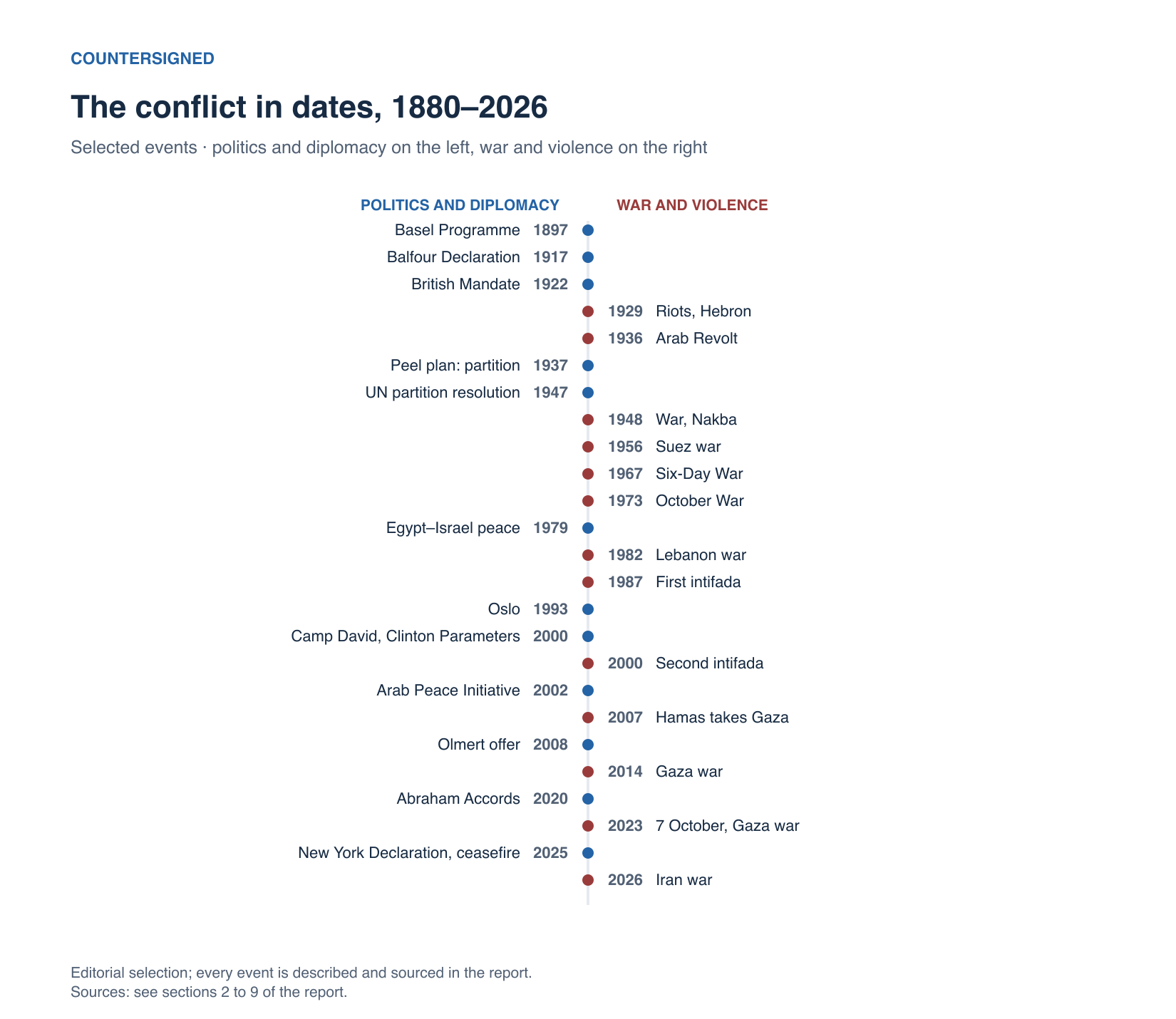
2. The roots: Ottoman Palestine and early Zionism (to 1917)
The State of Israel was founded in 1948, but its roots reach back into the 19th century. That was when Zionism emerged: a political movement that sought a homeland of their own for the Jewish people, scattered across many countries. Jewish religious and historical ties to the land are far older; Zionism turned them into a political programme.
A land under Ottoman rule
There was no state called Palestine at the time. The land belonged to the Ottoman Empire; the coastal towns of Jaffa and Gaza, for example, came under the district of Jerusalem. Around 1880 Gaza had some 18,000 inhabitants and Jaffa some 10,000 (S010). The great majority of the population were Arab Muslims, a minority Arab Christians. Figures for the country as a whole exist only from the British period: the first census, in 1922, counted about 649,000 inhabitants, including some 486,000 Muslims, 71,000 Christians and 84,000 Jews (S040).
The Jewish community was small. Around 1840 some 10,000 Jews lived in the country, mainly in the four “holy cities” of Jerusalem, Hebron, Safed and Tiberias. Most had come for religious reasons, and many lived largely on donations from the Jewish world, known as the halukka (S017). This community is called the “Old Yishuv”; Yishuv is the Hebrew term for the Jewish population of the land. These long-established Jews, a British commission of inquiry observed in 1937, had long since adapted to life among Arabs (S030).
Why Zionism arose in Europe
Modern Zionism arose not in Palestine but in Europe. Around 1880 a new antisemitism emerged there that excluded Jews no longer because of their faith but because of their supposed “race”. It spread from Germany across Central Europe, and the affair around the French officer Alfred Dreyfus showed how strong it was in France as well (S030). In the Russian Empire, pogroms – violent attacks on Jews – broke out in 1881 and 1882 (S018). Between 1880 and 1910 at least three million Jews left Eastern Europe, most of them for the United States (S030).
The first immigrants
Only a small share went to Palestine. In July 1882 a first group of 14 members of the Bilu movement landed at Jaffa. By 1903 almost 35,000 Jews had arrived, and nearly half of them left again after a few years (S018). This first wave of immigration is called the aliyah, Hebrew for “ascent”. The newcomers founded villages such as Rishon LeZion, Rosh Pina and Zikhron Ya’akov and lived by farming. The unfamiliar climate, disease, heavy Ottoman taxes and the resistance of Arab neighbours made life hard. That the settlements survived their first years was due above all to Baron Edmond de Rothschild, who supported them financially (S018; S030).
By 1914 the Jewish population had grown from about 25,000 in 1881 to more than 80,000. Almost 12,000 of them lived in 43 agricultural colonies, the rest mainly in Jerusalem, Haifa, Jaffa and their suburbs (S030).
Herzl and the Basel Programme
Zionism was organised politically by Theodor Herzl. In “The Jewish State”, published in Leipzig and Vienna in 1896, he demanded (in this report’s translation from the German original): “Give us sovereignty over a piece of the earth’s surface sufficient for the rightful needs of our people, and we will take care of everything else ourselves.” As possible locations he named Argentina and Palestine, “our unforgettable historic homeland” (S316). The Arab inhabitants of Palestine are not mentioned in the text.
In 1897 Herzl convened the First Zionist Congress in Basel; some 200 participants from 17 countries attended (S002). The Basel Programme adopted there set out the goal: “Zionism strives for the establishment of a publicly and legally secured home in Palestine for the Jewish people.” It was to be reached through settlement of the land, the organisation of Jews worldwide, the strengthening of their national consciousness and the consent of governments (S001; S002).
First conflicts on the ground
The Ottoman government viewed the immigration with concern. It wanted no further nationality problem of the kind it knew from other parts of the empire; it feared tension with the Arab majority, which was already beginning to stir against Jewish activity; and it wanted to give European powers no pretext to intervene in the Holy Land. Foreign Jews were therefore in principle barred from settling, but the ban was enforced only patchily. According to Ben-Bassat, and contrary to a common portrayal, the authorities were by no means only hostile to the immigrants; when they did intervene, it was often Arab peasants who bore the consequences (S010).
The land for the new villages was bought; at Rishon LeZion most of it came from two Arab brothers from Jaffa. How conflicts nevertheless arose is shown by the village of Qatra. It had lost some 3,000 dunams of land through debt (a dunam is about 1,000 square metres), which passed through a French intermediary to Jewish buyers. The peasants kept working it as tenants and regarded it as theirs, until the settlement of Gedera was founded on it in 1884. Clashes followed repeatedly in the years after (S010). Classical Zionist historiography attributed such clashes simply to cultural misunderstanding or to quarrels over land and water. The historian Yuval Ben-Bassat argues that this view needs to be re-examined, pointing to their wider social and economic context and their links to the later political conflict (S010).
What set the newcomers apart from the established residents the British Peel Commission later summed up this way: they did not want to merge into the existing life of the country but to build a Jewish society of their own (S030). With the First World War and British rule over Palestine, this coexistence turned into open political conflict.
3. The British Mandate: two promises, one land (1917–1947)
In the First World War the Ottoman Empire fought alongside Germany against Britain and France. To win allies, the British government made promises in these years that later proved hard to reconcile. By the end of 1918 Palestine was in British hands (S030).
Wartime promises
In October 1915 the British High Commissioner in Egypt, Sir Henry McMahon, wrote to Sharif Hussein of Mecca that Britain was “prepared to recognise and support the independence of the Arabs”. Excluded were “portions of Syria lying to the west of the districts of Damascus, Homs, Hama and Aleppo” (S025). The word Palestine does not appear in the correspondence, and whether the country fell under the exclusion remains disputed. In 1922 the British government stated that it had meant to exclude the whole of Palestine west of the Jordan (S029). The Arabs understood the pledge differently; their disappointment was among the causes of the first riots (S030).
In 1916 Britain and France divided the Arab lands of the Ottoman Empire into zones of influence in the secret Sykes-Picot Agreement. Palestine was to come under “an international administration”, and the ports of Haifa and Acre were to go to Britain (S026; S327).
Finally, on 2 November 1917, Foreign Secretary Arthur Balfour wrote to Lord Rothschild that the British government viewed “with favour the establishment in Palestine of a national home for the Jewish people”, on the understanding that “nothing shall be done which may prejudice the civil and religious rights of existing non-Jewish communities in Palestine” (S302). Those non-Jewish communities then made up more than 90 per cent of the population (S327). The British Peel Commission later explained the declaration mainly by the state of the war: it had been believed that Jewish sympathy could make a substantial difference to the Allied cause, not least by securing the support of American Jewry. Germany, too, was courting the Zionist movement at the time (S030).
The League of Nations mandate
After the war the League of Nations, the forerunner of the United Nations, entrusted Britain with the administration of Palestine as a mandate, a form of trusteeship. The mandate was approved on 24 July 1922 and came into operation in September 1923; a British civil administration under Sir Herbert Samuel had governed since 1920 (S027; S030). The text incorporated the Balfour Declaration. Britain was to create the conditions for the Jewish national home, “facilitate Jewish immigration under suitable conditions” and at the same time safeguard the civil and religious rights of “all the inhabitants of Palestine”. A Jewish agency was to advise the administration; the text made no comparable provision for the Arab majority. (S027).
As early as 1922 London tried to ease the contradiction. The government did not contemplate that “Palestine as a whole should be converted into a Jewish National Home”, and it rejected the idea that the country would become “as Jewish as England is English”. Immigration was to be limited by the economic capacity of the country to absorb new arrivals (S029).
Immigration and land
Under British rule the country changed quickly. According to a United Nations study, about 9 per cent of the population was Jewish in 1917 and about 32 per cent by 1947 (S328). Legal immigration alone brought more than 376,000 Jews during the Mandate (S327). Immigration rose most steeply in the mid-1930s, when many Jews also came from Germany: some 30,000 immigrants were authorised in 1933 and almost 62,000 in 1935 (S030).
Jewish organisations bought land. Their holdings grew from 650,000 dunams in 1920 to about 1.6 million at the end of 1946 – 6.2 per cent of Palestine’s total area and 12 per cent of its cultivable land (S327). According to the UN study, Jewish settlement displaced large numbers of Arab peasants (S327). The Peel Commission noted that the official count of “landless” Arabs captured only part of this displacement (S030).
The first outbreaks of violence
Arab opposition to British policy soon turned violent. In April 1920 Arabs attacked Jews in Jerusalem; five Jews were killed and 211 wounded, and on the Arab side four were killed and 21 wounded. A later inquiry named among the causes, besides the disappointed hope of independence, the Arabs’ belief that the Balfour Declaration denied them self-determination and their fear that the national home would subject them economically and politically to the Jews. In May 1921 riots in Jaffa left 47 Jews dead, most killed by Arabs, and 48 Arabs dead, most killed by police and troops (S030).
In 1929 a dispute escalated over the Western Wall in Jerusalem, sacred to Jews and revered by Muslims as al-Buraq, part of the al-Aqsa compound. After a Jewish demonstration at the Wall on 15 August and a Muslim one the following day, Jews were attacked in late August (S106; S105). In Hebron on 24 August, according to the Shaw Commission, “more than 60 Jews” were murdered; in Safed five days later some 45 Jews were killed or wounded. The British Shaw Commission counted 133 Jews and 87 Arabs killed in all (S105); the Peel Commission later gave 116 Arabs killed, most of them by troops or police (S030). The Shaw Commission found the fundamental cause in “racial animosity on the part of the Arabs, consequent upon the disappointment of their political and national aspirations and fear for their economic future”. The outbreak, it concluded, “was not premeditated” (S105; S106).
The Arab Revolt, 1936–1939
In April 1936 an uprising began that the Peel Commission described as “the outcome of a conflict between Arab and Jewish Nationalism”. The Arab parties formed the Arab Higher Committee under the Mufti of Jerusalem, Haj Amin al-Husseini, and called a general strike. They demanded a ban on Jewish immigration, a ban on land sales to Jews and a national government responsible to an elected council. After six months, in October 1936, the committee ended the strike at the request of Arab rulers. In 1936 alone, the official list counted 195 Arabs and 80 Jews killed; the full Arab toll could not be established, the Commission wrote, but had “been credibly estimated at 1,000” (S030).
The Commission reported in July 1937. Its central finding has shaped the debate ever since: “An irrepressible conflict has arisen between two national communities within the narrow bounds of one small country.” About a million Arabs were in strife with some 400,000 Jews, and “there is no common ground between them”. It therefore proposed partition: a Jewish state in Galilee, the Jezreel Valley and the coastal plain; an Arab state to be united with Transjordan; and a British zone around Jerusalem and Bethlehem with a corridor to Jaffa. Land was to be transferred and, as far as possible, populations exchanged (S030). The Arab side rejected partition; in 1938 the newspaper Falastin wrote that the Arabs “speak as one in their refusal of the partition” (S216).
In autumn 1937 the revolt flared again after Palestinians assassinated the British district commissioner for Galilee, Lewis Andrews. The British outlawed the Higher Committee and all Palestinian parties, and the Mufti fled to Beirut in October 1937 (S216). A further British commission declared partition unworkable in November 1938, while the Mandate authorities crushed the revolt with heavy reinforcements. According to the Palestinian historian Walid Khalidi, 55 Palestinians were hanged in this offensive and at least 1,200 killed in action by British forces. His colleague Rashid Khalidi writes that hundreds of homes, perhaps as many as 2,000, were blown up. By one survey of this research, more than one in ten adult Palestinian men had been killed, wounded, imprisoned or exiled by the end of 1939 (S216). The revolt also split Palestinian society: the Nashashibi family, rivals of the Mufti, supported the British counter-insurgency with their own “peace bands” (S216). With the Higher Committee banned, the historian Ghada Khalaf concludes, all responsible Palestinian leadership was destroyed (S216).
White Paper, world war and underground struggle
In May 1939, on the eve of the Second World War, London changed course. A White Paper – a government policy statement – declared that it was “not part of their policy that Palestine should become a Jewish State”. An independent Palestinian state was to be established within ten years. A further 75,000 Jewish immigrants would be admitted over five years; after that, immigration would depend on Arab consent. Land sales to Jews were also restricted (S032); from 1940 they were prohibited or subject to approval in zones covering 95 per cent of the country (S040).
For the Zionist movement this was a break, and it came as Nazi Germany was persecuting and murdering the Jews of Europe. The Mufti, Haj Amin al-Husseini, sided with the Nazis during the Second World War (S319). The number of victims of the Holocaust is estimated at approximately six million (S058). In 1942 a Zionist conference in New York called for unlimited immigration and for Palestine to be established as a Jewish Commonwealth. From 1945 Jewish resistance to the White Paper was accompanied by increasing violence, above all by the underground groups Irgun and Lehi, the “Stern Group” (S040; S317). In June 1946 the Mandate authorities detained some 2,600 Jews, including four members of the Jewish Agency Executive (S040). On 22 July 1946 the Irgun bombed a wing of the King David Hotel in Jerusalem that housed the government secretariat and British military headquarters. Ninety-one people were killed, among them 41 Arabs, 28 Britons and 17 Jews. Whether and in good time the attackers gave warning remains disputed (S317). The Jewish Agency and the Jewish National Council repeatedly condemned terrorism thereafter (S040).
An Anglo-American Committee of Inquiry recommended in April 1946 that 100,000 immigration certificates be issued at once for Jews who had been victims of Nazi persecution. It rejected both an Arab and a Jewish state (S035). Unauthorised immigration continued; in July 1947 the administration was holding almost 18,000 immigrants who had arrived without permission (S040). On 2 April 1947 Britain had already referred the question of Palestine to the United Nations (S040).
4. Partition, war and Nakba (1947–1949)
The partition plan
The United Nations set up a special committee, the United Nations Special Committee on Palestine (UNSCOP). The Arab Higher Committee boycotted it. Its eleven members agreed unanimously that the Mandate should end but disagreed on what should follow. Seven states proposed dividing the country into a Jewish and an Arab state linked by economic union, with Jerusalem under international administration. India, Iran and Yugoslavia favoured a federal state; Australia abstained (S040).
The committee’s own figures show how difficult partition would be. The proposed Jewish state would have had 498,000 Jews and 407,000 Arabs, plus about 90,000 Bedouin; the Arab state 725,000 Arabs and 10,000 Jews (S040). The starting positions were far apart. The Jewish Agency called partition a last resort, acceptable only if it ensured large-scale immigration and a Jewish state without delay. The Arab delegations had proposed in 1946 an independent unitary state with a permanent Arab majority, in whose legislature Jews would hold no more than a third of the seats (S040).
On 29 November 1947 the UN General Assembly adopted the partition plan as Resolution 181 by 33 votes to 13 with 10 abstentions. The United States, the Soviet Union and France voted in favour, the Arab member states against; Britain abstained. The two states were to come into existence no later than 1 October 1948 (S041). According to a later UN study, the plan “awarded 56 per cent of the territory of Palestine to 32 per cent of its population” (S328). That territory included the Negev, which the committee described as “desert land of little agricultural value” (S040). The Jewish leadership accepted the plan; the Palestinians and the Arab states rejected it (S319; S328).
The two great powers voted for it for different reasons. The Soviet Union, as its UN ambassador Andrei Gromyko explained in May 1947, would have preferred an “independent, dual, democratic, homogeneous Arab-Jewish State”; partition was the fallback if relations between the two peoples had deteriorated too far (S058). At the US State Department, officials feared a growing Soviet role in the Arab world and restrictions on Arab oil supplies, and recommended a UN trusteeship instead. President Harry S. Truman decided otherwise and recognised Israel on the day it was founded (S059; S060).
Civil war in the Mandate territory
Violence broke out after the vote. Historians today distinguish two wars: a first between Jews and Palestinians from December 1947 to mid-May 1948, and a second, conventional war between Israel and the Arab armies. The role of the British, who were preparing to leave during the first phase, is described as insufficiently explored (S318).
On 10 March 1948 the Haganah, the largest Jewish underground army, adopted Plan Dalet (Plan D). Its objective was to “gain control of the areas of the Hebrew state and defend its borders” (S043; S317). For Arab villages it laid down that “in the event of resistance, the armed force must be destroyed and the population must be expelled outside the borders of the state”; where there was no resistance, garrison troops would enter (S043). How far the plan explains the expulsions that followed is disputed.
On 9 April 1948 fighters of the Irgun and Lehi attacked the village of Deir Yassin west of Jerusalem. At the time 245 Arabs were reported dead (S045). Current estimates, for example by the Palestinian online encyclopedia PalQuest and the Israeli organisation Zochrot, are around 100 to 110; according to PalQuest, three quarters of them were women, children under 15 and old men (S325; S326). Irgun leaders later called Deir Yassin the principal act that “made the Arabs frightened of Jewish atrocities and led them to flee” (S045); the Israeli historian Benny Morris writes that the massacre “helped in a big way in instigating the general flight of Arabs from all around the country”, not least because Arab broadcasts “inflated the character of the atrocities” (S323). Four days later, on 13 April, Arab fighters attacked a convoy to the Hadassah hospital in Jerusalem. Seventy-eight Jews, among them the hospital’s director and 23 women, and one British soldier were killed; British troops intervened only in the afternoon (S047).
Statehood and the war of the armies
On 14 May 1948, the day the British Mandate ended, David Ben-Gurion read out the Declaration of Independence in Tel Aviv. It proclaimed “the establishment of the Jewish State in Palestine, to be called Israel”, promised equality “without distinction of race, creed, or sex” and called on the Arab inhabitants to play their part in the development of the state “with full and equal citizenship”. It did not define borders (S048). The next day the armies of five Arab states entered the country (S319). The Arab League told the United Nations that it was intervening “for the sole purpose of restoring peace and security” and sought a “United State of Palestine”; “over a quarter of a million” Arabs had already been compelled to leave their homes (S050).
Official Israeli historiography, in Shlaim’s account, long told the story of this war as David against Goliath. The historian Avi Shlaim counters that the Jewish side had more troops in the field at every stage: in mid-May 20,000 to 25,000 Arab fighters faced 35,000 first-line troops, and by December Israel had more than 96,000 under arms. King Abdullah of Transjordan, in Shlaim’s judgement, aimed not to prevent a Jewish state but “to make himself master of the Arab part of Palestine” (S319). Morris, by contrast, stresses that the decisive majority in the Arab world saw the war as a holy war, a jihad (S323). Israel lost about 6,000 people in the war, 4,000 soldiers and 2,000 civilians, around one per cent of its Jewish population (S319).
Civilians were also targeted in this phase. In July 1948 the inhabitants of Lydda and Ramle, tens of thousands of people, were expelled (S318). In Lydda, according to Morris, about 250 people were killed, “many of them it seems noncombatants” (S323).
Flight and expulsion
For Palestinians, 1948 is the Nakba, the “catastrophe” (S318). How many lost their homes could only be estimated even at the time. A UN economic mission concluded in December 1949 that the total number of refugees “does not exceed 774,000, including 48,000 in Israel, of whom 17,000 are Jews” (S051). The Geneva representative of the American Friends Service Committee, the Quaker relief organisation, estimated that no more than 660,000 to 700,000 refugees came from areas controlled by Israel (S053). A later UN study gives 726,000 refugees by the end of 1949, more than half the Palestinian population (S328); a research survey by Sciences Po in Paris speaks of 750,000 to 800,000. Almost two thirds stayed in the West Bank (39 per cent) and the Gaza Strip (26 per cent); most of the rest went to Lebanon, Syria and Transjordan (S318).
Why they left has been the subject of a historians’ dispute for decades. Three readings can be distinguished.
The older Israeli account held that the Palestinians mostly followed the calls of their own leaders (S319). This view, which the historian Efraim Karsh defends, places the primary responsibility for the Palestinian tragedy on “an extremist and short-sighted leadership”. Karsh also points out that older Israeli authors already accepted that no single explanation for the flight suffices (S321).
Palestinian historians such as Walid Khalidi contested this as early as 1959. There was “no trace of any such calls” in the communiqués of the Arab Higher Committee, but many calls to stay. More recent Palestinian research examines the role of massacres; the historian Saleh Abdel Jawad lists nearly 70 cases (S318).
In the late 1980s Israeli historians known as the New Historians worked through the Israeli archives that had by then been opened (S318; S320). Benny Morris found neither evidence of Arab calls to flee nor a general expulsion order from above. His conclusion: “The Palestinian refugee problem was born of war, not by design, Jewish or Arab” – largely a by-product of fear and fighting, in smaller part “the deliberate creation of Jewish and Arab military commanders and politicians” (S319). Shlaim considers Israeli responsibility, on Morris’s own material, to be considerably greater than Morris’s conclusion suggests (S319); Ilan Pappé speaks of ethnic cleansing (S318). Morris himself pointed out in 2004 that Haganah units in April and May 1948 received operational orders “to uproot the villagers, expel them and destroy the villages themselves”. At the same time the Arab Higher Committee and local Palestinian bodies ordered women, children and the elderly removed from villages (S322). In 2010 he summarised: “In general the Arabs fled; afterward we destroyed their villages and did not permit them to return. There were only cases of expulsion in a few places” (S323). Karsh accuses Morris of systematically falsifying evidence (S321). Palestinian scholars, for their part, received the New Historians’ work partly as confirmation from Israeli archives, but criticised their limited use of Arabic sources (S320).
In this report’s assessment, the state of research does not support a single-cause explanation: flight from the fighting and from fear, expulsions, and the later refusal to allow return worked together. How much weight each cause carried, and how much was planned, remains disputed.
Return, armistice and what remained open
In December 1948 the UN General Assembly resolved in Resolution 194 that “the refugees wishing to return to their homes and live at peace with their neighbours should be permitted to do so at the earliest practicable date”, and that compensation should be paid for the property of those choosing not to return (S054). In talks mediated by a UN commission, Israel offered in August 1949 to accept 100,000 refugees – on conditions, in locations of its choosing and only as part of a general peace settlement. The commission found the offer unsatisfactory. The Arab delegations demanded the return of all refugees from the areas that the partition plan had allotted to the Arab state or the international zone (S052). No agreement was reached.
Between February and July 1949 Israel concluded armistice agreements with Egypt, Lebanon, Transjordan and Syria (S303; S304; S305; S306). The lines they drew were expressly not final borders (see section 1). Israel now controlled 77 per cent of former Mandate Palestine and the larger part of Jerusalem. The Arab state envisaged by the partition plan did not come into being: Jordan and Egypt occupied the remaining areas (S328).
5. Between the wars (1949–1967)
An agency for the refugees
The refugee question remained open after 1949, and the United Nations prepared for longer-term support. On 8 December 1949 the General Assembly established UNRWA. It was to carry out direct relief and works programmes together with the governments of the region; under the original plan, direct relief was to end no later than the close of 1950 (S062). The agency still exists today (S197); for the definition of refugee status, see section 1.
Who ruled which territory
The Arab state envisaged by the partition plan did not exist. Jordan brought the West Bank formally under its control on 24 April 1950; the Gaza Strip remained under Egyptian control (S328).
The Palestinians who had stayed in Israel became citizens, but until 1966 most of them lived under a military government. According to the Israeli archive institute Akevot, its purpose was to control Arab areas and abandoned land, monitor the movements of Arabs and prevent them from returning to places captured in the war. About 85 per cent of Arab citizens lived under this regime, which imposed night curfews and travel restrictions. Prime Minister Levi Eshkol abolished it in 1966 (S066). Israel took control of the refugees’ property in 1950 with a law on “absentees’ property”: among others, anyone who had left his ordinary place of residence between November 1947 and May 1948 counted as absent (S054).
The Jews of the Arab world
In the same period most Jews left the Arab countries where their communities had often existed for centuries. The pro-Israeli Jewish Virtual Library counts some 820,000 Jewish refugees between 1948 and 1972, of whom 586,000 were resettled in Israel. About 110,000 Jews were airlifted from Iraq to Israel in 1950 and 1951, after the Iraqi parliament allowed emigration only on condition that Jews gave up their citizenship; from Yemen, Israel brought almost the entire Jewish community of nearly 50,000 people (S223). The causes are disputed. The scholar Philip Mendes describes two opposing readings: the Zionist one attributes the exodus almost solely to Arab violence or threats, the Arab one to a Zionist conspiracy. He himself sees both at work, anti-Jewish hostility as well as the attraction of Zionism and the new state. He rejects as too simple the equation with the Palestinian exodus as a kind of “population exchange”, which the Jewish Virtual Library, for example, draws (S222; S223).
Border violence, the Suez war and Kafr Qasim
Along the armistice lines the conflict did not rest. In October 1953 a hand grenade killed a mother and her two small children in the Israeli village of Yehud. Two days later Israeli forces attacked the village of Qibya in the West Bank; according to the UN truce supervisors, 53 inhabitants were killed and more than 40 houses destroyed (S342). The UN Security Council expressed “the strongest censure” of this retaliatory action (S064).
In July 1956 Egyptian President Gamal Abdel Nasser nationalised the company that ran the Suez Canal. Britain and France then secretly agreed with Israel, which saw Nasser as a threat, on an attack on Egypt, which began on 29 October 1956. Under US pressure the fighting stopped, and Israel had to withdraw from Sinai and the Gaza Strip (S329; S330).
On the first day of that war a crime was committed inside Israel. In the Arab village of Kafr Qasim the curfew was brought forward from 10 p.m. to 5 p.m. with only half an hour’s notice. Labourers working outside the village did not know. Members of the Israeli Border Police shot dead 47 men, women and children as they returned home. A military court convicted eight defendants of murder and sentenced the battalion commander to 17 years in prison. Judge Benjamin Halevy used the case to develop the “black flag” test: a patently illegal order must be disobeyed. The sentences were soon reduced, and the last of those convicted were free within a few years; the brigade commander who had ordered the curfew received a reprimand and a fine of ten Israeli cents (S066).
In the 1960s Palestinian fighters attacked Israel mainly from Jordan, with Syrian backing; Israel responded with reprisal raids, for example against the West Bank town of Samu in November 1966 (S330).
The Palestine Liberation Organization emerges
In 1964 the Arab League decided to organise the Palestinians. The same year the first Palestine National Council, the movement’s parliament, met in Jerusalem, and the Palestine Liberation Organization (PLO) was formed (S080; S328). Its first charter called Zionism a “colonialist” and “racist” movement and Israel its “spearhead” (S079). Alongside the PLO there was Fatah, a Palestinian liberation movement founded in 1959 with Yasser Arafat among its founders (S080).
6. Occupation and the struggle for representation (1967–1993)
The Six-Day War
In May 1967 the Soviet Union told Egypt and Syria that Israel was massing troops on the Syrian border. The report was false, but Nasser sent large forces into Sinai, demanded the withdrawal of the UN peacekeeping force and announced on 22 May that he would close the Straits of Tiran to Israeli shipping. Between 5 and 10 June Israel defeated Egypt, Jordan and Syria and occupied the Sinai Peninsula, the Gaza Strip, the West Bank, East Jerusalem and the Golan Heights (S330). Almost half a million Palestinians fled, many for the second time (S328). Israel absorbed East Jerusalem and began to build settlements in the occupied territories (S330).
In November 1967 the UN Security Council adopted Resolution 242, in the assessment of the US State Department’s Office of the Historian the bedrock of all subsequent US peace efforts. It emphasises “the inadmissibility of the acquisition of territory by war” and calls for the “withdrawal of Israel armed forces from territories occupied in the recent conflict”. In return, every state in the region is to be able to live in peace “within secure and recognized boundaries”; the resolution also calls for “a just settlement of the refugee problem” (S069). The absence of “the” or “all” before “territories” was deliberate: Arab states read the text as requiring full withdrawal, Israel did not. The British drafter said that every delegation might have its own interpretation, but “only the resolution would be binding” (S083; S330).
The settlements
The occupation brought settlement building that continues to reshape the West Bank. According to figures from the Israeli organisation Peace Now, based on Israel’s Central Bureau of Statistics, about 1,500 Israeli settlers lived in the West Bank (excluding East Jerusalem) in 1972, about 4,400 in 1977 and about 116,300 in 1993, the year of the Oslo Accords. In 2000 there were about 198,300, in 2010 about 311,100 and in 2024 about 511,100 (S225). In East Jerusalem, according to a UN commission of inquiry in 2022, some 230,000 people live in 14 settlements (S313). In a non-binding advisory opinion in 2024, the International Court of Justice found that the transfer of Israeli settlers into the occupied territories violates the Fourth Geneva Convention and that Israel’s policies amount to annexation of large parts of those territories. It held that Israeli laws and measures maintaining a near-complete separation of settlers and Palestinians breach Article 3 of the Convention on the Elimination of Racial Discrimination, which prohibits racial segregation and apartheid, and by 11 votes to 4 it declared Israel’s continued presence in the occupied territories unlawful (S313). Prime Minister Netanyahu rejected the opinion: “The Jewish people are not occupiers in their own land” (S340).
The PLO between armed struggle and diplomacy
After 1967 Fatah joined the PLO and soon took over its leadership. In 1968 the organisation committed itself to the “total liberation of Palestine through armed struggle”; in 1969 Arafat became its chairman (S080). The new charter described Israel as an illegal state, and Israel refused to deal with the PLO (S328). Palestinian groups also carried out attacks outside the region in this period. At the Munich Olympics in September 1972 the “Black September” group, a PLO affiliate, took Israeli athletes hostage to demand the release of 236 prisoners. Eleven members of the Israeli Olympic team and a West German police officer were killed (S215).
On 6 October 1973 Egypt and Syria attacked Israeli positions in Sinai and on the Golan Heights. The war ended with Security Council Resolution 338, which called for a ceasefire and negotiations on the basis of Resolution 242 (S331; S070).
Diplomatically, the PLO gained ground. In October 1974 the Arab states recognised it at Rabat as the sole legitimate representative of the Palestinian people, and the UN General Assembly granted it observer status the same year. Arafat told the Assembly that “the difference between the revolutionary and the terrorist lies in the reason for which each fights” (S328).
Camp David and peace with Egypt
In 1978 US President Jimmy Carter mediated at Camp David between Egyptian President Anwar Sadat and Israeli Prime Minister Menachem Begin. A framework agreement provided for a transitional period of no more than five years with “full autonomy” for the inhabitants of the West Bank and Gaza, followed by negotiations on their final status (S068). This part was never implemented: Palestinian representatives refused to take part, and the Egyptian and Israeli positions could not be bridged (S067). The Egypt–Israel peace treaty of 26 March 1979, by contrast, held: Israel undertook to withdraw completely from Sinai within three years, and the two states recognised each other (S071).
Lebanon 1982: Sabra and Shatila
In June 1982 Israel invaded Lebanon, where Palestinian organisations had their military base (S209). From 16 to 18 September 1982 militiamen of the Christian Lebanese Phalange killed hundreds of people in the Palestinian refugee camps of Sabra and Shatila in Beirut. The Israeli army had surrounded the camps, let the Phalange in and lit the area with flares at night. The Red Cross counted 328 bodies, a compilation by several bodies 460; Israeli military intelligence estimated 700 to 800 dead, and Palestinian sources speak of far more (S209; S210). Israel’s Kahan Commission found Israel indirectly responsible and Defence Minister Ariel Sharon personally responsible, and recommended that he draw the consequences or be removed (S209). Critics consider these findings too lenient; an international commission chaired by the Nobel peace laureate Seán MacBride concluded in 1983 that Israel bore direct responsibility (S210; S081).
The first intifada and two answers
In December 1987 an uprising began in the occupied territories, the first intifada. By the Oslo Declaration of Principles in September 1993, Israeli security forces had killed 1,070 Palestinians there, 237 of them minors, according to the Israeli human rights organisation B’Tselem; Israeli civilians killed another 54. In the same period Palestinians killed 47 Israeli civilians and 43 members of the security forces in the occupied territories (S076). Palestinians also killed other Palestinians whom they accused of collaborating with Israel; according to the Israeli army, 1,068 were killed on this suspicion by the end of November 1997 (S077).
Two opposing programmes emerged from the uprising. The newly founded Islamist movement Hamas declared in its charter of August 1988 that all of Palestine was an Islamic endowment (waqf) that must not be given up, dismissed peace initiatives as “a waste of time” and called jihad the only way. The charter also contains antisemitic conspiracy claims: Jews were behind the French Revolution, both world wars and almost every war, and as proof it cites the “Protocols of the Elders of Zion” (S073). The Palestine National Council, by contrast, proclaimed the State of Palestine with Jerusalem as its capital in Algiers on 15 November 1988. It invoked the 1947 partition resolution, which had provided for two states, and rejected “the threat or use of force, violence and terrorism” against its own territorial integrity as well as against that of other states (S075). In an accompanying political statement it called for an international peace conference on the basis of Resolutions 242 and 338 (S074). Resolutions 242 and 338 later also underpinned the negotiations of the 1990s (section 7).
7. Closer than ever: attempts at agreement and why they failed
Between 1991 and 2008 Israelis and Palestinians several times came closer to agreement than ever before or since. This section sets out the main attempts and distinguishes what was on paper from what participants reported afterwards.
Madrid and Oslo
In October 1991 the United States and the Soviet Union invited the parties to a peace conference in Madrid. It was based on Resolutions 242 and 338; the Palestinians attended “as part of a joint Jordanian-Palestinian delegation” (S084). The breakthrough, however, came from secret talks in Oslo. In September 1993 the PLO, in a letter from Arafat, declared that it “recognizes the right of the State of Israel to exist in peace and security”, accepted Resolutions 242 and 338 and renounced “the use of terrorism and other acts of violence”; the articles of its charter denying Israel’s right to exist were declared “inoperative and no longer valid”. Prime Minister Yitzhak Rabin in turn recognised the PLO as the representative of the Palestinian people (S086). The Declaration of Principles of 13 September 1993 provided for Palestinian self-government “for a transitional period not exceeding five years”. Negotiations on permanent status – on Jerusalem, refugees, settlements, security arrangements and borders – were to begin no later than the third year (S087).
The process soon lost momentum. Violence on both sides eroded trust: the massacre of Muslim worshippers by a Jewish settler in Hebron in 1994 as well as suicide bombings by Palestinian groups (see section 8). In November 1995 Rabin was assassinated by Yigal Amir, a Jewish extremist who opposed his peace policy (S332; S234). At the same time the number of settlers kept growing (section 6). Further partial agreements followed, such as the 1997 Hebron Protocol (S332), but the deadline for a final settlement passed.
Camp David 2000 and the Clinton Parameters
In July 2000 US President Bill Clinton brought Israeli Prime Minister Ehud Barak and Arafat to Camp David. The summit broke down over borders, Jerusalem and whether Israel would recognise a Palestinian right of return; Clinton blamed Arafat (S332). What exactly was offered is disputed, partly because there was no written offer. Robert Malley, then Clinton’s special assistant for Arab-Israeli affairs and a member of the US team at Camp David, and the Oxford scholar Hussein Agha, involved in Israeli-Palestinian contacts for decades, write that the ideas “were never stated in writing, but orally conveyed” and were presented as American concepts. On their account, Palestine would have had sovereignty over 91 per cent of the West Bank, Israel would have annexed 9 per cent and given land equal to 1 per cent in return; for the Temple Mount, which Muslims revere as the Haram al-Sharif, only a Palestinian “permanent custodianship” was envisaged (S088). Akram Hanieh, an adviser to Arafat and member of the Palestinian team, reports Israeli annexation demands of 10 to 13.5 per cent and Israel’s insistence on sovereignty over the Haram. Arafat, he writes, said the Palestinians were “demanding only 22 percent of our country” (S230).
Interpretations differ widely. Barak saw a historic compromise that the Palestinians rejected (S089). Malley and Agha see errors on all sides – in Barak’s tactics, in American mediation and in Arafat’s passivity (S088; S090). Shlomo Ben-Ami, then Israel’s foreign minister, sees the decisive chance only in December 2000: “If Arafat had said a ringing yes at the end of December he would have saved the Barak government and saved the peace” (S231). After a visit by Ariel Sharon, leader of the opposition Likud party, to the Temple Mount at the end of September 2000, riots broke out that escalated into the second intifada (S332).
On 23 December 2000 Clinton presented his “parameters”, a detailed outline of a two-state solution. Palestine was to receive “between 94-96 percent” of the West Bank, with a land swap of 1 to 3 per cent; 80 per cent of settlers were to remain in blocs going to Israel. In Jerusalem, “Arab areas are Palestinian and Jewish ones are Israeli”, including in the Old City; Palestine would have sovereignty over the Haram and Israel over the Western Wall. Both sides were to recognise a right of return for refugees to “historic Palestine” or to “their homeland”, but with “no specific right of return to Israel itself”; the Palestinian state would be “non-militarized” (S091). The Israeli cabinet endorsed the parameters with reservations (S091). According to Malley and Agha, Arafat replied after ten days that he had “accepted your parameters and have some views I must express” (S090). Clinton read this as rejection and later called it “an error of historic proportions” (S091); Ben-Ami was told by the Americans that “Arafat in fact said no” (S231).
In January 2001 the two sides continued talks at Taba in Egypt. According to the record of the EU Special Representative Miguel Moratinos, which both sides acknowledged as a fair description, the lines of 4 June 1967 were accepted as the basis of the border. Israel presented a map with 6 per cent annexation, the Palestinian side one with 3.1 per cent and a land swap. On Jerusalem the positions converged; on refugees they did not (S092). No agreement was concluded.
New plans, new division (2002–2007)
In March 2002 the Arab League offered Israel peace and “normal relations” in the Arab Peace Initiative. The conditions were full withdrawal to the lines of 4 June 1967, including the Golan Heights, a Palestinian state with East Jerusalem as its capital and a “just solution” to the refugee problem “to be agreed upon” (S096). In 2003 the Quartet of the United States, the European Union, Russia and the United Nations presented a “roadmap” towards two states (S237). The same year prominent Israelis and Palestinians acting without government mandate, led by former ministers Yossi Beilin and Yasser Abed Rabbo, presented the Geneva Initiative, a complete but unofficial draft treaty with borders based on the 1967 lines and land swaps on a one-to-one basis (S240; S097).
In summer 2005 Israel dismantled its 17 settlements in the Gaza Strip and four in the northern West Bank (S224). In January 2006 Hamas won the Palestinian parliamentary elections; after failed attempts to share power with Fatah and mounting internal fighting, it took control of the Gaza Strip in June 2007 (S080). Since then the Palestinian territories have been politically divided, and Israel has maintained a blockade of the Gaza Strip, fully enforced since 2007 (S108).
Annapolis and Olmert’s offer (2007–2008)
At a conference in Annapolis in November 2007, Olmert and Abbas agreed to “make every effort to conclude an agreement before the end of 2008” (S233). In 2008, by his own account, Prime Minister Ehud Olmert offered President Mahmoud Abbas the following: Israel would keep 6.3 per cent of the West Bank and compensate Palestine with Israeli land equal to 5.8 per cent plus a link to the Gaza Strip. The Arab neighbourhoods of East Jerusalem would go to Palestine, and the Old City with its holy sites would be overseen by an international body of Israel, Palestine, Jordan, the United States and Saudi Arabia; Israel would admit only a symbolic number of refugees (S234; S235). Palestinian negotiating records published by Al Jazeera in 2011, by contrast, describe an annexation of “more than 10%” (S236). Abbas later said Olmert showed him the map but did not give it to him: “How can I sign on something that I didn’t receive?” He rejected the offer (S234; S235). Olmert, for his part, insists that “Abbas never said no” (S235).
From Kerry to the Trump plan
In 2013 and 2014 the two sides negotiated for nine months under the mediation of US Secretary of State John Kerry. In his judgement the negotiations “did not fail because the gaps were too wide, but because the level of trust was too low”. The settler population in the West Bank, he noted, had grown by nearly 270,000 since Oslo (S333).
In January 2020 US President Donald Trump presented a plan of his own. About 97 per cent of Israelis and of Palestinians in the West Bank were to live in contiguous territory of their respective states, and the Jordan Valley was to come under Israeli sovereignty. The plan placed the Palestinian capital in parts of East Jerusalem beyond Israel’s barrier, such as Abu Dis; the state was to be fully demilitarised, and there would be “no right of return by, or absorption of, any Palestinian refugee into the State of Israel”. It also held out the prospect of more than $50 billion in investment (S098). In a poll, 94 per cent of Palestinians rejected the plan (S177). In September 2020 Israel and the United Arab Emirates agreed on full diplomatic relations, the first of the Abraham Accords (S099).
The 2025 attempt
After the war in Gaza the international community made a new attempt. On 12 September 2025 the UN General Assembly endorsed the “New York Declaration” by 142 votes to 10 with 12 abstentions; it grew out of a conference co-chaired by France and Saudi Arabia. Israel and the United States voted against. The declaration commits to “tangible, timebound, and irreversible steps” towards two states, condemns the attacks by Hamas against civilians on 7 October as well as Israel’s attacks on civilians in Gaza, the siege and starvation, and calls for the disarmament of Hamas and its exclusion from governance in Gaza (S101; S102).
Why it did not succeed
Where written proposals and consistent accounts exist, they show that between 2000 and 2008 positions on borders and Jerusalem converged considerably. The holy sites and above all the refugee question remained open. Who prevented agreement is answered in opposite ways by the participants, and the documents support no account that places sole blame on one side. In this report’s assessment, several factors worked together: violence that destroyed trust, continued settlement building, Rabin’s assassination and, from 2007, the Palestinian division.
8. Terror and violence against civilians
Violence against civilians runs through the entire history of the conflict, and it has come from both sides. This section applies the same yardstick to all.
One yardstick for all
The yardstick is a description by the UN Security Council from 2004. It refers to “criminal acts, including against civilians, committed with the intent to cause death or serious bodily injury, or taking of hostages, with the purpose to provoke a state of terror” in a population or to compel a government, where these fall under the international conventions on terrorism. Such acts “are under no circumstances justifiable by considerations of a political, philosophical, ideological, racial, ethnic, religious or other similar nature” (S334). This report applies the description to all actors, armed groups and states alike.
The report also uses three legal terms. War crimes are serious violations of the law of armed conflict, such as deliberate attacks on civilians or hostage-taking. Crimes against humanity are acts such as murder committed as part of a “widespread or systematic attack directed against a civilian population” (S257). Genocide, under the 1948 Convention, means certain acts, such as killing, committed “with intent to destroy, in whole or in part, a national, ethnical, racial or religious group, as such” (S115; S314). It matters who makes a finding: a court rules, a commission of inquiry or human rights organisation reaches findings, and an arrest warrant is not a conviction.
From 1920 to 1994
Applying the Security Council’s description, in this report’s assessment many of the acts described in this report meet its features: deliberate killing or hostage-taking of civilians to spread fear or compel governments. On the Jewish and Israeli side these include the Irgun bombing of the King David Hotel in 1946, the Deir Yassin massacre in 1948 and the Hebron massacre in 1994; on the Palestinian side the attack on the Hadassah convoy in 1948, the Munich hostage-taking in 1972, the suicide bombings of the 1990s and 2000s and the attack of 7 October 2023. Killings of civilians by state forces or police, as at Qibya, Kafr Qasim or in the Gaza war, are assessed by commissions and courts under the law of armed conflict; this report sets out their findings (sections 3 to 6 and below).
On 25 February 1994 the Jewish settler Baruch Goldstein, a physician from Kiryat Arba and an activist of the extremist Kach movement, shot dead 29 Muslim worshippers in the Cave of the Patriarchs in Hebron and wounded 129 (S212). In the riots that followed, Israeli soldiers killed further Palestinians (S212). The state Shamgar Commission concluded that Goldstein had planned and acted alone (S213).
Suicide bombings and the second intifada
In the years after Oslo, and above all in the second intifada, Palestinian groups carried out suicide bombings against civilians at bus stops, in cafés and other crowded places. Between January 2001 and August 2002 alone, Human Rights Watch counted 48 such attacks on Israeli civilians, carried out by Hamas, Islamic Jihad, the Popular Front for the Liberation of Palestine and the al-Aqsa Martyrs’ Brigades, which were close to Arafat. From the end of September 2000 to the end of August 2002 armed Palestinians killed more than 415 civilians. The organisation concluded that the scale and systematic nature of the attacks met the definition of crimes against humanity. It found no evidence that Arafat and the Palestinian Authority planned or ordered them, but said their failure to take steps to prevent them “implies a high degree of responsibility”. Justifications citing Israeli abuses and the occupation were “completely without merit” (S109).
According to B’Tselem, Israeli security forces killed 6,371 Palestinians from the start of the second intifada in September 2000 to September 2010, including 1,317 minors; at least 2,996 of them were not taking part in hostilities. Palestinians killed 1,083 Israelis in the same period, 741 of them civilians, including 124 minors (S228).
The wars over Gaza
After Hamas took over, Israel and the armed groups in Gaza fought several wars. For the war of summer 2014 a UN commission of inquiry produced a detailed record: 2,251 Palestinians were killed, including 1,462 civilians, 551 of them children. Palestinian groups fired 4,881 rockets and 1,753 mortar shells at Israel, killing six civilians (S108; S107). The commission found indications of possible war crimes by both sides. The indiscriminate rockets appeared intended to spread terror among civilians. Israel’s strikes on residential buildings, in which whole families died, “may have constituted military tactics reflective of a broader policy, approved at least tacitly by decision-makers at the highest levels”. In Gaza at least 21 alleged collaborators were summarily executed (S107; S108). Israel did not respond to the commission’s requests (S108).
Settler violence
In the West Bank, violent settlers have attacked Palestinian villages, farmers and herders for years. The Israeli organisation Yesh Din has tracked 1,701 police investigations into such acts since 2005: 93.8 per cent of the concluded cases were closed without indictment, and only 3 per cent ended in a conviction (S110). Violence has risen sharply since 2023. According to Human Rights Watch, settler attacks have fully or partly displaced 107 Palestinian communities with 5,900 people since January 2023; armed settlers often acted alongside soldiers or in their presence. The UN humanitarian office OCHA recorded an average of 6.6 settler attacks a day causing casualties or damage in 2026, more than in any previous year, and at least 15 Palestinians killed by settlers by 24 July (S111).
7 October 2023
On 7 October 2023 fighters of the Qassam Brigades, the armed wing of Hamas, and of other groups, accompanied by civilians from Gaza, at least 1,000 people in all, broke into southern Israel. They attacked kibbutzim, the Nova music festival and military posts. According to Israeli figures adopted by a UN commission of inquiry, more than 1,200 people were killed, at least 809 of them civilians and 314 members of the security forces; among the dead were 40 children and 68 foreign nationals. At least 252 people were taken hostage to Gaza (S335). The commission found, among other things, the war crimes of intentionally attacking civilians, murder, torture and hostage-taking (S335); Human Rights Watch also classified the killings and hostage-taking as crimes against humanity (S257).
The UN Special Representative on Sexual Violence in Conflict, Pramila Patten, found “reasonable grounds to believe” that sexual violence, including rape and gang rape, occurred at several locations, and “clear and convincing information” that some hostages in Gaza were subjected to sexual violence. Two allegations widely repeated in the media proved unfounded, and the extent could not be established without a full investigation (S117). The commission of inquiry likewise concluded that sexual violence occurred at several locations; it could not determine exactly who the perpetrators were. It also found “strong indications” that Israeli units applied the so-called Hannibal Directive, intended to prevent soldiers being captured, in several instances that day, harming Israelis as well (S335).
The war in Gaza and the charge of genocide
On 9 October 2023 Israel imposed a complete siege on the Gaza Strip. Defence Minister Yoav Gallant announced: “no electricity, no water, no food, no fuel” (S336). Israel named its war aims as destroying Hamas’s military capacity and governing infrastructure and bringing the hostages home (S336). Section 9 gives the number killed since.
The UN commission of inquiry concluded in 2024, for the first three months of the war, that Israel had committed, among other things, the war crime of starvation as a method of warfare and the crimes against humanity of extermination and gender persecution. It also noted that Hamas and other groups had built tunnels under civilian buildings, used some hospitals, schools and mosques for military purposes and thereby put the civilian population in harm’s way (S336). In September 2025 the commission went further: Israel had committed genocide in Gaza. Israeli forces had carried out four of the five acts listed in the Convention, and the intent to destroy the Palestinians in Gaza as a group was the only reasonable inference; President Herzog, Prime Minister Netanyahu and former Defence Minister Gallant had incited genocide (S115). Israel’s foreign ministry “categorically rejects” the report as a “libelous rant” (S341). Amnesty International had reached the same conclusion in December 2024; Israel’s foreign ministry called that report “entirely false and based on lies” (S258; S259). Critics such as the organisation UN Watch accuse the commission of accepting unverified Hamas casualty figures and of erasing Hamas as a party to the war (S251). Israel does not cooperate with the commission (S336). In August 2025 the Integrated Food Security Phase Classification (IPC) declared famine in Gaza (S114).
What courts have decided – and what they have not
Two international courts are dealing with the war, neither with a final ruling. In January 2024, on South Africa’s application, the International Court of Justice found that at least some of the rights claimed under the Genocide Convention were “plausible”. It ordered Israel, by 15 votes to 2, to prevent all acts within the scope of the Convention and, by 16 to 1, to prevent and punish incitement and to enable humanitarian assistance (S314). It expressly did not decide whether genocide had occurred (S314). In May 2024 it ordered, by 13 votes to 2, an immediate halt to the offensive in Rafah (S315).
The International Criminal Court issued arrest warrants for Netanyahu and Gallant in November 2024, including for the war crime of starvation as a method of warfare and for crimes against humanity (S247). It dropped warrants for three Hamas leaders over 7 October after Israel had killed them (S140). Israel is challenging the court’s jurisdiction. The court rejected a request to set the warrants aside pending that challenge in July 2025; the Prime Minister’s Office calls the proceedings “political and not judicial” and says Israel defends its citizens “in full accordance with the genuine principles of international law” (S140; S249; S250).
9. The situation in September 2026
This section describes the state of affairs at the editorial cutoff of 23 September 2026. Every figure carries its date, because much changes from week to week.
Gaza: a ceasefire without peace
The present situation rests on a 20-point plan presented by US President Trump at the end of September 2025. It provided for an end to the fighting, the return of all hostages, living and dead, within 72 hours, and in exchange the release by Israel of 250 prisoners serving life sentences and 1,700 Gazans detained after 7 October. Hamas was to have no role of any kind in governing Gaza and was to be disarmed; Israel would neither occupy nor annex Gaza. The territory was to be run temporarily by a non-political Palestinian technocratic committee under the oversight of a “Board of Peace” chaired by Trump, with an international stabilisation force providing security. A Palestinian state was held out only conditionally: if reconstruction advanced and the Palestinian Authority carried out its reforms, “the conditions may finally be in place for a credible pathway to Palestinian self-determination and statehood” (S141).
The ceasefire was announced on 10 October 2025 (S123). In November 2025 the UN Security Council endorsed the plan by 13 votes with China and Russia abstaining, and authorised the Board of Peace and the stabilisation force until the end of 2027. Russia explained its abstention by saying the resolution did not reflect the two-state formula (S121). Of the 251 people taken captive on 7 October – the UN commission of inquiry counted 252 – 168 returned alive, according to the Board of Peace; the remains of the last hostage were returned to Israel on 26 January 2026 (S122).
The remaining points of the plan are being implemented only slowly. In May 2026 the Board of Peace reported that the roadmap for disarmament had not been finalised, the stabilisation force had not been deployed, and the Palestinian administrative committee had not been able to enter Gaza; $17 billion had been pledged for reconstruction. It saw the principal obstacle in Hamas’s refusal to accept verified decommissioning (S122). In July 2026 Hamas dissolved its governing body in Gaza. According to an Al Jazeera correspondent there, this did not mean giving up its political or military role, but “stepping back from the direct civilian government in Gaza” (S188). At the end of July the Board of Peace announced an agreement on phased disarmament. Weapons are to go to a Palestinian committee, not to Israel; an international commission is to verify, and Israel is to withdraw in step (S189). Washington expects the process to take seven to eight months. Israeli officials said there would be no withdrawal without genuine disarmament (S263). The British think tank Chatham House considers an agreed timetable unlikely any time soon. Israel now controls nearly 70 per cent of the Gaza Strip, up from about 53 per cent at the start of the ceasefire (S190).
Casualty figures can only be given with their source. The Ministry of Health in Gaza, which operates under the Hamas de facto authorities, reported 71,667 killed and 171,343 injured between 7 October 2023 and the end of January 2026. From the start of the ceasefire to 16 September 2026 it reported a further 1,381 deaths (S126; S123). The United Nations reproduces these figures with the note that they have not yet been verified by the UN (S260); they do not distinguish between civilians and fighters. The Israeli army said in December 2023 that it had killed more than 7,850 fighters by then, but described the figure as not definitive (S336). According to Israeli sources, more than 1,671 Israelis and foreign nationals have been killed since 7 October 2023, most of them on that day; 471 Israeli soldiers had been killed in the Gaza operation by January 2026 (S126).
West Bank: violence, displacement and E1
In the West Bank, according to the UN, 82 Palestinians, including 19 children, were killed by Israeli forces or settlers between January and the end of August 2026, 23 of them in the context of settler attacks (S125). More than 4,300 Palestinians had been displaced in 2026 by mid-September, over a third of them by demolitions of buildings lacking Israeli permits (S123). According to Human Rights Watch, in January 2025 the Israeli army had already expelled some 32,000 residents from the Jenin, Tulkarem and Nur Shams refugee camps (S111). New settlement outposts, unauthorised even under Israeli law, have been established in rapidly rising numbers: according to Peace Now, 32 in 2023, 62 in 2024, 91 in 2025 and 65 in 2026 up to August (S225).
The E1 settlement project east of Jerusalem is particularly contested. It is to link East Jerusalem with the large settlement of Ma’ale Adumim and, in the view of critics, would cut the northern West Bank off from the south (S130). After Finance Minister Bezalel Smotrich announced its approval in August 2025, Israel tendered the first 1,234 homes in August 2026; bids close on 19 October, eight days before the Knesset election (S132; S130). The EU called on Israel to halt the project (S131). Britain summoned Israel’s chargé d’affaires, extended its sanctions on violent settlers to 38 individuals and announced measures against British companies supplying settlements; Israel responded with countermeasures that included closing the British consulate in Jerusalem (S130; S132).
An election year on both sides
Israel elects a new parliament, the Knesset, on 27 October 2026 (S133). In polls by Channel 12, the new party of former chief of staff Gadi Eisenkot was narrowly ahead of Netanyahu’s Likud, but the opposition parties together stood at 59 of 120 seats, two short of a majority (S270). On 28 November 2026 Palestinians are due to elect a parliament for the first time in 20 years; Abbas has announced presidential elections for early 2027 (S268; S134). Hamas was excluded from the local elections in April 2026 because candidates had to commit, among other things, to recognising Israel and to a two-state solution; in Gaza, voting took place only in the city of Deir al-Balah (S135; S269).
Courts and region
South Africa’s genocide case against Israel at the International Court of Justice will take years. Israel filed its counter-memorial in March 2026; the court set further written pleadings for November 2027 and May 2029 (S138; S137). A judgment on the merits is therefore not to be expected before 2029.
The conflict remains closely bound up with the region. On 28 February 2026 the United States and Israel attacked Iran; the strikes killed Supreme Leader Ali Khamenei. Iran and Lebanon’s Hezbollah responded with missile and drone attacks on Israel (S144; S143). A ceasefire with Iran was declared on 8 April (S143). With Lebanon, Israel agreed through US mediation on a ceasefire and a framework agreement by June, to which Hezbollah was not a party (S265; S267; S266).
10. Who backs whom – and why
The conflict is heavily shaped from outside. Support does not, however, follow clear camps: Germany, for example, supplies weapons to Israel and is at the same time the largest donor to the UN agency for Palestinian refugees. The table summarises the main actors; the entries are dated examples, not a complete account.
| Actor | Mainly supports | How (examples) | Official rationale |
|---|---|---|---|
| United States | Israel | $174 bn in aid since the Second World War (not inflation-adjusted); $38 bn military aid for 2019–2028; an additional $8.7 bn in 2024; 68% of Israel’s major arms imports 2021–2025 (SIPRI); two vetoes of ceasefire resolutions in 2024 | Shared strategic goals, historical ties, broad domestic support; Israel’s qualitative military edge in the region |
| Germany | Israel; also Palestinians (humanitarian) | 31% of Israel’s major arms imports 2021–2025 (SIPRI); export licences worth €485 m between October 2023 and May 2025; largest UNRWA donor in 2024 ($174 m) | Historical responsibility; Israel’s security as part of Germany’s “Staatsräson” (reason of state) |
| European Union | Palestinian Authority | Up to €1.6 bn for 2025–2027, tied to reforms; second-largest UNRWA donor in 2024 | Building a viable Palestinian state, two-state solution |
| United Kingdom | Israel, with restrictions | About 30 of some 350 export licences suspended in 2024 (parts for the F-35 fighter jet exempted); sanctions on violent settlers in 2026 | Clear risk of serious violations of international humanitarian law |
| Qatar | Palestinians in Gaza; mediator | Has hosted Hamas’s political office since 2012; before 2023, payments to Gaza of at times up to $30 m a month, coordinated with Israel according to Qatar | By its own account at US request, to keep a channel to Hamas; denies funding Hamas |
| Iran | Hamas, Islamic Jihad, Lebanon’s Hezbollah, Yemen’s Houthis | Money and weapons, according to the US government (report on 2024) | – |
| Turkey | Hamas (according to the US) | Parts of Hamas’s investment network in the country, according to the US Treasury (2023 and 2024) | – |
| Russia, China | Palestinian demands in the Security Council | Veto of a US draft resolution in March 2024; abstention on Gaza resolution 2803 | No call for a ceasefire, or no two-state formula |
| South Africa | Palestinian side (legal) | Genocide case against Israel at the ICJ since December 2023 | Obligations under the Genocide Convention |
Sources for the table: United States (S145; S148; S295); Germany (S148; S151; S155; S337); EU (S273; S274; S155); United Kingdom (S153; S132); Qatar (S290; S291); Iran (S158); Turkey (S282; S286); Russia and China (S160; S121); South Africa (S292).
The United States
According to the Congressional Research Service, Israel is the largest cumulative recipient of US foreign assistance since the Second World War; after 7 October, Congress approved a further $3.5 billion in military aid and $5.2 billion for missile defence in 2024. The research service cites as reasons shared strategic goals, historical ties dating from US support for Israel’s creation and robust support among the American public; the aid is designed to maintain Israel’s “qualitative military edge” in the region (S145). In the UN Security Council the United States blocked ceasefire resolutions on Gaza twice in 2024, the second time arguing that it could not support an unconditional ceasefire not tied to the release of the hostages (S295; S296).
Germany and Europe
For Germany, Chancellor Angela Merkel told the Knesset in 2008: “Diese historische Verantwortung Deutschlands ist Teil der Staatsräson meines Landes” – Germany’s historical responsibility is part of its reason of state – and Israel’s security was therefore “niemals verhandelbar”, never negotiable (S337). According to the Stockholm International Peace Research Institute (SIPRI), Germany is Israel’s second-largest supplier of major arms after the United States (S148). In 2023 the German government approved arms exports to Israel worth €326.5 million, ten times the previous year (S150). In August 2025 Chancellor Friedrich Merz announced that until further notice no military equipment that could be used in the Gaza Strip would be approved; citing the stabilised ceasefire, the government lifted the restriction with effect from 24 November 2025 (S338; S339).
The European Union supports the Palestinian Authority with substantial funds. In 2024 it paid €400 million in emergency support; for 2025 to 2027 it has proposed up to €1.6 billion, with disbursement tied to Palestinian Authority reforms (S273; S274). Politically, Europe is divided. According to the International Crisis Group, an independent conflict-analysis organisation, internal divisions and deference to Washington have hamstrung the EU, and Germany’s place among Israel’s most significant backers complicates collective action (S199). Britain suspended some 30 export licences in 2024 because there was a clear risk the goods might be used to commit or facilitate serious violations of international humanitarian law (S153).
The Arab states, Iran and Turkey
The Arab states follow different lines. Egypt and Jordan have made peace with Israel, and the United Arab Emirates and other states established diplomatic relations in 2020 (sections 6 and 7); Saudi Arabia co-chaired with France the conference from which the New York Declaration emerged in 2025 (S102). Qatar has hosted Hamas’s political office since 2012, by its own account at the request of the United States, to maintain an indirect channel (S290). Its payments to Gaza, at times up to $30 million a month, were coordinated with Israel according to Qatar, which denies that they funded Hamas; this report holds no independent evidence of where the money went (S291).
According to the US State Department, Iran is the world’s leading state sponsor of terrorism. Its financial support allowed Hamas to continue operating in 2024, and Iranian and criminal networks smuggled weapons into the West Bank (S158). Since October 2023 the US Treasury has sanctioned several people and companies it attributes to Hamas’s investment network, some of them based in Turkey (S282; S286). These findings come from the US government, which is closely aligned with Israel; this report holds no independent evidence of the scale and channels of such support.
What interests are at stake
The official rationales explain the support only in part. In this report’s assessment, three patterns emerge from the sources. First, among Israel’s Western partners, historical responsibility and values combine with strategic interests, such as a strong partner in an unstable region. Second, regional powers also use the conflict for their own purposes: Iran in its hostility to Israel and the United States, Qatar and Turkey in their roles as mediators and advocates. Third, Europe pays a large part of the aid to the Palestinians without matching political influence (S155; S199). As the 1973 oil crisis showed, the conflict can draw in the whole region and the world economy (S331).
11. What the politicians say
This section sets out what leading politicians and organisations on both sides declare. What the populations think follows separately in section 12, because the two do not always match.
Israel
The Netanyahu government’s guidelines of December 2022 state: “The Jewish people have an exclusive and inalienable right to all parts of the Land of Israel.” The government would promote settlement in all parts of the land, explicitly including “Judea and Samaria”, Israel’s name for the West Bank (S183). In July 2024 the Knesset passed by 68 votes to 9 a resolution that “firmly opposes the establishment of a Palestinian state west of Jordan”, which it called an “existential danger” to Israel. It was backed by the coalition, right-wing opposition parties and Benny Gantz’s centrist party; the nine votes against came from Arab parties (S185; S299). Netanyahu, in the assessment of Chatham House, “has fully rejected the notion of Palestinian statehood” (S190). His main challengers in the 2026 election, Gadi Eisenkot and Naftali Bennett, also reiterated their opposition in July 2026 (S186); Bennett said he “will not allow a Palestinian state” and “I am not giving up territory, period” (S187).
The Palestinian leadership
President Mahmoud Abbas committed himself before the United Nations in September 2025 to a State of Palestine on the territory occupied since 1967, with East Jerusalem as its capital, living peacefully alongside Israel. Hamas would have no role in governing it and must hand its weapons to the Palestinian Authority; “we do not want an armed State”. He condemned the killing and kidnapping of civilians, “including what Hamas committed on October 7, 2023”. He promised elections within a year after the end of the war and said previous payments to families of prisoners and killed fighters had been cancelled (S182; S181; S180).
In a 2017 policy document Hamas accepted a state on the lines of 4 June 1967 as “a formula of national consensus”, without recognising Israel. At the same time it maintained its rejection of “any alternative to the full and complete liberation of Palestine, from the river to the sea”, declared the 1947 partition resolution null and void and called armed resistance its “strategic choice”. Its conflict, it said, was with the Zionist project, not with Jews because of their religion (S178). In 2026 it said it had agreed to phased disarmament (section 9).
What follows
In this report’s assessment, the official positions are further apart today than at the time of Camp David or Annapolis. The Israeli government and the main opposition leaders reject a Palestinian state; the PLO demands one on the basis of the 1967 lines; Hamas does not recognise Israel. There is currently no constellation in which the leaderships of both sides would advocate a compromise at the same time.
12. What people think
Polls show a more nuanced picture than politicians’ statements. They must be read with care, however: questions are worded differently, and in the Gaza Strip interviewing was possible only in part, or not at all, during the war. This report therefore compares only results within the same poll series.
Palestinians
The Palestinian Center for Policy and Survey Research (PCPSR) interviewed 1,270 adults face to face in the West Bank and the Gaza Strip from 5 to 8 August 2026, in Gaza also in shelters. Asked without further explanation, 44 per cent supported a two-state solution and 50 per cent opposed it. When offered three models, however, 56 per cent chose two states based on the 1967 borders, 14 per cent a confederation and 10 per cent one state with equal rights. 58 per cent consider the two-state solution no longer practical because of settlement expansion (S162).
Views on the path to statehood have shifted markedly. Negotiations are now seen as the most effective approach by 44 per cent, up from 36 per cent ten months earlier; armed struggle fell from 41 to 27 per cent. Support for Hamas fell from 35 to 24 per cent, level with Fatah; 44 per cent say neither deserves to lead. In a presidential election the imprisoned Fatah politician Marwan Barghouti would win 54 per cent, Abbas only 14. At the same time 72 per cent oppose Hamas disarming before Israel has fully withdrawn from Gaza (S162). An Arab Barometer survey of October 2025, with differently worded questions, found 59 per cent support for two states (S175). In a PCPSR poll of September 2024, two thirds of respondents continued to support the 7 October attack (S177). According to the Pew Research Center, which interviewed in the West Bank and East Jerusalem in spring 2026, 21 per cent of Palestinians there consider peaceful coexistence with Israel possible and 68 per cent do not (S169).
Israelis
According to the Pew Research Center, which interviewed 1,001 adults in Israel face to face in April and May 2026, only 17 per cent of Israelis believe that Israel and an independent Palestinian state can coexist peacefully; 56 per cent say this is not possible. Among Jewish Israelis the figures are 16 and 64 per cent. Almost half of Arab Israelis did not answer (S169; S170). Already in 2025 the share of optimists had reached its lowest point since the measurements began in 2013 (S172). The joint Israeli-Palestinian “Pulse” survey found in July 2024 that 42 per cent of Jewish Israelis supported annexing the West Bank without equal rights for Palestinians, twice as many as supported a two-state solution (S163).
Both sides compared
The same question in the same series shows the trend most clearly. In the Pulse survey of June 2016, 53 per cent of Jewish Israelis and 51 per cent of Palestinians still supported the principle of two states. In 2022 the figures were 34 and 33 per cent; in July 2024 only 21 per cent of Jewish Israelis, but again 40 per cent of Palestinians; among Arab Israelis the figure was 72 per cent (S164).
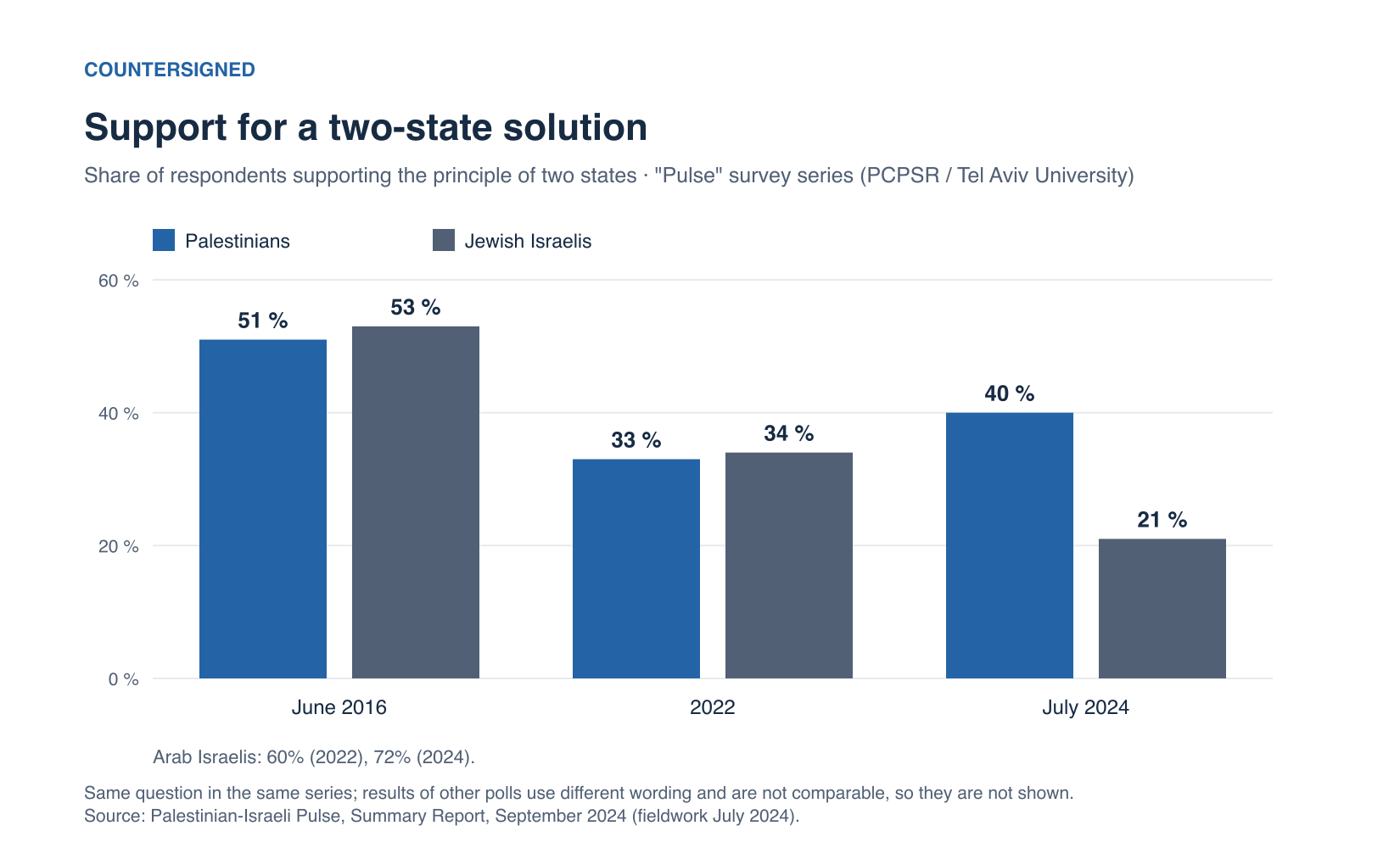
In this report’s assessment, low support for two states does not mean that a majority wants permanent war. Asked to choose between a regional war and a regional peace with two states and Arab-Israeli normalisation, 65 per cent of Palestinians and 62 per cent of Israelis chose peace in the 2024 Pulse survey (S163). Many doubt above all that a solution can still be reached: Israelis see a Palestinian state as a threat, Palestinians see the occupation as the greatest obstacle (S162; S169).
13. Why living together is so hard
The reasons follow from the history this report has traced. In this report’s assessment, five obstacles weigh particularly heavily.
Two claims to the same land. As early as 1937 the Peel Commission spoke of an “irrepressible conflict” between two national communities in one small country (section 3). Both sides tie their claim to history, religion and identity, most visibly in Jerusalem. Even at their best moments, negotiators could not agree on the Temple Mount and the Haram al-Sharif (section 7).
Fear and violence. Both societies have experienced the other side killing civilians, most recently on 7 October 2023 and in the ensuing war in Gaza (sections 8 and 9). Many Israelis see a Palestinian state as a threat to their existence, many Palestinians see the occupation as the greatest obstacle to peace (S169).
Land and settlements. Well over 700,000 Israeli citizens now live beyond the Green Line (S201). The International Crisis Group concludes that Israel is shifting the administration of the West Bank from the military to civilian agencies to establish permanent control, and that “much of the territory has, in effect, already been annexed” (S198).
The refugee question. None of the proposals so far gave refugees and their descendants access to the places their families came from, which, in the Century Foundation’s assessment, Palestinians “could not tolerate” (S201). Israel, for its part, rejects return on a large scale; its offers have always provided for only a limited or symbolic number (sections 4 and 7).
Divided and weakened leaderships. The Palestinians have been politically divided since 2007; the Palestinian Authority is in deep financial crisis, with a gap of the equivalent of €1.83 billion in 2025, according to the EU (S276). In Israel the government and important parts of the opposition reject a Palestinian state (section 11). The US think tank CSIS speaks pointedly of “failed states” on both sides and notes that the parties “can sometimes agree on a concept but can never agree on effective practical action” (S200).
14. What could come next
Forecasts in this conflict are especially uncertain. This section therefore gives no probabilities but describes four possible developments and the signs by which one can tell which is prevailing. They are not mutually exclusive.
1. Creeping annexation. The trend of recent years continues: more settlements and outposts, E1 is built, the Palestinian Authority loses further capacity to act. A Palestinian state would become practically impossible without Israel formally declaring annexation (S198). Signs: construction starting in E1, laws extending Israeli law, further growth in outposts and settler violence, insolvency of the Palestinian Authority. Right-wing Israeli ministers have also announced plans for new settlements in the Gaza Strip (S190).
2. Stabilisation of Gaza. Hamas disarmament begins, the international force deploys, Israel withdraws step by step and a Palestinian administration takes over. Chatham House sees little chance of this as long as Israel demands full disarmament before withdrawal and Hamas withdrawal before disarmament (S190). The Israeli Institute for National Security Studies (INSS) notes that there is “currently no internal alternative to Hamas in the Gaza Strip” and lists as options, besides a new Palestinian administration, prolonged Israeli military rule, continuation of the status quo and “encouraging voluntary emigration” (S206). Signs: an inventory of weapons, deployment of the force, entry of the Palestinian administrative committee, withdrawal behind agreed lines.
3. A new political process. The elections in Israel in October and in Palestine in November 2026 produce governments that resume negotiations, supported by the New York Declaration, which also envisages normalisation between Israel and the Arab states (S101). Against this stands the fact that the main Israeli opposition leaders also reject a Palestinian state (section 11), and that 64 per cent of Palestinians rate the chances of a state of their own within five years as low or non-existent (S162). Signs: election results and coalition agreements, Palestinian Authority reforms, further recognitions of Palestine, a resumption of direct talks.
4. New escalation. The conflict flares again, in Gaza, in the West Bank or across the region, as the war with Iran and Hezbollah in 2026 showed (section 9). Signs: failure of disarmament, collapse of the ceasefires with Lebanon or Iran, unrest in the West Bank.
In this report’s assessment, the signs currently visible point most strongly to the first scenario; whether Gaza can be stabilised depends on disarmament and Israeli withdrawal. Beyond these near-term developments, new models are being discussed. The initiative A Land for All and the US-based Century Foundation propose a confederation: two sovereign states living “in partnership on the same land” (S202; S201). Among Palestinians, 14 per cent currently prefer this model (S162).
Method and limits
Question and period. The report asks how the conflict arose and developed, why attempts at peace failed, who supports which side and why, what leaderships and societies want, and what may come next. It covers the period from about 1880 to the editorial cutoff of 23 September 2026.
Sources. 342 sources were registered, of which 302 could be downloaded with usable content and read locally; 199 are cited in the text. The core consists of original documents (treaties, resolutions, commission reports, court decisions), United Nations reports, historical scholarship from Israeli, Palestinian and international perspectives, analyses by think tanks of different orientations, human rights reports and polls. For events in 2026 the report also relies on press reports, which are named in each case.
Procedure. Each source was downloaded once and thereafter read only locally. Every direct quotation was checked by machine against the downloaded source text, and scanned figures against the page image. Every number in the text was matched against a register of 211 claims recording location, counter-evidence and reliability. Interpretations are attributed to their authors; where research disagrees, the report sets out the positions side by side. The same yardstick applies to violence against civilians on all sides. The report’s own assessments are marked as such; forecasts are framed as conditional scenarios without probabilities.
Limits. Some important texts were not accessible, among them Walid Khalidi’s 2005 article on the 1948 exodus, Benny Morris’s study of the historiography of Deir Yassin and tables from Israel’s Central Bureau of Statistics. Casualty figures from Gaza come from the Ministry of Health there and have not been independently verified by the United Nations. Polling in the Gaza Strip was possible only in part during the war. Many events of 2026 are so far documented only by press reports and official statements. Quotations from German, Arabic and French sources are this report’s own translations; the original wording is kept in the claim register.
How the report was made and reviewed. Research, drafting and checking were carried out by the AI system Claude (Anthropic) on behalf of and under the responsibility of Łukasz Ostrowski, the responsible editor. The report was researched and written anew, independently of earlier work on the subject; since the author knew that work, the independence is one of procedure. External specialist review is not part of Countersigned’s model. Corrections can be reported to the editors at countersigned.org/en/corrections.
Chronology
- 1882 First wave of Zionist immigration to Palestine.
- 1897 First Zionist Congress in Basel.
- 1915–1917 McMahon–Hussein correspondence, Sykes-Picot Agreement, Balfour Declaration.
- 1922 League of Nations approves the British Mandate for Palestine.
- 1929 Riots over the Western Wall; massacres in Hebron and Safed.
- 1936–1939 Arab Revolt; 1937 partition proposal of the Peel Commission.
- 1939 British White Paper limits Jewish immigration.
- 1946 Irgun bombing of the King David Hotel.
- 1947 UN partition resolution (Resolution 181).
- 1948 Deir Yassin massacre; attack on the Hadassah convoy; founding of Israel on 14 May; war with Arab states; flight and expulsion of the Palestinians (Nakba).
- 1949 Armistice agreements; UNRWA established.
- 1956 Suez war; Kafr Qasim massacre.
- 1964 PLO founded.
- 1967 Six-Day War; Israel occupies the West Bank, East Jerusalem, the Gaza Strip, Sinai and the Golan; Resolution 242.
- 1972 Attack on the Israeli Olympic team in Munich.
- 1973 October War; Resolution 338.
- 1978/1979 Camp David Accords; Egypt–Israel peace treaty.
- 1982 Lebanon war; Sabra and Shatila massacre.
- 1987 First intifada begins; 1988 Hamas charter, Palestine National Council declaration of independence.
- 1991 Madrid peace conference.
- 1993/1995 Oslo Accords; 1994 Hebron massacre; 1995 assassination of Rabin.
- 2000 Camp David summit; second intifada begins; Clinton Parameters.
- 2001 Taba talks.
- 2002 Arab Peace Initiative.
- 2005 Israel dismantles its settlements in the Gaza Strip.
- 2006/2007 Hamas election victory; takeover of the Gaza Strip.
- 2007/2008 Annapolis conference; Olmert’s offer; blockade of the Gaza Strip from 2007.
- 2013/2014 Negotiations mediated by John Kerry.
- 2014 Gaza war.
- 2020 Trump plan; Abraham Accords.
- 2023 7 October: attack by Hamas and other groups on Israel with massacres of civilians; Gaza war begins; South Africa brings a case at the ICJ.
- 2024 ICJ orders; advisory opinion on the occupation; International Criminal Court arrest warrants.
- 2025 New York Declaration; 20-point plan; ceasefire in Gaza from 10 October; Resolution 2803.
- 2026 Iran war; agreement on Hamas disarmament; E1 tender; Knesset election set for 27 October and Palestinian parliamentary election for 28 November.
Glossary
- Aliyah – Hebrew for “ascent”: Jewish immigration to Palestine or Israel.
- Balfour Declaration – British pledge of 1917 to support “a national home for the Jewish people” in Palestine.
- Fatah – leading organisation within the PLO, founded in 1959 with Yasser Arafat among its founders.
- Green Line – the 1949 armistice lines; they separate Israel from the territories it occupied in 1967.
- Hamas – Islamist movement that emerged in the first intifada, founding charter of 1988; has controlled the Gaza Strip since 2007.
- ICC – International Criminal Court in The Hague; prosecutes individuals.
- ICJ – International Court of Justice in The Hague, the UN court for disputes between states.
- Intifada – Arabic for uprising; the first 1987–1993, the second from 2000.
- Kibbutz – cooperative community in Israel.
- Knesset – Israel’s parliament.
- Likud – Israel’s main right-wing party, Netanyahu’s party.
- Mandate – a League of Nations trusteeship; for Palestine entrusted to Britain in 1922, in force 1923–1948.
- Mufti – Islamic legal scholar; the Mufti of Jerusalem was the leading Muslim religious figure in Mandate Palestine.
- Nakba – Arabic for “catastrophe”: the flight and expulsion of the Palestinians in 1948.
- Palestinian Authority (PA) – Palestinian self-government that began operating in 1994 under the Oslo Accords.
- PLO – Palestine Liberation Organization, founded in 1964; recognised by the Arab states as the sole legitimate representative of the Palestinians in 1974, and by Israel in 1993.
- Settlement, outpost – Israeli community in the occupied territories; outposts are settlements set up without government authorisation.
- UNRWA – UN Relief and Works Agency for Palestine Refugees in the Near East, established in 1949.
- Crimes against humanity – acts such as murder committed as part of a widespread or systematic attack on a civilian population.
- Genocide – acts committed with intent to destroy, in whole or in part, a national, ethnic, racial or religious group.
- West Bank – territory west of the Jordan, under Jordanian rule 1950–1967, occupied by Israel since 1967.
- Yishuv – the Jewish population of Palestine before statehood.
- Zionism – national movement seeking a Jewish homeland or state in Palestine.
Sources and exact reference points
- S001 · www.palquest.org — Basel Program (historical text) — PalQuest / Institute for Palestine Studies (1897)
- S002 · jewishvirtuallibrary.org — First Zionist Congress & Basel Program (1897) — Jewish Virtual Library (n.d.)
- S010 · openscholar.huji.ac.il — Reflections on the Ottoman Background of Proto-Zionist and Arab Encounters — Yuval Ben-Bassat / Hebrew University (n.d.)
- S017 · jwa.org — Old Yishuv: Palestine at the End of the Ottoman Period — Jewish Women’s Archive (n.d.)
- S018 · jewishvirtuallibrary.org — Immigration to Israel: The First Aliyah — Jewish Virtual Library (n.d.)
- S025 · en.wikisource.org — McMahon-Hussein Correspondence (transcription) — Wikisource (1915-1916)
- S026 · avalon.law.yale.edu — The Sykes-Picot Agreement (1916) — Avalon Project Yale (1916-05)
- S027 · avalon.law.yale.edu — The Palestine Mandate — Avalon Project Yale (League of Nations text) (1922-07-24)
- S029 · www.palquest.org — Churchill White Paper 3 June 1922 — PalQuest (Institute for Palestine Studies) (1922-06-03)
- S030 · unispal.un.org — Palestine Royal Commission (Peel) Report Cmd. 5479 — UK Government / UNISPAL (1937-07-07)
- S032 · www.palquest.org — MacDonald White Paper 17 May 1939 — PalQuest (1939-05-17)
- S035 · www.palquest.org — Report of the Anglo-American Committee of Inquiry 20 April 1946 — PalQuest (1946-04-20)
- S040 · www.un.org — UNSCOP Report to the General Assembly (A/364) Recommendations — UN Special Committee on Palestine (1947-09-03)
- S041 · avalon.law.yale.edu — General Assembly Resolution 181 (II) with recorded vote — Avalon Project Yale (1947-11-29)
- S043 · www.palquest.org — Text of Plan Dalet (Plan D) General Section 10 March 1948 — PalQuest (Khalidi translation) (1948-03-10)
- S045 · www.palestine-studies.org — Anniversary of Deir Yassin — Journal of Palestine Studies 1972 (1972)
- S047 · jewishvirtuallibrary.org — The Hadassah Convoy Massacre — Jewish Virtual Library (undated)
- S048 · israeled.org — Declaration of Establishment of State of Israel — Center for Israel Education (official text) (1948-05-14)
- S050 · en.wikisource.org — Arab League cablegram S/745 (transcription) — Wikisource (1948-05-15)
- S051 · unispal.un.org — UN Conciliation Commission for Palestine documents (A/AC.25/6 part 1) — UNCCP (1949-1961)
- S052 · www.palquest.org — UNCCP Fourth Progress Report 22 September 1949 — UNCCP (1949-09-22)
- S053 · www.un.org — Analysis of Palestine population statistics (refugees receiving UNRPR assistance) — AFSC / UNCCP (1949-1950)
- S054 · www.un.org — General Assembly Resolution 194 (III) — United Nations (1948-12-11)
- S058 · israeled.org — Gromyko speech to UN Special Session 14 May 1947 — Center for Israel Education (transcript) (1947-05-14)
- S059 · history.state.gov — Creation of Israel 1948 (Milestones) — US Office of the Historian (undated)
- S060 · www.archives.gov — Press Release Announcing U.S. Recognition of Israel — US National Archives (1948-05-14)
- S062 · www.unrwa.org — GA Resolution 302 (IV) Assistance to Palestine Refugees — UN General Assembly / UNRWA (1949-12-08)
- S064 · unispal.un.org — Security Council resolution 101 (1953) Qibya — UN (UNISPAL) (1953-11-24)
- S066 · kafr-qasim-massacre.akevot.org.il — Kafr Qasim massacre archive (trial documents) — Akevot Institute (undated)
- S067 · history.state.gov — Camp David Accords and the Arab-Israeli Peace Process (Milestones) — US Office of the Historian (undated)
- S068 · www.peaceau.org — Camp David Accords 1978 (text) — African Union PSD (hosting text) (1978)
- S069 · peacemaker.un.org — UN Security Council Resolution 242 (1967) — UN Peacemaker (1967-11-22)
- S070 · peacemaker.un.org — UN Security Council Resolution 338 (1973) — UN Peacemaker (1973-10-22)
- S071 · treaties.un.org — Egypt-Israel Treaty of Peace 1979 (UN Treaty Series) — UN Treaty Collection (1979-03-26)
- S073 · avalon.law.yale.edu — Hamas Covenant 1988 — Avalon Project Yale (1988-08-18)
- S074 · fmep.org — PNC Declaration of Independence 1988 — FMEP (PLO text) (1988-11-15)
- S075 · www.palquest.org — Palestinian Declaration of Independence (PalQuest) — PalQuest (1988-11-15)
- S076 · www.btselem.org — Fatalities in the first Intifada — B’Tselem (dataset)
- S077 · www.btselem.org — Ten Years Since the Intifada Began (report) — B’Tselem (1998-01)
- S079 · jewishvirtuallibrary.org — The Original Palestine National Charter (1964) — Jewish Virtual Library (1964)
- S080 · passia.org — PLO 60 Years Anniversary 1964-2024 — PASSIA (2024)
- S081 · merip.org — The Kahan Report: The Commission and the Evidence — MERIP (1983-06)
- S083 · history.state.gov — FRUS 1964-68 on Resolution 242 drafting — US Office of the Historian (1967)
- S084 · www.palquest.org — Letter of Invitation to the Madrid Peace Conference — US and USSR (PalQuest reproduction) (1991-10-18)
- S086 · peacemaker.un.org — Israel-PLO Mutual Recognition Letters and Speeches — UN Peacemaker (1993-09-09)
- S087 · www.palquest.org — Declaration of Principles (Oslo I) — Israel/PLO (PalQuest reproduction) (1993-09-13)
- S088 · www.nybooks.com — Camp David: The Tragedy of Errors — Malley & Agha / NYRB (2001-08-09)
- S089 · www.nybooks.com — Camp David and After—Continued — Malley Agha Morris / NYRB (2002-06-27)
- S090 · www.nybooks.com — Camp David and After: An Exchange (Reply to Barak) — Malley & Agha / NYRB (2002-06-13)
- S091 · israeled.org — The Clinton Parameters (23 December 2000) — Center for Israel Education (2000-12-23)
- S092 · www.palquest.org — Moratinos Non-Paper on the Taba Talks — EU Special Representative (PalQuest) (2001-01-27)
- S096 · www.palquest.org — Fourteenth Arab Summit: The Arab Peace Initiative — Arab League (PalQuest) (2002-03-28)
- S097 · unsco.unmissions.org — Geneva Accord consistent with Road Map - Annan — UNSCO (2003-11-05)
- S098 · trumpwhitehouse.archives.gov — Peace to Prosperity (2020 US plan) — The White House (archived) (2020-01)
- S099 · trumpwhitehouse.archives.gov — Abraham Accords Peace Agreement (Israel-UAE) — The White House (archived) (2020-09)
- S101 · press.un.org — General Assembly Endorses New York Declaration — UN Meetings Coverage (2025-09-12)
- S102 · news.un.org — GA endorses New York Declaration (UN News) — UN News (2025-09-12)
- S105 · cojs.org — Excerpts from the Shaw Commission report Cmd. 3530 — HMSO / CoJS reproduction (1930)
- S106 · www.palquest.org — Report of the Shaw Commission (PalQuest) — HMSO / PalQuest (1930)
- S107 · reliefweb.int — Report of the COI on the 2014 Gaza conflict (A/HRC/29/52) — UN HRC / ReliefWeb (2015-06-24)
- S108 · www.un.org — Detailed findings of the COI on the 2014 Gaza conflict (A/HRC/29/CRP.4) — OHCHR / UNISPAL (2015-06-22)
- S109 · www.hrw.org — Erased In A Moment: Suicide Bombing Attacks Against Israeli Civilians — Human Rights Watch (2002-10-15)
- S110 · www.yesh-din.org — Data Sheet: Law Enforcement on Israeli Civilians in the West Bank 2005-2024 — Yesh Din (2025)
- S111 · www.hrw.org — West Bank: Israel-Backed Settler Violence Drives Displacement — Human Rights Watch (2026-08-20)
- S114 · www.ohchr.org — A/80/492 advance unedited version — OHCHR (2025)
- S115 · www.ohchr.org — Israel has committed genocide in the Gaza Strip UN Commission finds — OHCHR (2025-09-16)
- S117 · www.un.org — SRSG-SVC mission report Israel and West Bank Jan-Feb 2024 — UN SRSG-SVC / UNISPAL (2024-03-04)
- S121 · press.un.org — Security Council authorizes International Stabilization Force (Resolution 2803) — UN Meetings Coverage (2025-11-17)
- S122 · www.un.org — Implementation of Res 2803: Report of the Board of Peace (S/2026/418) — UNISPAL (2026)
- S123 · www.ochaopt.org — Humanitarian Situation Report 18 September 2026 — OCHA oPt (2026-09-18)
- S125 · www.unocha.org — oPt Humanitarian Situation Report 4 September 2026 — OCHA (2026-09-04)
- S126 · www.unocha.org — Humanitarian Situation Update #355 Gaza Strip — OCHA (2026)
- S130 · www.aljazeera.com — Why Israeli tenders for E1 settlement prompted outrage — Al Jazeera (2026-08-21)
- S131 · eeas.europa.eu — EU statement by the Spokesperson on settlements in the West Bank — EEAS (2026)
- S132 · commonslibrary.parliament.uk — UK-Israel relations 2026: E1 settlement plan trade and sanctions — House of Commons Library (2026)
- S133 · www.haaretz.com — Israel’s 2026 election will take place on October 27 — Haaretz (2026-07-12)
- S134 · time.com — What to know about the Palestinian Authority’s scheduled elections — TIME (2026-07-10)
- S135 · www.cnn.com — Gaza holds first elections in 20 years (Deir al-Balah) — CNN (2026-04-25)
- S137 · www.thepresidency.gov.za — Presidency notes ICJ order of 21 May 2026 — Presidency of South Africa (2026-05-21)
- S138 · www.un.org — ICJ order fixing time-limits (Reply and Rejoinder) — UNISPAL (ICJ order) (2026)
- S140 · www.timesofisrael.com — ICC rejects Israeli appeal against arrest warrants for Netanyahu and Gallant — Times of Israel (2026)
- S141 · www.aljazeera.com — Full text of Trump’s 20-point plan — Al Jazeera (2025-09-29)
- S143 · acleddata.com — Middle East Overview April 2026 — ACLED (2026-04)
- S144 · acleddata.com — Middle East Special Issue March 2026 — ACLED (2026-03)
- S145 · www.congress.gov — U.S. Foreign Aid to Israel: Overview and Developments since October 7 2023 — Congressional Research Service (2025-05-28)
- S148 · www.sipri.org — SIPRI Fact Sheet Trends in International Arms Transfers 2025 — SIPRI (2026-03)
- S150 · dserver.bundestag.de — Bundestag Drucksache 20/14661 (Rüstungsexporte 2024) — Deutscher Bundestag (2025-01-24)
- S151 · dserver.bundestag.de — Bundestag Drucksache 21/284 (Rüstungsexporte) — Deutscher Bundestag (2025-05-26)
- S153 · commonslibrary.parliament.uk — UK arms exports to Israel (Commons Library briefing CBP-9964) — House of Commons Library (2024-2025)
- S155 · www.unrwa.org — UNRWA 2024 Top 20 donor ranking — UNRWA (2024)
- S158 · www.state.gov — Country Reports on Terrorism 2024 — US Department of State (2026-06)
- S160 · news.un.org — Russia and China veto US ceasefire resolution (March 2024) — UN News (2024-03-22)
- S162 · www.pcpsr.org — Public Opinion Poll No (97) Press Release — PCPSR (2026-08)
- S163 · pcpsr.org — The Palestine/Israel Pulse, a Joint Poll: Press Release (survey of July 2024) — PCPSR / Tel Aviv University (undated)
- S164 · pcpsr.org — Palestinian-Israeli Pulse Summary Report (September 2024) — PCPSR / Tel Aviv University (2024-09-12)
- S169 · www.pewresearch.org — Many Israelis and Palestinians Say They Cannot Coexist Peacefully — Pew Research Center (2026-09-15)
- S170 · www.pewresearch.org — Pew coexistence report 2026 (PDF) — Pew Research Center (2026-09-15)
- S172 · www.pewresearch.org — Israeli Public Is Increasingly Skeptical About Lasting Peace — Pew Research Center (2025-06-03)
- S175 · pcpsr.org — Arab Barometer 9 in Palestine (second report) — Arab Barometer / PCPSR (2025-2026)
- S177 · www.pcpsr.org — Index PSR Polls — PCPSR (ongoing)
- S178 · www.palquest.org — Hamas Document of General Principles and Policies 2017 — Hamas (PalQuest archive) (2017-05-01)
- S180 · www.timesofisrael.com — Full text of Mahmoud Abbas’s speech to the UN General Assembly (2025) — Times of Israel (transcript) (2025-09-25)
- S181 · www.un.org — UNGA80 General Debate press release 25 September 2025 — UNISPAL (2025-09-25)
- S182 · www.timesofisrael.com — Full text of Abbas speech at two-state summit (Hamas must hand arms to PA) — Times of Israel (2025)
- S183 · www.timesofisrael.com — The new coalition’s policy guidelines (December 2022) — Times of Israel (2022-12)
- S185 · www.timesofisrael.com — Knesset votes overwhelmingly against Palestinian statehood (July 2024) — Times of Israel (2024-07-18)
- S186 · www.haaretz.com — Netanyahu rivals reject Palestinian statehood (2026) — Haaretz (2026-07-27)
- S187 · www.middleeasteye.net — Bennett rejects two-state solution as Eisenkot surges — Middle East Eye (2026)
- S188 · www.aljazeera.com — Hamas announces dissolution of Gaza governing body — Al Jazeera (2026-07-06)
- S189 · www.aljazeera.com — Gaza Board of Peace announces Hamas disarmament agreement — Al Jazeera (2026-07-31)
- S190 · www.chathamhouse.org — By agreeing to disarm Hamas is trying to call Israel’s bluff — Chatham House (2026-08)
- S197 · www.unrwa.org — Who is UNRWA mandated to serve? — UNRWA (undated)
- S198 · www.crisisgroup.org — Sovereignty in All but Name: Israel’s Quickening Annexation (Report 252) — International Crisis Group (2025-10)
- S199 · www.crisisgroup.org — Toward a Stronger European Stand on Israel-Palestine — International Crisis Group (2025-01-30)
- S200 · www.csis.org — Israel and the Palestinians: From the Two-State Solution to Five Failed States — CSIS (2021-05-26)
- S201 · tcf.org — Two States Together: An Alternative Vision — The Century Foundation (2025-01-27)
- S202 · alandforall.us — A Land for All: Two States One Homeland — A Land for All (undated)
- S206 · www.inss.org.il — Strategic Alternatives for the Gaza Strip — INSS (2026-04-10)
- S209 · jewishvirtuallibrary.org — First Lebanon War: The Kahan Commission of Inquiry — Jewish Virtual Library (1983)
- S210 · www.jadaliyya.com — Archive Documents: The Kahan Commission and the 1982 Sabra-Shatila Massacre — Jadaliyya (2019)
- S212 · catalog.archives.gov.il — Chapter 3: The Massacre in Hebron and its Aftermath — Israel State Archives (undated)
- S213 · www.jta.org — Hebron massacre inquiry exonerates government and IDF; blames Goldstein only — Jewish Telegraphic Agency (1994)
- S215 · www.npr.org — 50 years ago Munich Olympics massacre changed how we think about terrorism — NPR (2022-09-04)
- S216 · digitalcommons.oberlin.edu — Re-visiting the Arab Revolt of 1936-1939 in Palestine (honors thesis) — Oberlin College (2016)
- S222 · www.jewishvoiceforpeace.org — The Forgotten Refugees: causes of the post-1948 Jewish exodus from Arab countries — Philip Mendes (Australian Journal of Jewish Studies; reposted by JVP) (2002)
- S223 · jewishvirtuallibrary.org — Fact Sheet: Jewish Refugees from Arab Countries — Jewish Virtual Library (undated)
- S224 · peacenow.org.il — West Bank Settlements: Facts and Figures — Peace Now (current)
- S225 · peacenow.org.il — Settlement population (Settlements Watch) — Peace Now (current)
- S228 · www.btselem.org — 10 years to the second Intifada: summary of data — B’Tselem (2010-09-27)
- S230 · www.palestine-studies.org — The Camp David Papers — Akram Hanieh / Journal of Palestine Studies (2001-01)
- S231 · webhome.weizmann.ac.il — Interview with Shlomo Ben-Ami — Shlomo Ben-Ami (2001-09-14)
- S233 · www.un.org — Annapolis understanding (UNISPAL copy) — UNISPAL (2007-11-27)
- S234 · www.timesofisrael.com — Abbas admits he rejected 2008 peace offer from Olmert — Times of Israel (2015-11-19)
- S235 · www.timesofisrael.com — Abbas never said no to 2008 peace deal says Olmert — Times of Israel (quoting Olmert) (2021-06-25)
- S236 · www.aljazeera.com — The napkin map revealed (Palestine Papers) — Al Jazeera (2011-01-23)
- S237 · peacemaker.un.org — A Performance-based Road Map (2003) — UN Peacemaker (2003-04-30)
- S240 · www.jewishvirtuallibrary.org — The Geneva Accord (October 2003) — Jewish Virtual Library (2003-10)
- S247 · www.icc-cpi.int — ICC Pre-Trial Chamber I issues warrants for Netanyahu and Gallant — International Criminal Court (2024-11-21)
- S249 · www.icc-cpi.int — ICC Appeals Chamber record on Israel’s appeals (October 2025) — International Criminal Court (2025-10-17)
- S250 · www.jpost.com — PMO slams ICC after court partially rejects Israeli appeal — Jerusalem Post (2026)
- S251 · unwatch.org — UN Watch rebuttal to the September 2025 Commission of Inquiry report — UN Watch (advocacy) (2025-09)
- S257 · www.hrw.org — I Can’t Erase All the Blood from My Mind: Palestinian armed groups’ October 7 assault on Israel — Human Rights Watch (2024-07-17)
- S258 · www.amnesty.org — Amnesty concludes Israel is committing genocide against Palestinians in Gaza — Amnesty International (2024-12-05)
- S259 · www.malaymail.com — Israel rejects Amnesty report as entirely false — Malay Mail (wire) (2024-12-05)
- S260 · www.ochaopt.org — Reported impact snapshot Gaza Strip 9 September 2026 — OCHA oPt (2026-09-09)
- S263 · www.longwarjournal.org — Board of Peace announces Hamas disarmament agreement (Long War Journal) — FDD Long War Journal (2026-07-31)
- S265 · www.state.gov — Ten-day cessation of hostilities between Israel and Lebanon — US Department of State (2026-04)
- S266 · www.cnbc.com — Israel and Lebanon reach framework agreement — CNBC (2026-06-26)
- S267 · www.aljazeera.com — Israel and Lebanon agree to conditional ceasefire — Al Jazeera (2026-06-04)
- S268 · www.elections.ps — CEC announces legal periods for the 2026 legislative elections — Central Elections Commission Palestine (2026-07-23)
- S269 · www.elections.ps — CEC announces results of the 2026 local elections — Central Elections Commission Palestine (2026)
- S270 · www.aljazeera.com — Knesset dissolves: how will Israel vote in October’s general election? — Al Jazeera (2026-07-17)
- S273 · north-africa-middle-east-gulf.ec.europa.eu — Commission announces multiannual programme for Palestinian recovery and resilience (EUR 1.6 billion) — European Commission (2025-04-14)
- S274 · enlargement.ec.europa.eu — Commission and PA agree emergency financial support (2024) — European Commission (2024-07-19)
- S276 · north-africa-middle-east-gulf.ec.europa.eu — Annex I Action Document 2026 EU Palestine programme — European Commission (2026)
- S282 · home.treasury.gov — Following Terrorist Attack on Israel, Treasury Sanctions Hamas Operatives and Financial Facilitators — US Treasury (2023-10-18)
- S286 · home.treasury.gov — Treasury Targets Significant International Hamas Fundraising Network — US Treasury (2024-10-07)
- S290 · www.aljazeera.com — Why does Qatar host Hamas’s political office? — Al Jazeera (2025-09-09)
- S291 · www.timesofisrael.com — Qatar says its aid did not fund Hamas and if it did Israel is responsible — Times of Israel (2026-09-22)
- S292 · www.un.org — South Africa institutes proceedings against Israel (ICJ press release) — ICJ / UNISPAL (2023-12-29)
- S294 · digitallibrary.un.org — A/RES/67/19 (2012) — UN General Assembly (2012-12-04)
- S295 · news.un.org — United States vetoes Gaza ceasefire resolution (November 2024) — UN News (2024-11-20)
- S296 · press.un.org — Veto of ceasefire resolution: speakers tell General Assembly — UN Meetings Coverage (2024)
- S299 · www.haaretz.com — With Gantz’s backing Knesset passes resolution opposing Palestinian statehood — Haaretz (2024-07-18)
- S300 · peacemaker.un.org — Interim Agreement (Oslo II) 1995 full text PDF — UN Peacemaker (1995-09-28)
- S302 · avalon.law.yale.edu — Balfour Declaration 1917 (text) — Avalon Project Yale (1917-11-02)
- S303 · avalon.law.yale.edu — Egyptian-Israeli General Armistice Agreement 1949 — Avalon Project Yale (1949-02-24)
- S304 · avalon.law.yale.edu — Lebanese-Israeli General Armistice Agreement 1949 — Avalon Project Yale (1949-03-23)
- S305 · avalon.law.yale.edu — Jordanian-Israeli General Armistice Agreement 1949 — Avalon Project Yale (1949-04-03)
- S306 · avalon.law.yale.edu — Israeli-Syrian General Armistice Agreement 1949 — Avalon Project Yale (1949-07-20)
- S313 · www.un.org — ICJ Advisory Opinion 19 July 2024 full text (UNISPAL-hosted ICJ PDF) — International Court of Justice (hosted by UNISPAL) (2024-07-19)
- S314 · www.un.org — ICJ Order 26 January 2024 South Africa v. Israel (UNISPAL-hosted ICJ PDF) — International Court of Justice (hosted by UNISPAL) (2024-01-26)
- S315 · www.un.org — ICJ Order 24 May 2024 South Africa v. Israel (UNISPAL-hosted ICJ PDF) — International Court of Justice (hosted by UNISPAL) (2024-05-24)
- S316 · www.gutenberg.org — Der Judenstaat: Versuch einer modernen Lösung der Judenfrage (full German text) — Theodor Herzl / Project Gutenberg eBook 28865 (1896)
- S317 · research-repository.st-andrews.ac.uk — The bombing of the King David Hotel July 1946 (author accepted manuscript) — Bruce Hoffman / Small Wars & Insurgencies 31(3) (AAM via St Andrews repository) (2020)
- S318 · www.sciencespo.fr — The Historiography of the 1948 Wars — Sciences Po Mass Violence and Resistance Research Network (2008)
- S319 · press.umich.edu — The Debate about 1948 (chapter in Making Israel) — Avi Shlaim / University of Michigan Press (undated)
- S320 · press.umich.edu — A Palestinian Look at the New Historians and Post-Zionism (chapter in Making Israel) — Mustafa Kabha / University of Michigan Press (undated)
- S321 · www.meforum.org — Rewriting Israel’s History — Efraim Karsh / Middle East Quarterly (1996-06)
- S322 · newleftreview.org — On Ethnic Cleansing (interview) — Benny Morris / New Left Review 26 (2004-03)
- S323 · www.meforum.org — Benny Morris: The 1948 War Was an Islamic Holy War (interview) — Middle East Quarterly (Morris interview) (2010-06)
- S325 · www.palquest.org — The Deir Yasin Massacre, 9 April 1948 — PalQuest / Institute for Palestine Studies (undated)
- S326 · www.zochrot.org — Deir Yassin massacre: 68th anniversary this Saturday — Zochrot (unknown (c. 2016))
- S327 · www.un.org — The Origins and Evolution of the Palestine Problem, Part I: 1917-1947 — United Nations (prepared for the Committee on the Exercise of the Inalienable Rights of the Palestinian People) (1978 (web edition))
- S328 · www.un.org — The Origins and Evolution of the Palestine Problem, Part II: 1947-1977 — United Nations (prepared for the Committee on the Exercise of the Inalienable Rights of the Palestinian People) (1979 (web edition))
- S329 · history.state.gov — The Suez Crisis, 1956 (Milestones) — US Department of State, Office of the Historian (undated)
- S330 · history.state.gov — The 1967 Arab-Israeli War (Milestones) — US Department of State, Office of the Historian (undated)
- S331 · history.state.gov — The 1973 Arab-Israeli War (Milestones) — US Department of State, Office of the Historian (undated)
- S332 · history.state.gov — The Oslo Accords and the Arab-Israeli Peace Process (Milestones 1993-2000) — US Department of State, Office of the Historian (undated)
- S333 · 2009-2017.state.gov — Remarks on Middle East Peace (Secretary Kerry, 28 December 2016) — John Kerry / US Department of State (archived) (2016-12-28)
- S334 · www.un.org — Security Council resolution 1566 (2004) full text (S/RES/1566) — UN Security Council (2004-10-08)
- S335 · www.un.org — Detailed findings on attacks carried out on and after 7 October 2023 in Israel (A/HRC/56/CRP.3) — UN Independent International Commission of Inquiry on the OPT and Israel (2024-06-10)
- S336 · www.un.org — Detailed findings on the military operations and attacks carried out in the Occupied Palestinian Territory from 7 October to 31 December 2023 (A/HRC/56/CRP.4) — UN Independent International Commission of Inquiry on the OPT and Israel (2024-06-10)
- S337 · www.bundesregierung.de — Rede von Bundeskanzlerin Dr. Angela Merkel vor der Knesset (Bulletin, 18. März 2008) — Presse- und Informationsamt der Bundesregierung (2008-03-18)
- S338 · www.bundesregierung.de — Bundeskanzler Friedrich Merz erklärt zur Entwicklung in Gaza — Presse- und Informationsamt der Bundesregierung (2025-08-08)
- S339 · www.bundesregierung.de — Regierungspressekonferenz vom 17. November 2025 — Presse- und Informationsamt der Bundesregierung (2025-11-17)
- S340 · www.timesofisrael.com — Responding to ‘false’ ICJ ruling, PM says Jewish people can’t be occupiers in their own land — Times of Israel (quoting PMO) (2024-07-19)
- S341 · www.un.org — Israel categorically rejects the libelous rant published today by the Commission of Inquiry (non-UN document) — Israel Ministry of Foreign Affairs (via UNISPAL) (2025-09-16)
- S342 · www.un.org — Attacks on West Bank village Qibya, Gaza Bureij camp – UNTSO report (Bennike) — UNTSO Chief of Staff Vagn Bennike (via UNISPAL) (1953)