Key findings
- The occasion. After the AfD won 43.8 per cent in Saxony-Anhalt and 38.2 per cent (preliminary) in Mecklenburg-Western Pomerania in September 2026, calls for a ban grew louder, above all from the SPD, the Greens and the Left; the CDU/CSU leadership remains sceptical. As of 10 October 2026 no application has been filed, and the interior ministers are waiting for the Cologne administrative court to rule on the party’s classification (section 1).
- The party. Founded in 2013 as a euro-critical party, the AfD turned to migration, Islam and national identity after 2015. Its programmes adopted “remigration” and returned to a categorical rejection of Islam, but are framed within constitutional law; the Cologne court, in an interim order, found two demands — bans on minarets and on headscarves in public institutions — openly discriminatory and not compatible with the guarantee of human dignity (sections 2, 3 and 5).
- Money. In 2024 the party took in 36.3 million euros: 35 per cent from the state, 21 per cent from individual donors, 16 per cent from membership fees. It has been penalised twice for donations of unclear origin (one penalty not final); other cases, including a 2025 donation of 2.35 million euros withheld by the Bundestag administration, are unresolved. No source examined documents financing by a foreign state (section 4).
- The allegations. The courts have confirmed with final effect that the AfD may be observed as a suspected right-wing extremist case; the Münster court found even a “strong suspicion” of efforts against the human dignity of Muslim migrants. The intelligence service’s 2025 classification of the whole party as confirmed extremist was halted in February 2026: the Cologne court found anti-constitutional efforts established within the party, but not that they shape it as a whole. Several state associations are classified as confirmed extremist (section 5).
- The legal test. A ban requires that a party pursue aims against human dignity, democracy or the rule of law in a planned way and have the potential to succeed. The AfD clearly has that potential, which the NPD lacked in 2017. Whether its aims violate human dignity and democracy is contested; on the rule of law the intelligence service and the main pro-ban study found the evidence insufficient, and no court has decided the question. The decisive open question is whether the statements of leading officials represent the party’s real aims (sections 6 and 7).
- Comparison. The programmes of the KPD (banned 1956) and the NPD stated their anti-constitutional aims; the AfD’s programme does not, so in this sense it is not “as openly” unconstitutional. But the SRP (banned 1952) also had a vague programme, and the Court read its true aims from its functionaries’ statements — the kind of evidence now at issue for the AfD, which is moreover far more powerful than the NPD (section 8).
- Outlook. This report assesses it as very unlikely (15 per cent) that an application against the AfD or a part of it will be filed by the end of 2027, and extremely unlikely (3 per cent) that the Federal Constitutional Court will ban it by the end of 2029; evidence confidence is moderate. A ban limited to the state associations classified as extremist has the strongest evidential basis but no precedent (section 7).
- Foreign ties. The record shows shared positions with Moscow, many contacts, and investigations of two AfD politicians over alleged Russian and Chinese payments, without any reported charge in these investigations; a former aide of one of them was convicted of spying for China. Support from Elon Musk and from members of the Trump administration has been open and verbal (section 9).
- Why the established parties are alarmed. Both explanations — defence of institutions and fear of a competitor — have some support, and the evidence does not clearly discriminate between them. Measurable stakes include blocking minorities in four state parliaments and a possible AfD-led state government (section 10).
Method and review. Evidence cutoff: 10 October 2026. Some 390 sources were registered and about 315 downloaded and analysed locally, chiefly court decisions, statutes, intelligence-service reports, party programmes and accounts, parliamentary papers, legal studies and press reports. Every quotation and figure was checked against the stored source text. The report is not a legal opinion. The publisher approved this edition on 11 October 2026; external specialist review is not part of the Countersigned model. Details: “Method and evidence limits”.
1. Why the ban debate has returned
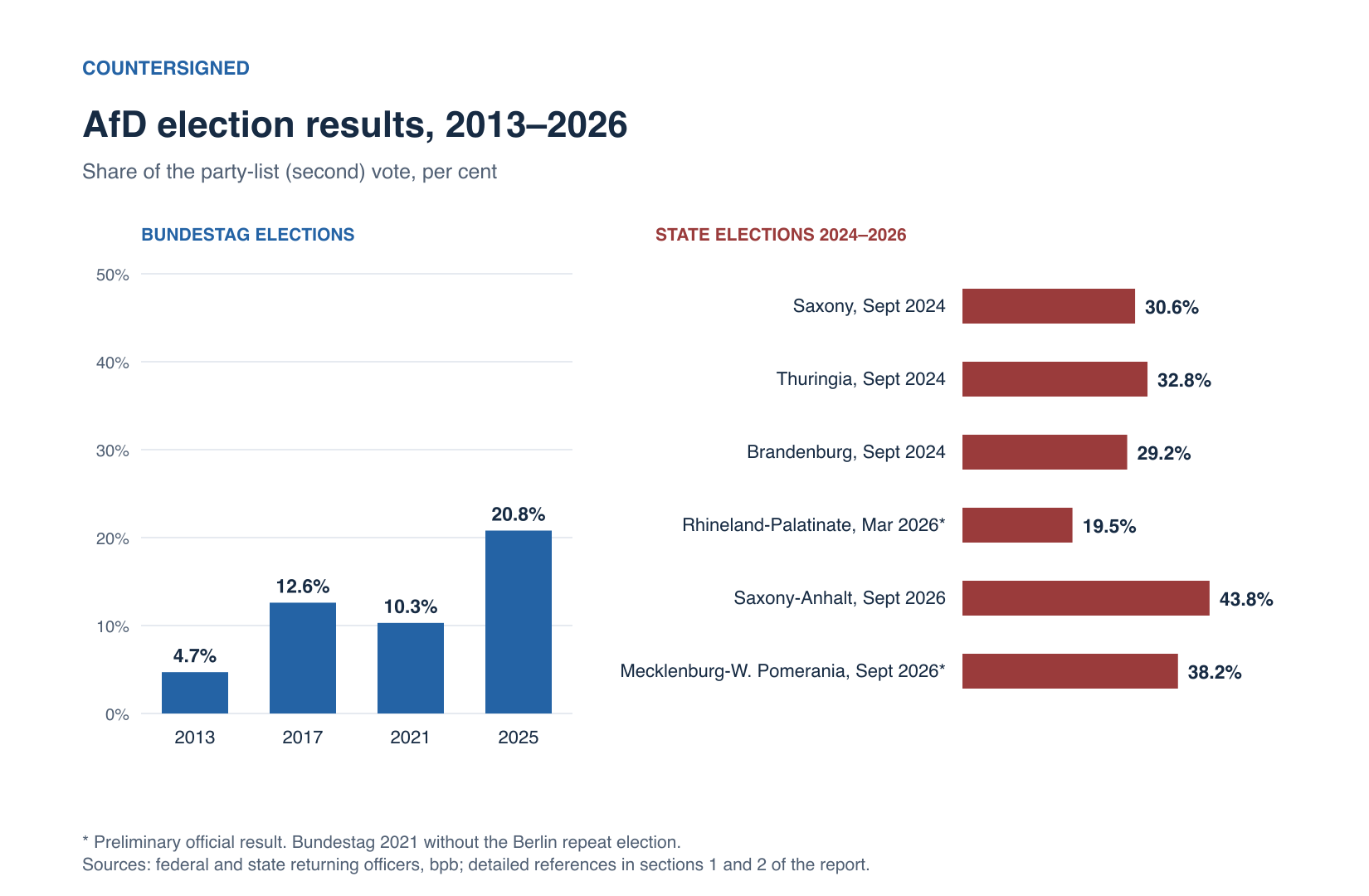
On 6 September 2026 the Alternative für Deutschland (AfD) won 43.8 per cent of the party-list votes in Saxony-Anhalt, more than twice its 2021 result, and 39 of 83 seats — three short of an absolute majority. The CDU, which had led the state government, fell from 37.1 to 17.2 per cent; turnout, at 77.8 per cent, was the highest in any free election to the state parliament (S260; S389; S034). Two weeks later the AfD came first in Mecklenburg-Western Pomerania with 38.2 per cent, according to the preliminary official result, while the CDU, with 4.89 per cent, failed for the first time in the history of the Federal Republic to enter a state parliament (S312; S315). Nationally, the AfD led the CDU/CSU by 27 to 21 per cent in the ARD DeutschlandTrend poll of September (S235). On 6 October the parliament in Magdeburg elected Tobias Rausch the first AfD president of a German state parliament, with 48 votes — nine of them, according to press reports, from outside his own group (S309; S310).
The renewed demands
On election night about 2,500 people demonstrated in Frankfurt am Main, according to the police, for a ban procedure to be examined (S387). The next day the CDU Minister-President of North Rhine-Westphalia, Hendrik Wüst, proposed a working group of the federal and state governments, with the domestic intelligence service and constitutional lawyers, to examine “with an open mind” how to deal with the AfD under the constitution; a ban, he said, could only be “the last resort” (S286). The AfD co-leader Alice Weidel called the proposal “the desperate attempt to distract from the failure of the Union” (S286). The demands did not begin with the election: on 28 August Defence Minister Boris Pistorius (SPD) and Baden-Württemberg’s Minister-President Cem Özdemir (Greens) had called for a procedure “as soon as possible”, focused on the “clearly völkisch” — ethnic-nationalist — state associations of the AfD in Thuringia, Saxony, Saxony-Anhalt and Brandenburg (S257). In September the SPD chair, Vice-Chancellor Lars Klingbeil, said that “it is the right time” for an examination, and the SPD’s parliamentary leaders at federal, state and European level called its preparation “our democratic duty” (S264).
Others remain sceptical. Chancellor Friedrich Merz (CDU) called the hurdle “very high” and doubted that a ban would solve the problems voters see; the CSU leader Markus Söder called a ban “hardly enforceable” under constitutional law (S256; S286). The interior ministers of the federal government and the states have agreed to wait for the final decision of the Cologne administrative court on the intelligence service’s classification of the AfD (section 5) (S286). As of early October 2026 none of the three bodies entitled to apply — the Bundestag, the Bundesrat and the federal government — had filed an application with the Federal Constitutional Court (S351; S264). Two days after the Saxony-Anhalt election, US President Donald Trump wrote that the populist party in Germany had just had a really big night, and two members of the US Congress advised against a ban (section 9) (S205; S204).
What this report examines
The report asks whether the accusations made against the AfD in the ban debate are supported by evidence and whether they could succeed under Article 21 of the Basic Law (Grundgesetz), Germany’s constitution. It describes the evidence available on 10 October 2026; it is not a legal opinion and does not recommend whether an application should be filed.
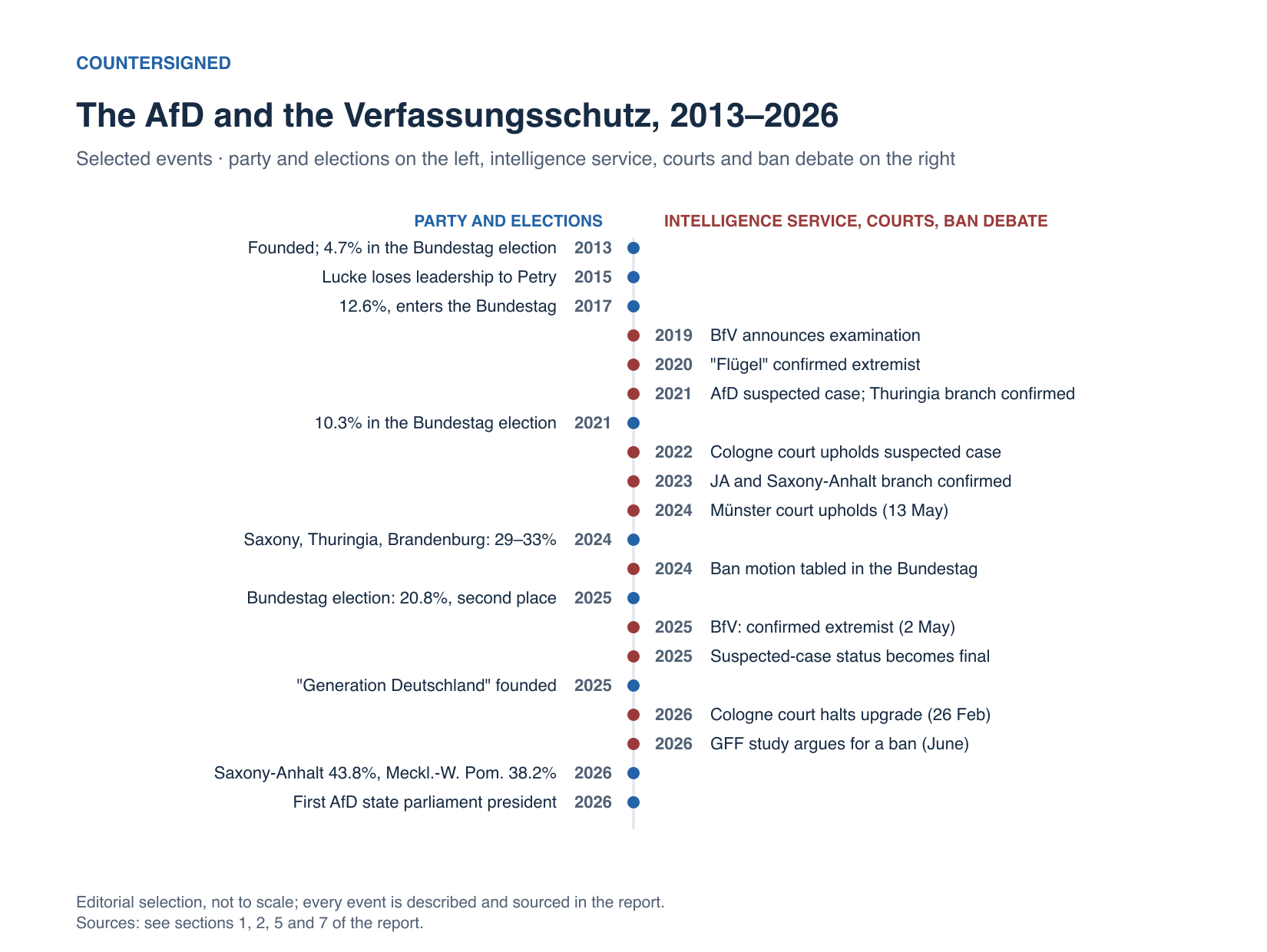
2. History 2013–2026: from a euro-critical protest party to the strongest force in two eastern states
Founding and the first split (2013–2015)
The AfD grew out of the “Wahlalternative 2013”, launched in September 2012 by Bernd Lucke, Konrad Adam, Alexander Gauland and others. The party was officially founded on 6 February 2013; its founding congress in Berlin on 13 April 2013 elected Lucke, Adam and Frauke Petry as equal spokespersons, and by May it had about 10,000 members and associations in all 16 states (S001). Its core issue was opposition to the rescue policy for the euro; political scientists at first classified it as liberal-conservative and “euro-critical” rather than right-wing populist (S001). In the Bundestag election of September 2013 it narrowly failed, with 4.7 per cent of the second votes (the votes for party lists that determine the distribution of seats) (S003). In the European election of 2014 it won 7.1 per cent and seven seats (S001).
The party’s direction changed in its first years. At the Essen congress in July 2015 Lucke lost the leadership election to Petry; by the end of August about a fifth of the then 21,000 members had left, among them Lucke and most of the economic-liberal wing (S001).
Entry into the Bundestag and the “Flügel” (2016–2021)
In 2016 the AfD won between 12.6 and 24.3 per cent in five state elections, its best result in Saxony-Anhalt (S001). In the Bundestag election of September 2017 it received 12.6 per cent and 94 seats, became the third-strongest party and, after the renewal of the grand coalition, formally led the opposition (S004; S001). Petry, who had lost the internal contest for the lead candidacy to Weidel and Gauland, left the party and its parliamentary group immediately after the election (S001).
The decisive internal conflict of these years concerned the “Flügel” (“wing”), the organisational network of the party’s völkisch-nationalist current led by Björn Höcke, the Thuringian party leader, and Andreas Kalbitz, the Brandenburg leader (S001). After the Verfassungsschutz declared the Flügel a confirmed right-wing extremist effort in March 2020, party leader Jörg Meuthen pushed for its formal dissolution; on 15 May 2020 the federal executive annulled Kalbitz’s membership by seven votes to five with one abstention, on the grounds that he had concealed his earlier membership of the right-wing extremist youth organisation HDJ, since banned (S001; S038). The daily taz observed that the formally dissolved Flügel had become more powerful within the party (S039). In the 2021 Bundestag election the AfD fell to 10.3 per cent (10.4 per cent after the partial repeat election in Berlin) and 83 seats (S005; S006). Meuthen left the party at the end of January 2022; according to the political scientist Frank Decker, the radical forces then finally gained the upper hand, and Tino Chrupalla and Alice Weidel have led the party and the Bundestag group together since 2022 (S001).
Radicalisation, scandals and electoral growth (2022–2025)
In January 2024 the investigative newsroom Correctiv reported on a meeting near Potsdam in November 2023 at which AfD politicians and representatives of the extreme right had discussed plans for the “remigration” of millions of people; a wave of protests followed (section 11 discusses the dispute over the report) (S338; S001). In May 2024 the AfD’s lead candidate for the European election, Maximilian Krah, told the Italian daily La Repubblica: “I will never say that everyone who wore an SS uniform was automatically a criminal”; the party barred him from campaign appearances, and the right-wing Identity and Democracy group in the European Parliament expelled all AfD members (S036). In the same month the Halle regional court convicted Höcke of using a slogan of Hitler’s stormtroopers (SA), “Alles für Deutschland”; a second conviction for using it again in December 2023 followed, and both became final in 2025 (S346; S344; S345).
None of this stopped the party’s growth. It won 15.9 per cent in the 2024 European election, its best result at the national level at that time (S008; S001). In September 2024 it achieved record results in the state elections in Saxony (30.6 per cent), Thuringia (32.8 per cent) and Brandenburg (29.2 per cent); in Thuringia it became the strongest party for the first time in any state or federal election, and in Thuringia and Brandenburg it gained a blocking minority of more than a third of the seats (S001). In January 2025 the Riesa congress nominated Weidel as the party’s first candidate for chancellor (S032) and decided to replace the Junge Alternative, then classified as extremist, with a youth organisation integrated into the party; the JA dissolved itself as of 31 March 2025 (S030). In the early Bundestag election of 23 February 2025 the AfD doubled its result to 20.8 per cent and 152 of 630 seats, and became the second-strongest party behind the CDU/CSU (S007; S320). The successor youth organisation, “Generation Deutschland”, was founded in Giessen on 29 November 2025 under the Brandenburg state MP Jean-Pascal Hohm, while more than 25,000 people protested outside (S347).
2026: first place in the polls and in the east
Membership grew to 51,319 by the end of 2024 according to the party’s statement of accounts, and to 70,000 in 2025 according to the party (S324; S120). In March 2026 the AfD came third in Rhineland-Palatinate with 19.5 per cent, more than doubling its 2021 share (S319). In April 2026 it moved ahead of the CDU/CSU in the Politbarometer poll of the Forschungsgruppe Wahlen for the first time (S236). In September it won the state elections in Saxony-Anhalt and Mecklenburg-Western Pomerania, and in October an AfD politician became president of a state parliament for the first time (section 1).
3. The programme and how it changed
A party’s programme is only one source of its aims; the courts also weigh the statements of its leaders (sections 5 and 6). The programmes nevertheless show how the AfD’s priorities moved: from the euro to migration, Islam and national identity. This section relies on the original texts of the 2021 Bundestag programme, the 2024 European programme and the 2026 Saxony-Anhalt government programme. The 2013, 2016, 2017, 2019 and 2025 programmes could not be retrieved in the original and are described from quotations in studies, court decisions and news reports.
Europe and the euro
According to material of the Left-affiliated Rosa Luxemburg Foundation, the 2013 programme demanded an “orderly dissolution of the euro area” and the reintroduction of national currencies, and in 2014 the AfD wanted to reduce the EU to a single market in a “union of free, sovereign states” (S041; S042). The 2016 Grundsatzprogramm (basic programme) called for the EU to be replaced by an economic community on the model of its forerunner, the EEC, and the “euro experiment” to be “ended in an orderly way”; Decker finds its wording “markedly more radical” than in 2013/14 (S046; S047). The 2019 European programme considered an exit “necessary” if reforms failed “within a reasonable time” (S050), and the 2021 Bundestag programme demanded it outright: “We consider an exit of Germany from the European Union … necessary”, together with leaving the euro (S051). The 2024 European programme calls the EU “not reformable” and seeks a new “Bund europäischer Nationen” (union of European nations), to be approved by referendum, and the abolition of the European Parliament; the earlier “orderly dissolution” wording and the exit demand were dropped at the Magdeburg assembly (S056; S057). According to Decker, the 2025 programme retains only the aim of refounding the EU as such a union (S047).
Migration and “remigration”
The meaning of “remigration” in the AfD’s programmes has shifted. In 2021 the term appeared as a “Remigrationsagenda” defined as protection in regions of origin and transit, alongside a “deportation offensive” for people obliged to leave (S051). The 2024 European programme demanded that asylum seekers return once peace prevails in most of their home country, and called for “remigration programmes” (S056). At the Riesa congress in January 2025 delegates added “remigration” as a goal to the Bundestag programme; the federal executive’s draft had not contained the term. According to AFP, the passage defines it as the deportation of people obliged to leave, the return of refugees when the reason for flight ends, and the return of offenders and “Gefährder” (people considered a security threat) (S062). Weidel, demanding “returns on a large scale”, told the congress: “if it is to be called remigration, then it is called remigration” (S063). The 2026 Saxony-Anhalt programme declares an “Abschiebe- und Remigrationsoffensive” (deportation and remigration offensive) “imperative”, with a state commissioner for remigration; it defines remigration as bringing back emigrated German skilled workers, deporting foreigners obliged to leave and voluntary return programmes for “illegal immigrants”, and states that this policy is lawful (S059).
None of the programme texts examined calls for the removal of German citizens. The political scientist Frank Decker notes that demands for the “remigration” of citizens with a migrant background are not found in the official programmes but can be shown from public statements of important officials (S047). In November 2024 the Bavarian state party adopted a resolution setting the “state goal of a comprehensive remigration in the millions” and calling for ways to withdraw citizenship already granted more easily (S239). How such statements relate to the programme is at the centre of the court disputes (section 5).
Islam
According to a study for the Green-affiliated Heinrich Böll Foundation, the 2016 Grundsatzprogramm stated “Islam does not belong to Germany” and rejected the minaret as an “Islamic symbol of domination” and the muezzin’s call (S046). The 2021 programme was more conditional: Muslims “who integrate and recognise our basic order and fundamental rights are valued members of our society”, while Islam is incompatible with the free democratic basic order “insofar as” it claims sole validity and seeks to impose sharia; it still declared minaret and muezzin call “not compatible” with a tolerant coexistence of religions and sought to ban the headscarf in the public service and in schools (S051). The 2024 European programme speaks of “fundamentalist Islam” (S056). The 2025 programme, according to the Cologne court, demands a ban on building minarets under the heading “We oppose any further spread of Islam” and a headscarf ban in public institutions — the two demands the court found to violate the dignity of Muslims (S361). The 2026 Saxony-Anhalt programme returns to the unconditional formula: “Islam belongs neither to Germany nor to Saxony-Anhalt” (S059).
People and citizenship
Since at least 2017 the programmes have demanded a return to the principle of descent (ius sanguinis) that governed German citizenship law until 2000 and the abolition of acquisition by birth in Germany; the 2021 programme added that there should no longer be any entitlement to naturalisation (S050; S051). The 2026 Saxony-Anhalt programme repeats this, adds that “anyone who seriously wants to can become German”, and ties a proposed “baby welcome payment” of 2,000 euros to at least one parent holding German citizenship (S059). Whether such demands are a lawful policy choice or part of an exclusionary concept of the people is precisely what the courts have weighed differently (sections 5 and 7).
Russia, energy and climate
Before Russia’s full-scale invasion, the 2021 programme called NATO membership “for the time being” central to German security, demanded the lifting of EU sanctions against Russia and called Nord Stream 2 “indispensable” (S051). After the invasion the 2024 European programme acknowledged that it “has caused much suffering” but demanded “the immediate lifting of economic sanctions against Russia” and the repair of the Nord Stream pipelines, and rejected arms deliveries to war zones (S056). The 2026 Saxony-Anhalt programme seeks a Bundesrat initiative to lift the Russia sanctions (S059). On climate, the 2021 programme stated that it “has not been proven” that humans are mainly responsible for climate change and called for leaving the Paris Agreement; the 2024 programme calls climate policy an “eco-socialist project” (S051; S056).
Economy
Analysts disagree on the economic profile. The business-funded German Economic Institute (IW) found in 2023 that the party had “largely remained true” to its liberal economic programme; a study for the SPD-affiliated Friedrich Ebert Foundation placed its 2021 programme at the most right-wing position on the socio-economic axis and at the most “conservative-authoritarian” end of the socio-cultural axis (S067; S053).
What the programmes show
Over thirteen years the AfD’s programmes moved from monetary policy to identity politics, on Islam from a categorical (2016) to a conditional (2021) and again to a categorical position (2026), and in Europe from exit back to a “union of European nations”. Their formulations are mostly framed within constitutional law: they demand changes to citizenship law and to the right of asylum, not a legal status below citizenship. The courts have found two programme demands — the minaret ban and the headscarf ban — to violate human dignity, but have drawn most of their evidence about the party’s aims from statements of officials (section 5).
4. Who finances the AfD
German parties must publish an annual statement of accounts as a Bundestag printed paper, listing donations above 10,000 euros with the donor’s name; large donations must be reported to the Bundestag, which publishes them (S094; S087). The latest statement, for 2024, is dated 15 December 2025 (S324).
The 2024 accounts
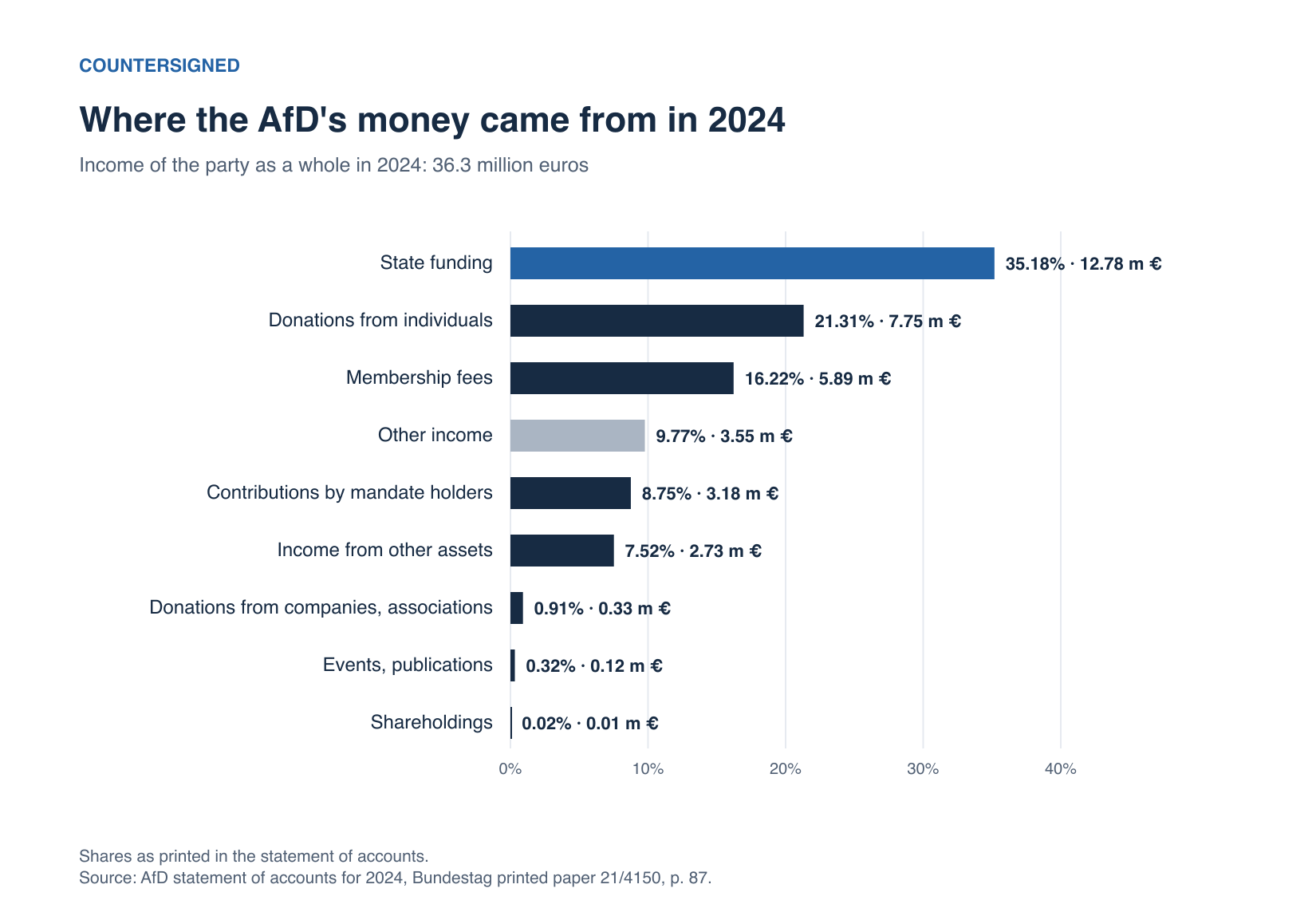
In 2024 the AfD as a whole — the federal party, its state associations and local branches — had an income of 36.3 million euros and spent 33.7 million, leaving a surplus of 2.6 million (S324). Its largest source of money was the state:
- State funding: 12.8 million euros, or 35.2 per cent of income. State funding is calculated from a party’s share of the vote and from the fees and donations it raises itself, within an overall ceiling for all parties (S324; S247).
- Donations from individuals: 7.7 million euros (21.3 per cent).
- Membership fees: 5.9 million euros (16.2 per cent), from 51,319 members at the end of the year.
- Other income: 3.6 million euros (9.8 per cent). By our calculation from the statement’s itemised list, about 3.0 million euros of this came from inheritances and legacies left to the party.
- Contributions by mandate holders — members of parliaments and councils who pay part of their salaries to the party: 3.2 million euros (8.8 per cent).
- Income from other assets: 2.7 million euros (7.5 per cent).
- Donations from companies, associations and other legal persons: 0.3 million euros (0.9 per cent).
(S324)
At the end of 2024 it held 19.2 million euros in cash and bank balances (S324). Election campaigns cost it 9.8 million euros in 2024, against 4.0 million in 2023 (S324). Income had been higher in 2023 — 39.6 million euros — because other income was unusually high at 14.8 million, including a single inheritance of 6.0 million euros (S324). The accounts thus show a party financed mainly by public money, its members, its mandate holders and private donors; donations from companies play almost no role.
Donation affairs
The AfD has repeatedly been penalised, or is under review, for money of unclear origin.
- Swiss money for Alice Weidel’s district association (2017). Before the 2017 Bundestag election, the Swiss pharmaceutical company PWS transferred about 130,000 euros in 18 payments to the AfD branch at Lake Constance, marked as a “campaign donation Alice Weidel”; the money was repaid only in April 2018 (S094; S100). A PWS board member said the company had forwarded it “on behalf of a business friend”; the party first named 14 Germans and other EU citizens as the donors, then said it had no reliable knowledge of the real donor (S100; S095). The administration imposed a penalty of about 396,000 euros, and the Berlin administrative court rejected the AfD’s suit in June 2021. Prosecutors in Konstanz closed their investigation of Weidel the same year: there was no sufficient suspicion that she had taken part in splitting the donations to conceal their origin (S095).
- Advertising paid by a Swiss agency (2016–2017). The Bundestag administration treated advertising by the Swiss agency Goal AG for Jörg Meuthen in 2016 (89,800 euros) and Guido Reil in 2017 (44,500 euros) as illegal donations (S097). In January 2020 the Berlin administrative court upheld the penalty of almost 270,000 euros in Meuthen’s case — three times the donation — and allowed an appeal; the AfD maintains that the advertising was not a donation (S098). The sources do not report a final outcome.
- Unexplained poster campaigns (2016–2018). According to Correctiv, it has never been established who paid for supportive advertising worth more than three million euros in those years; Berlin prosecutors opened an investigation into a possible illegal party donation, and as of February 2025 no sanction had been imposed (S086).
- A Dutch payment (2018). In 2018, 150,000 euros from the organisation Stichting Identiteit Europa arrived on the account of the same Lake Constance branch. The party returned the money and disclosed it to the Bundestag administration; it holds that it did not receive a donation, the administration takes the opposite view, and no decision had been issued by December 2025 (S324).
- The Dingler donation (2025). Before the February 2025 election, thousands of posters urging a vote for the AfD appeared across Germany. The party reported them to the Bundestag as a donation by Gerhard Dingler, a former official of Austria’s FPÖ, who said the money came from his private assets; the Bundestag put its value at 2.35 million euros (S086; S087). The Bundestag administration, however, said it had been told that Dingler had previously received “a transfer of an even larger amount” from Henning Conle, “who is on record here as a supporter of the AfD” — which would make Dingler a front man, whose donation a party may not accept (S087). The AfD transferred the money to the federal treasury as a precaution and sued in the Berlin administrative court to get it back; its treasurer said the party had found no indication of a front-man donation. As of October 2025 no hearing had been scheduled (S087).
In the first weeks of 2025 the AfD received more large donations than any other party — almost five million euros since January, according to Correctiv (S086). In January 2025 the Bundestag administration began examining whether Elon Musk’s public support for the AfD could amount to an illegal party donation; the sources do not report its result, and no payment by Musk is reported (S192) (section 9).
The party foundation
The AfD’s affiliated political foundation is the Desiderius-Erasmus-Stiftung (DES). In February 2023 the Federal Constitutional Court ruled that excluding it from federal grants in 2019 had violated the AfD’s right to equal opportunities, because such funding needed a basis in a specific law (S089). The Bundestag then passed a Foundation Financing Act, which requires among other things that a foundation stand for the free democratic basic order and international understanding (S091). The DES has applied for funding from the 2026 budget; as of December 2025 the Interior Ministry was examining the application, which according to Correctiv would bring it about 13.2 per cent of the money for party foundations (S092).
Foreign money
None of the sources examined documents payments to the AfD by a foreign state. The foreign-origin money that is documented is private: Swiss companies, an Austrian individual and a Dutch organisation. In the Swiss cases the actual donors were never identified (S086; S094; S098; S324). An unidentified donor is not evidence of state financing; but the repeated failure to identify donors is itself the reason for most of the penalties above. Investigations concerning alleged payments from Russia and China have targeted individual AfD politicians, not the party’s accounts (section 9).
A financing exclusion under Article 21(3) of the Basic Law (section 6) would end the party’s state funding — 35 per cent of its income in 2024 — and the tax privileges for donations to it.
5. The allegations: what the Verfassungsschutz and the courts have found
The case for a ban rests largely on the work of the Office for the Protection of the Constitution (Bundesamt für Verfassungsschutz, BfV), Germany’s domestic intelligence service, and of its counterparts in the states, and on the court decisions reviewing it. Their categories need explaining. A “suspected case” (Verdachtsfall) means there are “factual indications” of efforts against the free democratic basic order; it permits observation, including with intelligence means such as informants, but is not a finding that such efforts exist. A “confirmed extremist effort” (gesichert extremistische Bestrebung) requires that these indications have firmed up into sufficient certainty. Neither is a ban: an observed party can still contest elections, sit in parliaments and receive public funding, and only the Federal Constitutional Court can declare a party unconstitutional (S361; S362).
From “examination case” to final court confirmation
In January 2019 the BfV announced that it was examining the AfD; the Cologne administrative court stopped it from saying so publicly. The party’s youth organisation Junge Alternative (JA) and the nationalist “Flügel” (“wing”) current around Björn Höcke were classified as suspected cases at the same time, and the Flügel was upgraded to a confirmed extremist effort in March 2020 (S361; S360). In 2021 the BfV classified the AfD as a whole as a suspected case. The Cologne administrative court upheld this in March 2022, the Higher Administrative Court of North Rhine-Westphalia in Münster on 13 May 2024, and the Federal Administrative Court rejected the AfD’s complaints on 20 May 2025, making the classification final (S362; S360; S101; S120).
The Münster judgment is the most detailed judicial assessment of the party so far. It rests on three grounds.
- An ethnic concept of the people. The court found a “well-founded suspicion” that it corresponds to the political aims of “at least a decisive part” of the AfD to give German citizens with a migration background “only a legally devalued status” (S360). It stressed that describing the people in ethnic or cultural terms is in itself “neither right nor wrong” in law; what is unconstitutional is linking such a concept to the aim of questioning the legal equality of all citizens (S360). It noted that neither the party programme nor other party publications contain unambiguous demands for such discrimination, but held that disparaging statements made in the party’s political activity can be sufficient indications if they make clear that citizens with a migration background are not seen as equal members of society (S360). It relied instead on the frequent talk by Höcke and other leading members of “Umvolkung” (re-population), “Volksaustausch” (population replacement) or a looming “Volkstod” (death of the people), on the repeated use of the term “Passdeutsche” (“passport Germans”) — including a 2019 Facebook post by Alice Weidel headed “These are not Germans!” — and on the demand of executive member Christina Baum for a “right to vote by descent” (S360). The party’s declaration of January 2021 that all German citizens belong to the people did not dispel the suspicion; the election of Baum and Maximilian Krah to the federal executive in 2022 showed, in the court’s view, that such statements “enjoy broad support in the party” (S360).
- Hostility to migrants and Muslims. Migrants were described “in a sweeping and undifferentiated way” as “knife men”, “invaders”, “intruders” and “parasites”, Islam as a “totalitarian ideology”. Citing the intelligence service’s evidence, the court named Weidel, executive member Stephan Brandner and two members of the Bundestag among those using “knife men” or “knife migration”, and several federal and state MPs among those using “invaders” (S360). It found a concrete discrimination in the demand to ban minarets, which appeared in the AfD’s 2019 European election programme, and saw overall “even a strong suspicion” of efforts against the human dignity of Muslim migrants (S360). The Federal Administrative Court later noted that the Münster judgment rested “predominantly” on statements by high-ranking members — Höcke, Brandner, Krah, Alexander Gauland, Hans-Thomas Tillschneider, Baum and Weidel — who, the BfV said, could not have been its informants (S101).
- Democracy. The court found indications of anti-democratic efforts, “though not with the frequency and density assumed” by the BfV — for example Gauland’s remark that an SPD politician should be “disposed of in Anatolia” and the approval it received in the party (S360). Statements in a Bavarian AfD chat group advocating a violent overthrow showed real anti-constitutional efforts by the individuals concerned, but only a suspicion with regard to the party, which had distanced itself to some extent (S360).
The judgment did not quantify how widespread these positions are; it speaks of “decisive parts” of the party and of “a multitude of statements” by “numerous, including leading, members” (S360).
The 2025 upgrade and the Cologne order of February 2026
On 2 May 2025 the BfV announced that it now classified the AfD as a confirmed right-wing extremist effort “on account of the extremist character of the party as a whole, which disregards human dignity”. Its central argument: the AfD does not regard German citizens with a migration history from Muslim-majority countries “as equal members of the German people as defined ethnically by the party” (S361). The assessment ran to more than 1,100 pages, was classified for official use only and was published in May 2025 by the magazine Cicero and the website NIUS (S126). The AfD sued on 5 May 2025; the BfV undertook to keep treating it as a suspected case until a court decision (S361; S122).
On 26 February 2026 the Cologne administrative court ordered the BfV, until the main proceedings are decided at first instance, not to classify or publicly describe the AfD as a confirmed extremist effort (S361). The decision does not clear the party. The court held that there is “sufficient certainty” that efforts against the free democratic basic order are pursued within the AfD, and that “the strong suspicion” against the party persists (S361). It found that the AfD’s 2025 federal election programme contains “at least two concrete demands” discriminating against people of Islamic faith — a ban on building minarets, presented under the heading “We oppose any further spread of Islam”, and a headscarf ban in public institutions and schools — which it found openly discriminatory, the headscarf demand “manifestly” unconstitutional, and not compatible with the guarantee of human dignity; a ban on the muezzin’s call, by contrast, could possibly be designed lawfully under noise-control law (S361). Among the statements it cited from the BfV’s report was Weidel’s “What we experience on German streets is jihad” (S361).
But the court concluded that the party “is not shaped by these efforts in such a way that an anti-constitutional basic tendency can be established in its overall picture” (S361). The two programme demands were “still individual unconstitutional demands”; on the ethnic concept of the people there was a “well-founded suspicion, but no sufficient certainty”; the party’s statements on “remigration” remained “diffuse”, and not every use of the term pointed to anti-constitutional aims (S361). The court noted that the BfV had based its assessment “exclusively on publicly available sources” and had not presented intelligence findings about further, unpublished aims; where aims may be concealed, continued observation with intelligence means “may be necessary” (S361). The order, listed as final in the NRW case-law database, applies only until the first-instance judgment in the main proceedings, which are pending; the interior ministers have agreed to await their outcome (S361; S286). Until then the AfD remains a suspected case (S120).
The states, the youth organisation and the 2025 annual report
Several state offices have gone further. The AfD state associations in Thuringia (since March 2021), Saxony-Anhalt (since November 2023), Brandenburg (since spring 2025) and Saxony are classified as confirmed right-wing extremist (S115; S116; S123; S131); the Cologne court counted five of 16 state associations classified as extremist or in comparable state-law categories, including Lower Saxony (S361). The Saxon Higher Administrative Court confirmed the classification of the Saxon association in early 2025. Lower Saxony suspended its upgrade in March 2026 when the AfD sued; on 1 June 2026 the Hanover administrative court rejected the party’s urgent application and provisionally allowed it. Rhineland-Palatinate and Saarland have put their upgrades on hold pending court rulings (S264; S131).
The JA was classified as confirmed extremist by the BfV in April 2023 and dissolved itself at the end of March 2025; its successor, “Generation Deutschland” (section 2), is an integral part of the party and shows, according to the BfV, “a great deal of continuity in personnel and content” (S120).
The BfV’s annual report for 2025, presented on 30 June 2026, still treats the AfD as a suspected case. It states that no move away from positions relevant to the protection of the constitution was observed, that “liberal-conservative positions were hardly perceptible in public any longer”, and counts 28,000 people in the AfD towards Germany’s right-wing extremist potential (2024: 20,000), out of a membership the party puts at 70,000; the BfV notes that its figures are partly estimated (S120). The same report records 2,872 left-wing extremist offences against the AfD, its members and its facilities in 2025, up from 2,245 (S120).
6. The legal test: Article 21, the NPD judgment and the alternatives to a ban
What the Basic Law says
Article 21 of the Basic Law (Grundgesetz, Germany’s constitution) protects parties and sets their limits in the same provision. Parties “shall participate in the formation of the political will of the people” and may be “freely established”. But “parties that, by reason of their aims or the behaviour of their adherents, seek to undermine or abolish the free democratic basic order or to endanger the existence of the Federal Republic of Germany shall be unconstitutional.” Since 2017 a second, milder instrument exists: parties that are “oriented towards” the same goals “shall be excluded from state financing”. Only the Federal Constitutional Court decides on either question (S240; S241).
The procedure is set out in the Federal Constitutional Court Act. An application may be filed only by the Bundestag, the Bundesrat (the chamber of the 16 state governments) or the federal government; a state government may apply only against a party organised solely in its own state (S242). Any decision against the party requires a two-thirds majority of the members of the Court’s Senate — six of eight judges (S242; S248). If the application succeeds, the Court declares the party unconstitutional, orders its dissolution and prohibits substitute organisations; it may confiscate the party’s assets. The finding “may be limited to a legally or organisationally independent part of a party” (S242) — the legal basis for the proposal, discussed in section 7, to ban only certain state associations. Members of parliament elected for the party lose their seats: the Court held this in 1952 to follow directly from the constitution, and the Federal Elections Act now provides for it for the Bundestag, including where only a sub-organisation of the party is banned (S249; S132). A financing exclusion lasts six years and can be extended; it also ends the tax privileges for the party and for donations to it (S242; S240).
Whether to apply is a political decision. The Court has said since 1956 that it is a matter of the applicants’ “political discretion”, and in 2017 that arguments for trying other means first are questions of “political opportunity” (S250; S244). Once an application is before it, however, the Court has no discretion: if the conditions are proven, the finding of unconstitutionality and the dissolution are mandatory, without a separate test of proportionality (S244).
The standard of the NPD judgment (2017)
The current interpretation comes from the judgment of 17 January 2017 on the National Democratic Party (NPD). The Court called a ban “the sharpest and, moreover, double-edged weapon of a democratic state under the rule of law against its organised enemies” and an exception to be applied with restraint (S244). It defined each element of Article 21:
- The free democratic basic order covers only “those central fundamental principles which are absolutely indispensable for the free constitutional state”: human dignity (including “elementary equality before the law”), the principle of democracy (equal participation of all citizens and accountability of state power to the people) and the rule of law (including control by independent courts and the state’s monopoly on force) (S245; S244). The Court expressly narrowed the broader list of 1952; the republican form of state and federalism are not part of it, and the multi-party system and opposition rights are “subordinate” instruments (S244; S249). Concepts that give a collective unconditional priority over the individual, and “antisemitic or racist concepts”, violate the order; rejecting parliamentarism in favour of plebiscites does not, but contempt for parliament aimed at a one-party system does (S244).
- Undermining or abolishing: it suffices that a party turns against one of the three core elements. But “not every unconstitutional demand is in itself sufficient”; the Court stressed that a ban may serve only preventive protection of the constitution and “not the elimination of unwelcome political competition” (S244).
- Aims and adherents: what counts are the party’s “real aims, not the declared ones”, drawn from its programme, official statements, leaders’ speeches and party media. The conduct of the party’s organs and leaders, of leading officials of its sub-organisations and of its publications is attributable to it; that of ordinary members only if it occurs in a political context and the party approved or tolerated it; criminal acts cannot be attributed wholesale (S244).
- “Seek” (darauf ausgehen) requires “planned action” amounting to a qualified preparation of the attack on the order. “A ban on a party is not a ban on views or a world-view”; it is a ban on an organisation. Criminal conduct is not required, and a concrete danger need not yet exist (S244).
- Potential (Potentialität): the decisive innovation. There must be “concrete indications of weight that make it at least appear possible” that the party’s actions against the order could succeed. The Court abandoned the 1956 position that a party could be banned even with no prospect of success. Relevant factors include membership, organisation, campaigning capacity, finances, election results, representation in offices and mandates; it is sufficient if the order is impaired in regionally limited areas, for example through an “atmosphere of fear” (S244; S245).
- Similarity to National Socialism is not in itself a ground for a ban but has “considerable indicative significance”; the central principles of National Socialism, including “the ethnic concept of the people”, violate human dignity (S244).
The Court found that the NPD’s aims violated human dignity and democracy: it sought to replace the constitutional order with an authoritarian “national state” built on an ethnic “national community” (Volksgemeinschaft), and its concept of the people “negates the claim to respect” owed to every person. It also worked towards these aims in a planned way. But it lacked potential: one member of the European Parliament, no seats in any state parliament, 1.3 per cent in the 2013 Bundestag election, about 350 of more than 200,000 municipal seats and about 5,000 members. The application of the Bundesrat was therefore rejected unanimously (S244; S246).
Freedom from state interference
A ban procedure also has a procedural precondition that ended the first NPD case in 2003 (section 8): the party must be able to defend itself without being steered or spied on by the state. Informants of the intelligence services (V-Leute) must be withdrawn from the party’s executive boards at the federal and state level “at the latest with the public announcement of the intention” to apply; evidence must not rest materially on their work, and the party’s litigation strategy must not be spied on. In the 2017 case the federal and all state interior ministers certified that this had been done (S244; S246).
Exclusion from state financing
In the 2017 judgment the Court noted that sanctions below a ban, such as cutting state funding, were excluded under the constitution as it then stood and could only be created by amending it (S244). Bundestag and Bundesrat did so within months: Article 21(3) came into force on 20 July 2017 (S247). The wording differs in one respect: a party need not “seek” (darauf ausgehen) but only be “oriented towards” (darauf ausgerichtet) the goals, and the Court held in 2024 that this requires qualified, planned action but not potential (S247). On 23 January 2024 it unanimously excluded Die Heimat, the renamed NPD, from state financing for six years — the first decision of this kind, after an application filed in July 2019 (S247; S155). For a party with clear potential, a legal commentator noted, the applicants could choose between applying for a ban and applying for a financing exclusion (S155).
European standards
Germany’s rules are also measured against the European Convention on Human Rights. The European Court of Human Rights accepts party bans to protect democracy and does not require a state to wait until a party has come to power, but it requires a “pressing social need” and a sufficiently established and imminent risk (S244; S392). The Venice Commission, the Council of Europe’s advisory body on constitutional law, calls prohibition a “sanction of last resort” subject to strict proportionality and requires that the objectionable aims be set by the party’s bodies, not individual members (S392). The Federal Constitutional Court held in 2017 that a party meeting the Article 21 criteria also meets the “pressing social need” test (S244).
7. Do the allegations meet the test? Arguments for and against, criterion by criterion
No court has examined whether the AfD meets the conditions of Article 21. The court decisions of section 5 apply a different law — the Federal Act on the Protection of the Constitution — and ask whether the intelligence service may observe or label the party, not whether it may be banned. Christoph Möllers, a constitutional lawyer who has reviewed the most extensive pro-ban study, cautions that the administrative courts and the Constitutional Court operate too differently “to permit simple transfers” of such findings, which yield at most indications (S269). What follows sets the available evidence against the criteria of the 2017 judgment (section 6), with the strongest arguments of both sides. The assessment is ours; it is not a legal opinion.
Who argues what
The main documents in favour of a ban are a cross-party Bundestag motion of November 2024, a statement by 17 professors of constitutional law of the same month, an analysis by the German Institute for Human Rights of 2023 and, above all, a donation-funded study of about 1,500 pages published on 25 June 2026 by the civil-liberties organisation Gesellschaft für Freiheitsrechte (GFF) (S267; S145; S282; S351; S274). The GFF concludes that a ban application “would probably succeed” and rests this on “two pillars that each carry it independently”: the democracy principle and human dignity (S351). More than 1,000 lawyers signed an open letter calling for a procedure (S277).
The sceptics include the former president of the Constitutional Court, Hans-Jürgen Papier, who in January 2024 called an application “currently wrong” (S305), in 2025 said the applicants must be convinced of success “with predominant probability” (S278) and in August 2026 still considered a ban to have little prospect of success (S264); the criminal-law scholars Elisa Hoven, Marco Vöhringer and Frauke Rostalski, who criticised the GFF study in the Frankfurter Allgemeine Zeitung (their articles are known here only as summarised, and contested, in a reply on the Verfassungsblog) (S354); a contributor to the same blog who argues that the study cannot make good its claim of “unambiguous” unconstitutionality (S353); and the leaders of the CDU and CSU (section 10).
Criterion 1: potential — met
This is the criterion that saved the NPD, and here the debate is close to unanimous. The 17 professors write that the potential requirement “is not seriously disputed by anyone” for the AfD; Möllers calls it “clearly met”; Papier, a sceptic of a ban, also accepts that the AfD, unlike the NPD, has the necessary weight (S145; S269; S305). The legal scholar Markus Ogorek adds that “too big to ban” has no constitutional basis (S273); the 17 professors point to a “structural dilemma”: the more support an anti-constitutional development has, the less a ban can prevent it (S145).
Criterion 2: aims against human dignity — contested
This is the core of the case. The evidence assessed so far points in two directions.
- For: the Münster court found a well-founded suspicion that “at least a decisive part” of the party aims to give citizens with a migration background a legally devalued status, and a “strong suspicion” of efforts against the dignity of Muslim migrants, based mainly on statements by leading officials (section 5). In its interim order the Cologne court found two demands in the 2025 federal programme — the minaret ban and the headscarf ban — to be openly discriminatory against Muslims and not compatible with the guarantee of human dignity (S361). The GFF finds a policy concept aimed at “exclusion, contempt and far-reaching legal devaluation” of foreigners, Germans with a migration background and Muslims, based on an ethnic-cultural concept of the people that is incompatible with the Basic Law (S276; S351). The 17 professors argue that the party’s ambiguous statements form a “mosaic” revealing its ideological core and that it “tolerates anti-constitutional positions … and so makes them its own” (S145).
- Against: the Cologne court found only a “well-founded suspicion, but no sufficient certainty” that the party aims to give citizens with a migration background a lesser legal status, and called the two programme demands “individual unconstitutional demands” that do not shape the party (S361). The 2017 judgment itself holds that “not every unconstitutional demand is in itself sufficient” (S244). Hoven and Vöhringer treat the headscarf demand as a mere extension of the bans the Constitutional Court has accepted for the judiciary — a comparison the Verfassungsblog reply rejects, since a ban for judges differs fundamentally from one for all Muslim women in public institutions (S354). Möllers, who calls the GFF study “the strongest indication of the party’s hostility to the constitution” he has seen, considers its line between merely discriminatory and dignity-violating policy partly too low, especially regarding Muslims (S269). Ogorek notes that the party’s official basic programmes and congress resolutions “do not necessarily appear obviously unconstitutional” in essential areas (S273).
Criterion 3: aims against democracy — contested
The Münster court found indications “though not with the frequency and density” the BfV assumed (section 5). The GFF’s democracy pillar rests on the persecution and intimidation of political opponents, not on a plan to abolish parliament: it counts more than 220 “serious items of evidence” that the AfD wants to prosecute politicians of other parties for political decisions; Möllers describes more than 200 such statements by 35 members of the Bundestag, 5 members of the European Parliament and 36 state MPs, and 50 cases of concrete intimidation of individuals, but notes that the study itself finds no sufficient probability of efforts to abolish parliamentary democracy (S351; S269). The intelligence service’s own 2025 assessment, as summarised by Correctiv, saw indications of violations of the democracy and rule-of-law principles but considered the evidence insufficient to establish such a stance for the party as a whole (S264). The 2017 judgment treats contempt for parliament only as unconstitutional if it aims at replacing it — for example with a one-party system (section 6).
Criterion 4: the rule of law — not met on present evidence
The Münster court left the question open, because its findings on human dignity and democracy were sufficient for its decision (S360). The intelligence service’s 2025 assessment (see above) and the GFF found no sufficient evidence of efforts against the rule of law (S264). The GFF also rejects a similarity of the AfD to National Socialism and, according to Möllers, sees no sufficient probability of antisemitic efforts (S351; S269).
Criterion 5: attribution to the party and “planned action”
A ban requires that the anti-constitutional aims be those of the party, pursued in a planned way — not views of individual members (section 6). The decisive question is therefore whether the statements of Höcke, Weidel, Krah, Baum and others represent the party’s “real aims”. The 2017 judgment attributes the conduct of leaders and leading officials to the party (S244); the Federal Administrative Court noted that the Münster findings rest predominantly on such officials (S101). On the federal party only the Cologne court has ruled, and provisionally: it did not find a party-wide character established (S361). Courts have upheld the classification of individual state associations on their own evidence — the Saxon Higher Administrative Court for Saxony and, provisionally, the Hanover administrative court for Lower Saxony (S264). These decisions concern different bodies and are not in conflict. The European standard is stricter still: the Venice Commission requires that the objectives be set by the party’s statutory bodies (S392).
Criterion 6: freedom from state interference
Informants must be withdrawn from the party’s executives before an application is announced (section 6). The 2024 Bundestag motion conceded that the Bundestag cannot itself ensure this and proposed to presume it two months after its own decision (S267). Two legal scholars warn that announcing an application too early could prevent the collection of central evidence, so that the decision to apply also depends on “investigative calculation” (S306). The Cologne court noted that the BfV’s 2025 assessment rested “exclusively on publicly available sources” (S361).
A ban of individual state associations
Defence Minister Boris Pistorius (SPD) and Baden-Württemberg’s Minister-President Cem Özdemir (Greens) proposed in August 2026 to focus a procedure on the “clearly völkisch state associations” in Thuringia, Saxony, Saxony-Anhalt and Brandenburg; in their view the German-national current “may possibly be compatible with the Basic Law” (S257; S289). The 17 professors and Ogorek consider this legally possible: the application would formally target the whole party, but the Court can limit its finding to an independent part (S145; S273). It has never been tried; CSU leader Markus Söder called a partial ban “constitutionally extraordinarily difficult” (S264), and the sources examined do not settle whether potential must then be shown for the part alone. State governments cannot apply against a state association of a nationwide party (S273).
Financing exclusion
Excluding the AfD from state funding (section 6) would not require proof of potential, but Ogorek points out that the central proof — that the party is directed against the free democratic basic order — is no easier than in a ban procedure (S273).
Assessment
On the evidence publicly available in October 2026, the AfD clearly meets the potential criterion that the NPD failed, and courts have repeatedly found strong indications that leading members pursue aims incompatible with human dignity. Whether these aims shape the party as a whole — the question on which a ban would turn — is disputed among experts; the only court to have examined the federal party’s 2025 classification found it, provisionally, not established with certainty. A ban of the whole party would therefore depend on evidence the Court has not yet seen and on its own evaluation, by a two-thirds majority, of the “real aims”. A ban limited to the state associations classified as extremist has the strongest evidential basis but no precedent.
Two forecasts
The probabilities below are this report’s assessments, not measurements, and use fixed ranges (a value on a boundary belongs to the lower band): extremely unlikely 1–10 per cent, very unlikely 10–25 per cent, unlikely 25–45 per cent, about as likely as not 45–55 per cent, likely 55–75 per cent, very likely 75–90 per cent, almost certain 90–99 per cent. Evidence confidence states how well founded the assessment is.
- An application is filed by 31 December 2027 — very unlikely, 15 per cent. The event: the Bundestag, the Bundesrat or the federal government files an application with the Federal Constitutional Court under Article 21(2) or (3) against the AfD or a part of it (decided by the Court’s announcements). As of October 2026 no application has been filed; there is no majority in the Bundestag; the conference of interior ministers has agreed to await the Cologne main proceedings, which in one expert’s view could take at least another year; a Bundesrat initiative needs 35 votes; according to a survey of the state chancelleries, seven state governments are open to a joint working group, while four have rejected a ban (S351; S286; S263; S264). The chancellor calls the hurdle “very high” but has said he would not close his mind to banning the völkisch part (S256; S264). Evidence confidence: moderate. More likely if the Cologne court confirms the classification in the main proceedings, if the CDU-led states join a Bundesrat initiative, or if an AfD-led state government acts against institutions; less likely if the classification is finally overturned.
- The Court declares the AfD or a part of it unconstitutional by 31 December 2029 — extremely unlikely, 3 per cent. Decided by a judgment of the Federal Constitutional Court; a financing exclusion would not count, because it is not a ban. The two figures together imply a chance of roughly one in five that an application filed by 2027 would lead to a ban by 2029. Even if an application were filed in 2027, the earlier procedures took between eleven months and almost five years, the two NPD procedures two and three years, and a ban requires six of eight votes (sections 6 and 8). Evidence confidence: moderate.
8. Germany’s earlier party bans — and how the AfD compares
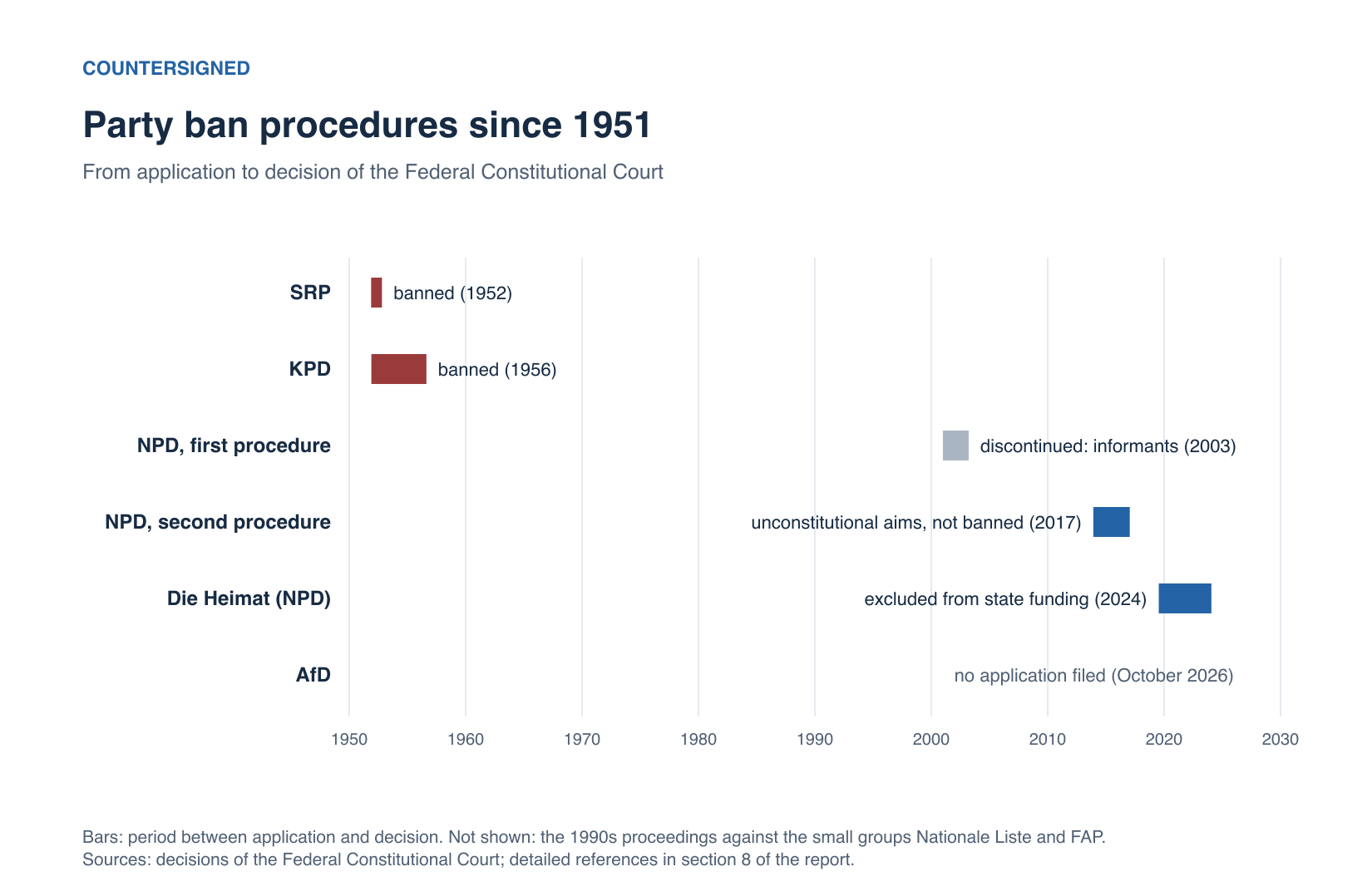
Article 21(2) has been invoked before the Federal Constitutional Court against the SRP and the KPD in the 1950s, against two small far-right groups in the 1990s — the Nationale Liste and the Freiheitliche Deutsche Arbeiterpartei (FAP) — and twice against the NPD (S244); the FAP was banned in 1995 under the law on associations (S244). Two parties were banned by the Court, in 1952 and 1956; the two procedures against the NPD failed, in 2003 and 2017. A further procedure, under a provision added to the Basic Law in 2017, excluded the NPD’s successor from state funding in 2024.
Socialist Reich Party (SRP), 1952. The federal government applied on 19 November 1951; on 23 October 1952 the Court declared the SRP unconstitutional, dissolved it, banned substitute organisations, voided the seats of its members of parliament without replacement and confiscated its assets — eleven months after the application (S249). The Court found that the SRP was “in its programme, its world of ideas and its overall style akin in nature to the former NSDAP”, that its leadership consisted largely of former National Socialists, that it revived antisemitism, fought the multi-party principle as such and was organised internally on the leader principle (S249). The SRP was not marginal: in May 1951 it had won about 11 per cent of the vote in Lower Saxony, with 16 of 158 seats there and 8 of 100 in Bremen (S249). Its announced self-dissolution shortly before the judgment was held to be legally irrelevant (S249).
Communist Party of Germany (KPD), 1956. The federal government’s application was received on 28 November 1951; the Court banned the KPD on 17 August 1956 — almost five years later (S250). It found that the KPD aimed to bring about a socialist-communist order “by way of the proletarian revolution and the dictatorship of the proletariat”, which was incompatible with the free democratic order, and that it already sought to undermine that order, although revolution was not its current goal (S250). The Court required “an actively combative, aggressive attitude” towards the existing order but held that a party could be banned even if it had no prospect of realising its aims in the foreseeable future (S250) — a position abandoned in 2017.
NPD, first procedure (2001–2003). The federal government, the Bundestag and the Bundesrat all applied in 2001. On 18 March 2003 the Court discontinued the proceedings without examining the party’s aims. All judges accepted that the intelligence services had maintained contacts with members of the NPD’s federal and state executive boards immediately before and after the applications (S248). Three of the seven judges sitting saw an irremediable procedural obstacle; four did not. Because rejecting the NPD’s request to discontinue required six votes, the minority decided the outcome (S248). The minority’s demand — informants must be withdrawn from party leaderships before an application — became the Court’s rule in 2017 (section 6).
NPD, second procedure (2013–2017). The Bundesrat alone applied in December 2013, after deciding to do so a year earlier; judgment came on 17 January 2017, about three years later (S244). The Court found the NPD’s aims unconstitutional and its action planned, but rejected the application unanimously for lack of potential (section 6) (S244). The same party, renamed Die Heimat, was excluded from state financing for six years in January 2024 after a joint application of Bundestag, Bundesrat and federal government in 2019; by then it had about 3,000 members and had already lost its entitlement to funding through poor election results (S247).
How the AfD compares
The comparison has to be made criterion by criterion, because the standard changed in 2017. Under the 1950s case law, a party’s weakness was no obstacle; today it is.
- Potential. On this criterion the AfD differs fundamentally from the NPD. The NPD had about 5,000 members, 1.3 per cent nationally and no seats in any state parliament when it escaped a ban (S244). The AfD won 20.8 per cent and 152 seats in the 2025 Bundestag election, leads national polls in 2026, gained 43.8 per cent in Saxony-Anhalt and 38.2 per cent in Mecklenburg-Western Pomerania in September 2026, and provides the president of a state parliament (sections 1 and 2). Commentators on both sides of the debate agree that the potential required by the 2017 judgment is present (S155; S145). The SRP had about 11 per cent in its strongest state.
- Openness of the aims. The KPD’s programme called for the dictatorship of the proletariat, and the NPD’s programme expressed an ethnic “national community” that the Court found to violate human dignity (S250; S244). The SRP case is closer to the AfD’s: the Court found the SRP’s programme similar in style to the NSDAP’s but so non-committal that it was of “little value” for recognising the party’s “true aims”, which could be recognised only in connection with the statements of its leading functionaries (S249). The AfD’s programmes contain no statement of aims comparable to those of the KPD or the NPD. In January 2021 the party adopted a declaration defining the German people in the constitutional sense as all persons holding German nationality, irrespective of their ethnic and cultural background; the Cologne administrative court regarded such declarations in 2022 as “in large parts lip service” (S362). The case against the AfD rests largely on statements of officials and members and on individual programme demands — the type of evidence that carried the SRP ban in 1952 — and whether these represent the party’s “real aims” (section 6) is the question on which the courts and experts have so far reached different assessments (sections 5 and 7).
- Similarity to National Socialism. In 1952 this carried the finding; in 2017 it became an indication only (S249; S244). Björn Höcke has twice been convicted for using a slogan of Hitler’s stormtroopers (section 2), but no court has found the party as a whole to be akin in nature to the NSDAP.
- State informants. The 2003 failure shows the risk for a party that has been under intelligence observation for years. An application against the AfD would require the prior withdrawal of all informants from its federal and state executives and a certification to that effect (section 6).
- Duration. Past procedures took between eleven months (SRP) and almost five years (KPD); the two NPD procedures about two and three years.
The short answer to the question whether the AfD is “as openly” unconstitutional as the parties banned earlier is therefore no, in the sense that its programme, unlike those of the KPD and the NPD, does not declare aims against the constitutional order. The SRP precedent shows, however, that a ban can rest on the statements of leading functionaries where the programme is vague. The AfD is also far more powerful than the NPD, whose ban failed for lack of power. Whether its real aims can be proven from its officials’ conduct is the open question assessed in section 7.
9. Russia, China and the United States: what is documented
Three things need to be kept apart: positions the party shares with a foreign government, contacts between its officials and foreign actors, and money or instructions flowing from abroad. Only the last would amount to control or coordination; for most allegations the record shows the first two. Each case is given with its procedural stage: a preliminary inquiry (prosecutors check whether to open a case), an investigation, a charge or a court judgment.
Positions on Russia
The AfD repeatedly demands that the damaged Nord Stream gas pipelines be repaired and restarted. According to the news agency dpa, the party has condemned Russia’s war against Ukraine but holds back from criticising Moscow, directs its criticism more at the West and at Ukraine, and rejects support for the country under attack (S372). The leadership is not of one mind: in November 2025 co-leader Tino Chrupalla said of Vladimir Putin that “he hasn’t done anything to me” and that he did not “currently see any danger to Germany from Russia”, while co-leader Alice Weidel had said two months earlier that Russia was testing NATO’s air defences and had urged Putin to de-escalate (S373). Shared positions are a matter for political debate; on their own they are not evidence of payment or control.
The “Voice of Europe” case
On 27 May 2024 the Council of the European Union placed the Prague-based website Voice of Europe, its operator Artem Marchevskyi and the pro-Russian Ukrainian politician Viktor Medvedchuk under sanctions. The Council stated that the outlet was “secretly financed and directed by” Medvedchuk and had been used to pay propagandists and to build “an influence network connecting Medvedchuk and his associates with representatives of political parties in Europe” (S161). The legal text names no party and no politician. According to documents of the Czech intelligence service BIS reported by Czech media, the politicians promoted on the website included the AfD’s European election candidates Petr Bystron and Maximilian Krah; Czech media later reported that Bystron had accepted cash, which he called “nonsense” (S163).
Munich prosecutors opened an investigation against Bystron, then a member of the Bundestag, “on the initial suspicion of bribery of elected officials and money laundering”; properties in Berlin, Bavaria and Mallorca were searched on 16 May 2024 (S166). After Bystron moved to the European Parliament, that parliament lifted his immunity on 6 May 2025. Its summary of the prosecutors’ request states that in 2020 Bystron “may have received cash payments in person or received cryptocurrency transfers from the operator” of Voice of Europe in return for speaking and voting in the interests of the Russian government. The Parliament found no evidence that the proceedings were intended to harm his political activity (S160). Bystron denies the accusations and calls them a “defamation campaign”; the party leaders said in 2024 that “no evidence” had been presented (S165; S166). In March 2025 the investigative network OCCRP reported that prosecutors had not charged him in the bribery investigation (S165). None of the sources reviewed reports a later charge or a court decision on these allegations; their status after May 2025 is open.
Krah, his former aide and China
The only criminal conviction in this area concerns China, not Russia, and not an AfD office-holder but a former parliamentary aide. On 30 September 2025 the Higher Regional Court in Dresden sentenced Jian Guo, who had worked for Maximilian Krah in the European Parliament from 2019 to 2024, to four years and nine months in prison for acting as an agent of a Chinese intelligence service; he passed on information about parliamentary negotiations and decisions (S169; S171; S327). Prosecutors also said he gathered information on the AfD (S169). Krah testified as a witness and said he had been unaware of the allegations (S169; S327).
Krah himself, now a member of the Bundestag, has been under investigation by the Dresden public prosecutor general since May 2025 on suspicion of bribery and money laundering in connection with possible Chinese payments during his time as an MEP (S325). The Bundestag lifted his immunity on 11 September 2025 to allow searches of his offices and homes (S326); a regional report states that a further decision followed on 26 February 2026 and that no indictment was known as of mid-August 2026 (S327). Krah calls the accusations “absurd” and politically motivated (S325). A separate preliminary inquiry concerning alleged Russian payments was still pending in September 2025 (S325; S328); in November 2024 Krah had acknowledged meeting two associates of Medvedchuk in Sochi (S377). After the European election of June 2024 the AfD’s new delegation in the European Parliament excluded Krah (S172).
Frohnmaier, trips to Russia and parliamentary questions
In 2019 the BBC, Der Spiegel, ZDF and La Repubblica reported on Russian documents from April 2017 which described Markus Frohnmaier, then an AfD candidate for the Bundestag, as a prospective “absolutely controlled MP”. The BBC added that it was not clear whether the Kremlin acted on the paper and that there was no evidence of “material support” for his campaign; Frohnmaier said through his lawyers that he “was never under the control of any third party” (S174). No investigation of Frohnmaier is reported in the sources. He is today a deputy leader of the AfD group in the Bundestag. In June 2026 he travelled with the Saxon party leader Jörg Urban, MP Steffen Kotré and MEP Petr Bystron to the St Petersburg International Economic Forum, held under Putin’s patronage, and by his own account met the head of Gazprom, Alexei Miller. The Foreign Office had explicitly advised against the trip; Weidel supported it (S372).
Trips to Russia have divided the party: in November 2025 Weidel said of a delegation to a conference in Sochi, “I don’t understand what we’re supposed to be doing there,” and announced stricter internal rules for foreign travel (S373; S175).
In October 2025 Thuringia’s interior minister, Georg Maier (SPD), accused the AfD of using parliamentary questions to probe critical infrastructure — 47 in Thuringia within twelve months — and said it “almost seems as if the AfD is working off a Kremlin order list”. The AfD called the claim “completely ridiculous”; the federal government said it had “no findings of its own” (S181). In a Bundestag debate on 5 November 2025, coalition MPs called the AfD an instrument of Russian interests; Frohnmaier replied that if there were anything to it, there would be charges, trials and verdicts (S370). No investigation arising from these questions is reported.
Internal documents of the Russian contractor Social Design Agency, which ran the “Doppelganger” disinformation campaign, list “strengthening the far-right party AfD” among the campaign’s goals for Germany, according to the research centre CeMAS; the documents also show that the agency exaggerated its impact to its clients (S184). They describe Russian intentions, not cooperation by the party.
Elon Musk and the Trump administration
Support from Elon Musk and from members of the US administration and Congress has been open, verbal and political. At the end of December 2024 Elon Musk, an ally of the then President-elect Donald Trump, wrote in the German newspaper Welt am Sonntag that “only the AfD can save Germany” and called it, in one English rendering of the German text, the “last spark of hope for this country”; the paper’s opinion editor resigned in protest (S187; S188). On 9 January 2025 he hosted a live conversation with Alice Weidel on his platform X, and on 25 January he addressed the AfD’s campaign launch in Halle by video, calling the party Germany’s “best hope” (S189; S190; S191). The Bundestag administration began examining whether this could amount to an illegal party donation (S192); none of the sources documents any payment or in-kind funding by Musk or any other US actor to the AfD (section 4).
At the Munich Security Conference on 14 February 2025, Vice President JD Vance said that “there is no room for firewalls” (S194). He did not name the AfD in the speech, but met Weidel on the sidelines of the conference (S196). When the Verfassungsschutz classified the AfD as “confirmed right-wing extremist” on 2 May 2025 (section 5), Secretary of State Marco Rubio wrote: “Germany just gave its spy agency new powers to surveil the opposition. That’s not democracy—it’s tyranny in disguise.” The German Foreign Office replied: “This is democracy. … It is independent courts that will have the final say. We have learnt from our history that rightwing extremism needs to be stopped.” (S197; S198).
The US National Security Strategy of December 2025 states that “the growing influence of patriotic European parties indeed gives cause for great optimism”; it lists “cultivating resistance to Europe’s current trajectory within European nations” among US priorities (S254). The document names neither the AfD nor any other party; the German news agency dpa wrote that the latter passage “sounds like” a call to support the AfD (S201). In the autumn of 2025 AfD politicians met officials of the State Department, the National Security Council and the Vice President’s office in Washington, and in December 2025 Markus Frohnmaier received an award at a gala of the New York Young Republican Club; according to the Washington Post, Trump officials had not returned these visits (S202; S201; S203).
Two days after the Saxony-Anhalt election of 6 September 2026, Trump wrote on his platform Truth Social that the populist party in Germany had just had a really big night; he did not name the AfD (S205; S255). (The post is held only in German translation; the wording here is our rendering.) A planned telephone call between Chancellor Friedrich Merz and Trump was postponed; the government spokesman would not say whether the two were connected (S205). Republican Senator Mike Lee and Representative Anna Paulina Luna congratulated the AfD and advised the German government against banning the party (S204). Later in September, according to a report by Focus relayed by Correctiv, Luna wrote to the Thuringian state parliament — at the AfD’s request — that she would ask Secretary of State Rubio to seek US travel bans for applicants and supporters of a ban procedure (S264).
What follows from the record
The sources document many contacts with Russia and the United States and overlapping positions — with Moscow on energy, sanctions and Ukraine, with the Trump movement on migration, free speech and the “firewall”. They document one espionage conviction of a former staff member (for China), investigations of two AfD parliamentarians without any reported charge in these investigations, and Russian plans to strengthen the party. They do not document that the AfD as a party is financed or directed by a foreign state; the foreign-origin money in its accounts that is documented came from private individuals and companies (section 4). Foreign contacts are not in themselves a criterion for a ban; they could become relevant only as evidence that the party works against the free democratic basic order or endangers the existence of the Federal Republic — a link that no proceeding has so far established. In February 2026 the chair of the conference of interior ministers noted that the AfD’s foreign connections had not yet been part of the Verfassungsschutz assessment then before the courts (S108).
10. Why the established parties see the AfD as a threat
The tone of the established parties hardened after the September 2026 elections. Chancellor Friedrich Merz said he was “deeply shocked” that almost 60 per cent of voters in a state had chosen parties that “fundamentally call into question the democratic institutions and rules of our country”, and called the result the CDU’s heaviest defeat in decades (S378). In the Bundestag he accused Alice Weidel of having urged her lead candidate in Saxony-Anhalt to commit “the first electoral fraud” within six hours of the polls closing — by which he meant breaking the candidate’s pledge to govern only with an absolute majority (S380) — and after the vote for the AfD’s Landtag president he warned of “false-flag operations” in politics, which dpa read as suspecting MPs of other parties of having voted for the AfD candidate to discredit the CDU; Greens and Left reacted with outrage (S379). Two explanations for this alarm are offered in public debate: the defence of democratic institutions against a party regarded as anti-constitutional, and fear of a competitor. The evidence supports elements of both.
What is measurably at stake
Blocking minorities. In several state constitutions, amendments, the election of constitutional judges and the early dissolution of parliament require a two-thirds majority; a party holding more than a third of the seats can block them (S212). The AfD has held such a blocking minority in Thuringia and Brandenburg since 2024 (S001) and, since September 2026, in Saxony-Anhalt (39 of 83 seats) and Mecklenburg-Western Pomerania (32 of 71), where it is the only opposition group with one (S221). This is not hypothetical. In Thuringia the AfD group blocked the formation of the committee that appoints judges for months in 2020 and made its cooperation conditional on the election of its candidate as vice-president of the parliament; in 2025 it again blocked the committee’s new composition (S212; S213). In September 2024 the AfD’s senior member presiding over the constituent session of the Thuringian parliament refused to put a procedural motion to the vote; the state’s constitutional court ruled the next day that this was unconstitutional (S208).
Protecting the Federal Constitutional Court. In December 2024 the Basic Law was amended to anchor the Court’s structure and to let the other electing body step in if one cannot agree on a judge’s successor — in the words of a Verfassungsblog commentary, to protect the Court against “enemies of democracy” (S219; S213).
Power in a state. The states are responsible for police, schools, the media and universities (S225). An AfD-led government would appoint the political civil servants, including the head of the state’s Verfassungsschutz; according to one report, the AfD’s lead candidate in Saxony-Anhalt announced that he would replace up to 200 civil servants (S224). There are limits: the law professor Winfried Kluth points out that judges are bound by law and that “a judge who abides by the law cannot be transferred against his will”, and the political scientist Sabine Kropp that a state government’s freely disposable budget is under 10 per cent (S226; S225). In anticipation, the parties in Saxony-Anhalt’s parliament from the FDP to the Left changed the rules on state treaties and elections; the AfD had announced that it would terminate the state’s media treaty (S225). In the new parliament the AfD can pass laws on its own if six or more members of other groups are absent, and it alone can demand that parliament be convened (S311).
Party competition
The CDU’s losses are the most visible sign of electoral pressure. In Saxony-Anhalt its share fell from 37.1 to 17.2 per cent; in Mecklenburg-Western Pomerania it failed to enter parliament (S221; S315). Nationally the AfD led the Union by 27 to 21 per cent in September 2026, while only 15 per cent of respondents were satisfied with the federal coalition’s work (S235). How to respond is disputed within the CDU. Since 2018 the party has a resolution barring cooperation with both the AfD and the Left (S233); in January 2025 a CDU/CSU motion on migration passed the Bundestag with the votes of the AfD (S306); in July 2026 Saxony’s minister-president Michael Kretschmer said that “anyone still talking about firewalls has not recognised the signs of the times” (S384). Comparative research from twelve Western European countries finds that adopting restrictive immigration positions does not weaken radical-right parties (S230).
Testing the two explanations
Several observations bear on whether the alarm is driven by concern for institutions or by self-interest:
- Timing. Ban demands intensified around elections, and some proponents acknowledged the problem: the Schleswig-Holstein SPD leader Ulf Kämpfer, a constitutional lawyer, said a demand made just after the Saxony-Anhalt result could be read “as a reaction to the electoral success” (S256). The main legal documents predate the 2026 elections — the Institute for Human Rights’ analysis (2023), the Bundestag motion (2024) and the GFF study (June 2026) — but the motion and the GFF study followed the AfD’s gains in the 2024 state elections and its rise in the polls in 2026 (section 2) (S282; S267; S351). The timing test is therefore inconclusive.
- Who pushes, who resists. If fear of losing votes were the main driver, the party under the heaviest electoral pressure from the AfD would be expected to push hardest for a ban. In fact the CDU and CSU leadership has been the most sceptical, warning of a “martyr status” for the AfD and arguing that it must be “governed away, not banned away”, while the SPD, the Greens and the Left — and many lawyers outside party politics — have led the calls (S264; S289; S291). This pattern is our observation, not a finding of the sources, and it can be read either way: the CDU may hope to win back AfD voters and fear a “martyr” effect, while parties that lose fewer voters to the AfD could gain if a competitor that blocks majorities disappeared. It therefore does not discriminate clearly between the two explanations.
- The perception of voters. In a July 2025 Allensbach poll, 54 per cent considered the AfD right-wing extremist, yet 52 per cent opposed a ban procedure; many respondents suspected that parties favouring a ban mainly wanted to get rid of a competitor that had become too strong (S298). The AfD makes the same argument: its parliamentary manager called the espionage accusations an expression of “pure desperation over the AfD’s poll ratings” (S181), and the former Verfassungsschutz president Hans-Georg Maaßen, nominated by the AfD as an expert, warned that a ban procedure could be misused “to push an unwelcome competitor off the political field” (S358).
- A built-in safeguard. The constitution addresses this concern: only the Federal Constitutional Court can ban a party, and its 2017 judgment states that a ban may serve only preventive protection of the constitution, “not the elimination of unwelcome political competition” (S244). The 17 professors make the same point: it is the Court, not the other parties, that would exclude the AfD (S145).
The political scientist Sabine Kropp describes the established parties’ dilemma: their cooperation “from the FDP to the Left” to protect institutions gives “new nourishment” to the accusation of a “cartel of parties”, which helps the AfD present itself as the only real alternative (S225).
11. Contested claims — what the evidence shows
“Correctiv revealed a plan to deport German citizens.” Correctiv’s report of January 2024 described a meeting near Potsdam in November 2023 at which the Austrian far-right activist Martin Sellner named three target groups who should leave Germany: asylum seekers, foreigners with a right to stay and “non-assimilated citizens”, whom he called the greatest “problem”; Correctiv summarised the aim as expelling people on racist criteria “regardless of whether they have a German passport” (S338). The lawyer Ulrich Vosgerau, a participant, and Gernot Mörig, who had initiated the meeting, sued (S341). In December 2025 the Hamburg regional court dismissed both suits, in judgments not yet final: readers could distinguish between the detailed account of what was said and evaluative summary, and would not understand the report to claim that Sellner or another participant had literally spoken of the “expulsion” or “deportation” of German citizens (S341). Correctiv corrected one detail in September 2025 — Sellner had spoken of a “model city”, not a “model state” (S338). Critics such as the website NIUS dispute that there was any “secret plan” (S342). On the evidence: the content of Sellner’s talk as reported has not been successfully challenged in court; the characterisation of the meeting as a plan for “expulsion” is Correctiv’s own evaluation. How the AfD itself uses “remigration” is discussed in section 3.
“Postal votes show that the Saxony-Anhalt election was rigged.” On social media a chart circulated showing that the AfD won 51.2 per cent of the votes cast at polling stations but only 24.3 per cent of postal votes. The figures match the official results, but according to the ARD fact-checking unit there is no evidence of fraud: postal and polling-station voters are different groups of people, and every other party also did better by post (S261).
“The Verfassungsschutz has established that the AfD is right-wing extremist.” Only partly. That the AfD may be observed as a suspected right-wing extremist case has been confirmed by the courts with final effect. The federal classification as a “confirmed” extremist effort of May 2025 has been blocked by the Cologne court pending the main proceedings; several state associations are classified as confirmed extremist by their state offices (section 5).
“Banning a party is undemocratic” — “Banning the AfD is required by the constitution.” Neither is the legal position. The Basic Law provides for party bans. The former Constitutional Court president Hans-Jürgen Papier calls a ban a legitimate instrument for protecting democracy but at the same time “an authoritarian means alien to democracy as such”, to be used only if the applicants are convinced of success with predominant probability (S278). Pistorius and Özdemir argue that a procedure against the völkisch state associations is “required by the constitution” (S289). The Court has held since 1956 that whether to apply is a matter of political discretion; only once the conditions are proven before the Court is a ban mandatory (section 6).
“The AfD is financed by Russia.” No source examined documents Russian or other foreign state financing of the party. Investigations concern individual politicians — Petr Bystron (alleged payments via Voice of Europe) and Maximilian Krah (alleged Chinese payments) — and according to the sources neither has been charged in these investigations (section 9). The party’s statement of accounts for 2024 shows income mainly from state funding, donations from individuals, membership fees, inheritances and contributions by mandate holders (section 4).
“Germany is a tyranny in disguise” (US Secretary of State Rubio, May 2025). The classification Rubio criticised was a decision of an executive agency. Observation of the AfD as a suspected case had already been confirmed by the courts, and the upgrade itself was subject to judicial review: the Cologne administrative court provisionally stopped it in February 2026 (section 5) (S198; S361).
Method and evidence limits
Question and period. The questions are set out in section 1. The report covers the years 2013 to 2026; the editorial cutoff is 10 October 2026.
Sources. Some 390 sources were registered, of which about 315 could be downloaded and analysed locally: court decisions, statutes, intelligence-service reports, party programmes and statements of accounts, parliamentary papers, legal studies and statements by lawyers on both sides of the debate, and polling data. For events in 2025 and 2026 the report also relies on press reports, named in each case.
Procedure. Each source was downloaded once and thereafter read only locally. A factual claim was entered in an evidence register only after the cited passage had been found by machine in the stored source text, and every quotation and figure in the text was checked against this register. A sample of ten central passages was rechecked against the sources in separate AI checking runs, and an adversarial editorial read was carried out; the errors found were corrected. Interpretations are attributed to their authors. The report’s own assessments are marked as such; the forecasts give probabilities for precisely defined events and state the confidence in the evidence separately.
Limits. No court has yet examined a ban application against the AfD; the assessment in section 7 compares the available evidence with the criteria of the 2017 judgment and is not a legal opinion. The domestic intelligence service’s 2025 assessment of more than 1,100 pages has not been officially published; the report relies on the Cologne court’s account of it. The party’s website and parts of the Bundestag’s website refused automated access, so several older programmes are described from quotations in studies and court decisions, and some Bundestag publications on large donations could not be used. The result in Mecklenburg-Western Pomerania is preliminary. Some statements, including the joint article by Boris Pistorius and Cem Özdemir, are known only as reported by news agencies. Several proceedings described here are pending. German quotations are translated by Countersigned; the German edition quotes the originals. The names of deceased private persons who left inheritances to the party are not reported.
How the report was made and reviewed. Research, drafting and checking were carried out by the AI system Claude (Anthropic) on behalf of and under the responsibility of Łukasz Ostrowski, the responsible editor, whose reading and approval of the text are the only human review. The publisher approved this edition on 11 October 2026. External specialist review is not part of the Countersigned model. No one mentioned in the report was contacted. Corrections can be reported to the editors at countersigned.org/en/corrections.
Glossary
- BfV (Bundesamt für Verfassungsschutz) – the Federal Office for the Protection of the Constitution, Germany’s domestic intelligence service; each state has its own office.
- Blocking minority – more than a third of the seats in a parliament, enough to prevent decisions that need a two-thirds majority.
- Bundesrat – the chamber through which the 16 state governments take part in federal legislation; one of the three bodies that can apply for a party ban.
- Confirmed extremist effort (gesichert extremistische Bestrebung) – the intelligence services’ classification when indications of anti-constitutional aims have firmed up into certainty.
- Financing exclusion – the exclusion of a party from state funding under Article 21(3) of the Basic Law, introduced in 2017.
- Free democratic basic order (freiheitliche demokratische Grundordnung) – the core of the constitutional order protected by Article 21: human dignity, democracy and the rule of law.
- Informants (V-Leute) – people inside an organisation who supply information to the intelligence services.
- Potential (Potentialität) – the requirement, since 2017, that there be concrete indications that a party could actually achieve its anti-constitutional aims.
- Remigration – a term for the return of migrants to their countries of origin; its meaning in AfD programmes and statements varies (section 3).
- Suspected case (Verdachtsfall) – the classification that permits intelligence observation when there are factual indications of anti-constitutional efforts.
- Völkisch – an ethnic-nationalist view that defines the people by descent.
Sources and exact reference points
- S001 · www.bpb.de — Etappen der Parteigeschichte der AfD — Bundeszentrale für politische Bildung (Frank Decker) (2026-05-16)
- S003 · www.bundeswahlleiterin.de — Endgültiges amtliches Ergebnis der Bundestagswahl 2013 (Pressemitteilung Nr. 34/2013) — Die Bundeswahlleiterin (2013-10-09)
- S004 · www.bundeswahlleiterin.de — Bundestagswahl 2017: Endgültiges Ergebnis (Pressemitteilung Nr. 34/17) — Die Bundeswahlleiterin (2017-10-12)
- S005 · www.bundeswahlleiterin.de — Bundestagswahl 2021: Endgültiges Ergebnis (Pressemitteilung Nr. 52/21) — Die Bundeswahlleiterin (2021-10-15)
- S006 · bundeswahlleiterin.de — Wiederholung der Bundestagswahl 2021: Endgültiges Ergebnis (Pressemitteilung Nr. 10/24) — Die Bundeswahlleiterin (2024-03-01)
- S007 · www.bundeswahlleiterin.de — Vorläufiges Ergebnis der Bundestagswahl 2025 steht fest (Pressemitteilung Nr. 27/25) — Die Bundeswahlleiterin (2025-02-24)
- S008 · bundeswahlleiterin.de — Europawahl 2024: Endgültiges Ergebnis (Pressemitteilung Nr. 42/24) — Die Bundeswahlleiterin (2024-07-03)
- S030 · web.de — Junge Alternative löst sich auf — WEB.DE News (dpa) (2025-02-01)
- S032 · www.euronews.com — Germany’s AfD names Alice Weidel as chancellor candidate ahead of February election — Euronews (2025-01-11)
- S034 · www.stuttgarter-zeitung.de — Regierungsbildung in Sachsen-Anhalt: Wer wird neuer Ministerpräsident? — Stuttgarter Zeitung (2026-09-18)
- S036 · web.de — AfD aus rechter Fraktion im Europaparlament ausgeschlossen — WEB.DE News (dpa) (2024-05-23)
- S038 · www.leinetal24.de — AfD-Bundesvorstand wirft Kalbitz aus der Partei — leinetal24.de (dpa) (2020-05-15)
- S039 · taz.de — Machtkampf in der AfD: Meuthens gewagte Ansage — taz (Sabine am Orde) (2020-05-17)
- S041 · www.rosalux.de — Mindestlohn und Abendland? Die Programmatik der AfD, Vorläufer, Netzwerke, intellektuelles Umfeld – Widersprüche und Kontinuitäten — Rosa-Luxemburg-Stiftung Thüringen (Helge Meves) (2018-02-15)
- S042 · www.axel-troost.de — Europawahl 2014: Wahlprogramme der Parteien im Vergleich — Rosa-Luxemburg-Stiftung, Reihe Papers (Cornelia Hildebrandt, Jochen Weichold) (2014-04)
- S046 · www.weiterdenken.de — Programmatik, Themensetzung und politische Praxis der Partei „Alternative für Deutschland“ (AfD) — Heinrich-Böll-Stiftung / Weiterdenken – Heinrich-Böll-Stiftung Sachsen (Alexander Häusler, Rainer Roeser, Lisa Scholten) (2016-06-07)
- S047 · www.bpb.de — Die Programmatik der AfD — Bundeszentrale für politische Bildung (Frank Decker) (2026-05-16)
- S050 · correctiv.org — Dieses Bild mit falschen Behauptungen zum AfD-Wahlprogramm 2017 wird zehntausendfach geteilt — Correctiv (2019-05-29)
- S051 · www.klimareporter.de — Programm der Alternative für Deutschland für die Wahl zum 20. Deutschen Bundestag — Alternative für Deutschland (copy hosted by Klimareporter) (2021-04-11)
- S053 · collections.fes.de — Eine Wahl, sechs Visionen für Deutschland: Die Wahlprogramme für die Bundestagswahl 2021 — Friedrich-Ebert-Stiftung (Tobias Burst, Pola Lehmann, Sven Regel, Lisa Zehnter) (2021-09)
- S056 · www.vgsd.de — Europawahlprogramm 2024: Programm der Alternative für Deutschland für die Wahl zum 10. Europäischen Parlament — Alternative für Deutschland (copy hosted by VGSD) (2023-08-06)
- S057 · www.leinetal24.de — AfD fordert „Bund europäischer Nationen“ – EVP-Chef Weber sieht Kriegserklärung — leinetal24.de (dpa/AFP) (2023-08-08)
- S059 · afd-regierungsprogramm.de — Regierungsprogramm der AfD Sachsen-Anhalt — AfD Sachsen-Anhalt (2026-04-11)
- S062 · www.stuttgarter-zeitung.de — Bundestagswahl 2025: AfD-Parteitag nimmt Forderung nach „Remigration“ ins Wahlprogramm auf — Stuttgarter Zeitung (AFP) (2025-01-11)
- S063 · www.stuttgarter-zeitung.de — Alice Weidel auf AfD-Parteitag in Riesa: Wenn das Radikale schleichend normal wird — Stuttgarter Zeitung (Rebekka Wiese) (2025-01-12)
- S067 · www.iwkoeln.de — „Wohlstand für alle?” — Institut der deutschen Wirtschaft (Knut Bergmann, Matthias Diermeier) (2023-12-05)
- S086 · correctiv.org — Einfluss auf die Bundestagswahl: Millionenspende für AfD-Werbeplakate — Correctiv (2025-02-06)
- S087 · www.beck-aktuell.de — AfD klagt auf Rückgabe von Millionenspende — beck-aktuell (2025-10-31)
- S089 · servat.unibe.ch — Urteil vom 22. Februar 2023 – 2 BvE 3/19 (BVerfGE 166, 93 – Desiderius-Erasmus-Stiftung) — Bundesverfassungsgericht, Zweiter Senat (text via Das Fallrecht (DFR), Universität Bern) (2023-02-22)
- S091 · www.beck-aktuell.de — Karlsruhe verwirft AfD-Antrag zu Stiftungsgeld — beck-aktuell (2025-03-27)
- S092 · correctiv.org — Neue Website dokumentiert Grundströmung der AfD-nahen Stiftung — Correctiv (2025-12-16)
- S094 · www.lto.de — Ermittlungen gegen Alice Weidel: Verbotene Spenden — Legal Tribune Online (Sebastian Roßner) (2018-11-16)
- S095 · www.lto.de — Parteispendenaffäre: Ermittlungen gegen Alice Weidel eingestellt — Legal Tribune Online (2021-09-20)
- S097 · www.tagesspiegel.de — Parteispenden-Affäre: AfD legt eine Million Euro für Strafzahlungen zurück — Der Tagesspiegel (dpa) (2019-03-13)
- S098 · correctiv.org — CORRECTIV-Recherche kostet die AfD 269.400 Euro — Correctiv (2020-01-09)
- S100 · www.srf.ch — Spenden-Affäre - Schweizer Pharma-Firma bestätigt AfD-Spende — Schweizer Radio und Fernsehen (SRF) (2018-11-12)
- S101 · www.bverwg.de — Keine Zulassung der Revision gegen die Urteile des OVG Münster zur Einstufung der AfD als “Verdachtsfall”, der Beobachtung ihrer internen Sammlungsbewegung “Der Flügel” und ihrer Jugendorganisation “Junge Alternative” durch das BfV (Pressemitteilung Nr. 54/2025) — Bundesverwaltungsgericht (2025-07-22)
- S108 · www.lto.de — Reaktionen auf den Kölner AfD-Beschluss: Zwischen “Klatsche für Faeser” und “unberechtigtem Triumphgeheul” — Legal Tribune Online (2026-02-27)
- S115 · www.beck-aktuell.de — Verfassungsschutz: AfD Sachsen-Anhalt gesichert rechtsextremistisch — beck-aktuell (2023-11-08)
- S116 · www.beck-aktuell.de — Jetzt auch in Brandenburg: Verfassungsschutz stuft AfD als gesichert rechtsextrem ein — beck-aktuell (2025-08-14)
- S120 · verfassungsschutzberichte.de — Verfassungsschutzbericht 2025 — Bundesministerium des Innern (copy hosted by verfassungsschutzberichte.de) (2026-06)
- S122 · www.evangelisch.de — Verfassungsschutz setzt Einstufung der AfD als rechtsextrem aus — evangelisch.de (epd) (2025-05-08)
- S123 · www.evangelisch.de — AfD Brandenburg als gesichert rechtsextrem eingestuft — evangelisch.de (epd) (2025-05-07)
- S126 · www.beck-aktuell.de — Verschlusssache: Cicero und Nius veröffentlichen AfD-Gutachten des Verfassungsschutzes — beck-aktuell (2025-05-14)
- S131 · orf.at — AfD Niedersachsen als rechtsextrem eingestuft — news.ORF.at (ORF) (2026-02-17)
- S132 · www.buzer.de — Artikel 21 - Grundgesetz für die Bundesrepublik Deutschland (GG) — buzer.de (2025-03-22)
- S145 · www.uni-wuerzburg.de — Rechtswissenschaftliche Stellungnahme zu einem Parteiverbotsverfahren gegen die »Alternative für Deutschland« (AfD) — Constitutional law scholars (signatories incl. Andreas von Arnauld, Andreas Fischer-Lescano), addressed to Bundestag Innen- und Rechtsausschuss; copy hosted by Universität Würzburg (2024-11-27)
- S155 · www.lto.de — BVerfG zum Ausschluss aus der Parteienfinanzierung: Generalprobe mit der NPD — Legal Tribune Online (Christian Rath) (2024-01-23)
- S160 · oeil.europarl.europa.eu — Request for the waiver of the immunity of Petr Bystron – 2024/2047(IMM) – Text adopted by Parliament, single reading (summary) — European Parliament, Legislative Observatory (OEIL) (2025-05-06)
- S161 · eur-lex.europa.eu — Council Implementing Regulation (EU) 2024/1493 of 27 May 2024 implementing Regulation (EU) No 269/2014 concerning restrictive measures in respect of actions undermining or threatening the territorial integrity, sovereignty and independence of Ukraine — Council of the European Union (EUR-Lex) (2024-05-27)
- S163 · www.intellinews.com — Czech spy agency says pro-Kremlin media ring targets European Parliament elections in several states — bne IntelliNews (2024-04-02)
- S165 · www.occrp.org — Far-Right European Parliament Member Faces German Propaganda Probes — OCCRP (2025-03-27)
- S166 · courthousenews.com — Germany raids properties in bribery probe said to target far-right politician — Courthouse News Service (AFP) (2024-05-16)
- S169 · www.thelocal.de — German far-right MP’s former aide jailed for spying for China — The Local Germany (AFP) (2025-09-30)
- S171 · www.scmp.com — Far-right German politician’s former aide jailed for spying for China — South China Morning Post (2025-09-30)
- S172 · harici.com.tr — AfD lawmaker Maximilian Krah’s immunity lifted amid China bribery probe — Harici (2025-09-12)
- S174 · www.unian.info — German far-right MP “could be absolutely controlled by Russia”: BBC — UNIAN (2019-04-05)
- S175 · eutoday.net — AfD split over Sochi BRICS–Europe trip as Weidel moves to curb “Russia junkets” — EU Today (2025-11-12)
- S181 · www.bluewin.ch — On the Kremlin’s collar: How the AfD in Germany allegedly spies for Putin — Bluewin (2025-10-22)
- S184 · cemas.io — To be continued: The pro-Kremlin disinformation campaign Doppelganger in Germany — CeMAS (Lea Frühwirth, Julia Smirnova) (2024-11-19)
- S187 · www.thelocal.de — Elon Musk digs in on German far right support, sparking row — The Local Germany (AFP) (2024-12-29)
- S188 · www.lbc.co.uk — Musk causes uproar by backing German far-right party ahead of key elections — LBC (Press Association) (2024-12-29)
- S189 · www.bluewin.ch — Elon Musk’s conversation with Alice Weidel in 3 points — Bluewin (2025-01-09)
- S190 · www.zdfheute.de — Musk und Weidel auf X: Viel Lachen, Lob und etwas Mars — ZDFheute (2025-01-09)
- S191 · wtop.com — Elon Musk speaks at Germany’s AfD campaign launch as thousands protest the far-right party — WTOP News (CNN) (2025-01-26)
- S192 · web.de — Bundestag prüft Verdacht gegen Elon Musk — WEB.DE News (2025-01-09)
- S194 · rollcall.com — Remarks: JD Vance Addresses the Munich Security Conference in Germany - February 14, 2025 — Roll Call Factba.se (2025-02-14)
- S196 · www.euronews.com — US Secretary of State Rubio says Germany is a ‘tyranny in disguise’ after AfD verdict — Euronews (2025-05-03)
- S197 · www.cp24.com — Rubio and German Foreign Ministry spar on X over comments accusing Germany of ‘tyranny in disguise’ — CP24 (CNN) (2025-05-02)
- S198 · www.aa.com.tr — Rubio blasts Germany for classifying AfD as ‘extremist group’ — Anadolu Agency (2025-05-03)
- S201 · www.stuttgarter-zeitung.de — AfD-Politiker zu Besuch in den USA: Markus Frohnmaier reist zu US-Republikaner-Gala nach New York — Stuttgarter Zeitung (dpa) (2025-12-09)
- S202 · www.leinetal24.de — AfD findet offene Türen in Trumps Amerika — leinetal24.de (2025-12-12)
- S203 · newstime.joyn.de — AfD-Reise zur MAGA-Bewegung in die USA: “Tear down this Brandmauer” — :newstime (Joyn) (2025-12-15)
- S204 · www.leinetal24.de — Nach AfD-Triumph in Sachsen-Anhalt: Merz erschüttert, aber aus Washington kommt Beifall — leinetal24.de (2026-09-08)
- S205 · www.zdfheute.de — Sachsen-Anhalt: Bundesregierung verärgert über Trump-Lob für AfD — ZDFheute (2026-09-09)
- S208 · landtag-rlp.de — Im Fokus! Nr. 18/18: Der Alterspräsident des Landtags — Landtag Rheinland-Pfalz, Wissenschaftlicher Dienst (2024-10-15)
- S212 · verfassungsblog.de — Sperrminorität kommt vor dem Fall: Wie der Rechtsstaat in Thüringen, Sachsen und Brandenburg blockiert werden könnte — Verfassungsblog (Anna-Mira Brandau, Juliana Talg) (2024-08-30)
- S213 · verfassungsblog.de — Sperrminorität Archives — Verfassungsblog (undated)
- S219 · www.buzer.de — Artikel 93 - Grundgesetz für die Bundesrepublik Deutschland (GG) — buzer.de (2025-03-22)
- S221 · jura-online.de — Schicksalswahljahr 2026: Was die neuen Landtage vor sich haben — Jura Online (blog) (2026-09-24)
- S224 · netzpolitik.org — Polizei und Verfassungsschutz: Was bei einer Machtübernahme durch Rechtsextreme droht — netzpolitik.org (2026-08-18)
- S225 · www.freitag.de — Wenn die AfD an der Macht wäre: Diese Institutionen wären zuerst betroffen — der Freitag (Sebastian Bähr) (2026-04-24)
- S226 · www.volksstimme.de — Sachsen-Anhalt: Rechtswissenschaftler: AfD könnte Justiz kaum beeinflussen — Volksstimme (dpa) (2026-07-09)
- S230 · www.uni-mannheim.de — International Study: Copying the Far Right Doesn’t Help Mainstream Parties - On the Contrary. — University of Mannheim (press release) (2022-04-21)
- S233 · www.t-online.de — CDU: Kooperation mit AfD? Partei geht Verdachtsfällen offenbar nicht nach — t-online (2024-08-11)
- S235 · www.infratest-dimap.de — ARD-DeutschlandTREND September 2026 — infratest dimap (for ARD) (2026-09)
- S236 · ms-aktuell.de — Politbarometer April 2026: AfD erstmals vor Union – SPD auf Tiefstwert — ms-aktuell (2026-04-17)
- S239 · correctiv.org — Bayern-AfD fordert „Remigrations“-Plan: Wie die AfD mit einem rassistischen Begriff Politik macht — Correctiv (2024-11-25)
- S240 · www.gesetze-im-internet.de — Grundgesetz für die Bundesrepublik Deutschland, Art 21 — Bundesministerium der Justiz (gesetze-im-internet.de) (undated)
- S241 · www.gesetze-im-internet.de — Basic Law for the Federal Republic of Germany — Bundesministerium der Justiz (gesetze-im-internet.de; translation by Christian Tomuschat, David P. Currie, Donald P. Kommers, Raymond Kerr) (2025-03-22)
- S242 · www.gesetze-im-internet.de — Gesetz über das Bundesverfassungsgericht (Bundesverfassungsgerichtsgesetz - BVerfGG) — Bundesministerium der Justiz (gesetze-im-internet.de) (2025-12-22)
- S244 · www.bundesverfassungsgericht.de — Urteil vom 17. Januar 2017 – 2 BvB 1/13 — Bundesverfassungsgericht (2017-01-17)
- S245 · www.bundesverfassungsgericht.de — Judgment of 17 January 2017 – 2 BvB 1/13 — Bundesverfassungsgericht (official English translation) (2017-01-17)
- S246 · www.bundesverfassungsgericht.de — No prohibition of the National Democratic Party of Germany as there are no indications that it will succeed in achieving its anti-constitutional aims (Press Release No. 4/2017) — Bundesverfassungsgericht (2017-01-17)
- S247 · www.bundesverfassungsgericht.de — Urteil vom 23. Januar 2024 – 2 BvB 1/19 — Bundesverfassungsgericht (2024-01-23)
- S248 · www.bundesverfassungsgericht.de — Beschluss vom 18. März 2003 – 2 BvB 1/01, 2 BvB 2/01, 2 BvB 3/01 — Bundesverfassungsgericht (2003-03-18)
- S249 · www.servat.unibe.ch — Urteil vom 23. Oktober 1952 – 1 BvB 1/51 (BVerfGE 2, 1 – SRP-Verbot) — Bundesverfassungsgericht, Erster Senat (text via Das Fallrecht (DFR), Universität Bern) (1952-10-23)
- S250 · www.servat.unibe.ch — Urteil vom 17. August 1956 – 1 BvB 2/51 (BVerfGE 5, 85 – KPD-Verbot) — Bundesverfassungsgericht, Erster Senat (text via Das Fallrecht (DFR), Universität Bern) (1956-08-17)
- S254 · www.whitehouse.gov — National Security Strategy of the United States of America — The White House (2025-11)
- S255 · www.infranken.de — Trump gratuliert AfD zu Wahlsieg in Sachsen-Anhalt - Bewegung “im Aufwind” — inFranken.de (dpa) (2026-09-09)
- S256 · www.echo24.de — Wüst fordert Prüfung, Merz winkt ab: Die Union entzweit sich am AfD-Verbot — echo24.de (2026-09-10)
- S257 · www.evangelisch.de — Özdemir und Pistorius werben für AfD-Verbotsantrag — evangelisch.de (epd) (2026-08-28)
- S260 · www.wahlrecht.de — Landtagswahl in Sachsen-Anhalt am 6. September 2026 — Wahlrecht.de (2026-09-06)
- S261 · www.tagesschau.de — Desinformation im Netz: Fakes zu angeblichem Wahlbetrug in Sachsen-Anhalt — tagesschau.de (ARD-faktenfinder) (2026-09-07)
- S263 · www.zdfheute.de — Rechtsexperte: “Der AfD ist kein Persilschein erteilt worden” — ZDFheute (2026-02-26)
- S264 · correctiv.org — Debatte um AfD-Verbot — Correctiv (2026-10-07)
- S267 · katharina-beck.de — Antrag auf Entscheidung des Deutschen Bundestages über die Einleitung eines Verfahrens zur Feststellung der Verfassungswidrigkeit der „Alternative für Deutschland“ gemäß Artikel 21 Absatz 2, 3 und 4 des Grundgesetzes i. V. m. § 13 Nummer 2 und 2a, den §§ 43 ff. des Bundesverfassungsgerichtsgesetzes — Deutscher Bundestag, Drucksache 20/13750 (Antrag der Abgeordneten Carmen Wegge, Marco Wanderwitz u. a.; copy hosted by Katharina Beck MdB) (2024-11-13)
- S269 · freiheitsrechte.org — Stellungnahme zum Gutachten der Gesellschaft für Freiheitsrechte zu den Aussichten eines Parteiverbotsverfahrens gegen die AfD — Christoph Möllers (published by Gesellschaft für Freiheitsrechte) (undated)
- S273 · verfassungsblog.de — Parteiverbotsverfahren in der öffentlichen Debatte: Zehn populäre Irrtümer und ihre verfassungsrechtliche Einordnung — Verfassungsblog (Markus Ogorek) (2025-07-30)
- S274 · www.lto.de — Gutachten der NGO “GFF”: Verfassungsjuristen halten AfD-Verbot für “wahrscheinlich erfolgreich” — Legal Tribune Online (2026-06-25)
- S276 · www.beck-aktuell.de — GFF-Gutachten: Gute Chancen für AfD-Verbotsverfahren — beck-aktuell (2026-06-25)
- S277 · www.beck-aktuell.de — RAV-Initiative: Mehr als 1.000 Juristen für AfD-Verbot — beck-aktuell (2026-08-03)
- S278 · www.beck-aktuell.de — Ex-BVerfG-Präsident Papier warnt vor AfD-Verbotsverfahren — beck-aktuell (2025-05-14)
- S282 · www.lto.de — Diskussion um Parteienverbot nach DIMR-Studie: “Die AfD ist eine verfassungsfeindliche Organisation” — Legal Tribune Online (Joschka Buchholz, Hasso Suliak) (2023-06-07)
- S286 · www.leinetal24.de — Wüst für Bund-Länder-Gruppe zur AfD-Prüfung – CSU skeptisch — leinetal24.de (dpa) (2026-09-08)
- S289 · www.stuttgarter-zeitung.de — Vor Landtagswahl in Sachsen-Anhalt: Özdemir und Pistorius: AfD-Verbotsverfahren beantragen — Stuttgarter Zeitung (dpa) (2026-08-28)
- S291 · www.zdfheute.de — SPD: Parteitag fordert Vorbereitung von AfD-Verbotsverfahren — ZDFheute (2025-06-29)
- S298 · www.evangelisch.de — Umfrage: Mehrheit hält AfD für rechtsextrem und ist gegen Verbot — evangelisch.de (epd) (2025-07-19)
- S305 · www.t-online.de — AfD-Verbot? Ex-Verfassungsgerichtspräsident: “Würde ihr in die Hände spielen” — t-online (2024-01-13)
- S306 · www.bonner-rechtsjournal.uni-bonn.de — Parteiverbotsverfahren gegen die AfD? — Bonner Rechtsjournal, Sonderausgabe 01/2025 (Felix Hanschmann, Kaie Lemken) (2025)
- S309 · www.stuttgarter-zeitung.de — Landesparlament in Sachsen-Anhalt: Erster AfD-Landtagspräsident gewählt — Stuttgarter Zeitung (dpa/AFP) (2026-10-06)
- S310 · www.zdfheute.de — AfD-Landtagspräsident: So lief die Sitzung in Sachsen-Anhalt — ZDFheute (2026-10-06)
- S311 · verfassungsblog.de — Alle da? Zur neuen politischen Anwesenheitspflicht in Sachsen-Anhalt — Verfassungsblog (Janos Richter) (2026-09-08)
- S312 · www.stuttgarter-zeitung.de — Mecklenburg-Vorpommern: Wer hat die Wahl gewonnen? — Stuttgarter Zeitung (dpa) (2026-09-21)
- S315 · ms-aktuell.de — CDU verpasst erstmals den Einzug in den Landtag — ms-aktuell (2026-09-21)
- S319 · www.bpb.de — Landtagswahl Rheinland-Pfalz 2026: CDU ist stärkste Kraft — Bundeszentrale für politische Bildung (bpb) (2026-03-17)
- S320 · bundeswahlleiterin.de — 2025 Bundestag election: final result (Press release no. 29/25) — The Federal Returning Officer (Die Bundeswahlleiterin) (2025-03-14)
- S324 · lobbypedia.de — Rechenschaftsbericht für das Jahr 2024 — Alternative für Deutschland; Deutscher Bundestag, Drucksache 21/4150 (copy hosted by Lobbypedia) (2025-12-15)
- S325 · www.beck-aktuell.de — Staatsanwaltschaft ermittelt gegen AfD-Politiker Krah — beck-aktuell (2025-05-09)
- S326 · www.lto.de — Ermittlungen wegen Bestechlichkeit und Geldwäsche: Bundestag hebt Maximilian Krahs Immunität auf — Legal Tribune Online (2025-09-11)
- S327 · ms-aktuell.de — Haftbefehl gegen Krah: Das steckt tatsächlich dahinter — ms-aktuell (2026-08-13)
- S328 · gazettengr.com — German parliament lifts immunity of AfD MP over China bribery claims — Peoples Gazette (News Agency of Nigeria) (2025-09-11)
- S338 · correctiv.org — Geheimplan gegen Deutschland — Correctiv (2024-01-10)
- S341 · www.horizont.net — Potsdamer Treffen: Gericht weist Klagen gegen Correctiv ab — Horizont (2025-12-19)
- S342 · nius.de — „Geheimplan gegen Deutschland“: Wie das staatlich finanzierte Portal Correctiv eine Wannseekonferenz 2.0 erfand — NIUS (Björn Harms, Jan A. Karon) (2024-01-14)
- S344 · www.beck-aktuell.de — Verurteilung wegen SA-Parolen: Höcke vor BGH erfolglos — beck-aktuell (2025-09-11)
- S345 · www.zdfheute.de — Urteile gegen Höcke wegen NS-Parole rechtskräftig — ZDFheute (2025-09-11)
- S346 · www.lto.de — Vorsatz nachgewiesen: LG Halle verurteilt Björn Höcke zu Geldstrafe von 13.000 Euro — Legal Tribune Online (2024-05-14)
- S347 · www.zdfheute.de — Neue AfD-Jugendorganisation Generation Deutschland gegründet — ZDFheute (2025-11-29)
- S351 · correctiv.org — FAQ zu neuem Gutachten: 1.500 Seiten zur Verfassungsfeindlichkeit der AfD — Correctiv (2026-06-25)
- S353 · verfassungsblog.de — Grenzen der Verbotsprognose: Über Chancen und Grenzen von Gutachten zur Verfassungswidrigkeit der AfD — Verfassungsblog (Sofiane Benamor) (2026-07-23)
- S354 · verfassungsblog.de — Zurück zur Sache: Was zwei Beiträge zum AfD-Parteiverbot über unsere Debattenkultur verraten — Verfassungsblog (Bernhard Stüer) (2026-08-03)
- S358 · www.volksstimme.de — Anhörung im Thüringer Landtag: AfD verbieten? Was Juristen und Kerkeling dazu sagen — Volksstimme (dpa) (2026-09-30)
- S360 · nrwe.justiz.nrw.de — Urteil vom 13. Mai 2024 – 5 A 1218/22 — Oberverwaltungsgericht NRW (2024-05-13)
- S361 · nrwe.justiz.nrw.de — Beschluss vom 26. Februar 2026 – 13 L 1109/25 — Verwaltungsgericht Köln (2026-02-26)
- S362 · nrwe.justiz.nrw.de — Urteil vom 8. März 2022 – 13 K 326/21 — Verwaltungsgericht Köln (2022-03-08)
- S370 · www.zdfheute.de — AfD-Russland-Verhältnis: “Glück für Putin, dass es die AfD gibt” — ZDFheute (2025-11-05)
- S372 · www.tagesspiegel.de — Wirtschaftsforum: AfD-Politiker bei Putin-Treffen - Kritik in Berlin — Der Tagesspiegel (dpa) (2026-06-03)
- S373 · www.thelocal.de — Far-right Alternative for Germany torn over Russia ties — The Local Germany (AFP) (2025-11-14)
- S377 · taz.de — AfD-Abgeordnete reisten nach Russland: Zu Gast bei „alten Freunden“ — taz (2024-12-02)
- S378 · www.news.at — Merz wegen Wahl in Sachsen-Anhalt “zutiefst schockiert” — News.at (APA/dpa) (2026-09-07)
- S379 · www.volksstimme.de — Sachsen-Anhalt: False-Flag-Operation? Grüne und Linke empört über Merz — Volksstimme (dpa) (2026-10-08)
- S380 · www.leinetal24.de — AfD sorgt in Sachsen-Anhalt für „ersten Wahlbetrug“: Brisanter Merz-Satz in Generaldebatte — leinetal24.de (2026-09-14)
- S384 · www.leinetal24.de — Kretschmer stellt Merz’ Brandmauer infrage – „Müssen mit jedem reden, der reden will“ — leinetal24.de (2026-07-22)
- S387 · www.volksstimme.de — Landtagswahl in Sachsen-Anhalt: Proteste in Berlin und Frankfurt gegen AfD-Triumph — Volksstimme (dpa) (2026-09-06)
- S389 · wahlergebnisse.sachsen-anhalt.de — Sitzverteilung_LT_2026.csv — Statistisches Landesamt Sachsen-Anhalt / Landeswahlleiterin (undated)
- S392 · www.venice.coe.int — Guidelines on Political Party Regulation, Second Edition (CDL-AD(2020)032) — European Commission for Democracy through Law (Venice Commission) and OSCE/ODIHR (2020-12-14)