The European Green Deal has identifiable institutions behind it, financial mechanisms that can be traced, and costs that deserve scrutiny. But those three subjects are often collapsed into a single story about who “created” it and who profits. The documents support a more useful investigation: distinguish the political programme from the laws that implement it, separate public auction revenue from private trading income, and examine household bills component by component. This approach does not assume the policy is efficient or fair. It establishes what would need to be measured before making either claim. It also prevents a large investment number or a list of institutional connections from being mistaken for proof of hidden control.
The programme and the law have different authorship
The European Commission presented the Green Deal in December 2019. Its communication, COM(2019) 640, is an institutional policy programme. Binding obligations then depend on the relevant legal instruments and decision-making processes. Identifying the Commission as the author of the programme does not mean it unilaterally enacted every measure associated with the label. Commission, original Green Deal factsheets
The European Climate Law provides one concrete example. Adopted in 2021, it made climate neutrality by 2050 a legal objective and set an intermediate target of at least a 55% reduction in net greenhouse-gas emissions by 2030 against 1990. It was amended in 2026 to include a 90% net reduction target for 2040. This is a changing legal framework, not a single announcement frozen in 2019. Commission, European Climate Law and legislative history
The emissions trading system predates the Green Deal. The EU ETS began in 2005, after an earlier legislative process. The Commission’s own history traces the system through a 2000 green paper, the original directive and subsequent trading phases. Its later expansion and tightening belong to the Green Deal’s implementation, but its existence cannot be attributed to a programme announced fourteen years after its launch. Commission, development of the EU ETS
These dates constrain causal stories. A long-term fall in emissions starting before 2019 cannot all be assigned to the Green Deal. Neither can every earlier carbon-market controversy be treated as a consequence of it. To judge a particular measure, the investigation must identify when it was proposed, adopted and applied, and which outcomes it could plausibly have affected.
A connection is a lead, not proof of control
Funders, businesses, campaign organisations and public institutions can have overlapping networks and interests. A grant, a meeting or a shared board member may justify further reporting. It does not establish that one organisation dictated legislation or that a public decision was bought. Such a conclusion requires a documented link between the relationship and the decision being explained.
For example, a meeting count needs a defined universe: which officials, which period, which register and which types of contact are included? Without that denominator, comparing business and civil-society meetings can overstate what the count measures. Even a complete register would establish recorded access, rather than the effect of each meeting on the final text.
The same standard applies to financial links. An organisation’s grant record may establish who paid whom, the amount, the stated purpose and the date. It does not, by itself, establish a covert purpose or the recipient’s influence over a particular vote. This edition therefore does not turn the earlier research’s network leads into findings of capture. That question remains open wherever decision-specific evidence is absent.
This is a meaningful limit, not a blanket defence of the institutions involved. Transparency about access and funding is useful precisely because it allows narrower hypotheses to be checked. A strong investigation would compare documented requests with changes in drafts, official correspondence and the adopted rules. It would also preserve evidence of proposals that were rejected, rather than selecting only connections that fit the story.
Follow the money through separate channels
Under the EU ETS, an allowance represents permission to emit one tonne of CO₂ equivalent. Covered operators report their emissions and surrender allowances. Allowances are auctioned or, in specified circumstances, allocated free; they can also be traded. The cap and the market price create different elements of the incentive. An allowance’s market value is not a fixed tax rate printed on every electricity bill. Commission, how the EU ETS works
Three financial channels must be kept separate. An auction payment generates public revenue. A subsequent trade transfers an existing asset between market participants. A grant or investment programme spends or mobilises money under a separate set of conditions. Treating all three as the same pot can count the same economic activity repeatedly and obscure the eventual recipient.
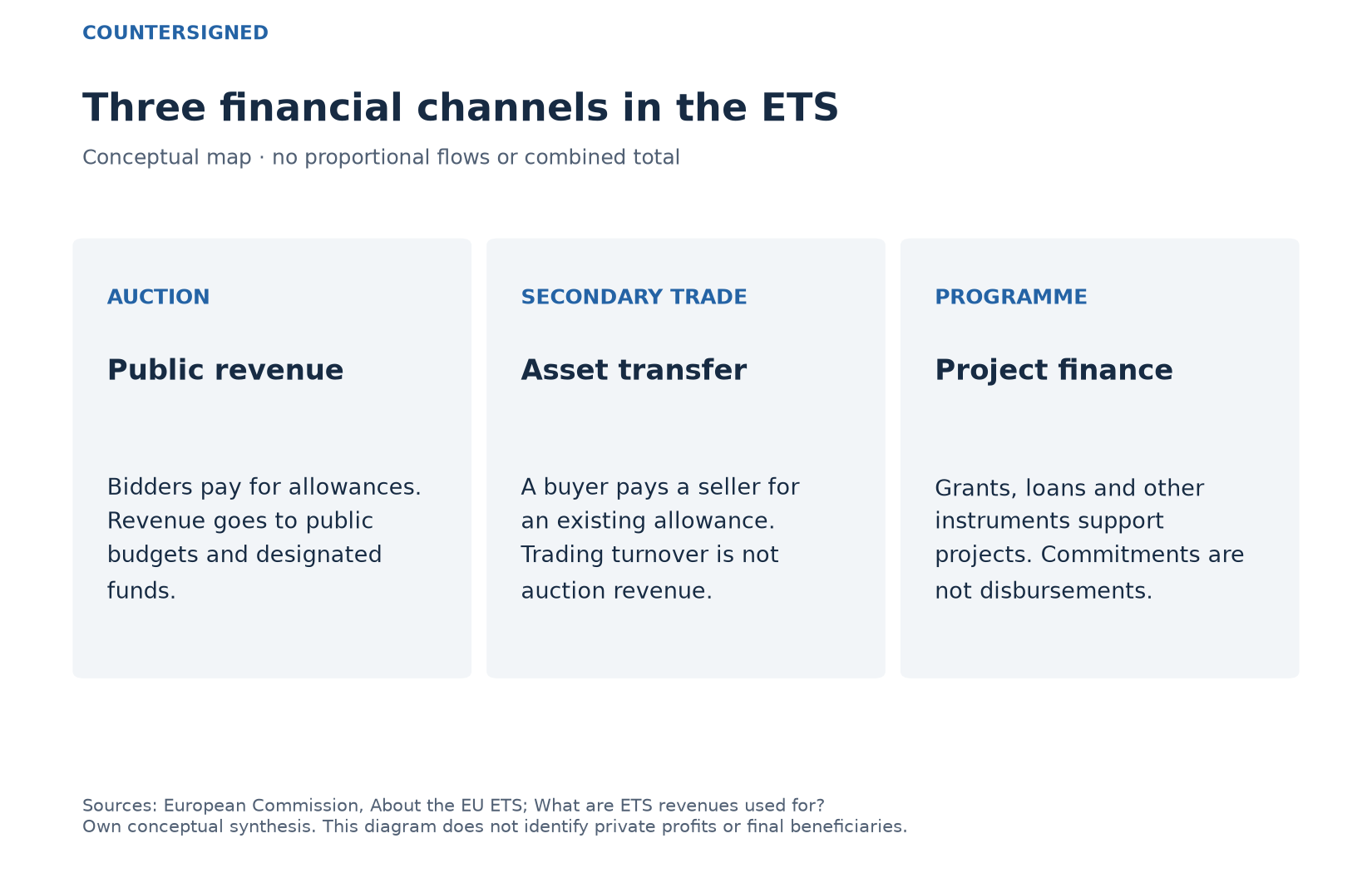
For 2024, the Commission reports €38.8 billion in total ETS auction revenue. Of that, €24.4 billion went directly to Member States; the remainder supported the Innovation Fund, Modernisation Fund and Recovery and Resilience Facility. These are reported destinations of auction proceeds, not a measure of bank profits or the Green Deal’s total cost. Commission, use of ETS revenues
The spending record also needs careful interpretation. Member States can report disbursement, commitment and amounts still to be allocated. Money assigned to a programme is not necessarily money already spent, and money spent does not itself establish that the project delivered the expected benefit. Evaluating value for money requires project outcomes, additionality and alternatives, alongside accounting records.
For a reader asking “who benefits?”, the next useful step is consequently specific: identify a programme and its beneficiaries, distinguish grants from loans and guarantees, and compare actual payments with delivered outputs. A company receiving a public loan is in a different position from a company receiving an unconditional grant. Combining their face values into a headline about private gains would hide that difference.
The market evidence contains a legitimate concern
ESMA’s 2025 carbon-market report records a high concentration of auction purchases in 2024: almost 90% of allowances auctioned on the Common Platform were acquired by ten bidders. It also reports a decline in average allowance prices and examines trading behaviour and data limitations. Concentration is therefore a documented feature worth investigating. It does not automatically mean those bidders were the ultimate users of the allowances or that they manipulated the market. ESMA, Carbon Markets Report 2025, executive summary
This illustrates why a critical finding needs a precise label. “Auction purchases are concentrated” is supported by a defined dataset. “Ten firms control climate policy” is a different claim requiring evidence about decision-making power. “Ten firms receive almost all auction revenue” would misdescribe the transaction: bidders pay at auction. Their subsequent positions and earnings are another matter.
A market can be regulated and still deserve scrutiny for concentration, transparency or distributional effects. Conversely, a large trading volume is not itself evidence of fraud. The useful questions concern market behaviour and incentives, and must be tested against transaction and ownership information rather than inferred from the size of the market.
Investment totals are not profit totals
The IEA projects global energy investment of roughly $3.4 trillion in 2026. Around $2.2 trillion is expected to go to renewables, nuclear, grids, storage, low-emissions fuels, efficiency and electrification, and around $1.2 trillion to oil, gas and coal. These are global projections for investment spending across broad categories. They are not realised company profits and not a European Green Deal budget. IEA, World Energy Investment 2026 announcement
The distinction matters even when a policy helps create demand. Equipment purchases can generate supplier revenue, but revenue is not profit. Investment can also include construction, infrastructure and other expenditure, with different funding sources and beneficiaries. Establishing how much a particular company gains from a policy would require company-level financial evidence and a credible comparison with the situation without that policy.
Likewise, calling all spending in a broad clean-energy category a subsidy would be inaccurate. Private investment and public support are not interchangeable. A funding announcement may combine public contributions with an estimate of additional private capital, which makes it especially important to distinguish money actually paid from money expected to be mobilised.
What a Polish electricity bill can show
Poland’s energy regulator separates the purchase of electricity from its distribution. Its announcement of approved 2026 tariffs also describes charges related to capacity, renewable energy, cogeneration and system quality. The listed regulated prices are before VAT and excise. This structure makes it unsafe to label every non-energy line a Green Deal tax. Different components have different legal bases and purposes. URE, approved 2026 tariffs and bill components
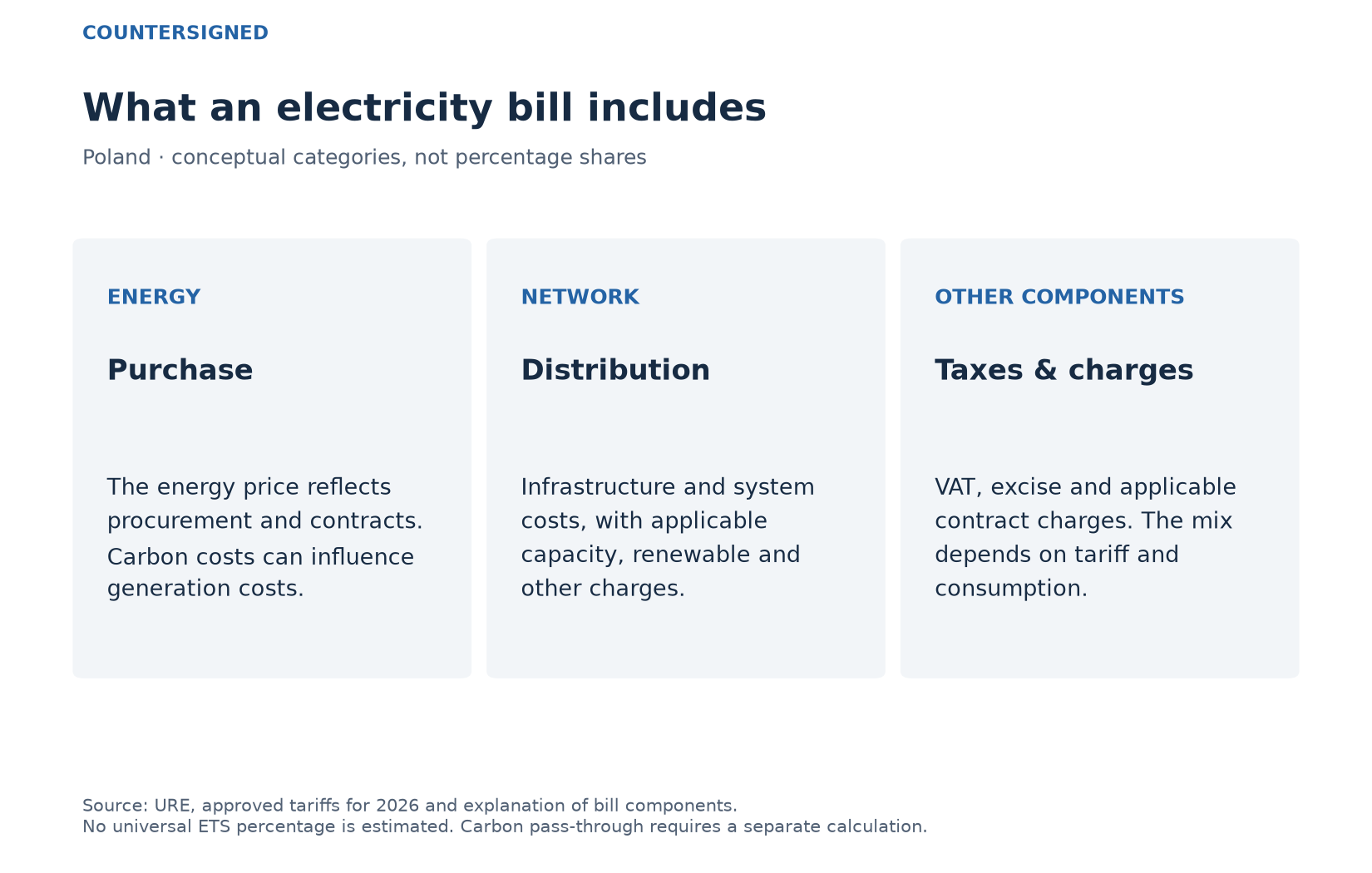
Carbon pricing can affect the cost of fossil-fuel generation and, through market pricing and contracts, the price paid for electricity. But calculating its contribution to a household bill requires assumptions about generation, wholesale prices, hedging, pass-through and the household’s contract. Simply multiplying a coal plant’s emissions intensity by an allowance price does not establish the carbon-cost share of every household’s final bill.
The denominator matters too. A percentage of wholesale energy cost is not the same as a percentage of a bill including distribution, taxes and fixed charges. Consumption levels and tariff choices change that final mix. A defensible estimate should name a customer profile, period and tariff, disclose the calculation and show how the answer changes under reasonable alternatives.
None of this implies the cost is negligible. It means the magnitude needs evidence. The same discipline is required when evaluating benefits: lower exposure to fuel prices, changes in air pollution or future emissions reductions need their own measurement. Costs and benefits should be compared over compatible periods and populations.
What the documents establish
The record identifies the programme’s institutional origin, the earlier history of emissions trading, documented auction revenues and a concentrated auction market. It also establishes that household electricity charges and global investment totals cannot be read as simple measures of Green Deal profits or costs. Those are findings about the evidence, not an overall score for the policy.
The outstanding evaluative questions are distributional and causal: which households and firms bear which costs, which projects deliver additional benefits, and how outcomes compare with feasible alternatives. A credible answer may be critical, favourable or mixed. It should follow the particular mechanism and the measured outcome rather than begin with a conclusion about the entire programme.
Method and limits
This article is a document-based analysis of EU institutional records, ESMA’s 2025 report, the IEA’s 2026 investment projection and Poland’s regulator guidance. It does not allege wrongdoing by named private actors. Network leads without a demonstrated link to legislative decisions were excluded. No interviews, audit of recipients or original estimate of household carbon-cost incidence was performed. The 2024 revenue data and the 2026 investment forecast refer to different years, currencies and concepts and are not added together. Sources were checked on 9 September 2026. Proposed ETS reforms must be distinguished from measures already in force; this article does not treat a proposal as enacted law.